


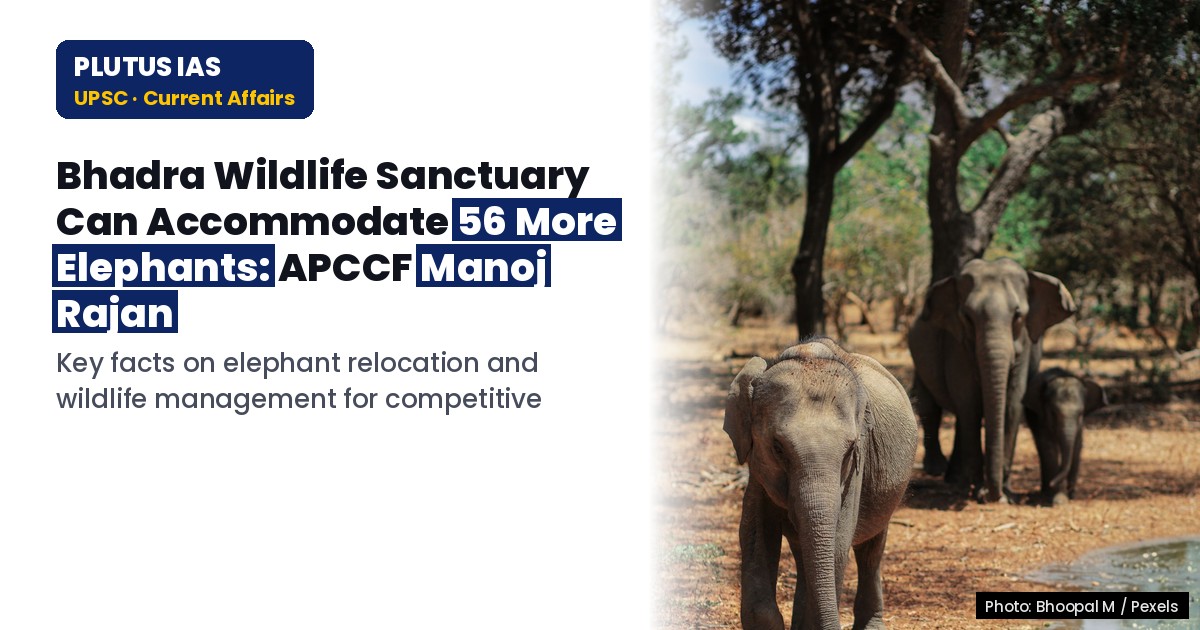
24 Nov Bhadra Wildlife Sanctuary: Elephant Relocation & Capacity
✎ Bhadra Wildlife Sanctuary, a Project Tiger Reserve in Karnataka, demonstrates the critical role of protected areas in elephant conservation and human-wildlife conflict management through habitat provision and strategic…
Subject Relevance — Where This Topic Fits
- GS Paper III — Environment, Ecology, Bio-diversity, Climate Change
- Prelims: Bhadra Wildlife Sanctuary, Project Elephant, Human-Wildlife Conflict, Wildlife Protection Act, 1972, Tiger Reserve, Kumki elephants
- Essay: Balancing development with environmental conservation: The challenge of human-wildlife coexistence, The role of protected areas in biodiversity conservation and mitigating human-wildlife conflict
Quick Revision: Bhadra Wildlife Sanctuary, a Project Tiger Reserve in Karnataka, demonstrates the critical role of protected areas in elephant conservation and human-wildlife conflict management through habitat provision and strategic interventions.
Why is this in the news?
The Additional Principal Chief Conservator of Forests (APCCF), Project Elephant, stated that the Bhadra Wildlife Sanctuary possesses sufficient capacity to accommodate additional elephants, even with an existing population exceeding 500. This assessment follows an operation by the Forest Department to manage wild elephants after incidents of human fatalities in Belur taluk, Karnataka, highlighting ongoing efforts to mitigate human-wildlife conflict and ensure elephant conservation.
Background
- Human-elephant conflict is a significant conservation challenge in India, often resulting from habitat loss, fragmentation, and increased human encroachment into elephant corridors and foraging areas.
- The Forest Department’s operation to manage elephant movement was initiated in response to reported human casualties, underscoring the critical need for effective conflict mitigation strategies.
- The natural movement patterns of elephants, which can cover extensive distances, complicate efforts to trace their origins and manage their dispersal effectively.
- The use of trained ‘kumki’ elephants is a traditional and established method in India for assisting forest staff in managing wild elephants, including guiding them and responding to conflict situations.
- Protected areas like wildlife sanctuaries and tiger reserves play a crucial role in providing safe habitats for elephants and other wildlife, thereby reducing their interactions with human settlements.
- Solar fencing is an increasingly deployed measure to deter wildlife, including elephants, from entering agricultural lands and human habitations, thereby reducing conflict.
What is Bhadra Wildlife Sanctuary?
- Bhadra Wildlife Sanctuary is a protected area located in the Chikkamagaluru and Shivamogga districts of Karnataka, India.
- It was declared a wildlife sanctuary in 1951 and subsequently recognized as a Project Tiger Reserve in 1998, making it the 25th tiger reserve in India.
- The sanctuary is characterized by moist deciduous and semi-evergreen forests, supporting a rich biodiversity including tigers, leopards, elephants, gaurs, sambar, and various bird species.
- The Bhadra River flows through the sanctuary, contributing to its ecological diversity and providing a vital water source for its inhabitants.
- It is part of the Western Ghats, a UNESCO World Heritage Site and one of the world’s eight ‘hottest hotspots’ of biological diversity.
- The management of Bhadra Tiger Reserve falls under the purview of the Karnataka Forest Department, adhering to the guidelines of Project Tiger and Project Elephant.
- The sanctuary’s capacity to accommodate a large elephant population is attributed to its vast area and suitable habitat, which includes diverse vegetation and water sources.
- Conservation efforts within Bhadra focus on habitat protection, anti-poaching measures, and human-wildlife conflict mitigation strategies.
Key Features
| Feature | Significance |
|---|---|
| Bhadra Wildlife Sanctuary | Designated as a Tiger Reserve, indicating its ecological importance and conservation status. |
| Elephant Carrying Capacity | The sanctuary is assessed to accommodate additional elephants without undue ecological burden, with an estimated capacity of one elephant per square kilometre. |
| Natural Movement of Wildlife | Forest Department policy emphasizes allowing elephants to move naturally, avoiding forced relocation, which aligns with ethical wildlife management practices. |
| Human-Wildlife Conflict Mitigation | Deployment of staff and kumki elephants, along with temporary camps and solar fencing, aims to manage elephant movements and reduce conflict with human settlements. |
| Project Elephant | The Additional Principal Chief Conservator of Forests (APCCF) for Project Elephant is directly involved, highlighting the national conservation programme’s role in managing elephant populations. |
Why it Matters
Environmental Significance
- The Bhadra Wildlife Sanctuary’s capacity to host a larger elephant population underscores its role as a critical habitat and a vital component of biodiversity conservation efforts in the region.
- The natural movement of elephants across landscapes contributes to seed dispersal and forest regeneration, maintaining ecological balance.
Conservation Significance
- The proactive assessment of sanctuary capacity and the planned deployment of resources reflect a commitment to scientific wildlife management and conservation strategies.
- The involvement of Project Elephant leadership signifies a coordinated national approach to elephant conservation, emphasizing habitat protection and conflict mitigation.
Socio-Economic Significance
- Effective management of elephant populations, particularly in areas bordering human habitation, is crucial for mitigating human-wildlife conflict, which has direct impacts on local livelihoods and safety.
- The measures taken to guide elephants away from human settlements and towards protected areas contribute to agricultural protection and reduce economic losses for local communities.
Challenges
1. Human-Wildlife Conflict
- The presence of elephants in agricultural estates and close to human habitations, leading to fatalities, highlights the persistent challenge of managing interactions between wildlife and human populations.
- Ensuring the safety of both human residents and wild elephants requires continuous monitoring and adaptive management strategies.
UPSC Link: Environment and Ecology: Conservation, environmental pollution and degradation, environmental impact assessment
2. Habitat Fragmentation and Corridor Management
- Elephant movements across vast distances, including through non-forest areas, indicate potential habitat fragmentation and the necessity of maintaining viable wildlife corridors.
- The challenge lies in securing and managing these corridors to facilitate natural elephant migration while minimizing human-wildlife encounters.
UPSC Link: Environment and Ecology: Conservation, environmental pollution and degradation, environmental impact assessment
3. Resource Management and Infrastructure
- The establishment of temporary elephant camps, deployment of kumki elephants, and solar fencing require significant financial and human resources.
- Sustaining these efforts over time, especially with fluctuating elephant movements, presents an ongoing logistical and budgetary challenge.
UPSC Link: Government Policies and Interventions: Development processes and the development industry
4. Public Cooperation and Awareness
- Appeals to local communities for cooperation and alertness underscore the importance of public participation in wildlife management.
- Overcoming public apprehension and fostering a sense of shared responsibility for conservation is critical for the success of mitigation efforts.
UPSC Link: Environment and Ecology: Conservation, environmental pollution and degradation, environmental impact assessment
Challenges — UPSC Perspective
| Issue | Concern |
|---|---|
| Elephant presence near human settlements | Risk of human fatalities and property damage, leading to heightened human-wildlife conflict. |
| Tracing elephant origin | Difficulty in understanding migratory patterns and designing effective long-term conservation strategies due to elephants’ extensive travel. |
| Ensuring elephant stay in sanctuary | The challenge of naturally guiding and retaining elephants within protected areas without forced intervention. |
| Public perception and cooperation | Gaining community trust and ensuring adherence to safety advisories during elephant movement operations. |
| Long-term ecological balance | Maintaining the ecological integrity of the sanctuary with an increased elephant population, ensuring resource availability for all species. |
Government Initiatives — Must-Memorise for Prelims
- Project Elephant
Way Forward
- Strengthen inter-departmental coordination between Forest, Revenue, and local administration for integrated human-wildlife conflict management.
- Enhance community engagement and awareness programmes to educate local populations on elephant behaviour and safety protocols.
- Invest in advanced technological solutions, such as real-time tracking and early warning systems, to monitor elephant movements effectively.
- Develop and maintain robust wildlife corridors to facilitate natural elephant migration and reduce encounters with human settlements.
- Conduct regular ecological assessments of sanctuaries to ensure carrying capacity is not exceeded and resource availability is sustained for all wildlife.
- Promote sustainable land-use practices in buffer zones around protected areas to minimize habitat encroachment and reduce conflict opportunities.
- Establish rapid response teams equipped with trained personnel and resources to manage conflict situations promptly and humanely.
- Explore innovative funding mechanisms to ensure the long-term financial sustainability of elephant conservation and conflict mitigation efforts.
UPSC Value Addition
Keywords for Mains Answer-Writing
Human-wildlife conflict · Elephant conservation · Wildlife corridors · Project Elephant · Protected Area management · Habitat fragmentation · Bhadra Wildlife Sanctuary · Tiger Reserves · Forest Department initiatives · Ecological carrying capacity · Conservation strategies · Sustainable coexistence
Constitutional & Policy Linkages
- Article 48A: Protection and improvement of environment and safeguarding of forests and wild life.
Concept Flow
Elephants move from forests towards human settlements. → Human-wildlife conflict incidents occur, including fatalities. → Forest Department initiates operations to guide elephants. → Bhadra Wildlife Sanctuary identified as suitable habitat. → Measures like temporary camps and solar fences are implemented. → Elephants are encouraged to move naturally towards the sanctuary. → Efforts aim to mitigate conflict and ensure elephant conservation.
Prelims Practice Questions
Q1. Consider the following statements regarding elephant conservation in India:
1. Project Elephant was launched in 1992 as a centrally sponsored scheme.
2. The ‘Kumki’ elephants are wild elephants trained for various forest management activities.
3. Bhadra Wildlife Sanctuary is also designated as a Tiger Reserve.
How many of the above statements are correct?
- Only one
- Only two
- Only three
- None
Answer: Only three — Statement 1 is correct: Project Elephant was indeed launched in 1992 as a centrally sponsored scheme. Statement 2 is incorrect: ‘Kumki’ elephants are captive elephants, not wild ones, that are trained for specific tasks such as capturing wild elephants, patrolling, or managing human-wildlife conflict. Statement 3 is correct: Bhadra Wildlife Sanctuary is part of the Bhadra Tiger Reserve, one of India’s prominent tiger conservation areas.
Q2. Which of the following is NOT a primary cause of human-elephant conflict in India?
- Habitat loss and fragmentation
- Expansion of agricultural land into elephant corridors
- Increased elephant population density in certain areas
- Absence of dedicated elephant conservation laws
Answer: Absence of dedicated elephant conservation laws — Habitat loss, fragmentation, and agricultural expansion into corridors are significant drivers of human-elephant conflict. Increased elephant population density can also exacerbate conflict. However, India has dedicated wildlife conservation laws, including the Wildlife (Protection) Act, 1972, which covers elephants, making the absence of dedicated laws an incorrect cause.
Mains Practice Question
✍ Examine the challenges associated with managing human-wildlife conflict, particularly concerning elephants, in India. Discuss the strategies employed by the Forest Department to mitigate such conflicts, with specific reference to the role of protected areas. (15 Marks)
Approach: Introduction: Briefly define human-wildlife conflict and its increasing prevalence in India, especially with elephants. Challenges: Discuss key challenges such as habitat fragmentation, encroachment on elephant corridors, crop raiding, retaliatory killings, lack of awareness among local communities, and the migratory nature of elephants. Strategies Employed: Detail various mitigation strategies including the establishment and management of elephant corridors, solar fencing, trenching, early warning systems, crop compensation schemes, community participation (e.g., ‘Haathi Mere Saathi’ campaign), and the use of trained ‘Kumki’ elephants. Role of Protected Areas: Explain how protected areas like wildlife sanctuaries and tiger reserves (e.g., Bhadra Wildlife Sanctuary/Tiger Reserve) serve as critical habitats, providing refuge and reducing conflict by containing populations. Discuss their role in maintaining ecological balance and supporting elephant populations. Conclusion: Summarize the need for an integrated, multi-pronged approach involving ecological, social, and economic considerations for sustainable coexistence.
Source: The Hindu
Generated by AanyaAi for educational purpose.
Related guides on our sites
- How to prepare for GS paper 1 for UPSC CSE mains exam
- Best UPSC coaching for IFOS exam
- Best geography optional coaching
- Best geography optional coaching

- Bhadra Wildlife Sanctuary: Elephant Relocation & Capacity - November 24, 2026
- केरल सरकार द्वारा कल्याणकारी पेंशन हेतु ₹1,088 करोड़ स्वीकृत - November 24, 2026
- GST Arrears & Notices: Impact on Cottage & Micro Industries - November 24, 2026

No Comments