


08 Aug BJP, CPI Protests Over Karnataka’s Cauvery Water Delay: UPSC Analysis
Cauvery Water Disputes TribunalMekedatu dam projectKuruvai crop seasonFederal framework✎ The Cauvery Water Disputes Tribunal (CWDT) final award of 2007, notified in 2013, allocates 419 TMC to Tamil Nadu and 270 TMC to Karnataka, with the Inter-State River Water Disputes (Amendment) Act, 2017, aiming to streamline…
Subject Relevance — Where This Topic Fits
- GS Paper II — Functions and Responsibilities of the Union and the States, Issues and Challenges Pertaining to the Federal Structure, Devolution of Powers and Finances up to Local Levels and Challenges Therein | GS Paper III — Conservation, Environmental Pollution and Degradation, Environmental Impact Assessment
- Prelims: Inter-State Water Disputes Act, 1956, Cauvery Water Disputes Tribunal (CWDT), Karnataka-Tamil Nadu water sharing agreements, Mekedatu project, kuruvai crop, Inter-State River Water Disputes (Amendment) Act, 2019
- Essay: Federalism and Centre-State Relations: The Cauvery Water Dispute as a Case Study, Water Security and Sustainable Development: Balancing Agricultural Needs and Ecological Integrity
Quick Revision: The Cauvery Water Disputes Tribunal (CWDT) final award of 2007, notified in 2013, allocates 419 TMC to Tamil Nadu and 270 TMC to Karnataka, with the Inter-State River Water Disputes (Amendment) Act, 2017, aiming to streamline dispute resolution through a permanent tribunal and data bank.
Why is this in the news?
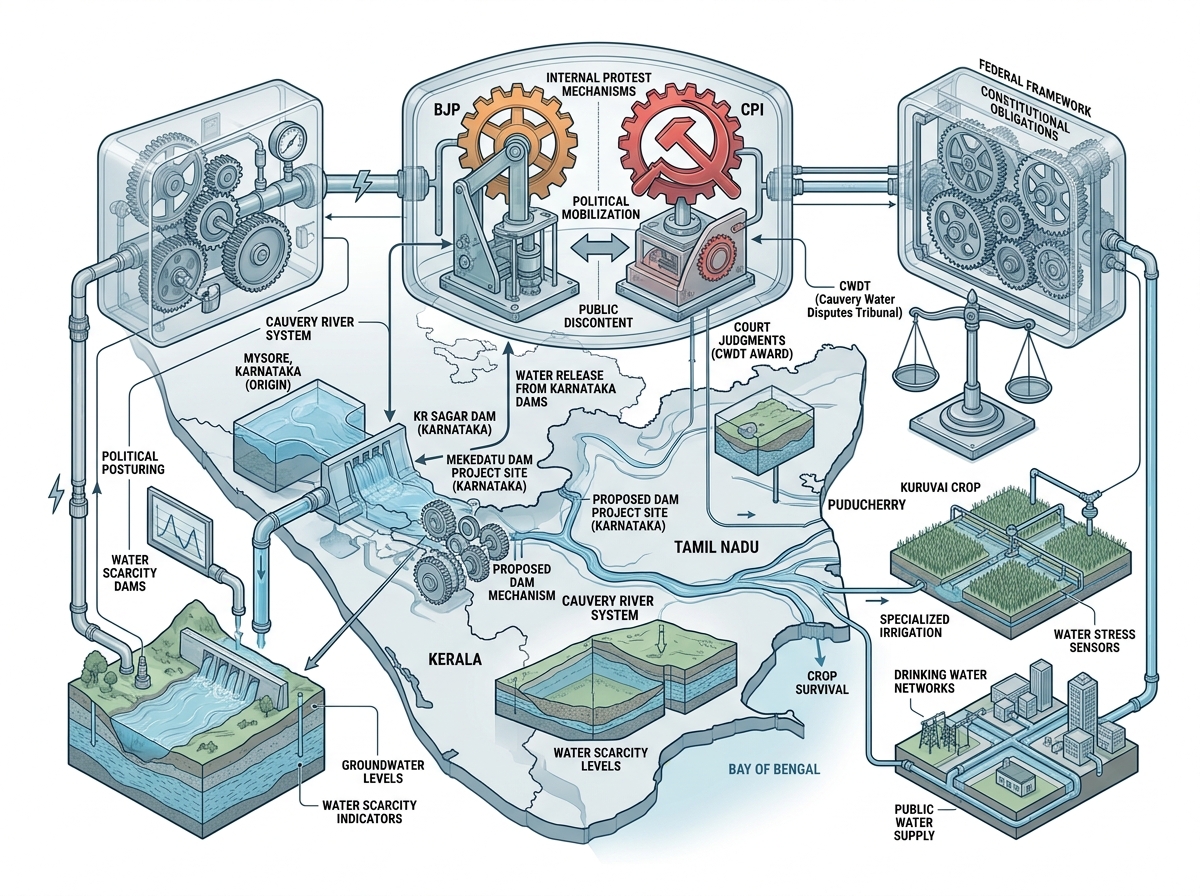
The recent protests by the BJP and CPI in Tamil Nadu against the Karnataka government’s decision to proceed with the Mekedatu dam project and its failure to release Tamil Nadu’s due share of Cauvery water highlight the enduring volatility of inter-state river disputes in India. These protests, framed around the immediate exigencies of the kuruvai crop and drinking water shortages, underscore the intersection of hydrological realities, political posturing, and constitutional obligations under India’s federal framework.
Background
- The Cauvery river, originating in Karnataka and flowing through Tamil Nadu, Puducherry, and Kerala before draining into the Bay of Bengal, is governed by the Cauvery Water Disputes Tribunal (CWDT), constituted in 1990 under the Inter-State Water Disputes Act, 1956.
- The CWDT, in its final award of 2007, allocated specific water shares to Karnataka (270 TMC), Tamil Nadu (419 TMC), Kerala (30 TMC), and Puducherry (7 TMC), with a residual clause for distress conditions. This award was notified by the Union government in 2013.
- Karnataka’s proposal to construct the Mekedatu reservoir and balancing reservoir project, located near the Karnataka-Tamil Nadu border, has been a point of contention since 2017. Tamil Nadu opposes the project, arguing it violates the CWDT award and reduces downstream water availability.
- The kuruvai (summer) crop in Tamil Nadu’s delta districts, primarily sown in June-July and dependent on Cauvery water, is currently under stress due to inadequate releases from Karnataka, exacerbating agricultural and drinking water crises.
- Historically, the dispute has seen periodic escalations during drought years, with both states accusing each other of non-compliance with water-sharing agreements and tribunal directives.
What is the Cauvery Water Dispute?
- The Cauvery Water Dispute is a protracted inter-state conflict primarily between Karnataka and Tamil Nadu over the sharing and utilisation of waters of the Cauvery river basin, governed by the Cauvery Water Disputes Tribunal (CWDT) award of 2007.
- The dispute arises from competing claims: Karnataka argues for greater utilisation rights due to its upstream position and developmental needs, while Tamil Nadu contends that historical usage and agricultural dependence justify its higher allocation.
- The Mekedatu project, proposed by Karnataka, involves constructing a reservoir to meet Bengaluru’s drinking water needs and generate hydroelectric power, but Tamil Nadu opposes it on grounds of reduced downstream flow and violation of the CWDT award.
- The kuruvai crop, a major paddy variety in Tamil Nadu’s delta districts, is highly water-intensive and directly dependent on Cauvery releases during the summer months (June–September), making it a critical flashpoint during water scarcity.
- The dispute is exacerbated by climatic variability, with both states experiencing recurring droughts that intensify competition for limited water resources and strain inter-state relations.
- The constitutional framework under Article 262 empowers the Parliament to adjudicate inter-state river water disputes, while Article 253 enables the Union to legislate on international water agreements, though implementation challenges persist.
- The Cauvery dispute exemplifies the broader challenges of federalism in India, where water governance must balance state autonomy, equity, and ecological sustainability under the doctrine of equitable apportionment.
UPSC Value Addition
Keywords for Mains Answer-Writing
Inter-State River Water Disputes Act, 1956 · Cauvery Water Disputes Tribunal (CWDT) · Karnataka-Tamil Nadu water sharing · Mekedatu dam project · Inter-State Water Disputes (Amendment) Bill, 2019 · Article 262 of the Constitution · Federalism and Centre-state relations · River basin management · Kuruvai crop and agricultural water demand · Drinking water security · Inter-State Water Disputes Authority · Judicial interventions in water disputes
Prelims Practice Questions
Q1. Consider the following statements regarding the Cauvery Water Disputes Tribunal (CWDT):
1. The CWDT was constituted under the Inter-State River Water Disputes Act, 1956.
2. The CWDT’s award was notified by the Government of India in 2013.
3. The Cauvery Management Board (CMB) was established by the Supreme Court in 2018 to implement the CWDT award.
How many of the above statements are correct?
- Only one
- Only two
- All three
- None
Answer: All three — Statements 1 and 2 are correct. The CWDT was constituted under the Inter-State River Water Disputes Act, 1956, and its award was notified by the Government of India in 2013. Statement 3 is incorrect because the Supreme Court, in its 2018 judgment, directed the constitution of the Cauvery Water Management Authority (CWMA) and Cauvery Water Regulation Committee (CWRC), not the CMB.
Q2. Which of the following Articles of the Indian Constitution empowers the Parliament to provide for the adjudication of disputes relating to inter-state rivers and river valleys?
- Article 262
- Article 263
- Article 253
- Article 32
Answer: Article 262 — Article 262 of the Indian Constitution empowers the Parliament to provide for the adjudication of disputes relating to inter-state rivers and river valleys. This article also bars the jurisdiction of the Supreme Court in such disputes.
Q3. Assertion (A): The Mekedatu dam project proposed by Karnataka is located upstream of the Cauvery basin.
Reason (R): The Cauvery basin is shared by Karnataka, Tamil Nadu, Kerala, and Puducherry.
- Both A and R are true, and R is the correct explanation of A
- Both A and R are true, but R is not the correct explanation of A
- A is true, but R is false
- A is false, but R is true
Answer: Both A and R are true, but R is not the correct explanation of A — Assertion (A) is true as the Mekedatu dam is proposed upstream in Karnataka. Reason (R) is also true but does not explain why the dam is upstream; it merely states the basin-sharing states. Hence, R is not the correct explanation of A.
Mains Practice Question
✍ The Cauvery water dispute between Karnataka and Tamil Nadu exemplifies the structural tensions inherent in India’s federal framework. Critically analyse the efficacy of constitutional, statutory, and judicial mechanisms in resolving inter-state river water disputes. Also, examine the implications of unilateral projects like the Mekedatu dam on the federal balance and water security. (15 Marks)
Approach: Introduction: Briefly define inter-state river water disputes and their constitutional basis (Article 262). Constitutional and Statutory Mechanisms: – Inter-State River Water Disputes Act, 1956: Key provisions, tribunal formation, and award implementation. – Inter-State Water Disputes (Amendment) Bill, 2019: Key features, including the establishment of the Inter-State Water Disputes Authority. Judicial Interventions: – Role of the Supreme Court in the Cauvery dispute (2018 judgment: CWMA and CWRC). – Critique of judicial activism vs. federalism (e.g., federal encroachment, delays in implementation). Unilateral Projects and Federal Balance: – Mekedatu dam: Rationale, ecological and federal concerns (Karnataka’s arguments vs. Tamil Nadu’s objections). – Impact on water security, agricultural productivity (kuruvai crop), and drinking water supply. Critique and Way Forward: – Limitations of existing mechanisms: Delays, lack of binding enforcement, and political interference. – Need for integrated river basin management (e.g., National River Basin Authority). – Role of cooperative federalism and Centre-state coordination. Conclusion: Balancing federal autonomy with national water security, with a focus on sustainable and equitable solutions.
Source: The Hindu
Generated by AanyaAi for educational purpose.

- आरबीआई ने सरकारी प्रतिभूतियों की ओएमओ बिक्री की घोषणा, जानिए पूरा विवरण - September 23, 2026
- RBI to Sell ₹25,000 Crore Govt Securities via OMO on Sept 28, 2026 - September 23, 2026
- भारत-श्रीलंका नौसैनिक अभ्यास ‘स्लाईनेक्स-26’: विशाखापत्तनम में संपन्न, जानें प्रमुख बिंदु - September 23, 2026

No Comments