


20 Apr BPSC Geography Optional Syllabus
BPSC Geography Optional Syllabus with Marking Pattern
BPSC Geography Optional Syllabus
The Bihar Public Service Commission (BPSC) Mains examination allows candidates to choose one optional subject, and Geography is a popular choice for many aspirants. The Geography optional offers a wide-ranging syllabus that not only helps in scoring well in the optional paper, but also significantly overlaps with General Studies (especially Indian and Bihar geography, environment, agriculture, etc.). This overlap can be a major advantage, as preparation for the optional can reinforce your GS answers. Additionally, Geography as a discipline is scientific and analytical, which means answers can be enriched with maps, diagrams, and flowcharts for better clarity. Many candidates with backgrounds in science or engineering find it comfortable due to its logical concepts, while arts graduates appreciate its relevance to socio-economic issues. Overall, choosing Geography optional can be beneficial due to its interdisciplinary nature, availability of study material, and relevance to real-world issues.
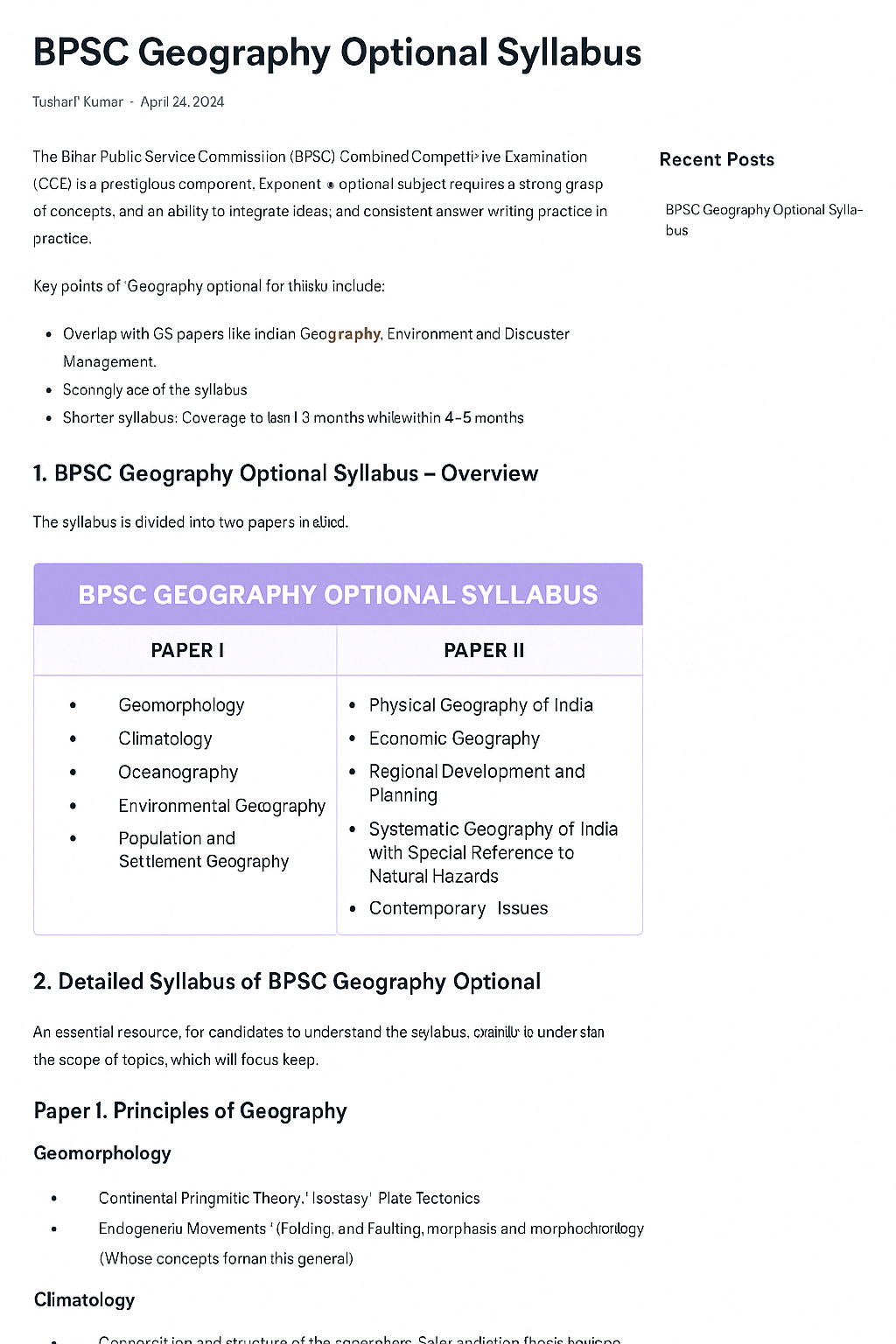
In BPSC Mains, there is only one optional paper (300 marks), but the syllabus for Geography is extensive. For clarity, the syllabus is often described in two broad parts (akin to “papers” in UPSC pattern): Paper I, which covers the Principles of Geography (Physical and Human Geography topics), and Paper II, which covers Geography of India and Bihar. Below we provide a detailed breakdown of each part of the syllabus. Understanding this division is crucial, as it helps in planning your preparation – you’ll need to cover both the world-focused physical/human geography and the region-specific Indian and Bihar geography. The following infographic gives an overview of the syllabus structure at a glance:
:contentReference[oaicite:0]{index=0} *Infographic: BPSC Geography Optional Syllabus at a glance.* This figure outlines the major sections of the syllabus, divided into Paper I (Physical & Human Geography) and Paper II (Indian & Bihar Geography). It highlights the key topics under each section, providing a quick visual roadmap for study planning. Aspirants can refer to this overview to ensure they cover all important areas during preparation.
Paper I: Physical and Human Geography
Paper I covers the fundamental principles of Geography. It is divided into two parts – Physical Geography (the scientific study of Earth’s natural processes and features) and Human & Economic Geography (the study of human societies, economies, and their spatial dynamics). Mastering these topics builds the foundation, as concepts here often link to topics in Paper II and even General Studies.
Physical Geography
- Geomorphology: Origin and evolution of the earth’s crust; Earth movements and plate tectonics; volcanism. **Geomorphological cycles** of erosion (theories of Davis and Penck); various landforms – fluvial (river), glacial, arid (desert) and karst landscapes; concepts of rejuvenated and polycyclic landforms (landscapes formed through multiple cycles of uplift and erosion).
- Climatology: Composition and structure of the atmosphere; air masses and fronts (how air parcels of different characteristics interact); cyclones and related weather phenomena (including tropical and temperate cyclones). **Climatic classification** systems – especially Köppen’s and Thornthwaite’s schemes; understanding of groundwater and the hydrological cycle (water cycle).
- Soils and Vegetation: Soil genesis (formation processes), classification and global distribution of soils. Overview of ecological aspects of major biomes such as Savanna and Monsoon Forests (tropical deciduous) – understanding how climate and soil influence natural vegetation.
- Oceanography: Ocean bottom topography – features of the ocean floor; specific study of the relief of the Indian Ocean floor. Factors like ocean water salinity, ocean currents and tides; ocean deposits (sediments) and coral reefs (their formation and types).
- Ecology (Ecosystem): Concepts of ecosystem – structure and functions of ecosystems; Man’s impact on ecosystems and the environment. Issues of global ecological imbalance, such as climate change, ozone depletion, biodiversity loss, etc.
Human & Economic Geography
- Development of Geographical Thought: Contributions of European and British geographers in the development of geography as a field. Key philosophical debates: Determinism vs. Possibilism (the extent to which environment influences human activities vs human agency); Dualism in Geography (such as physical vs human geography); the Quantitative Revolution and Behavioral Revolution in geography (shifts in methodological approaches).
- Human Geography: Evolution of mankind – emergence of modern humans and the racial classifications of humanity. Cultural evolution and major cultural realms of the world. Patterns of international migration (historical and contemporary). World population distribution and growth; the concept of the demographic transition (stages of population growth) and contemporary world population issues.
- Settlement Geography: Characteristics of rural and urban settlements. The process and stages of urbanization; rural settlement patterns (types of villages, etc.). Classification of cities (by size or function); the concept of urban spheres of influence and the rural-urban fringe. Internal structure of cities (land use patterns within cities, e.g., CBD, residential, industrial zones). Problems of urban growth worldwide (such as congestion, pollution, housing shortages, slums).
- Political Geography: Concept of nation and state; geographical boundaries and frontiers, and the idea of buffer zones between powerful states. Classic geopolitical theories like the Heartland and Rimland theories. Federalism and the spatial organization of power within states (central vs state/provincial powers).
- Economic Geography: World economic development – measures (such as GDP, HDI) and problems (inequality, poverty). Concept of resources and resource distribution; global resource problems (resource depletion, conflicts). The world energy crisis (reliance on fossil fuels, etc.) and “limits to growth” debate. World agriculture – types/classification of agricultural systems and major agricultural regions of the world; Von Thünen’s theory of agricultural location. World industry – theories of industrial location (e.g., Weber’s theory); patterns of world industrial development and associated problems (deindustrialization, pollution). World trade patterns – major commodities and trade routes, and the changing patterns of international trade (WTO era, trade blocs, etc.).
Paper II: Geography of India and Bihar
Paper II focuses on regional geography, specifically Indian geography in a broad sense and a dedicated section on the Geography of Bihar. This part connects the principles from Paper I to the context of India and the state of Bihar. It is highly relevant for BPSC since Bihar-specific knowledge is directly tested. A good grasp of Indian geography provides context for understanding Bihar’s local geographical issues.
Geography of India
- Physical Aspects: Geological history of India and an overview of its physiographic regions (Himalayas, Indo-Gangetic plains, Peninsular plateau, coastal areas, etc.) and major drainage systems (river systems). Origin and mechanism of the Indian Monsoon (factors influencing monsoon; onset and retreat). Indian soils (types, distribution) and natural vegetation (forest types, distribution, and conservation).
- Human Aspects: Tribal areas of India and their problems (isolation, development, integration). Population distribution, density, and growth in India; demographic problems (like overpopulation in some regions) and population policies (family planning, etc.).
- Resources: Conservation and utilization of land resources (land use planning, issues like desertification), mineral resources (iron ore, coal, bauxite, etc.), water resources (rivers, groundwater – issues of overuse), biotic resources (forests, wildlife) and marine resources (fisheries, etc.). Ecological problems in India (deforestation, pollution, climate change effects) and their management (conservation efforts, environmental policy).
- Agriculture: Irrigation in India (types, extent, issues like waterlogging); intensity of cropping and crop combinations in different regions; the Green Revolution and its impact; agricultural land use policy in India (land reforms, sustainable agriculture practices).
- Rural Economy: Rural livelihood aspects such as animal husbandry, social forestry (community forestry initiatives), and cottage/household industries in rural areas – how these support rural economy and employment.
- Industry: Historical development of industries in India. Factors affecting industrial location (availability of raw materials, power, labor, transport, etc.). Study of major industries – mineral-based industries (like iron and steel), agro-based industries (sugar, textile), and forest-based industries (paper, timber). Industrial complexes (clusters like Mumbai-Pune belt, Ahmedabad-Vadodara, etc.) and industrial regions of India; issues faced by industries (regional disparities, infrastructure bottlenecks).
- Transport and Trade: Overview of India’s transportation networks – roadways, railways, inland waterways, shipping and air routes. Intra-regional and inter-regional trade in India; role of rural market centers in the local economy. Major exports and imports of India, and the connectivity between production centers and ports/markets.
- Settlements: Rural settlement patterns in India (clustered, linear, dispersed, etc.). Urban development in India and associated problems (urban sprawl, slums, inadequate infrastructure). Internal structure of Indian cities (e.g., old city vs new city areas, functional zones). Urban planning, the growth of slums and urban housing issues. National Urbanization Policy (efforts like Smart Cities Mission, AMRUT, etc. to manage urban growth).
- Regional Development and Planning: An overview of India’s planned development – Five-Year Plans (goals and achievements related to geography, like irrigation projects, industrial corridors). Multi-level planning in India – national, state, district, and block level planning and their inter-relationships. Regional disparities in development in India (economic and social imbalances between different states/regions) and measures to address them.
- Political Aspects: Political geography of India – issues like the reorganization of states (languages, administrative convenience) and its geographical implications. India’s international boundaries and related border issues (e.g., boundary disputes, border management with neighbors). India in the geopolitics of the Indian Ocean region (strategic importance of Indian Ocean, India’s role and challenges like maritime security).
Geography of Bihar
- Physiographic Divisions and Climate: The physical divisions of Bihar (North Bihar Plains, South Bihar Plains, etc.), soil types and forest cover in the state. Overall climate of Bihar and its seasonal pattern. **Agricultural patterns** in Bihar – major crops and cropping seasons. Problems of drought-prone areas and flood-affected regions in Bihar (Bihar faces frequent floods in North Bihar and droughts in South-western districts) and possible solutions/management strategies for these issues.
- Mineral Resources: Important mineral resources of Bihar – occurrences of iron ore, copper, bauxite, mica, coal, etc. (Bihar’s mineral deposits and their locations, though many are now in Jharkhand after state bifurcation, historically they are considered). The status of mining and its economic significance in the state.
- Industries: Major industries of Bihar – e.g., Iron and steel plant(s) (like at Baruni or vicinity, though Bihar is not a big steel producer today), aluminium, cement factories, sugar mills (sugar industry is significant in Bihar). Location of these industries and the factors influencing their location (proximity to raw material like sugarcane, etc.).
- Industrial Regions: The principal industrial regions of Bihar (for instance, areas around Patna, Barauni-Begusarai, etc.). Challenges faced by industries in Bihar (power supply, infrastructure, raw material supply, etc.) and prospects for industrial growth in the state.
- Population Issues: The problems of population in Bihar – high population density, population growth trends. Issues related to the *tribal population* in Bihar (though tribal population is a smaller fraction in Bihar, there are Santals and others in some areas) – their socio-economic problems and measures for their welfare and integration.
- Urbanization Pattern: The pattern of urbanization in Bihar – relatively low level of urbanization, distribution of towns and cities. Growth of Patna and a few other urban centers. Problems associated with urbanization in Bihar (slums, urban poverty, inadequate services) and the state’s initiatives for urban development.
As seen above, the BPSC Geography optional syllabus is quite comprehensive. Candidates should approach it by integrating their understanding of general concepts (from Paper I) with regional specifics (in Paper II). For example, concepts of rivers and floods in physical geography directly apply to flood management in Bihar, and so on. Next, we will discuss how to prepare for this optional subject effectively.
Preparation Tips and Strategy
Preparing for the Geography optional requires a combination of deep conceptual understanding and the ability to apply concepts to real-world scenarios, especially those relevant to India and Bihar. Here are some key preparation tips and strategies for BPSC Geography optional:
- Master the Basics: Begin with building a strong foundation. Read the NCERT Geography textbooks (Class 11 and 12) to clear fundamentals in physical, human, and Indian geography. These give you a basic framework upon which you can layer more advanced knowledge. A clear grasp of basic concepts like plate tectonics, climate systems, soil formation, etc., makes it easier to tackle advanced topics and analytical questions.
- Syllabus as a Guide: Always keep the official syllabus in front of you while studying. Geography is a vast subject, so it’s crucial to stay within the scope of the BPSC syllabus. Tick off topics as you cover them, and make sure you understand each sub-topic mentioned. If the syllabus mentions specific theories or scholars (e.g., Davis’ cycle of erosion, or Heartland theory), ensure you prepare those specifically, as questions can directly come from those areas.
- Structured Study Plan: Divide your preparation time between the two parts of the syllabus. For instance, you might study a Physical Geography topic and then see its application in India/Bihar context. Maintain a balanced schedule so that you cover both Paper I and Paper II topics methodically. Many candidates start with Physical Geography, then Human, and finally Indian and Bihar geography. You can also intermix to keep it interesting – e.g., devote mornings to world geography concepts and evenings to Indian/Bihar geography case studies.
- Make Notes and Diagrams: While studying each topic, prepare concise notes. Geography often involves processes and interlinkages – try to summarize these in flowcharts or diagrams. For example, draw the rock cycle, illustrate monsoon mechanism, sketch the demographic transition model, etc. For India and Bihar geography, make region-specific notes – e.g., notes on Bihar’s flood zones with a simple map, or a table of major crops in Bihar and corresponding districts. These notes will be invaluable for quick revisions before the exam.
- Use Maps Extensively: A geography answer is always enriched by maps. Practice drawing maps of India and Bihar quickly. For any regional discussion (like mineral resources, industrial locations, rainfall distribution), be ready to sketch a map and highlight the areas in your answer. This not only fetches extra marks but also makes your answer more authoritative. In your preparation, whenever you study a topic, correlate it with a map – for instance, locate all national parks you read about, or mark the course of important rivers in Bihar.
- Current Examples and Case Studies: While the syllabus is static, you should update your answers with current information. For human and economic geography, use the latest data – e.g., mention the current population of Bihar or latest urbanization percentage, quote data from the Bihar Economic Survey or reports. For environmental geography, mention recent events or schemes (like a recent flood event and what measures were taken). Brief case studies can be very effective – for example, while writing on river floods, reference the Kosi floods in Bihar and government mitigation projects.
- Practice Previous Year Questions: Go through previous years’ question papers of BPSC (and even UPSC Geography optional, as some questions might be similar in nature). This will help you understand the exam pattern, the depth of answer expected, and important areas of the syllabus from which questions are frequently asked. Practice writing answers to these questions within a time limit. This will improve your speed and help in structuring answers under exam conditions.
- Answer Writing and Presentation: Geography answers should be well-structured. Begin with a brief introduction (definition or context), follow with the main body (with subheadings if possible, or point-wise answers for clarity), and a short conclusion. Incorporate diagrams wherever relevant – e.g., a question on climatic regions can have a world map showing those regions, a question on Bihar’s agriculture can include a small map of Bihar showing rice/wheat belts. Practice drawing neat diagrams quickly – you get better with practice. Also, use geographic terminology appropriately (for example, use terms like “alluvial plain” instead of just saying “flat land”).
- Time Management in Exam: During the exam, allocate your time wisely. Since the optional paper is 3 hours for 300 marks, you should roughly spend about 30 minutes for a 30-mark question (adjust as per the question weight). Do not get stuck on one tough question – it’s better to write a decent answer for all questions than to perfect a few and leave others. Through practice tests, develop a sense of how much depth is needed for, say, a 10-mark question versus a 20-mark question. Usually, a 20-mark answer might require a brief introduction, 4-5 key points explained (with maybe a diagram), and a conclusion.
- Regular Revision: Given the vastness of the syllabus, periodic revision is essential. Revisit your notes frequently. One strategy is to have short weekly revisions of topics covered earlier, and monthly full-syllabus revisions in brief. This will ensure you retain information till the exam. Closer to the exam, focus on revising important definitions, examples, and diagrams so they remain fresh in memory.
By following these strategies – covering the syllabus comprehensively and practicing application through maps and previous questions – you can develop confidence in tackling the Geography optional. Remember that consistency is key; studying geography a little every day (instead of cramming occasionally) will yield better retention and understanding. Also, if possible, discuss topics with fellow aspirants or mentors – sometimes a discussion on, say, a current event like a cyclone or a new irrigation project, can give you insights that enrich your answers.
Recommended Books and Resources
Choosing the right study material is crucial for efficient preparation. Below is a list of recommended books and resources for BPSC Geography optional, along with what they are useful for:
- NCERT Geography Textbooks (Class XI & XII) – As mentioned, these are the starting point to build basic concepts in physical and human geography. They are written in simple language and cover topics like physiography of India, climate, resources, etc., which directly overlap with the syllabus.
- Physical Geography by Savindra Singh – A comprehensive book covering Geomorphology, Climatology, Oceanography and other physical geography topics in depth. It helps in building a strong foundation and provides detailed explanations and diagrams for physical processes.
- Human Geography by Majid Husain – This book is excellent for human geography topics such as population, settlement, and economic geography. Majid Husain’s style is easy to understand, making complex concepts (like models of urban structure or demographic theories) accessible. It’s very useful for Paper I Part B (Human & Economic Geography).
- Models and Theories in Geography by Majid Husain – This resource focuses on the conceptual and theoretical aspects of geography. It covers important models (like Central Place Theory, Ravenstein’s laws of migration, etc.) and theories which are often asked in exams to test conceptual clarity. It’s especially useful for answering questions related to geographical thought and human geography theories.
- Geography of India by Majid Husain – A comprehensive book for Paper II (Indian Geography). It covers India’s physical setting, drainage, climate, resources, agriculture, industries, and regional development in detail. It will help you prepare the Indian Geography portion thoroughly, with facts and examples that can be directly used in answers.
- Geography of Bihar – While there may not be a single standard textbook for Bihar’s geography, you should refer to multiple sources: Bihar government publications like the Bihar Economic Survey, statistical handbooks, and reports for updated data on Bihar’s economy, agriculture, and infrastructure. Additionally, some coaching institutes or authors might have compiled Bihar-specific geography notes which can be useful. Ensure you have material on Bihar’s rivers, climate, soils, crops, etc., as required by the syllabus above.
- Environmental Geography by Savindra Singh – This book is helpful for topics related to ecology and environment (ecosystems, environmental problems) which are part of the syllabus (in both Paper I and Indian geography context). It covers concepts like ecological imbalances, conservation, etc., which are increasingly important.
- Economic and Social Geography Made Simple by Rupa Publications – A handy guide for economic geography topics (like resources distribution, industries, trade) and social geography. It can supplement your understanding for both world economic geography and Indian economic geography segments.
- Oxford School Atlas – An atlas is a must for a geography student. The Oxford School Atlas (or any good atlas) will help you visualize locations, and practice map-based information. Use the atlas to study maps of India and Bihar intensively – for example, be able to locate all national parks, major dams, mineral areas, industrial hubs, etc., on the map.
- Previous Years’ Question Papers and Mock Tests: Collect past BPSC Geography optional question papers. They might be available in compilations or on websites. Solve them and then check model answers or get them evaluated by a mentor. Also, consider joining a test series or writing mock tests specifically for Geography optional – this gives you exam-like practice and feedback on answer writing.
These resources, when used in combination, cover almost all aspects of the syllabus. It’s not necessary to read every book cover to cover – strategize according to your strengths and weaknesses. For instance, if you have a science background, physical geography might be easier, so you can focus more on human geography books. Conversely, if you are from a humanities background, ensure you devote time to grasping physical geography concepts from Savindra Singh and NCERTs. Always make notes from these books rather than trying to memorize everything – notes will help in quick revision and answer formulation.
With dedication, proper planning, and the right resources, cracking the BPSC Geography optional is certainly achievable. Geography is an extremely rewarding subject that enhances your understanding of the world and the local region, making your preparation journey intellectually enriching as well.
Geography is a highly preferred optional subject in the BPSC Civil Services Mains exam due to its balanced mix of scientific and humanities perspectives. Aspirants from a science or engineering background often find Geography manageable and scoring. In this article, we present the complete BPSC Geography Optional Syllabus, the marking pattern, and a strategic preparation approach to help aspirants make informed choices.
BPSC Mains Optional Paper Overview
- Paper Name: Optional Subject – Geography
- Total Marks: 300
- Duration: 3 Hours
- Type: Descriptive/Analytical

Geography optuional syllabus Pros and cons for BPSC
Complete BPSC Geography Optional Syllabus
Paper Structure
The syllabus can be broadly divided into two major parts:
- Part A: Physical Geography
- Part B: Human and Regional Geography (with a focus on Bihar)
Part A: Physical Geography
- Geomorphology – Earth’s structure, weathering, mass wasting, landforms
- Climatology – Atmosphere, temperature, pressure belts, monsoon
- Oceanography – Ocean currents, tides, coral reefs
- Biogeography – Ecosystems, biodiversity, environmental degradation
- Environmental Geography – Pollution, conservation, sustainable development
Part B: Human and Regional Geography
- Human Geography – Population, migration, settlement patterns
- Economic Geography – Agriculture, industries, transport, trade
- Regional Planning – Planning in India, growth poles, rural-urban linkages
- Geography of Bihar – Physical features, natural resources, agriculture, economy, population
Marking Pattern for BPSC Geography Optional
- Total Marks: 300
- Duration: 3 Hours
- Number of Questions: Typically 5–6, with internal choices
- Nature: Analytical, Descriptive, and Map-Based
Preparation Strategy for Geography Optional
- Start with NCERT Geography textbooks (Class VI to XII)
- Refer to GC Leong, Majid Husain, and Savindra Singh for detailed understanding
- Prepare well-labeled maps of India and Bihar for region-based questions
- Use diagrams and flowcharts in answers
- Keep updated with environmental issues and government policies
- Practice answer writing with focus on structure, facts, and analysis
- BPSC Anthropology optional syllabus
Download BPSC Geography Optional Syllabus PDF
Click below to download the complete syllabus in PDF format:
Download Geography Optional Syllabus PDF
Conclusion
Geography as an optional subject offers clarity, scoring potential, and relevance to both GS papers and interview stage. With its scientific orientation and wide overlap with current affairs and environment topics, Geography remains a strong choice for BPSC aspirants aiming for top ranks. Focus on conceptual clarity, consistent writing practice, and smart revision to make the best of this subject.
BPSC_Geography_Optional_Syllabus

- महाराष्ट्र में त्योहार जुलूसों पर बॉम्बे हाईकोर्ट का बड़ा फैसला: पटाखे, लेजर और संगीत पर रोक - September 24, 2026
- Bombay HC Bans Firecrackers, Music in Maharashtra Processions: Key UPSC Analysis - September 24, 2026
- तमिलनाडु में महिला कर्मचारियों के लिए सवैतनिक माहवारी अवकाश नीति पर HC का आदेश - September 24, 2026

No Comments