Strategic Significance of DHRUV64 for India
DHRUV64 represents a major milestone in India’s pursuit of technological sovereignty and self-reliance in semiconductors. It significantly strengthens India’s indigenous capability in advanced 64-bit processor design, a critical component of modern digital infrastructure.
By supporting core digital systems—ranging from computing platforms to strategic and industrial applications—DHRUV64 helps reduce India’s long-term dependence on imported microprocessors, which are vulnerable to supply chain disruptions and geopolitical pressures. This aligns directly with the objectives of Atmanirbhar Bharat and the India Semiconductor Mission.
India consumes nearly 20% of the world’s microprocessors, yet remains heavily import-dependent. The development of DHRUV64 provides India’s vast talent pool—start-ups, academia, and R&D institutions—with access to a fully modern, indigenous processor platform, catalysing the growth of a domestic semiconductor design and innovation ecosystem.
Even prior to DHRUV64, India had initiated efforts to build an indigenous processor landscape:
SHAKTI (2018, IIT Madras): Designed for strategic, defence, and space applications
AJIT (2018, IIT Bombay): Focused on industrial and robotics applications
VIKRAM (2025, ISRO–SCL): Developed for space missions, capable of withstanding extreme conditions
THEJAS64 (2025, C-DAC): Targeted at industrial automation
The addition of DHRUV64 strengthens this continuum and signals India’s transition from isolated processor projects to a coherent processor ecosystem. Collectively, these indigenous processors enhance national security, promote trusted hardware, enable innovation, and position India as an emerging player in the global semiconductor value chain
DHRUV64’s Impact on India’s R&D and Innovation
DHRUV64 provides a homegrown microprocessor technology designed for startups, academia, and industry to build, test, and scale indigenous computing products without relying on foreign processors.
DHRUV64 supports prototype development for new system architectures at lower cost.
India already has 20% of the world’s chip design engineers. DHRUV64 further helps in building a strong pipeline of skilled semiconductor chip professionals.
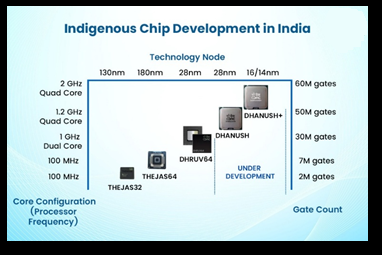
The success of DHRUV64 accelerates the roadmap for Dhanush and Dhanush+ processors. They are now under development phase.
Rollout of DHRUV64 and India’s Digital India RISC-V (DIR-V) Progress
The Government of India launched the Digital India RISC-V (DIR-V) Programme to advance the vision of Aatmanirbhar Bharat. It aims to establish India as a global hub for Electronics System Design and Manufacturing (ESDM). The initiative develops a complete portfolio of RISC-V–based microprocessors. These processors will power applications across industry, strategic sectors, and consumer technologies.
RISC-V Open Architecture and Its Significance for India
RISC-V is an open architecture that provides a set of instructions for chip design. It involves no licence costs, which allows wider adoption through shared innovation by industry, start-ups and research institutions.
It helps build a complete portfolio of indigenous microprocessors under the DIR-V Programme for use in various sectors.
It encourages shared innovation by providing common tools and standards for developers, improving collaboration across research organisations and companies.
DHRUV64: Driving India’s Indigenous Chip Roadmap
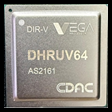
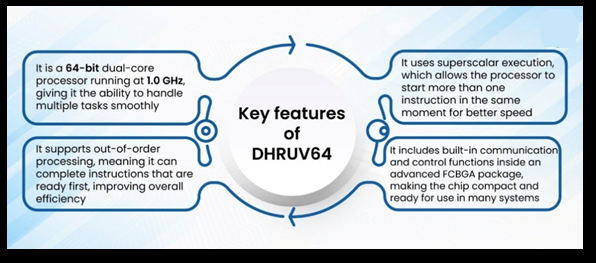
The launch of DHRUV64 marks a significant step in strengthening India’s self-reliant microprocessor ecosystem. Built on an open-source instruction set architecture, DHRUV64 eliminates recurring licence costs, enhances design flexibility, and enables long-term, scalable deployment across diverse platforms, including strategic, industrial and digital infrastructure applications.
DHRUV64 is the third chip fabricated under the DIR-V (Digital India RISC-V) Programme, which aims to enable the creation of future-ready indigenous microprocessors and reduce India’s dependence on imported chips.
Progress under the DIR-V Programme includes:
1. THEJAS32: the first chip, fabricated at the Silterra facility, Malaysia, marking India’s initial step in indigenous RISC-V processor realisation.
2. THEJAS64: the second chip, manufactured domestically at Semiconductor Laboratory (SCL), Mohali, reflecting growing in-country fabrication capability.
3. DHRUV64: the latest addition, showcasing advances in design maturity, performance and ecosystem readiness.
4. DHANUSH64 and DHANUSH64+ (SoC variants): currently under development, aimed at deeper system-level integration.
The rollout of DHRUV64 highlights India’s increasing capability across the semiconductor value chain—from design to fabrication and system integration. Continued progress under the DIR-V initiative reinforces India’s commitment to building a robust, trusted and globally competitive microprocessor ecosystem, aligned with Atmanirbhar Bharat and the India Semiconductor Mission.
Institutional Ecosystem Driving Processor Development
India’s efforts to build a strong semiconductor ecosystem are supported by a coordinated institutional framework led by key national agencies. These institutions provide policy direction and programme support that enable the design, and development of indigenous processors.
Ministry of Electronics and Information Technology (MeitY): MeitY plays a central role in advancing India’s processor and semiconductor initiatives. It guides national programmes through policy support, funding and long-term planning under schemes; such as the Microprocessor Development Programme, DIR-V, C2S and the India Semiconductor Mission. These measures have strengthened the country’s design ecosystem and enabled steady progress in indigenous processor development.
C-DAC: C-DAC leads the design of India’s indigenous processors. It creates processor Intellectual Properties (IPs), System-on-Chips (SoCs), development boards and related tools under MeitY’s flagship programmes, supporting the growth of a complete domestic processor ecosystem. The organisation is now advancing work on the next processors in the RISC-V roadmap, Dhanush and Dhanush+. These upcoming processors are expected to strengthen India’s homegrown RISC-V ecosystem. It expands the range of indigenous options available for strategic, and commercial use.
Key National Programmes Supporting Indigenous Chip Design
| Programme |
Launch Year |
Nodal Ministry / Agency |
Key Objectives |
Key Achievements / Features |
| India Semiconductor Mission (ISM) |
2021 |
MeitY |
Attract large-scale semiconductor investments; build fab, ATMP and design ecosystem |
10 projects approved across 6 states; investment commitment of ₹1.60 lakh crore (as of 2025); global industry partnerships |
| Digital India RISC-V (DIR-V) Programme |
2022 |
MeitY |
Develop indigenous processors using open-source RISC-V architecture; promote collaborative design ecosystem |
Enabled THEJAS, DHRUV and DHANUSH series; reduced licensing costs; strengthened indigenous processor roadmap |
| Chips to Startup (C2S) Programme |
2022 |
MeitY |
Build skilled manpower and fabless chip design ecosystem |
Implemented across 113 institutions; ₹250 crore outlay (5 years); target of 85,000 industry-ready professionals |
| Design Linked Incentive (DLI) Scheme |
2021 |
MeitY |
Provide financial and infrastructure support for semiconductor design |
Incentives for ICs, Chipsets, SoCs, IP cores and systems; supports design-to-deployment cycle over 5 years |
| Indian Nanoelectronics Users Programme – Idea to Innovation (INUP-i2i) |
— |
MeitY |
Provide access to national nanofabrication facilities; hands-on training |
49 familiarisation workshops; 42 hands-on trainings; 36 industrial trainings; 10 hackathons; 8,000+ trained; 348 short-term & 220 mid-term R&D projects |
Conclusion
India’s progress in indigenous processor development reflects a strong commitment to Aatmanirbhar Bharat in the semiconductor sector. DHRUV 64 powered and supported by national programmes such as DIR-V, C2S, ISM, DLI and INUP-i2i, the processor showcases the country’s growing capability to design, develop and prototype advanced processors. With coordinated efforts across MeitY, C-DAC, academic institutions and industry, India is building the talent, research strength and infrastructure needed for long-term leadership in advanced technologies. The progress from THEJAS32 to DHRUV64, and the ongoing development of Dhanush and Dhanush+, illustrates a confident national pathway toward indigenous processor innovation and technological self-reliance.
Prelims question:
Q. With reference to DHRUV64 microprocessor and India’s indigenous chip development initiatives, consider the following statements:
1. DHRUV64 is a fully indigenous 64-bit microprocessor developed by C-DAC under the Microprocessor Development Programme.
2. DHRUV64 is built on a proprietary architecture that requires recurring licence fees.
3. The Digital India RISC-V (DIR-V) Programme aims to develop a complete portfolio of indigenous RISC-V–based processors.
4. THEJAS64 was fabricated domestically at the Semiconductor Laboratory (SCL), Mohali.
Which of the statements given above are correct?
(a) 1, 3 and 4 only
(b) 1 and 2 only
(c) 2 and 3 only
(d) 1, 2, 3 and 4
Answer: A





No Comments