


24 Jul Cabinet Approves ₹3,030 Cr ‘Bhavya Rasayan’ Chemical Park Scheme for 2026-31
Subject Relevance — Where This Topic Fits
- GS Paper II — Government Policies and Interventions for Development in various sectors | GS Paper III — Industrial Policy, Infrastructure Development, and Employment Generation | GS Paper III — Environmental Pollution and Sustainable Development
- Prelims: Chemical Parks, PLI Scheme, Import Substitution, Petrochemicals, Waste Management Infrastructure, CETP, TSDF, Logistics Parks, Production Linked Incentive (PLI) for Chemicals, National Industrial Corridor Development Programme (NICDP), Sustainable Development Goals (SDGs) 9, 12, 13
- Essay: The Role of Industrial Parks in Achieving ‘Atmanirbhar Bharat’ by 2047, Balancing Industrial Growth with Environmental Sustainability: Lessons from Chemical Parks
Why is this in the news?
This initiative, announced in the Union Budget 2026-27, aims to catalyse the chemical and petrochemical sector by enhancing domestic manufacturing, reducing logistics costs, and promoting sustainable industrial ecosystems. The scheme is pivotal for India’s self-reliance agenda, particularly in sectors like pharmaceuticals, agrochemicals, and electronics, and aligns with the vision of ‘Viksit Bharat 2047’.
Background
- The chemical and petrochemical sector is a critical enabler for multiple industries, including agriculture, textiles, pharmaceuticals, construction, automotive, and electronics, contributing significantly to India’s GDP and employment.
- India’s chemical industry, valued at approximately USD 200 billion in 2023, remains heavily import-dependent for high-value intermediates and specialty chemicals, with a trade deficit exceeding USD 30 billion annually.
- The sector faces challenges such as fragmented land holdings, inadequate shared infrastructure, high logistics costs (15-20% of total production costs), and environmental compliance issues due to decentralised industrial operations.
- Global chemical demand is projected to grow at 4-5% annually, with India’s share in global chemical exports currently below 2%, necessitating structural reforms to enhance competitiveness.
- The PLI Scheme for Chemicals (announced in 2021) and the National Industrial Corridor Development Programme (NICDP) have laid the groundwork for industrial clustering, but dedicated chemical parks are essential to realise economies of scale and sustainability.
What is Bharat Udyog Vikas Yojana Rasayan (BHARAT RASAAN)?
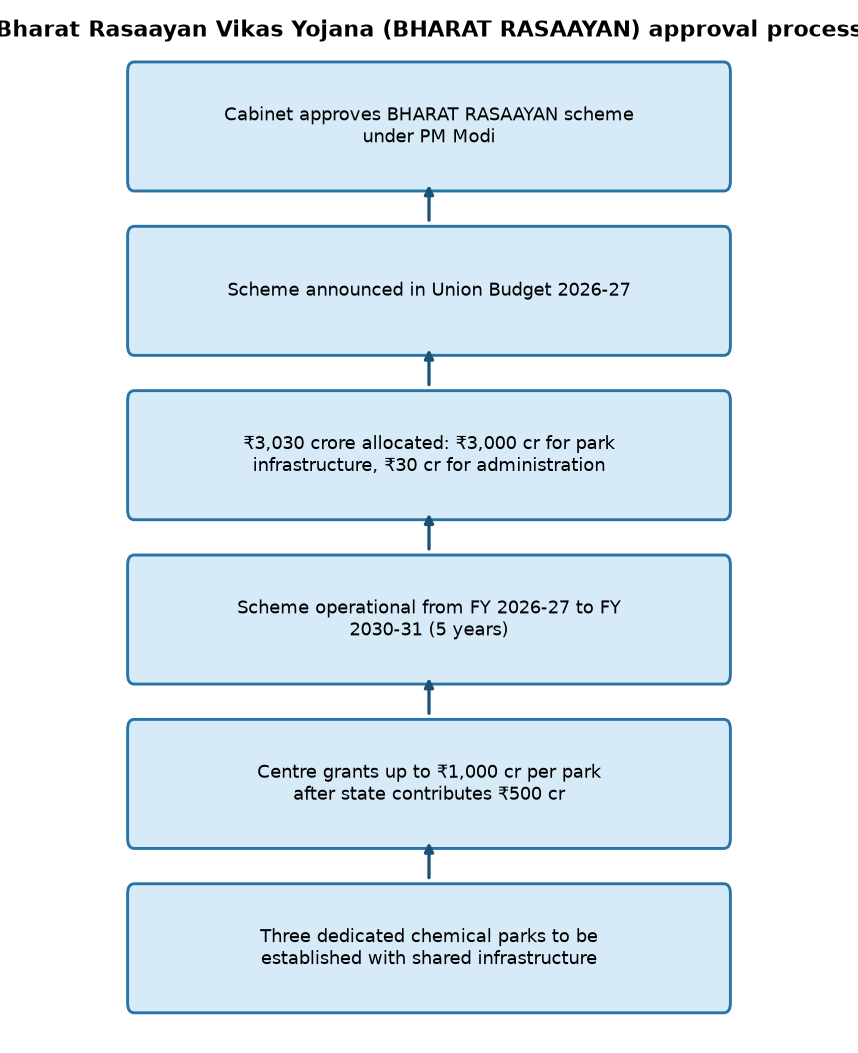
- The scheme operates under a **challenge-based competitive funding mechanism**, where the central government will provide up to ₹1,000 crore per park **only after** the respective state government contributes a minimum of ₹500 crore, ensuring shared fiscal responsibility and accountability.
- The total financial outlay for the scheme is **₹3,030 crore**, with ₹3,000 crore allocated for core infrastructure (e.g., Common Effluent Treatment Plants (CETPs), Treatment Storage and Disposal Facilities (TSDFs), water supply, steam networks) and ₹30 crore for administrative expenses over five years (2026-27 to 2030-31).
- The parks will offer **shared utilities** such as solvent recovery and distillation facilities, interconnected pipeline networks, logistics and warehousing hubs, and integrated steam distribution systems to reduce per-unit production costs and enhance competitiveness.
- Environmental sustainability is a cornerstone: each park will include **centralised waste management infrastructure**, including CETPs, TSDFs, and hazardous waste disposal systems, to ensure strict compliance with environmental norms (e.g., Water Act, 1974; Air Act, 1981; Environmental Protection Act, 1986).
- The scheme aims to **integrate India into global value chains** by reducing import dependence for intermediates (e.g., in pharmaceuticals, agrochemicals) and boosting exports of high-value chemicals, thereby improving the trade balance.
- The scheme aligns with India’s **circular economy goals** by promoting resource efficiency, reducing pollution, and ensuring sustainable industrial practices, thereby contributing to SDGs 9 (Industry, Innovation, and Infrastructure), 12 (Responsible Consumption and Production), and 13 (Climate Action).
Key Features
| Feature | Significance |
|---|---|
| Financial Allocation (₹3,030 crore) | Provides dedicated funding for infrastructure (₹3,000 crore) and administrative expenses (₹30 crore) over five years (2026-27 to 2030-31). |
| State-Private Partnership Model | Mandates a minimum ₹500 crore contribution from state governments for each park, with central government grants up to ₹1,000 crore per park. |
| Land Requirement (8 sq km per park) | Ensures contiguous land availability for integrated chemical industry operations, reducing logistical fragmentation. |
| Shared Infrastructure Facilities | Includes CETP, TSDF, water supply, solvent recovery, steam networks, and pipeline systems to enhance cost efficiency and regulatory compliance. |
| Sustainability Focus | Mandates eco-friendly facilities like centralized waste management, hazardous waste infrastructure, and pollution control systems to align with environmental norms. |
Why it Matters
Economic Growth and Competitiveness
- Strengthens the chemical and petrochemical value chain, reducing import dependence and enhancing export potential through cost-effective production.
- Promotes backward and forward linkages with sectors like agriculture, pharmaceuticals, textiles, and automobiles, fostering industrial symbiosis.
- Boosts domestic manufacturing capacity, attracting foreign direct investment (FDI) and generating employment across the value chain.
Strategic Autonomy and Self-Reliance
- Aligns with the vision of ‘Atmanirbhar Bharat’ by reducing reliance on imported chemicals and intermediates, particularly in critical sectors like pharmaceuticals and agrochemicals.
- Enhances India’s position in global chemical supply chains by integrating domestic production with international markets.
Sustainable Industrial Development
- Ensures compliance with environmental regulations through centralized waste management and pollution control infrastructure, mitigating ecological risks.
- Promotes circular economy principles via solvent recovery, waste recycling, and resource optimization within industrial parks.
Regional Development and Employment
- Stimulates economic activity in selected regions through industrial clusters, creating direct and indirect employment opportunities in manufacturing, logistics, and allied services.
- Supports ancillary industries such as packaging, transportation, and maintenance, amplifying regional multiplier effects.
Policy Integration with National Goals
- Contributes to the vision of a ‘Developed India by 2047’ by fostering high-value industrial growth and technological advancements in the chemical sector.
- Complements other initiatives like the Production-Linked Incentive (PLI) scheme for chemicals, ensuring a cohesive industrial policy framework.
Challenges
1. Land Acquisition and Regulatory Hurdles
- Acquisition of contiguous land parcels (8 sq km) may face delays due to legal disputes, environmental clearances, or local resistance.
- Complex regulatory frameworks for environmental impact assessments (EIA) and hazardous waste management could slow project implementation.
UPSC Link: Land Reforms & EIA Notification 2006
2. Infrastructure Bottlenecks
- Dependence on shared infrastructure (e.g., CETP, pipelines) may lead to operational inefficiencies if demand exceeds capacity or maintenance is inadequate.
- Logistics challenges, including connectivity to ports and highways, could undermine the cost advantages of the parks.
UPSC Link: Multi-Modal Logistics Parks (MMLP) Policy
3. Financial Viability and ROI
- High initial capital expenditure (₹3,000 crore per park) requires sustained private sector participation, which may be deterred by market uncertainties.
- Long gestation periods for chemical plants could delay revenue generation, impacting investor confidence.
UPSC Link: Public-Private Partnership (PPP) Models
4. Environmental and Safety Risks
- Chemical parks pose inherent risks of pollution, accidents, or hazardous waste mismanagement, necessitating stringent monitoring and compliance mechanisms.
- Balancing industrial growth with environmental sustainability remains a persistent challenge, especially in ecologically sensitive zones.
UPSC Link: Environmental Protection Act 1986
5. Skilled Workforce and Technology Adoption
- The chemical industry demands specialized skills in operations, safety, and R&D, which may be scarce in certain regions.
- Adoption of advanced technologies (e.g., green chemistry, automation) requires significant investment and training, posing adoption barriers.
UPSC Link: Skill India Mission & National Skill Development Corporation
Challenges — UPSC Perspective
| Issue | Concern |
|---|---|
| Land Fragmentation | Contiguous land acquisition may face legal and socio-political challenges, delaying project timelines. |
| Regulatory Delays | Environmental clearances and hazardous waste permits could slow down infrastructure development. |
| Investor Skepticism | High capital costs and long payback periods may deter private sector participation without robust incentives. |
| Logistics Constraints | Inadequate connectivity to ports and highways could erode the cost competitiveness of the parks. |
| Environmental Compliance | Ensuring adherence to pollution norms requires continuous monitoring and enforcement mechanisms. |
| Skill Gaps | Limited availability of specialized labor in chemical engineering and safety protocols may hinder operations. |
Way Forward
- Establish a dedicated nodal agency (e.g., under the Ministry of Chemicals and Fertilizers) to streamline land acquisition, regulatory clearances, and project monitoring.
- Incentivize private sector participation through tax breaks, viability gap funding (VGF), and long-term offtake agreements for chemical products.
- Develop integrated logistics hubs near the parks to enhance connectivity with ports, railways, and highways, reducing transportation costs.
- Invest in skill development programs in collaboration with IITs, NITs, and industry bodies to address the shortage of specialized labor.
- Implement a phased rollout strategy, prioritizing parks in states with conducive policies, existing chemical clusters, and robust infrastructure.
- Strengthen environmental governance by deploying real-time monitoring systems for pollution control and hazardous waste management.
- Foster R&D collaborations between industry and academia to promote green chemistry, waste minimization, and technological innovation.
- Conduct periodic reviews of the scheme’s progress, with independent audits to assess financial utilization, employment generation, and environmental impact.
UPSC Value Addition
Keywords for Mains Answer-Writing
Chemical Parks · Make in India · PLI Schemes · Industrial Infrastructure · Petrochemical Sector · Atmanirbhar Bharat · Export Promotion · Import Substitution · Sustainable Development · Waste Management · Logistics Efficiency · Green Chemistry · Chemical Value Chain · Public-Private Partnership · Union Budget 2026-27
Concept Flow
Central Government approves ‘BHARAT’ Chemical Parks Scheme (2026-31) → → Allocation of ₹3,030 crore for infrastructure and administration → → State governments contribute ₹500 crore per park; Centre provides ₹1,000 crore grant → → Identification and acquisition of 8 sq km contiguous land parcels → → Development of shared infrastructure (CETP, TSDF, pipelines, logistics) → → Attraction of private investment in chemical manufacturing and ancillary industries → → Integration into global value chains, reducing import dependence and boosting exports → → Contribution to ‘Developed India 2047’ through industrial growth and employment generation.
Prelims Practice Questions
Q1. Which of the following is NOT a stated objective of the ‘Bhagyam Rasaayan’ (Grand Chemicals) Scheme approved by the Union Cabinet in July 2026?
- A. Establishment of three dedicated chemical parks with shared infrastructure
- B. Promotion of import substitution in the chemical sector
- C. Mandatory 100% FDI in chemical parks
- D. Creation of centralized waste management facilities
Answer: C. Mandatory 100% FDI in chemical parks — The scheme emphasizes shared infrastructure and waste management but does not mandate 100% FDI; it focuses on attracting domestic and foreign investment through competitive funding mechanisms.
Q2. Under the ‘Bhagyam Rasaayan’ Scheme, the central government’s financial assistance to each chemical park is subject to:
- A. The state government contributing a minimum of ₹500 crore
- B. The state government providing land free of cost
- C. The state government ensuring 100% export-oriented production
- D. The state government waiving all local taxes
Answer: A. The state government contributing a minimum of ₹500 crore — The central government provides up to ₹1,000 crore per park as grant, but only after the state government contributes a minimum of ₹500 crore.
Q3. The ‘Bhagyam Rasaayan’ Scheme aims to enhance the competitiveness of the Indian chemical industry primarily by:
- A. Reducing corporate tax rates for chemical manufacturers
- B. Establishing shared infrastructure and reducing logistics costs
- C. Banning imports of all chemical products
- D. Providing subsidies for raw material imports
Answer: B. Establishing shared infrastructure and reducing logistics costs — The scheme targets cost reduction through shared infrastructure (e.g., CETP, TSDF, logistics networks) and improved supply chain efficiency, thereby enhancing global competitiveness.
Mains Practice Question
✍ Analyse how the ‘Bhagyam Rasaayan’ Scheme aligns with the broader objectives of India’s industrial policy, particularly the ‘Make in India’ initiative and the goal of achieving self-reliance in the chemical sector. In your response, discuss the scheme’s potential impact on employment generation, export promotion, and environmental sustainability.
Approach: Begin by contextualizing the ‘Bhagyam Rasaayan’ Scheme within India’s industrial policy framework, highlighting its alignment with ‘Make in India’ and self-reliance goals. Discuss the scheme’s focus on shared infrastructure (e.g., CETP, TSDF) and logistics efficiency to reduce costs and enhance competitiveness. Evaluate its potential to generate employment through industrial growth and value-chain integration. Examine export promotion via improved integration into global value chains and import substitution by boosting domestic production. Conclude by assessing the scheme’s contribution to environmental sustainability through centralized waste management and green chemistry practices.
Source: PIB (Press Information Bureau)
Generated by AanyaAi for educational purpose.

- तमिलनाडु के लिए क्या है ‘एल नीनो’ और उत्तर-पूर्वी मानसून का खतरा? - September 23, 2026
- El Nino & Northeast Monsoon: Impact on Tamil Nadu for UPSC 2026 - September 23, 2026
- हिमाचल में डिजिटल भुगतान क्रांति: बिलासपुर अव्वल, महिलाओं की भागीदारी 93% तक पहुंची - September 23, 2026

No Comments