


06 Aug Cabinet approves Gobardhan Scheme: ₹23,731 Cr for Compressed Biogas Expansion
✎ Gobardhan Scheme: ₹23,731 crore integrated plan to scale up Compressed Biogas (CBG) production, ensuring assured demand, stable pricing, capital support, and pipeline connectivity to transform organic waste into clean energy and…
Subject Relevance — Where This Topic Fits
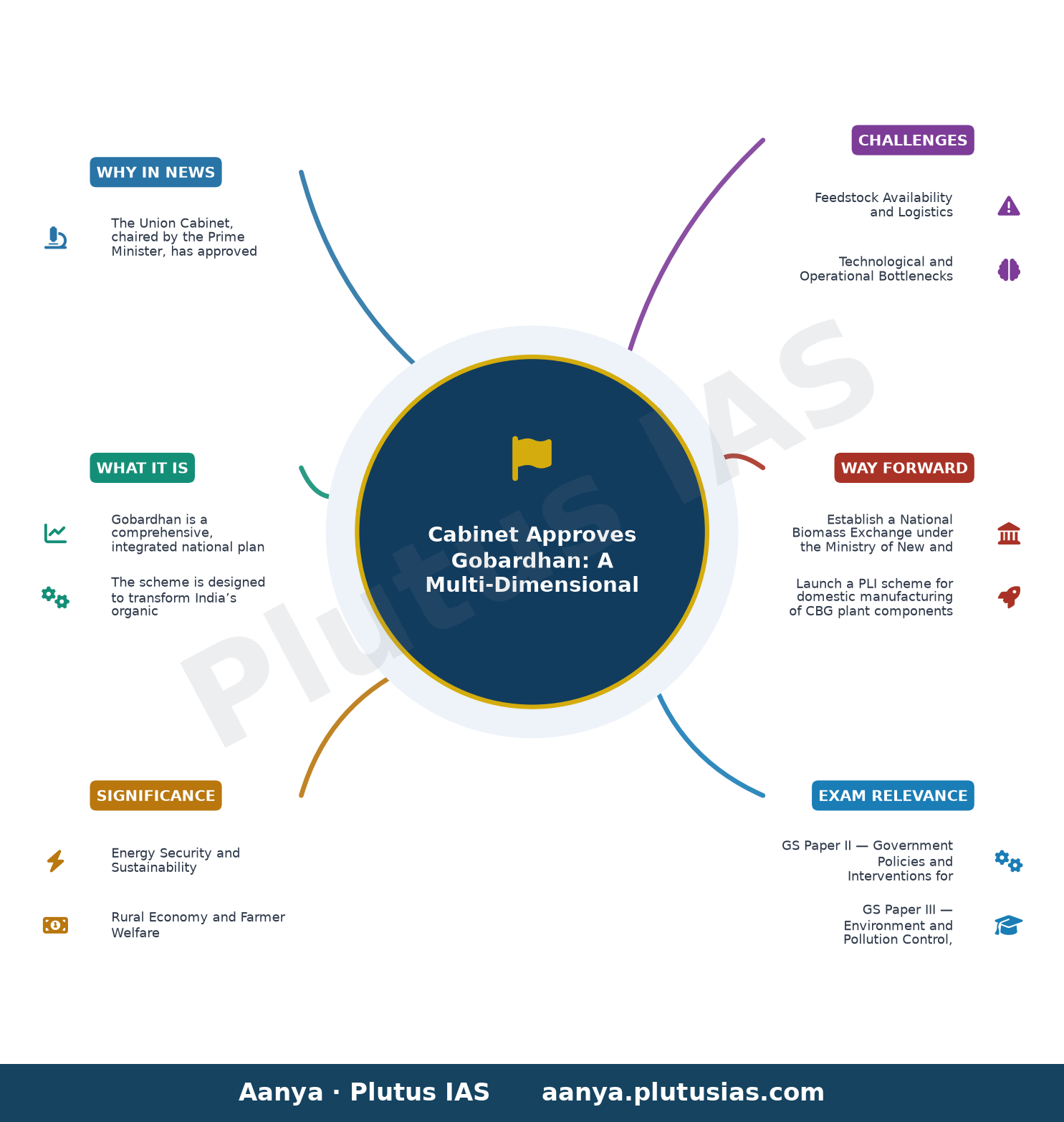
- GS Paper II — Government Policies and Interventions for Development in various sectors and Issues arising out thereof | GS Paper III — Environment and Pollution Control, Energy Resources, Infrastructure: Energy
- Prelims: Compressed Biogas (CBG), Gobardhan Scheme, SATAT Initiative, Bio-CNG, Renewable Energy, Waste-to-Wealth, Circular Economy, Energy Security, Bio-Fertiliser, National Bioenergy Programme
- Essay: India’s Energy Transition: Balancing Renewable Integration with Energy Security, Waste Management as a Catalyst for Rural Prosperity and Sustainable Development
Quick Revision: Gobardhan Scheme: ₹23,731 crore integrated plan to scale up Compressed Biogas (CBG) production, ensuring assured demand, stable pricing, capital support, and pipeline connectivity to transform organic waste into clean energy and rural prosperity, operational from FY 2026-27 to FY 2035-36.
Why is this in the news?
The Union Cabinet, chaired by the Prime Minister, has approved the ‘Gobardhan’ scheme with a total financial outlay of ₹23,731 crore to accelerate the production of Compressed Biogas (CBG) in India. This integrated national plan aims to transform India’s abundant agricultural residues, cattle dung, press mud, municipal organic waste, and other biomass resources into clean fuel, organic fertiliser, and rural income streams. The scheme is designed to operationalise a robust and predictable framework for CBG production, ensuring assured demand, stable pricing, capital support, pipeline connectivity, and access to finance, thereby positioning CBG as a key pillar of India’s future energy mix and a strategic instrument for energy security and rural development.
Background
- The Government of India has systematically strengthened the CBG ecosystem through multiple initiatives under the SATAT (Sustainable Alternative Towards Affordable Transportation) initiative, launched in 2018, which aims to establish 5,000 CBG plants by 2025.
- Market Development Assistance (MDA) scheme for organic fertilisers has been operationalised to enhance demand and value realisation for bio-manure, ensuring economic viability of CBG plants.
- The Biomass Aggregation Machinery (BAM) scheme provides financial support for procurement and aggregation of biomass, reducing feedstock supply risks for CBG plants.
- The National Bioenergy Programme (NBP) under the Ministry of New and Renewable Energy (MNRE) has been providing Central Financial Assistance (CFA) for setting up CBG plants, catalysing private sector participation.
- As of 2026, over 200 CBG plants have been commissioned across India, demonstrating the technical and economic feasibility of the CBG value chain in diverse feedstock and geographical contexts.
What is the Gobardhan Scheme?
- Gobardhan is a comprehensive, integrated national plan for promoting Compressed Biogas (CBG) production in India, approved with a financial outlay of ₹23,731 crore for implementation from FY 2026-27 to FY 2035-36.
- The scheme is designed to transform India’s organic waste—agricultural residues, cattle dung, press mud, municipal organic waste, and other biomass—into clean energy (CBG), organic fertiliser, and rural economic opportunities, thereby operationalising the ‘waste-to-wealth’ paradigm.
- Gobardhan establishes a robust and predictable framework for CBG production by ensuring assured demand through long-term offtake agreements, stable and remunerative pricing, capital subsidies, pipeline infrastructure support, access to finance, and technology development.
- The scheme aims to increase domestic CBG production nearly tenfold, attract large-scale private investment, and build a vibrant circular bio-economy across India, integrating farmers, rural entrepreneurs, and industries into a sustainable energy ecosystem.
- Gobardhan is administered by the Ministry of Petroleum and Natural Gas (MoPNG).
- The scheme aligns with India’s broader energy transition goals by positioning CBG as a renewable and indigenous alternative to conventional fuels, thereby enhancing energy security and reducing dependence on imported fossil fuels.
- CBG, being chemically equivalent to natural gas, can be seamlessly integrated into India’s existing gas infrastructure, including pipelines, city gas distribution networks, and vehicular fuel applications, leveraging the country’s growing gas grid.
- Each CBG plant under Gobardhan will catalyse local circular economies by creating opportunities in feedstock supply, transportation, plant operations, organic fertiliser production, and clean waste management, while contributing to greenhouse gas emission reductions.
Key Features
| Feature | Significance |
|---|---|
| Total Outlay of ₹23,731 crore | Provides substantial capital infusion to scale CBG production from current levels (~3.5 lakh tonnes/year) to ~35 lakh tonnes/year by 2030, ensuring financial viability across the value chain. |
| Guaranteed offtake and stable pricing | Mitigates market risk for investors by ensuring demand for CBG through long-term purchase agreements at pre-determined remunerative prices. |
| Capital subsidy and credit support | Reduces upfront capital burden on entrepreneurs via viability gap funding (up to 40% of project cost) and facilitates access to low-interest loans through NABARD and other financial institutions. |
| Pipeline connectivity and infrastructure | Integrates CBG plants with existing gas grid (GAIL, IOCL networks) to enable seamless distribution, reducing transportation costs and enhancing energy security. |
| Technology development and R&D thrust | Promotes indigenisation of CBG plant technologies (e.g., anaerobic digestion, gas upgrading systems) through PLI schemes and partnerships with IITs/CSIR for cost reduction and efficiency gains. |
| Feedstock aggregation and supply chain | Establishes decentralised biomass collection centres to ensure steady supply of agricultural residues, cattle dung, and municipal organic waste, reducing logistical bottlenecks. |
Why it Matters
Energy Security and Sustainability
- Reduces import dependence on fossil fuels by substituting ~15% of projected natural gas demand with domestically produced CBG, aligning with India’s net-zero commitments.
- Leverages India’s vast biomass potential (estimated 500–600 million tonnes/year) to diversify the energy mix, particularly in rural and semi-urban areas.
- Supports India’s 2070 net-zero target by enabling a transition from conventional fuels to renewable gaseous fuels in transport, industry, and cooking sectors.
Rural Economy and Farmer Welfare
- Creates a circular economy where farmers earn additional income from selling agricultural residues, cattle dung, and organic waste, enhancing farm profitability.
- Generates rural employment in feedstock collection, plant operations, and bio-fertiliser production, addressing agrarian distress and promoting inclusive growth.
- Strengthens the bio-fertiliser value chain, reducing chemical fertiliser dependency and improving soil health, which is critical for sustainable agriculture.
Environmental and Climate Benefits
- Reduces methane emissions from agricultural burning and open dumpsites by converting organic waste into CBG and bio-fertiliser, contributing to India’s NDC targets.
- Lowers CO₂ emissions by ~1.5 tonnes per tonne of CBG compared to conventional fuels, supporting India’s climate action goals.
- Promotes decentralised waste management, reducing urban organic waste pollution and improving public health outcomes in peri-urban areas.
Industrial and Commercial Viability
- CBG’s chemical equivalence to natural gas allows seamless integration into existing gas infrastructure (pipelines, CNG stations), minimising transition costs for industries.
- Enables industries (e.g., textiles, food processing) to meet their renewable energy obligations and carbon footprint reduction targets through CBG adoption.
- Attracts private investment in CBG plants, creating a new asset class for renewable energy infrastructure with long-term revenue certainty.
Policy and Institutional Synergy
- Builds on existing schemes like SATAT, PM-KUSUM, and National Bioenergy Programme to create a cohesive policy ecosystem for CBG expansion.
- Strengthens inter-ministerial coordination (MNRE, MoPNG, MoA&FW, MoHUA) to address cross-sectoral challenges in feedstock supply, technology, and financing.
- Demonstrates India’s leadership in the Global Biofuel Alliance (GBA) by scaling CBG production, positioning the country as a model for other developing nations.
Challenges
1. Feedstock Availability and Logistics
- Seasonal variability in agricultural residues (e.g., rice straw post-harvest) may disrupt supply chains, necessitating robust aggregation mechanisms and storage infrastructure.
- Competition for biomass between CBG plants, traditional uses (e.g., cattle feed, fuelwood), and other bioenergy sectors (e.g., biomass power) could drive up feedstock costs.
- Last-mile connectivity for feedstock collection remains a challenge in remote and hilly regions, increasing transportation costs and reducing project viability.
UPSC Link: GS-III: Energy, Environment
2. Technological and Operational Bottlenecks
- Limited domestic capacity for high-efficiency CBG plant components (e.g., gas upgraders, digesters) may lead to import dependence, increasing project costs and timelines.
- Variability in feedstock composition (e.g., moisture content, lignin) affects biogas yield and necessitates pre-treatment, adding complexity to plant operations.
- Scaling up CBG production requires skilled manpower for plant management, maintenance, and troubleshooting, which is currently in short supply.
UPSC Link: GS-III: Science & Tech
3. Financial Viability and Investment Risks
- High capital expenditure (₹15–20 crore per 4 TPD plant) and long payback periods (8–10 years) may deter small-scale entrepreneurs despite subsidies, necessitating blended finance models.
- Volatility in natural gas prices and policy changes (e.g., subsidy withdrawal) could undermine the economics of CBG projects, requiring long-term policy stability.
- Access to credit remains constrained for marginal farmers and rural cooperatives due to lack of collateral and high perceived risks by financial institutions.
UPSC Link: GS-III: Economy
4. Policy and Regulatory Gaps
- Inconsistent implementation of waste management rules (e.g., Solid Waste Management Rules, 2016) hampers the availability of segregated organic waste for CBG plants.
- Lack of a unified national policy for bio-fertiliser certification and marketing creates market fragmentation, reducing farmer adoption of CBG-derived fertilisers.
- Delays in land acquisition and environmental clearances for CBG plants can stall project timelines, increasing costs and investor uncertainty.
UPSC Link: GS-II: Governance
5. Social and Environmental Concerns
- Large-scale biomass extraction may lead to soil degradation if not balanced with residue retention for soil health, necessitating sustainable feedstock management guidelines.
- Potential conflicts over land use between CBG plants and food/feed production could arise in densely populated regions, requiring zoning regulations.
- Odour and noise pollution from CBG plants may face local resistance, necessitating community engagement and strict compliance with environmental norms.
UPSC Link: GS-III: Environment
Challenges — UPSC Perspective
| Issue | Concern |
|---|---|
| Feedstock seasonality | Disruptions in supply chain due to uneven availability of agricultural residues and cattle dung. |
| High capital costs | Large upfront investment (₹15–20 crore per plant) deters small-scale entrepreneurs despite subsidies. |
| Technology import dependence | Limited domestic manufacturing of CBG plant components increases project costs and timelines. |
| Policy inconsistency | Frequent changes in waste management rules and subsidy frameworks create investor uncertainty. |
| Land and regulatory delays | Protracted approval processes for plant setup and environmental clearances stall project execution. |
| Market fragmentation | Lack of standardised bio-fertiliser certification and marketing channels reduces farmer adoption. |
Government Initiatives — Must-Memorise for Prelims
- Sustainable Alternative Towards Affordable Transportation (SATAT)
- Market Development Assistance (MDA) Scheme for Organic Fertilisers
- Biomass Aggregation Machinery (BAM) Scheme
- National Bioenergy Programme
Way Forward
- Establish a National Biomass Exchange under the Ministry of New and Renewable Energy to ensure transparent pricing and efficient allocation of feedstock.
- Launch a PLI scheme for domestic manufacturing of CBG plant components (e.g., digesters, gas upgraders) to reduce import dependence and costs.
- Strengthen rural cooperative models for feedstock aggregation, enabling small farmers to participate in the CBG value chain and access credit.
- Develop a unified national bio-fertiliser certification and marketing framework to enhance farmer trust and adoption of CBG-derived fertilisers.
- Accelerate the expansion of gas pipeline networks in rural and semi-urban areas to enable seamless CBG distribution and reduce transportation costs.
- Implement a real-time monitoring system for CBG plants using IoT and AI to optimise operations, predict maintenance needs, and ensure compliance with environmental norms.
- Conduct large-scale awareness campaigns among farmers, FPOs, and local bodies to educate stakeholders on the economic and environmental benefits of CBG adoption.
- Foster public-private partnerships for R&D in advanced biogas technologies (e.g., thermophilic digestion, bio-methanation) to improve yields and reduce costs.
UPSC Value Addition
Keywords for Mains Answer-Writing
Compressed Bio-Gas (CBG) · Gobardhan Scheme · Circular Bio-economy · Energy Security · Renewable Energy · Waste-to-Wealth · Biogas Policy Framework · Sustainable Alternative Fuels · Bio-manure Production · Greenhouse Gas Emission Reduction · National Bioenergy Programme · Gas Infrastructure Integration · Rural Livelihoods · Circular Economy · Sustainable Development Goals (SDGs)
Concept Flow
Agricultural residues and cattle dung → Feedstock aggregation and supply chain → CBG plant operations → Biogas upgrading and compression → Distribution via gas grid → End-use in transport, industry, and cooking → Organic waste from municipalities → Segregation and collection → CBG plant processing → Bio-fertiliser production → Soil health improvement and carbon sequestration → Policy frameworks (SATAT, PM-KUSUM) → Financial incentives (subsidies, PLI) → Private investment in CBG plants → Scaled production and market integration → Rural employment generation → Farmer income augmentation → Reduced agrarian distress → Sustainable rural development → Reduced methane emissions → Lower carbon footprint → Alignment with NDC targets → Enhanced climate resilience → Energy security enhancement → Reduced fossil fuel imports → Improved trade balance → Macroeconomic stability
Prelims Practice Questions
Q1. Consider the following statements regarding the Gobardhan Scheme:
1. It aims to increase domestic Compressed Bio-Gas (CBG) production by approximately tenfold.
2. The scheme provides capital support and stable pricing mechanisms for CBG producers.
3. It focuses exclusively on urban organic waste for biogas generation.
4. The scheme is implemented under the Ministry of Environment, Forest and Climate Change.
How many of the above statements are correct?
- Only one
- Only two
- Only three
- All
Answer: Only three — Statements 1 and 2 are correct as per the scheme’s objectives and provisions. Statement 3 is incorrect because the scheme includes agricultural residues, cattle dung, press mud, and municipal organic waste. Statement 4 is incorrect as the scheme is administered by the Ministry of Petroleum and Natural Gas.
Q2. Assertion (A): Compressed Bio-Gas (CBG) is chemically equivalent to natural gas and can be integrated into existing gas infrastructure.
Reason (R): The Gobardhan Scheme aims to strengthen India’s energy security by reducing dependence on imported conventional fuels.
Options:
A. Both A and R are true, and R is the correct explanation of A.
B. Both A and R are true, but R is not the correct explanation of A.
C. A is true, but R is false.
D. A is false, but R is true.
Answer: ? — Assertion (A) is true as CBG is chemically similar to natural gas and compatible with existing infrastructure. Reason (R) is also true but does not directly explain the chemical equivalence of CBG to natural gas.
Q3. Match the following components of the Gobardhan Scheme with their respective roles:
Column I (Component):
1. Capital Support
2. Stable Pricing Mechanism
3. Pipeline Infrastructure
4. Loan Facilitation
Column II (Role):
A. Ensures predictable revenue for CBG producers
B. Provides financial assistance for setting up CBG plants
C. Enables efficient transport and distribution of CBG
D. Facilitates access to credit for investors and developers
Options:
1-A, 2-B, 3-C, 4-D
1-B, 2-A, 3-C, 4-D
1-C, 2-D, 3-A, 4-B
1-D, 2-C, 3-B, 4-A
Answer: ? — Capital Support (1) provides financial assistance (B). Stable Pricing Mechanism (2) ensures predictable revenue (A). Pipeline Infrastructure (3) enables efficient transport (C). Loan Facilitation (4) provides access to credit (D).
Mains Practice Question
✍ The Gobardhan Scheme represents a transformative approach to India’s energy and waste management sectors by integrating circular economy principles with renewable energy production. Critically analyse the scheme’s potential to achieve energy security, rural prosperity, and environmental sustainability. Also, examine the challenges in its implementation and suggest measures to enhance its effectiveness. (15 Marks)
Approach: MODEL-ANSWER SKELETON:
1. **Introduction (2 Marks)**
– Define the Gobardhan Scheme: A national integrated plan for Compressed Bio-Gas (CBG) production with a ₹23,731 crore outlay.
– Objectives: 10x increase in domestic CBG production, rural livelihood enhancement, waste-to-wealth conversion, and energy security.
– Context: India’s rising natural gas demand and the role of CBG as a renewable alternative.
2. **Potential to Achieve Energy Security (4 Marks)**
– **Renewable Energy Integration**: CBG as a domestic, sustainable substitute for imported fossil fuels.
– **Infrastructure Compatibility**: CBG’s chemical equivalence to natural gas allows seamless integration into existing gas pipelines and distribution networks.
– **Reduction in Import Dependency**: Aligns with India’s goal of reducing reliance on conventional fuels and meeting SDG 7 (Affordable and Clean Energy).
– **Scalability**: The scheme’s phased implementation (2026-2036) ensures long-term energy transition planning.
3. **Rural Prosperity and Circular Economy (4 Marks)**
– **Waste-to-Wealth Model**: Utilizes agricultural residues, cattle dung, and municipal organic waste, creating local economic opportunities.
– **Livelihood Generation**: Engages farmers, rural entrepreneurs, and MSMEs in CBG plant operations, feedstock supply, and bio-manure production.
– **Bio-Manure Production**: Enhances soil health and reduces chemical fertilizer dependency, contributing to sustainable agriculture.
– **Local Value Addition**: Each CBG plant fosters a localized circular economy, supporting ancillary industries like feedstock supply and logistics.
4. **Environmental Sustainability (3 Marks)**
– **Greenhouse Gas Reduction**: CBG production reduces methane emissions from organic waste decomposition.
– **Waste Management**: Addresses the challenge of agricultural residue burning and urban organic waste disposal.
– **Carbon Neutrality**: CBG is a carbon-neutral fuel, aligning with India’s climate commitments under the Paris Agreement.
5. **Challenges in Implementation (4 Marks)**
– **Feedstock Availability**: Seasonal variability in agricultural residues and competition for biomass use.
– **Infrastructure Gaps**: Limited pipeline connectivity in rural areas and high capital costs for CBG plants.
– **Financial Viability**: Ensuring profitability for producers despite volatile energy prices and feedstock costs.
– **Regulatory and Policy Hurdles**: Streamlining approvals, land acquisition, and environmental clearances.
– **Awareness and Capacity Building**: Need for training and skill development among stakeholders.
6. **Measures to Enhance Effectiveness (3 Marks)**
– **Strengthen Supply Chains**: Develop decentralized biomass aggregation centers and improve logistics.
– **Policy Support**: Extend stable pricing mechanisms and long-term purchase agreements for CBG.
– **Financial Incentives**: Expand subsidies, low-interest loans, and risk mitigation instruments for investors.
– **Technology Adoption**: Promote R&D in biogas upgrading technologies and modular plant designs.
– **Stakeholder Collaboration**: Foster partnerships between government, private sector, and local communities for sustainable implementation.
7. **Conclusion (2 Marks)**
– Reiterate the scheme’s transformative potential in achieving energy security, rural development, and environmental sustainability.
– Emphasize the need for a multi-stakeholder approach and adaptive policy frameworks to overcome implementation challenges.
– Conclude with a forward-looking statement on India’s transition towards a circular bio-economy.
Source: PIB (Press Information Bureau)
Generated by AanyaAi for educational purpose.

- मुख्यमंत्री माझी बोले, शिक्षकों की समस्याओं पर त्रिपाठी पैनल की रिपोर्ट के बाद होगी निर्णय - September 21, 2026
- Odisha CM Majhi to Decide on Teachers’ Issues via Tripathy Panel Report - September 21, 2026
- एनएससी ने हरियाणा में कुरुक्षेत्र आईटीआई क्लस्टर के लिए ₹320 करोड़ मंजूर किए, जिंदल नवीन साझेदार - September 21, 2026

No Comments