


06 Aug Cabinet Approves Gobardhan Scheme for Compressed Biogas with ₹23,731 Crore Outlay
✎ Gobardhan is a ₹23,731 crore national integrated plan to scale up compressed biogas production tenfold, transforming organic waste into clean energy, organic fertilizers, and rural prosperity, while enhancing India’s energy…
Subject Relevance — Where This Topic Fits
- GS Paper III — Environment, Conservation, Environmental Pollution and Degradation | GS Paper III — Agriculture | GS Paper III — Infrastructure: Energy | GS Paper III — Government Budgeting and Policies | GS Paper III — Renewable Energy
- Prelims: Compressed Biogas (CBG), Gobardhan Scheme, Bio-CNG, Circular Economy, Biomass, Energy Transition, Carbon Neutrality, Bio-Fertilizer, Waste-to-Wealth, PM-KUSUM, SATAT Initiative
- Essay: India’s Energy Transition: Balancing Growth and Sustainability, Circular Economy as a Pathway to Sustainable Development
Quick Revision: Gobardhan is a ₹23,731 crore national integrated plan to scale up compressed biogas production tenfold, transforming organic waste into clean energy, organic fertilizers, and rural prosperity, while enhancing India’s energy security and reducing carbon emissions.
Why is this in the news?
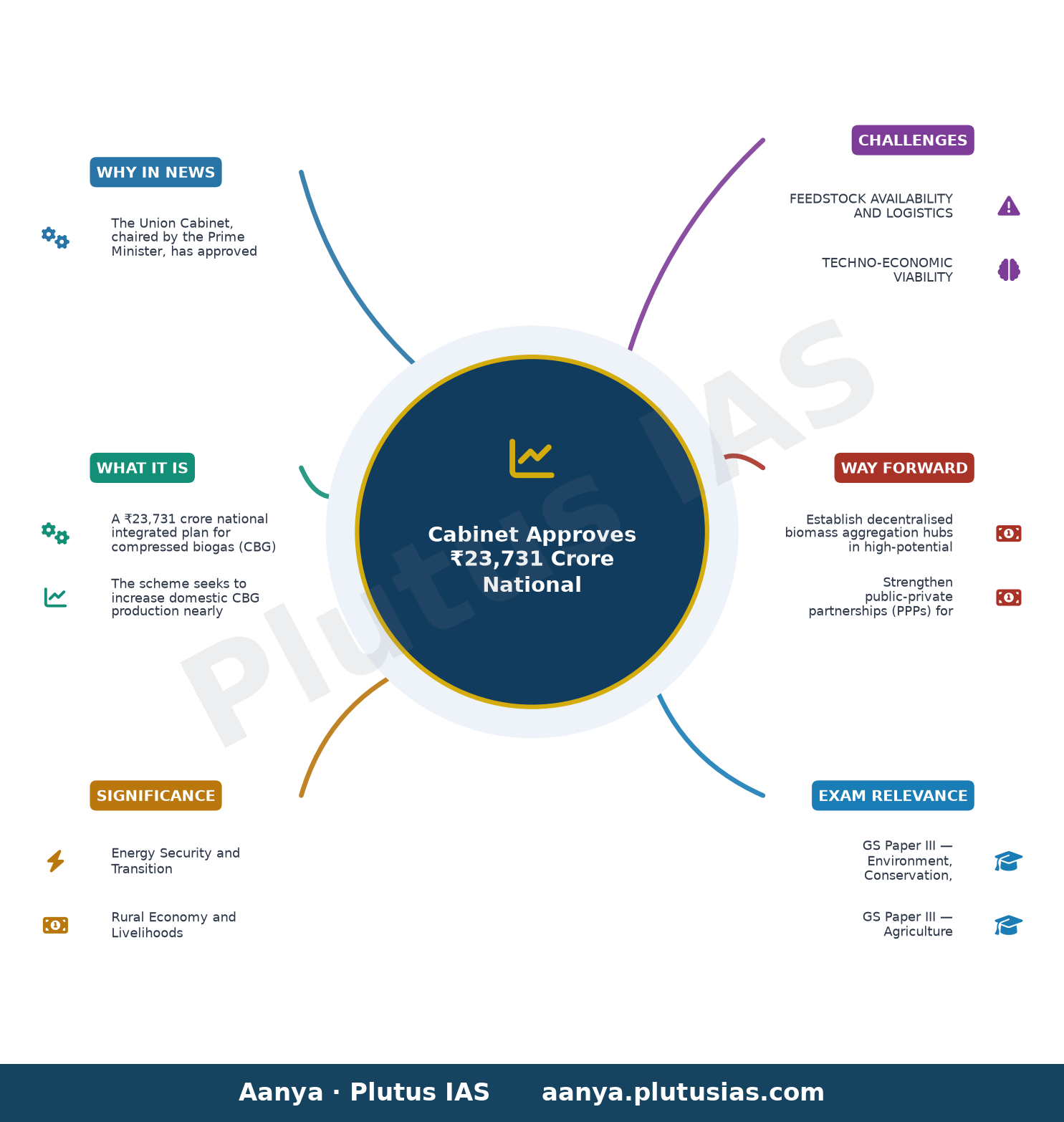
The Union Cabinet, chaired by the Prime Minister, has approved the ‘Gobardhan’ scheme—a ₹23,731 crore national integrated plan for compressed biogas (CBG) production—aimed at transforming India’s abundant organic waste into clean energy, rural prosperity, and economic growth. The scheme, operational from FY 2026-27 to FY 2035-36, seeks to scale domestic CBG production nearly tenfold, attract private investment, and integrate biogas into the national energy mix, thereby enhancing energy security and reducing reliance on imported fossil fuels.
Background
- India generates over 500 million tonnes of agricultural residue annually, much of which is burnt, contributing significantly to air pollution and greenhouse gas emissions.
- The country’s natural gas demand is projected to rise substantially, necessitating diversification of energy sources to ensure energy security.
- The SATAT (Sustainable Alternative Towards Affordable Transportation) initiative, launched in 2018, laid the foundation for CBG adoption by encouraging entrepreneurs to set up plants and supply CBG to oil marketing companies.
- Prior schemes such as the Market Development Assistance (MDA) for organic fertilizers, Biomass Aggregation Machinery (BAM) scheme, and the National Bioenergy Programme have collectively supported the establishment of over 200 CBG plants across India.
- The scheme aligns with India’s commitments under the Paris Agreement to reduce carbon emissions and promote renewable energy.
- The ‘Waste to Wealth’ and ‘Atmanirbhar Bharat’ missions underscore the government’s focus on leveraging organic waste for economic and environmental benefits.
What is the Gobardhan Scheme?
- A ₹23,731 crore national integrated plan for compressed biogas (CBG) production, operational from FY 2026-27 to FY 2035-36, aimed at transforming organic waste into clean energy and economic value.
- The scheme seeks to increase domestic CBG production nearly tenfold, thereby strengthening energy security.
- It provides a robust framework for the CBG value chain, including assured offtake, stable pricing, capital subsidies, pipeline connectivity, and access to finance, to accelerate investment and project implementation.
- Gobardhan integrates agriculture residues, cattle dung, municipal organic waste, press mud, and other biomass resources into a circular bio-economy, generating clean fuel (CBG), organic fertilizers, and rural employment.
- The scheme is administered by the Ministry of Petroleum and Natural Gas and aligns with the National Bioenergy Programme, building on past initiatives like SATAT and the National Biofuel Policy.
- Six key components under Gobardhan include: assured CBG offtake, stable pricing, capital subsidies, pipeline infrastructure, access to finance, and technology development, ensuring a predictable and conducive ecosystem for investors.
- Each CBG plant creates a local circular economy, generating opportunities in feedstock supply, transportation, plant operations, bio-fertilizer production, and waste management, while reducing greenhouse gas emissions.
- The scheme positions India to meet rising natural gas demand domestically, reduce import dependence, and contribute to global climate goals through renewable energy adoption.
Key Features
| Feature | Significance |
|---|---|
| Total Outlay of ₹23,731 Crore | Provides a robust financial framework for scaling Compressed Biogas (CBG) production to ~10x current levels over 10 years. |
| Guaranteed Offtake and Stable Pricing | Mitigates market risk for investors and producers, ensuring predictable revenue streams for CBG plants. |
| Capital Subsidy and Credit Support | Reduces upfront capital burden and improves project viability through financial incentives and loan facilitation. |
| Pipeline Connectivity Integration | Enables seamless integration of CBG into existing natural gas infrastructure, enhancing distribution efficiency. |
| Technology Development and Innovation | Promotes R&D in feedstock diversification, plant efficiency, and by-product utilisation (e.g., bio-fertilisers). |
Why it Matters
Energy Security and Transition
- Reduces import dependency on conventional fuels by substituting natural gas with domestically produced CBG, aligning with India’s energy diversification goals.
- Supports India’s commitment to 45% non-fossil fuel share in energy mix by 2030 under NDCs.
- CBG’s chemical equivalence to natural gas allows direct integration into existing gas grids, minimising transition costs and infrastructure gaps.
Rural Economy and Livelihoods
- Transforms agricultural residues, cattle dung, and municipal organic waste into economic assets, enhancing farmer incomes through waste-to-wealth models.
- Creates decentralised rural enterprises, generating employment in feedstock collection, logistics, plant operation, and bio-fertiliser production.
- Strengthens circular economy principles by closing the loop between waste generation and resource recovery in rural areas.
Environmental Sustainability
- Reduces greenhouse gas emissions by capturing methane from organic waste, a potent GHG with 28x higher warming potential than CO₂.
- Curbs open burning of agricultural residues, mitigating air pollution and associated health hazards.
- Promotes sustainable agricultural practices through organic fertiliser production, reducing chemical fertiliser use.
Investment and Industrial Growth
- Attracts private investment in CBG plants, estimated at ₹50,000–70,000 Crore over the scheme’s tenure, boosting Make-in-India in clean energy.
- Stimulates ancillary industries such as biomass aggregation, transport logistics, and bio-fertiliser marketing.
- Enhances India’s global leadership in bioenergy, positioning it as a model for circular economy adoption in developing nations.
Challenges
1. FEEDSTOCK AVAILABILITY AND LOGISTICS
- Seasonal variability in agricultural residues and cattle dung supply may disrupt plant operations, necessitating robust aggregation models.
- High transportation costs for bulky biomass reduce economic viability; decentralised processing hubs are essential.
- Competition with traditional uses of agricultural waste (e.g., fodder, fuel) may limit feedstock availability.
UPSC Link: GS3: Energy, Environment
2. TECHNO-ECONOMIC VIABILITY
- High capital expenditure (CAPEX) for CBG plants (~₹50–70 Crore per 4–5 TPD plant) requires sustained subsidies and tariff support.
- Operational costs (OPEX) are sensitive to feedstock prices and energy inputs, impacting profitability margins.
- Long payback periods (7–10 years) deter private investment without long-term offtake agreements.
UPSC Link: GS3: Investment Models
3. POLICY AND REGULATORY HARMONISATION
- Inconsistent state-level policies on biomass pricing, waste management, and land-use regulations create operational uncertainties.
- Lack of standardised CBG certification and quality parameters may hinder market acceptance and export potential.
- Delays in land acquisition and environmental clearances for plant set-up can stall project timelines.
UPSC Link: GS2: Governance
4. PUBLIC AWARENESS AND STAKEHOLDER ENGAGEMENT
- Low awareness among farmers and rural communities about CBG’s economic and environmental benefits limits participation.
- Resistance from traditional waste management practices (e.g., open burning) persists due to lack of alternative livelihoods.
- Coordination gaps between central ministries (MNRE, MoPNG, MoHUA) and state agencies slow implementation.
UPSC Link: GS2: Social Empowerment
5. INFRASTRUCTURE AND SKILL GAPS
- Limited pipeline connectivity in rural areas restricts CBG distribution, necessitating targeted infrastructure investments.
- Shortage of skilled manpower for plant operation, maintenance, and bio-fertiliser production hampers scalability.
- Weak waste collection and segregation systems at municipal levels reduce feedstock quality and quantity.
UPSC Link: GS3: Infrastructure
6. CLIMATE VARIABILITY AND RESILIENCE
- Extreme weather events (droughts, floods) disrupt feedstock supply chains, particularly in rainfed agricultural regions.
- Increased temperatures may alter biomass composition, affecting biogas yield and plant efficiency.
- Energy-intensive feedstock pre-treatment (e.g., drying, chopping) raises costs during peak demand periods.
UPSC Link: GS3: Disaster Management
Challenges — UPSC Perspective
| Issue | Concern |
|---|---|
| Feedstock Aggregation | Seasonal supply gaps and high logistics costs threaten plant viability. |
| Capital Intensity | High CAPEX and long payback periods deter private investment without subsidies. |
| Policy Fragmentation | State-level inconsistencies in waste management and biomass pricing create regulatory uncertainty. |
| Public Participation | Low awareness and resistance to behavioural change limit community engagement. |
| Infrastructure Bottlenecks | Inadequate pipeline networks and skill shortages hinder scalability. |
| Climate Resilience | Extreme weather events disrupt supply chains and reduce biogas yield. |
Government Initiatives — Must-Memorise for Prelims
- SATAT (Sustainable Alternative Towards Affordable Transportation)
- Market Development Assistance (MDA) Scheme for Organic Fertilisers
- Biomass Aggregation Machinery (BAM) Scheme
- National Bioenergy Programme
- City Compost Scheme
Way Forward
- Establish decentralised biomass aggregation hubs in high-potential districts to ensure year-round feedstock supply and reduce transportation costs.
- Strengthen public-private partnerships (PPPs) for CBG plant financing, leveraging Viability Gap Funding (VGF) and blended finance models.
- Develop standardised CBG certification protocols and quality benchmarks to enhance market acceptance and facilitate exports.
- Launch nationwide awareness campaigns targeting farmers, rural cooperatives, and municipal bodies to promote waste-to-wealth models.
- Invest in rural pipeline infrastructure and last-mile connectivity to integrate CBG into existing gas grids efficiently.
- Incentivise R&D in feedstock diversification (e.g., algae, energy crops) and advanced biogas upgrading technologies to improve efficiency.
- Integrate CBG plants with existing agricultural and waste management schemes (e.g., PM-KISAN, Swachh Bharat Mission) for synergy and scalability.
- Monitor and evaluate scheme performance through real-time data dashboards to identify bottlenecks and course-correct dynamically.
UPSC Value Addition
Keywords for Mains Answer-Writing
Compressed Bio-Gas (CBG) Policy · GOBARdhan Scheme · Circular Bio-Economy · Energy Transition in India · Biofuel Policy Framework · Rural Livelihood Enhancement · Sustainable Alternative Fuels · Bio-CNG Integration · Waste-to-Wealth Mission · National Bioenergy Programme
Concept Flow
Agricultural residues, cattle dung, and municipal organic waste → Biogas production via anaerobic digestion → Compressed Biogas (CBG) upgrading → Integration into natural gas pipelines → Substitution of conventional fuels → Reduction in GHG emissions and air pollution → Enhanced rural livelihoods through circular economy models → Strengthened energy security and self-reliance
Prelims Practice Questions
Q1. Consider the following statements regarding the GOBARdhan Scheme:
1. The scheme aims to increase domestic Compressed Bio-Gas (CBG) production by approximately tenfold.
2. It is administered by the Ministry of New and Renewable Energy.
3. The scheme includes provisions for capital assistance, pipeline connectivity, and assured procurement.
How many of the above statements are correct?
- Only one
- Only two
- All three
- None
Answer: Only two — Statement 1 is correct as the scheme targets a tenfold increase in CBG production. Statement 2 is incorrect because the scheme is administered by the Ministry of Petroleum and Natural Gas, not MNRE. Statement 3 is correct as the scheme includes capital assistance, pipeline connectivity, and assured procurement mechanisms.
Q2. Assertion (A): Compressed Bio-Gas (CBG) is chemically equivalent to natural gas and can be integrated into existing gas infrastructure.
Reason (R): CBG is produced from agricultural residues, cattle dung, and municipal organic waste, making it a renewable energy source.
In the context of the above two statements, which one of the following is correct?
- Both A and R are true, and R is the correct explanation of A.
- Both A and R are true, but R is not the correct explanation of A.
- A is true, but R is false.
- A is false, but R is true.
Answer: Both A and R are true, and R is the correct explanation of A. — Both A and R are true. CBG is chemically equivalent to natural gas and can be integrated into existing gas infrastructure (A). CBG is produced from organic waste sources, making it a renewable energy source (R). R correctly explains A as the chemical equivalence of CBG to natural gas enables its integration into existing infrastructure.
Q3. Match the following components of the GOBARdhan Scheme with their respective roles:
Column I (Component)
A. Assured CBG Offtake
B. Capital Subsidy
C. Pipeline Connectivity
D. Credit Support
Column II (Role)
1. Provides financial assistance for setting up CBG plants
2. Ensures a reliable market for CBG producers
3. Facilitates transportation of CBG to demand centers
4. Enables access to finance for project developers
Select the correct match:
- A-2, B-1, C-3, D-4
- A-1, B-2, C-3, D-4
- A-3, B-4, C-1, D-2
- A-4, B-3, C-2, D-1
Answer: A-2, B-1, C-3, D-4 — A (Assured CBG Offtake) matches with 2 (ensures a reliable market). B (Capital Subsidy) matches with 1 (provides financial assistance). C (Pipeline Connectivity) matches with 3 (facilitates transportation). D (Credit Support) matches with 4 (enables access to finance).
Mains Practice Question
✍ The GOBARdhan Scheme represents a strategic pivot in India’s energy policy by integrating waste management, rural livelihoods, and renewable energy. Critically examine the scheme’s objectives, institutional framework, and potential challenges in achieving its goals. Also, analyse how the scheme aligns with India’s commitments under the Paris Agreement and the Sustainable Development Goals. (15 Marks)
Approach: MODEL-ANSWER SKELETON:
1. **Objectives of GOBARdhan Scheme (3 points)**
– Target: Tenfold increase in domestic Compressed Bio-Gas (CBG) production (2026-27 to 2035-36).
– Framework: Integrated approach covering assured procurement, stable pricing, capital assistance, pipeline connectivity, and credit support.
– Vision: Transform organic waste (agricultural residues, cattle dung, municipal waste) into clean energy, bio-fertilizers, and rural income.
2. **Institutional Framework (3 points)**
– Administrative Ministry: Ministry of Petroleum and Natural Gas (MoPNG).
– Implementation Partners: State governments, private sector, and financial institutions.
– Existing Support: Synergy with SATAT initiative, Biomass Aggregation Machinery (BAM) Scheme, and National Bioenergy Programme.
3. **Potential Challenges (4 points)**
– **Feed Stock Availability**: Seasonal variability in agricultural residues and cattle dung supply.
– **Economic Viability**: High capital costs for CBG plants and need for stable pricing mechanisms.
– **Infrastructure Gaps**: Limited pipeline connectivity in rural areas and logistical bottlenecks.
– **Policy Coordination**: Need for seamless integration with state-level waste management and energy policies.
4. **Alignment with Global Commitments (3 points)**
– **Paris Agreement**: Contributes to India’s NDCs by reducing reliance on fossil fuels and lowering greenhouse gas emissions (mitigation).
– **SDG 7 (Affordable and Clean Energy)**: Promotes renewable energy adoption and energy access.
– **SDG 13 (Climate Action)**: Supports waste-to-energy conversion, reducing methane emissions from organic waste.
5. **Conclusion (2 points)**
– GOBARdhan is a transformative scheme that aligns economic, environmental, and social goals.
– Success hinges on robust implementation, stakeholder collaboration, and adaptive policy frameworks.
Source: PIB (Press Information Bureau)
Generated by AanyaAi for educational purpose.

- UPSC Civil Services (Main) Examination 2026 — Sanskrit Literature Paper II: Question Paper | Plutus IAS - September 21, 2026
- चीनी राष्ट्रपति शी जिनपिंग अमेरिका दौरे पर, ट्रंप से मिलेंगे वार्ता हेतु - September 21, 2026
- Xi Jinping’s US Visit: Key Takeaways for UPSC & State PCS Aspirants - September 21, 2026

No Comments