


15 Jul Cabinet Approves Mobile Phone Manufacturing Scheme (MPMS) for Atmanirbhar Bharat
Subject Relevance — Where This Topic Fits
- GS Paper III — Indian Economy and issues relating to planning, mobilization of resources, growth, development and employment; Industrial Policy; Make in India initiative; Infrastructure: Energy, Ports, Roads, Airports, Railways etc. | GS Paper II — Government Policies and Interventions for Development in various sectors and issues arising out of their design and implementation.
- Prelims: MPMS Scheme, Production Linked Incentive (PLI), Atmanirbhar Bharat, Electronics Manufacturing, Value Addition, Technological Sovereignty, Export Promotion, Make in India, Global Value Chains, Domestic Sourcing
- Essay: India’s Journey Towards Economic Self-Reliance: The Role of Sector-Specific Policies., From Import Substitution to Export Leadership: The Transformation of India’s Manufacturing Sector.
Quick Revision: The Mobile Phone Manufacturing Scheme (MPMS) is a ₹62,500 crore, five-year initiative to boost domestic mobile phone production, value addition, and exports through production-linked incentives, R&D promotion, and domestic sourcing, aiming for technological sovereignty and job creation under Atmanirbhar Bharat.
Why is this in the news?
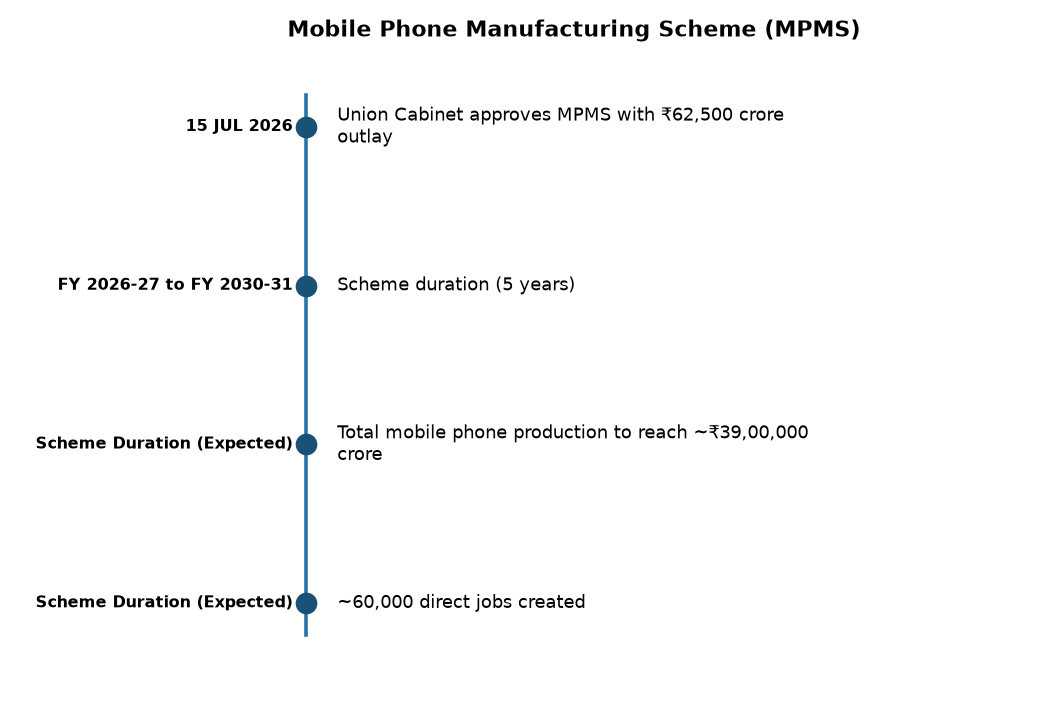
The Union Cabinet, chaired by Prime Minister Shri Narendra Modi, has recently approved the Mobile Phone Manufacturing Scheme (MPMS) with a substantial budgetary outlay of ₹62,500 crore. This strategic approval, effective for a five-year period from FY 2026-27 to FY 2030-31, underscores the government’s unwavering commitment to bolstering domestic manufacturing, enhancing global competitiveness, and achieving technological sovereignty in the critical electronics sector, aligning seamlessly with the broader vision of Atmanirbhar Bharat.
Background
- India’s electronics manufacturing sector has witnessed remarkable growth, increasing 7-fold since FY 2014-15, driven by the ‘Make in India’ initiative.
- The country has emerged as the world’s second-largest mobile phone manufacturer, with 99.2% of mobile phones consumed domestically now being manufactured within India.
- Mobile phones have become a cornerstone of India’s electronics manufacturing ecosystem and a significant driver of exports, surpassing traditional export categories like diesel fuel and cut diamonds by 2025.
- The Production Linked Incentive (PLI) scheme for Large Scale Electronics Manufacturing (PLI-LSEM), which concluded on March 31, 2026, played a pivotal role in establishing India as a global hub for mobile manufacturing and exports.
- The new MPMS builds upon the successes of previous initiatives, aiming to deepen domestic value addition, foster indigenous brand development, and strengthen India’s position in global value chains.
- The sector is a major employment generator, particularly for youth in remote areas, with some plants employing over 5,000 individuals.
What is the Mobile Phone Manufacturing Scheme (MPMS)?
- The Mobile Phone Manufacturing Scheme (MPMS) is a government initiative approved by the Union Cabinet with a budgetary outlay of ₹62,500 crore.
- Its primary objective is to promote production, enhance domestic value addition, build resilient supply chains, and improve global competitiveness in mobile phone manufacturing.
- The scheme aims to achieve technological sovereignty, generate significant economic value, and foster the creation of indigenous brands with Indian patents in design and R&D.
- MPMS will be operational for a period of five years, specifically from Financial Year 2026-27 to Financial Year 2030-31.
- It offers varying incentive rates, ranging from 2.25% to 5% on eligible sales of domestically manufactured mobile phones.
- An additional incentive of up to 1.5% is provided for domestic sourcing of key components and sub-assemblies, encouraging deeper localization.
- To promote indigenous brand development, a further 3% incentive is offered on eligible sales for product design and Research & Development (R&D) activities.
- The scheme is projected to lead to a total mobile phone production of approximately ₹39,00,000 crore and create around 60,000 direct jobs over its duration.
Key Features
| Feature | Significance |
|---|---|
| Budgetary Outlay of ₹62,500 Cr | Demonstrates significant government commitment and provides substantial financial impetus for large-scale investment and expansion in the sector. |
| 5-Year Duration (FY 2026-27 to FY 2030-31) | Offers long-term policy certainty and stability, crucial for attracting sustained domestic and foreign investment in manufacturing and R&D. |
| Production-Linked Incentives (2.25% to 5% on sales) | Directly links incentives to increased production volumes, encouraging manufacturers to scale up operations and achieve economies of scale. |
| Additional 1.5% Incentive for Domestic Sourcing | Promotes backward integration and localization of the supply chain, reducing import dependence and fostering a robust domestic component ecosystem. |
| Additional 3% Incentive for Design & R&D | Crucial for fostering innovation, developing indigenous intellectual property, creating ‘Made in India’ brands, and achieving technological sovereignty. |
| Focus on Production, Value Addition, Supply Chain Resilience | Comprehensive approach to not just manufacturing, but also enhancing quality, reducing vulnerabilities, and integrating India more deeply into global value chains. |
Why it Matters
Economic Growth and Employment Generation
- The scheme is expected to drive total mobile phone production to approximately ₹39,00,000 crore, significantly boosting industrial output and GDP.
- It is projected to create around 60,000 direct jobs, with a multiplier effect on indirect employment, particularly benefiting youth in rural and semi-urban areas.
- Increased manufacturing activity will stimulate demand for ancillary industries, logistics, and services, fostering overall economic development.
Global Competitiveness and Export Promotion
- By offering production-linked incentives, MPMS aims to make Indian-manufactured mobile phones more competitive in global markets, leading to a significant increase in exports.
- The scheme reinforces India’s position as the world’s second-largest mobile phone manufacturer and strengthens its ambition to become a global electronics manufacturing hub.
- The focus on design and R&D will enable Indian brands to innovate and compete effectively on a global scale, moving beyond mere assembly.
Technological Sovereignty and Value Addition
- Incentives for domestic sourcing of components and sub-assemblies will reduce reliance on imports, enhancing self-reliance and supply chain resilience.
- The emphasis on R&D and Indian patent creation is crucial for achieving technological sovereignty, allowing India to control critical aspects of product development and innovation.
- Promoting indigenous brands and design capabilities will enable India to capture higher value in the global electronics value chain, moving from ‘Make in India’ to ‘Design in India’.
Strategic Importance
- A robust domestic electronics manufacturing base is vital for national security, reducing dependence on foreign suppliers for critical communication technologies.
- The scheme aligns with the ‘Atmanirbhar Bharat’ vision, fostering self-reliance across strategic sectors and building a resilient economy.
- Strengthening the electronics ecosystem has cascading benefits for other sectors like IoT, AI, and digital infrastructure, which rely heavily on advanced electronics.
Challenges
1. Supply Chain Vulnerabilities
- Despite progress, India still relies heavily on imports for high-value components like semiconductors, displays, and advanced chipsets.
- Geopolitical tensions and natural disasters can disrupt global supply chains, impacting domestic production.
UPSC Link: GS Paper III — Industrial Policy; Infrastructure
2. Research & Development (R&D) Ecosystem
- While incentives are provided, building a world-class R&D ecosystem and fostering a culture of innovation takes time and sustained investment.
- Lack of adequate skilled workforce in cutting-edge design and advanced manufacturing processes.
UPSC Link: GS Paper III — Science and Technology; Skill Development
3. Infrastructure Deficiencies
- High logistics costs, inconsistent power supply, and inadequate testing facilities can hinder efficient manufacturing and competitiveness.
- Need for specialized industrial parks with plug-and-play infrastructure for electronics manufacturing.
UPSC Link: GS Paper III — Infrastructure; Industrial Policy
4. Intellectual Property Rights (IPR) Protection
- Ensuring robust IPR protection is crucial to attract global R&D investments and encourage indigenous innovation.
- Challenges in enforcing IPR laws effectively and preventing counterfeiting.
UPSC Link: GS Paper III — IPR; Industrial Policy
5. Global Competition and Trade Dynamics
- India faces intense competition from established manufacturing hubs like China, Vietnam, and Taiwan, which have mature ecosystems.
- Changing global trade policies, tariffs, and non-tariff barriers can impact export competitiveness.
UPSC Link: GS Paper III — Liberalization; International Trade
Challenges — UPSC Perspective
| Issue | Concern |
|---|---|
| Component Import Dependence | Continued reliance on foreign sources for critical high-value components like semiconductors, displays, and camera modules. |
| Skilled Workforce Gap | Shortage of highly skilled engineers and technicians for advanced manufacturing, design, and R&D in electronics. |
| Logistics & Power Costs | Higher operational costs due to inefficient logistics and inconsistent or expensive power supply compared to global competitors. |
| R&D Investment & Innovation | Relatively lower private sector investment in cutting-edge R&D and limited indigenous intellectual property creation. |
| Market Access & Trade Barriers | Potential for non-tariff barriers and protectionist policies in key export markets affecting market access for Indian products. |
| Environmental Sustainability | Managing electronic waste (e-waste) and ensuring environmentally sustainable manufacturing practices as production scales up. |
Government Initiatives — Must-Memorise for Prelims
- Production Linked Incentive (PLI) Scheme for Large Scale Electronics Manufacturing (LSEM)
- Scheme for Promotion of Manufacturing of Electronic Components and Semiconductors (SPECS)
- Modified Special Incentive Package Scheme (M-SIPS)
- Electronics Development Fund (EDF)
- Digital India Programme
- Make in India
- National Policy on Electronics (NPE) 2019
- Scheme for Promotion of Electronics System Design and Manufacturing (ESDM)
- National Semiconductor Mission (NSM)
- Phased Manufacturing Programme (PMP)
Way Forward
- Invest strategically in R&D infrastructure and talent development, fostering collaboration between academia, industry, and government to drive indigenous innovation.
- Strengthen the domestic component ecosystem through targeted incentives and technology transfer programs, reducing reliance on imports for critical parts.
- Improve logistics and power infrastructure, including dedicated electronics manufacturing clusters with world-class facilities, to reduce operational costs.
- Streamline regulatory processes and enhance ease of doing business to attract further domestic and foreign direct investment in the sector.
- Focus on skill development programs tailored to advanced manufacturing, design, and emerging technologies like AI and IoT in electronics.
- Promote sustainable manufacturing practices and robust e-waste management policies to ensure environmental responsibility alongside economic growth.
- Actively engage in international forums to shape trade policies favorable to India’s electronics exports and secure market access.
- Encourage the development of Indian ‘champion brands’ through marketing support, quality certification, and design innovation incentives.
UPSC Value Addition
Keywords for Mains Answer-Writing
Atmanirbhar Bharat · Technological Sovereignty · Global Value Chains · Production Linked Incentive · Domestic Value Addition · Electronics Manufacturing Hub · Export Diversification · Supply Chain Resilience · Indigenous R&D · Skill Development · Economic Multiplier Effect · Industrial Policy
Constitutional & Policy Linkages
- Article 38: State to secure a social order for the promotion of welfare of the people (DPSP – economic justice)
- Article 39(a): Right to an adequate means of livelihood (DPSP – employment generation)
- Article 43: Living wage, etc., for workers (DPSP – fair wages, decent standard of life)
- Seventh Schedule (Union List – Entry 52): Industries, the control of which by the Union is declared by Parliament by law to be expedient in the public interest (Central legislation on industries)
- National Policy on Electronics 2019: Government policy framework for electronics manufacturing.
- Foreign Trade Policy: Government policy governing imports and exports.
Concept Flow
Government Policy (MPMS) → Incentives for Manufacturing & R&D → Increased Domestic Production & Value Addition → Enhanced Global Competitiveness & Exports → Economic Growth & Employment Generation → Technological Sovereignty & Atmanirbhar Bharat
Prelims Practice Questions
Q1. Consider the following statements regarding the Mobile Phone Manufacturing Scheme (MPMS):
1. The scheme has a budgetary outlay of ₹62,500 crore for a period of five years.
2. It offers an additional incentive for domestic sourcing of key components and sub-assemblies.
3. The scheme primarily aims to promote import substitution rather than export promotion.
Which of the statements given above is/are correct?
- A. 1 only
- B. 1 and 2 only
- C. 2 and 3 only
- D. 1, 2 and 3
Answer: B. 1 and 2 only — Statement 1 is correct: The MPMS has a budgetary outlay of ₹62,500 crore for FY 2026-27 to FY 2030-31. Statement 2 is correct: The scheme includes an additional 1.5% incentive for domestic sourcing. Statement 3 is incorrect: The scheme explicitly aims to promote both domestic production and exports, strengthening global competitiveness, not solely import substitution.
Q2. Which of the following initiatives has played a significant role in establishing India as the world’s second-largest mobile phone manufacturer?
- A. National Food Security Mission
- B. Production Linked Incentive (PLI) scheme for Large Scale Electronics Manufacturing
- C. Pradhan Mantri Kisan Samman Nidhi
- D. Swachh Bharat Abhiyan
Answer: B. Production Linked Incentive (PLI) scheme for Large Scale Electronics Manufacturing — The Production Linked Incentive (PLI) scheme for Large Scale Electronics Manufacturing (PLI-LSEM) was instrumental in boosting mobile phone manufacturing and exports, contributing to India becoming the world’s second-largest manufacturer. The other options are unrelated to electronics manufacturing.
Mains Practice Question
✍ The Mobile Phone Manufacturing Scheme (MPMS) represents a significant stride towards India’s ambition of becoming a global electronics manufacturing hub and achieving technological sovereignty. Critically examine the potential of MPMS to deepen domestic value addition and enhance India’s position in global value chains, while also discussing the key challenges that need to be addressed for its successful implementation. (250 words)
Approach: Begin by introducing MPMS as a continuation of India’s ‘Make in India’ and ‘Atmanirbhar Bharat’ vision in electronics. Discuss its potential by highlighting features like production-linked incentives, domestic sourcing, and R&D promotion, explaining how these will drive value addition, export growth, and technological sovereignty. Subsequently, critically examine challenges such as supply chain dependencies (e.g., semiconductors), gaps in R&D ecosystem, infrastructure bottlenecks, and the need for skilled workforce. Conclude by offering a forward-looking perspective on how these challenges can be mitigated to fully realize the scheme’s objectives and solidify India’s global standing in electronics manufacturing.
Source: PIB (Press Information Bureau)

- विशाखापट्टनम में उच्च जोखिम गर्भावस्था की निगरानी बढ़ाने पर कलेक्टर का निर्देश, जानिए पूरी जानकारी - October 21, 2026
- National Unity Day 2026: Key Preparations & Significance for UPSC - October 21, 2026
- 14वां इंडिया केम 2026: मुंबई में वैश्विक रसायन उद्योग का महाकुंभ - October 21, 2026

No Comments