


03 Sep Cabinet Approves ₹105.2 Crore Irrigation Projects for Kalaburagi District
✎ The Cabinet-approved irrigation projects for Kalaburagi district include a ₹56-crore lift irrigation scheme to fill 12 tanks in Aland taluk and a ₹49.2-crore minor irrigation and water conservation project, aimed at enhancing…
Subject Relevance — Where This Topic Fits
- GS Paper II — Governance, Government Policies and Interventions for Development in various sectors | GS Paper III — Agriculture, Water Resources, and Infrastructure Development
- Prelims: Irrigation projects, Minor irrigation works, Water conservation, Lift irrigation, Groundwater recharge, Tank irrigation, Check dams, Nalas (streams), Mahatma Gandhi National Rural Employment Guarantee Scheme (MGNREGS), Pradhan Mantri Krishi Sinchayee Yojana (PMKSY)
- Essay: Water conservation and sustainable agricultural development in India, Role of state-led infrastructure in rural transformation
Quick Revision: The Cabinet-approved irrigation projects for Kalaburagi district include a ₹56-crore lift irrigation scheme to fill 12 tanks in Aland taluk and a ₹49.2-crore minor irrigation and water conservation project, aimed at enhancing water storage, groundwater recharge, and agricultural productivity in the semi-arid region.
Why is this in the news?
The State Cabinet of Karnataka has approved two irrigation and water conservation projects for Kalaburagi district, involving a total outlay of ₹105.2 crore. These projects aim to enhance water storage, groundwater recharge, and irrigation infrastructure through lift irrigation, tank development, and minor irrigation works, thereby addressing agricultural water scarcity in the region. The approval underscores the state’s commitment to rural development and agricultural sustainability through targeted infrastructure interventions.
Background
- Kalaburagi district, located in the northern part of Karnataka, is characterized by semi-arid climatic conditions with erratic rainfall, leading to frequent water scarcity and low agricultural productivity.
- The district has historically relied on tank irrigation and minor water sources, but inadequate maintenance and limited storage capacity have constrained water availability for farming.
- Karnataka has implemented several state and centrally sponsored schemes to improve irrigation and water conservation, including the Pradhan Mantri Krishi Sinchayee Yojana (PMKSY) and the Karnataka Minor Irrigation Project.
- The state government has prioritized district-specific development initiatives to address regional disparities in infrastructure and agricultural output.
- The approval of these projects aligns with the broader national agenda of doubling farmer incomes and ensuring sustainable water use in agriculture.
What are the approved irrigation and water conservation projects for Kalaburagi district?
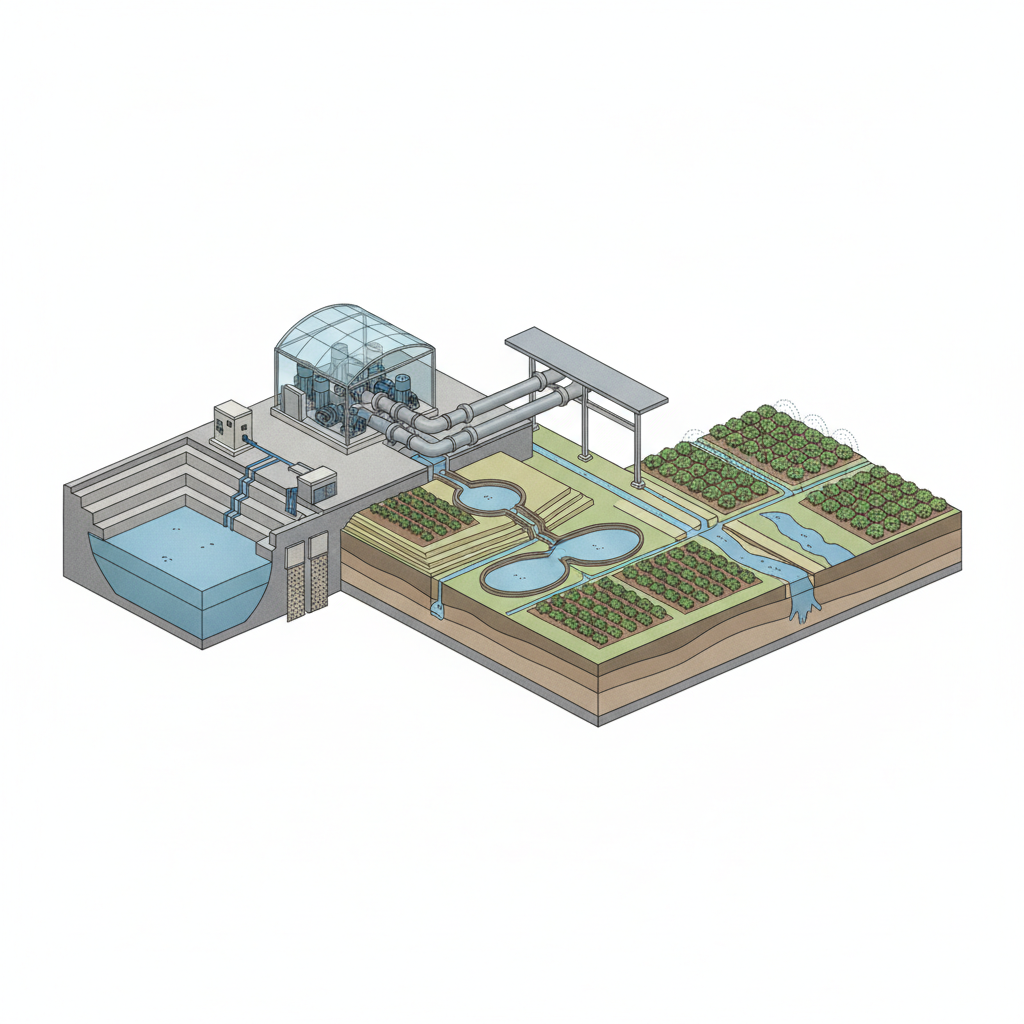
- The first project, with an outlay of ₹56 crore, is a lift irrigation scheme to fill 12 tanks in Aland taluk by drawing water from the Boli river. The project includes a pumping system, pump house, power substation, pipelines, and a distribution network to lift 28.94 million cubic feet (mcft) of water.
- The second project, with an outlay of ₹49.2 crore, focuses on minor irrigation and water conservation works across Kalaburagi district. This includes the development of tanks, nalas (streams), and other water sources, construction of check dams, and deepening and widening of nalas to enhance water storage and groundwater recharge.
- The lift irrigation component is designed to overcome topographical challenges by lifting water from lower to higher elevations, ensuring equitable distribution across the 12 tanks.
- The projects aim to improve water storage capacity, reduce dependence on monsoon rains, and enhance irrigation potential for kharif and rabi seasons.
- The projects are part of the state’s broader strategy to integrate irrigation infrastructure with water conservation measures, including rainwater harvesting and groundwater recharge.
- The administrative approval for the Aland lift irrigation project was granted in 2023-24, indicating a phased and structured implementation approach.
- The projects are aligned with the objectives of the Pradhan Mantri Krishi Sinchayee Yojana (PMKSY), which seeks to expand irrigation coverage and improve water-use efficiency in agriculture.
Key Features
| Feature | Significance |
|---|---|
| Lift irrigation project (₹56 crore) | Enables transfer of 28.94 million cubic feet (mcft) of water from the Boli river to 12 tanks in Aland taluk, enhancing surface water availability for irrigation. |
| Pumping system and power infrastructure | Includes pump houses, substations, pipelines, and distribution networks to facilitate efficient water conveyance and utilisation. |
| Minor irrigation and water conservation works (₹49.2 crore) | Covers development of tanks, nalas, check dams, and deepening/widening of nalas to improve water storage and groundwater recharge across Kalaburagi district. |
| Water storage augmentation | Increases storage capacity through tank filling and nala interventions, reducing water scarcity for agricultural activities. |
| District-wide coverage | Projects span multiple taluks in Kalaburagi, ensuring equitable distribution of water resources and rural development benefits. |
Why it Matters
Agricultural Productivity
- Directly enhances irrigation potential, reducing dependency on monsoon variability and improving crop yields in water-stressed regions.
- Supports multiple cropping seasons by ensuring reliable water supply, particularly for Kharif and Rabi cultivation.
- Facilitates diversification into high-value crops (e.g., horticulture, floriculture) with assured water availability.
Rural Economy and Livelihoods
- Boosts farm incomes through increased productivity, stabilising rural economies in Kalaburagi district.
- Generates employment opportunities in construction, maintenance, and allied agricultural sectors.
- Reduces migration pressures by improving local agricultural viability and economic resilience.
Water Security and Sustainability
- Augments surface water storage, reducing over-extraction of groundwater and mitigating depletion risks.
- Promotes groundwater recharge through nala deepening and check dam construction, enhancing long-term water availability.
- Aligns with national water conservation goals under schemes like Pradhan Mantri Krishi Sinchayee Yojana (PMKSY).
Regional Development
- Addresses regional disparities in irrigation infrastructure, promoting balanced development within the state.
- Supports the government’s commitment to inclusive growth by prioritising historically water-deficient districts.
- Enhances climate resilience of agriculture in the Deccan Plateau region, vulnerable to erratic rainfall.
Institutional and Governance Impact
- Demonstrates state-level initiative in water resource management, complementing central schemes like PMKSY.
- Highlights inter-departmental coordination (irrigation, power, rural development) for integrated project execution.
- Sets a precedent for evidence-based planning in water infrastructure, using hydrological data (e.g., 28.94 mcft capacity).
Challenges
1. Technical and Engineering Challenges
- Ensuring efficiency of lift irrigation systems to minimise energy losses and operational costs over time.
- Managing sediment deposition in tanks and nalas, which can reduce storage capacity and require periodic desilting.
- Addressing terrain constraints in Aland taluk for pipeline routing and infrastructure installation.
UPSC Link: Geography: Watershed Management
2. Environmental Concerns
- Potential ecological impacts of water diversion from the Boli river, necessitating environmental impact assessments.
- Risk of over-extraction from the river if demand exceeds sustainable yield, threatening downstream ecosystems.
- Need for afforestation and soil conservation measures to prevent erosion and siltation in project areas.
UPSC Link: Environment: River Basin Management
3. Financial and Operational Sustainability
- Long-term viability of projects depends on adequate budgetary allocations for O&M (Operation & Maintenance).
- Ensuring equitable water distribution among farmers to prevent conflicts and maximise collective benefits.
- Monitoring and evaluation mechanisms to assess actual vs. projected water utilisation and benefits.
UPSC Link: Economics: Public Expenditure Management
4. Climate Variability and Adaptation
- Increasing frequency of droughts and erratic rainfall may reduce river flows, impacting project efficacy.
- Need for climate-resilient design (e.g., drought-proofing infrastructure, contingency plans for water scarcity).
- Integration with weather forecasting systems to optimise water release and storage schedules.
UPSC Link: Disaster Management: Drought Preparedness
5. Land Acquisition and Rehabilitation
- Potential delays due to land acquisition for pipelines, pump houses, or reservoir expansions.
- Ensuring fair compensation and livelihood restoration for affected communities under Right to Fair Compensation and Transparency in Land Acquisition Act, 2013.
UPSC Link: Polity: Land Acquisition Laws
6. Community Participation and Awareness
- Low farmer participation in water management practices may limit project utilisation and benefits.
- Need for capacity-building programmes to educate farmers on efficient irrigation techniques (e.g., drip irrigation).
- Addressing gender gaps in access to water resources and decision-making in agricultural practices.
UPSC Link: Sociology: Rural Development and Gender
Challenges — UPSC Perspective
| Issue | Concern |
|---|---|
| Energy costs for lift irrigation | High operational expenses may reduce project profitability and sustainability. |
| Siltation in storage structures | Reduces water-holding capacity, necessitating costly desilting operations. |
| Equitable water distribution | Risk of elite capture or conflicts over water access among farmers. |
| Climate change impacts | Altered rainfall patterns may reduce river flows, undermining project benefits. |
| Regulatory compliance | Delays in environmental clearances or land acquisition approvals. |
| Maintenance gaps | Lack of post-project monitoring may lead to infrastructure decay. |
Government Initiatives — Must-Memorise for Prelims
- Pradhan Mantri Krishi Sinchayee Yojana (PMKSY)
Way Forward
- Conduct hydrological studies to validate water availability in the Boli river and ensure sustainable extraction levels.
- Implement a robust O&M framework with dedicated funds and periodic audits to maintain infrastructure efficiency.
- Launch farmer awareness campaigns on water-efficient irrigation techniques (e.g., micro-irrigation) to maximise benefits.
- Integrate climate resilience measures, such as drought-resistant crop varieties and contingency water storage plans.
- Establish a multi-stakeholder monitoring committee (farmers, officials, environmentalists) for transparent project governance.
- Prioritise gender-inclusive water management by involving women in decision-making and training programmes.
- Explore public-private partnerships (PPPs) for technology adoption (e.g., solar-powered pumps) to reduce energy costs.
- Document best practices and lessons learned for replication in other water-scarce districts.
UPSC Value Addition
Keywords for Mains Answer-Writing
Kalaburagi district irrigation projects · Lift irrigation schemes in India · Minor irrigation and water conservation works · Boli river water utilisation · Groundwater recharge mechanisms · State-level irrigation governance in India · Multi-purpose irrigation projects · Drought-prone areas development · Farmers’ welfare through irrigation · Integrated water resource management
Concept Flow
Erratic monsoon rainfall in Kalaburagi district → Low surface water availability → Reduced irrigation potential → Declining agricultural productivity and farmer incomes. → State Cabinet approval of irrigation projects → Investment in lift irrigation and water conservation infrastructure → Augmented water storage and groundwater recharge. → Implementation of pumping systems, pipelines, and check dams → Enhanced water conveyance and storage → Improved irrigation coverage for Kharif/Rabi seasons. → Increased water availability → Higher crop yields and diversification → Boosted rural economy and employment generation. → Sustainable water management practices → Reduced groundwater depletion → Long-term water security and climate resilience. → Monitoring and evaluation → Data-driven adjustments → Optimised project outcomes and equitable benefits.
Prelims Practice Questions
Q1. Consider the following statements regarding irrigation projects in India:
1. Lift irrigation involves pumping water from a lower elevation to a higher elevation.
2. Minor irrigation projects typically include large dams and reservoirs.
3. The primary objective of water conservation works is groundwater recharge.
4. The Boli river basin is located in Karnataka.
How many of the above statements are correct?
- Only one
- Only two
- Only three
- All four
Answer: Only three — Statements 1, 3, and 4 are correct. Statement 2 is incorrect because minor irrigation projects generally involve small-scale structures like tanks, check dams, and nalas, not large dams.
Q2. Assertion (A): The Cabinet approval for irrigation projects in Kalaburagi district is aimed at enhancing agricultural productivity.
Reason (R): Increased water availability through irrigation directly correlates with higher crop yields and farmer income.
Options:
A. Both A and R are true, and R is the correct explanation of A.
B. Both A and R are true, but R is NOT the correct explanation of A.
C. A is true, but R is false.
D. A is false, but R is true.
Answer: ? — Both A and R are true, and R correctly explains A. Improved irrigation infrastructure enhances water availability, which is a critical input for agricultural productivity.
Q3. Match the following irrigation and water conservation structures with their primary functions:
Column I (Structure) | Column II (Primary Function)
1. Lift irrigation project | A. Direct water lifting from rivers to tanks
2. Check dam | B. Groundwater recharge through percolation
3. Nala deepening | C. Storage of rainwater for irrigation
4. Tank development | D. Preventing soil erosion and siltation
Select the correct match:
- 1-A, 2-D, 3-B, 4-C
- 1-B, 2-C, 3-D, 4-A
- 1-C, 2-A, 3-D, 4-B
- 1-D, 2-B, 3-A, 4-C
Answer: 1-A, 2-D, 3-B, 4-C — 1-A: Lift irrigation projects lift water from rivers to higher elevation tanks. 2-D: Check dams prevent soil erosion and siltation. 3-B: Nala deepening improves groundwater recharge. 4-C: Tank development stores rainwater for irrigation.
Mains Practice Question
✍ The augmentation of irrigation infrastructure through lift irrigation and minor water conservation works represents a critical strategy for addressing agricultural distress in drought-prone regions of India. Critically examine the role of such projects in enhancing water security and agricultural productivity, with specific reference to the Kalaburagi district initiatives. Also, outline the constitutional and institutional framework governing irrigation development in India. (15 Marks)
Approach: MODEL-ANSWER SKELETON:
1. **Introduction (2 Marks)**: Define irrigation infrastructure and its significance for agricultural productivity and water security in drought-prone regions like Kalaburagi district in Karnataka.
2. **Role of Irrigation Projects (4 Marks)**:
– **Lift Irrigation**: Explain the mechanism of lifting water from the Boli river to fill 12 tanks in Aland taluk, including the engineering components (pumping system, pipelines, power substation). Highlight its role in addressing topographic constraints and ensuring equitable water distribution.
– **Minor Irrigation and Water Conservation**: Discuss the development of tanks, nalas, check dams, and nala deepening/widening. Emphasise their contribution to groundwater recharge, soil moisture retention, and mitigation of water scarcity.
– **Agricultural Productivity**: Link improved water availability to increased cropping intensity, diversification, and resilience against monsoon variability.
3. **Water Security and Drought-Prone Regions (3 Marks)**:
– Explain how such projects reduce dependence on monsoon rains, particularly in regions like Kalaburagi with erratic rainfall patterns.
– Discuss the socio-economic benefits, including farmer income stability, rural employment generation, and food security.
4. **Constitutional and Institutional Framework (4 Marks)**:
– **Constitutional Provisions**: Article 246 (7th Schedule) – State List (Item 17: Water, that is to say, water supplies, irrigation and canals, drainage and embankments, water storage and water power). Mention the role of the state governments in irrigation development.
– **Institutional Framework**:
– **State Irrigation Departments**: Role in planning, execution, and maintenance of irrigation projects.
– **National Water Mission (NWM)**: Under the National Action Plan on Climate Change (NAPCC), aimed at improving water use efficiency and conservation.
– **Pradhan Mantri Krishi Sinchayee Yojana (PMKSY)**: Centrally sponsored scheme integrating various irrigation and water conservation initiatives, including Accelerated Irrigation Benefits Programme (AIBP), Har Khet Ko Pani, and Per Drop More Crop.
– **State Water Policy**: Karnataka’s water policy, which prioritises sustainable water use, conservation, and equitable distribution.
5. **Challenges and Way Forward (2 Marks)**:
– Highlight challenges such as high capital costs, maintenance of infrastructure, environmental concerns (e.g., river flow depletion, ecological impact), and inter-state water disputes.
– Suggest measures: community participation, adoption of micro-irrigation techniques (drip/sprinkler), integrated watershed management, and leveraging technology (GIS, remote sensing) for efficient project monitoring.
6. **Conclusion (1 Mark)**: Summarise the transformative potential of such projects in addressing agricultural distress and ensuring sustainable water management in drought-prone regions.
Source: The Hindu
Generated by AanyaAi for educational purpose.
Related guides on our sites
- Current affairs for upsc 2026
- How to prepare for GS paper 1 for UPSC CSE mains exam
- Best UPSC coaching for IFOS exam
- Best mentorship programme for upsc

- जयशंकर और टस्क की बैठक: मोदी-टस्क वार्ता से पहले भारत-पोलैंड संबंधों की दिशा तय - October 22, 2026
- UPSC Alert: 40-Day ‘Khet Bachao Abhiyan’ Launch by Union Minister - October 22, 2026
- भारत ने बताया UN रिपोर्ट में दाऊद इब्राहिम को ‘भारत-आधारित’ बताना ‘गलत’ - October 22, 2026

No Comments