


15 Jul Cabinet Approves ₹3,907 Cr Multi-Tracking Rail Projects in Odisha, Jharkhand
Subject Relevance — Where This Topic Fits
- GS Paper I — Geography (Infrastructure, Resources) | GS Paper II — Governance (Government Policies and Interventions) | GS Paper III — Economy (Infrastructure, Investment Models, Logistics, Industrial Corridors) | GS Paper III — Environment (Climate Change Mitigation, Sustainable Transport)
- Prelims: Multi-tracking rail projects, Cabinet Committee on Economic Affairs (CCEA), PM Gati Shakti National Master Plan, Eastern Dedicated Freight Corridor, Logistics Performance Index, Paradeep Port, Mineral corridors, Sustainable transport, Carbon emissions reduction, Economic corridors
- Essay: Infrastructure as a Catalyst for Inclusive Growth and Regional Development, The Role of Sustainable Transport in Achieving India’s Climate Goals and Economic Aspirations
Quick Revision: The Cabinet’s approval of ₹3,907 Cr multi-tracking rail projects in Odisha and Jharkhand, under PM Gati Shakti, is a strategic move to boost eastern India’s logistics efficiency, regional development, and environmental sustainability by enhancing rail capacity for mineral evacuation and trade.
Why is this in the news?
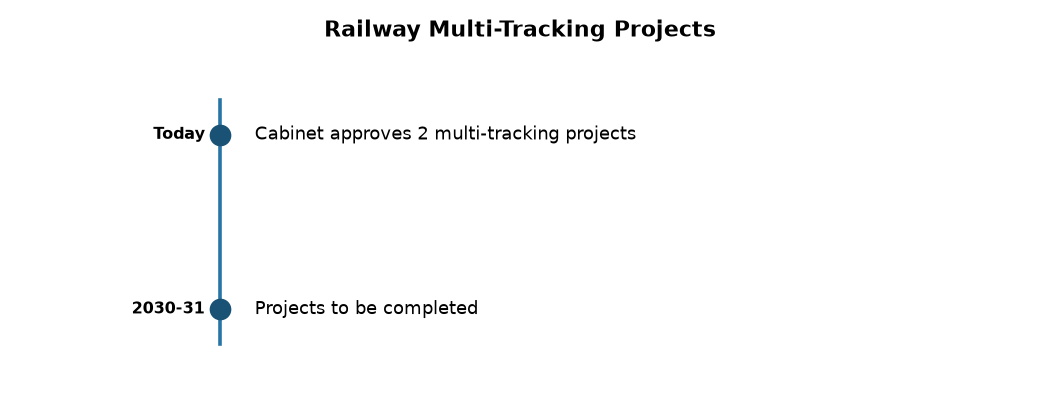
The Cabinet Committee on Economic Affairs (CCEA), chaired by the Prime Minister, recently approved two multi-tracking rail projects in Odisha and Jharkhand, with a total estimated cost of ₹3,907 crore. These projects, including the doubling of the Paradip–Haridaspur line and the fourth line between Rajkharsawan–Dangoaposi, aim to enhance railway network capacity by approximately 145 km, streamline operations, alleviate congestion, and boost economic activity in the mineral-rich eastern region of India by 2030-31.
Background
- India’s railway network, the fourth largest in the world, is a critical artery for freight and passenger movement, playing a pivotal role in economic development.
- The eastern states of Odisha and Jharkhand are rich in mineral resources such as coal, iron ore, bauxite, and chromite, necessitating robust logistics infrastructure for their efficient evacuation.
- Existing railway lines in these regions often face severe congestion due to high freight traffic, particularly from mining and industrial hubs to ports and consumption centres.
- The Government of India has prioritised infrastructure development through initiatives like the National Infrastructure Pipeline (NIP) and PM Gati Shakti, aiming for integrated planning and enhanced multi-modal connectivity.
- Improving logistics efficiency is crucial for India to enhance its competitiveness, reduce logistics costs (currently high at 13-14% of GDP), and achieve its ‘New India’ vision of self-reliance and regional development.
- The approved projects are strategically important for connecting key industrial and port clusters, including Paradip Port, a major deep-water port on the East Coast.
What are Multi-Tracking Rail Projects?
- Multi-tracking rail projects involve the addition of extra railway lines (e.g., doubling, third line, fourth line) alongside existing tracks to increase line capacity.
- These projects are crucial for decongesting high-density routes, allowing for simultaneous movement of more trains and reducing transit times.
- Doubling refers to adding a second track to a single-line section, enabling two-way traffic and greater operational flexibility.
- Third and fourth lines further enhance capacity on already double-line sections, typically in very high-traffic corridors or near major junctions/ports.
- The primary objective is to improve operational efficiency, enhance safety, and accommodate projected increases in both freight and passenger traffic.
- Such projects are integral to modernising railway infrastructure, facilitating faster movement of goods, and supporting industrial growth.
- They often involve significant civil engineering works, including bridge construction, earthwork, and signalling upgrades, requiring substantial capital investment.
- These projects contribute to reducing the carbon footprint of transportation by shifting freight from road to more energy-efficient rail.
Key Features
| Feature | Significance |
|---|---|
| Paradip–Haridaspur Doubling | Enhances connectivity to Paradip Port, a major hub for mineral exports, facilitating efficient evacuation of coal and iron ore. |
| Rajkharsawan–Dangoaposi Fourth Line | Crucial for decongesting the highly saturated mineral corridor in Jharkhand, improving throughput for iron ore and other minerals. |
| Total Estimated Cost: ₹3,907 Crore | Significant investment reflecting government’s commitment to infrastructure development and economic growth in eastern India. |
| Network Addition: ~145 km | Directly increases the operational capacity and reach of the Indian Railways network in critical mineral-rich regions. |
| Completion Target: 2030-31 | Provides a clear timeline for project execution, aligning with long-term infrastructure development goals. |
| Additional Freight Capacity: 44 Million Tonnes Per Annum (MTPA) | Substantially boosts the ability to transport bulk commodities, supporting industrial and mining sectors. |
Why it Matters
Economic Development and Logistics Efficiency
- These projects will significantly enhance the capacity for transporting critical commodities like coal, iron ore, dolomite, and limestone, vital for steel, power, and cement industries.
- Improved rail connectivity to Paradip Port will boost EXIM trade, reducing turnaround times for cargo and making Indian exports more competitive.
- By reducing congestion and improving operational efficiency, the projects will lower logistics costs for industries, contributing to a more competitive manufacturing sector.
- The enhanced rail network will support the growth of ancillary industries and create employment opportunities, both direct and indirect, in the project regions.
- Seamless movement of goods and services will attract further investments into the industrial corridors of Odisha and Jharkhand, fostering regional economic growth.
Regional Development and Social Impact
- The projects are expected to improve connectivity for approximately 1,526 villages, benefiting around 14 lakh people, by enhancing access to markets, services, and employment centers.
- Increased rail access to major tourist destinations like Lalitgiri Buddhist Complex, Shri Baladevjew Temple, and Meghahatuburu Hills will boost tourism and local economies.
- The creation of employment and self-employment opportunities aligns with the ‘New India’ vision of empowering local populations and fostering self-reliance.
- Improved infrastructure often leads to better access to education and healthcare facilities for communities along the rail corridors.
- Enhanced connectivity can bridge regional disparities by integrating remote areas into the national economic mainstream.
Environmental Sustainability and Climate Goals
- Shifting freight from road to rail, an environmentally friendly and energy-efficient mode of transport, will contribute to reducing the country’s carbon footprint.
- The projects are estimated to reduce oil imports by 6 crore litres and cut CO2 emissions by 29 crore kilograms, equivalent to planting 1 crore trees, directly supporting India’s climate action commitments.
- Lowering overall logistics costs through efficient rail transport indirectly contributes to sustainable development by optimising resource utilisation.
- These initiatives align with India’s Nationally Determined Contributions (NDCs) under the Paris Agreement, particularly in promoting sustainable transport systems.
- Reduced air pollution from road transport and decreased fuel consumption contribute to better public health outcomes in the long run.
Strategic Alignment with National Missions
- The projects are integral to the PM Gati Shakti National Master Plan, ensuring integrated planning and multi-modal connectivity for enhanced logistics efficiency.
- They contribute to the broader vision of ‘Atmanirbhar Bharat’ by strengthening domestic infrastructure and making Indian industries more self-reliant and globally competitive.
- These investments are part of the National Rail Plan 2030, which aims to create a ‘future-ready’ railway system capable of handling projected traffic growth.
- By enhancing rail infrastructure, the projects support the development of industrial corridors and Special Economic Zones (SEZs) in the eastern region.
- The focus on operational efficiency and reliability aligns with the Ministry of Railways’ long-term strategy for modernising and expanding the network.
Challenges
1. Land Acquisition and Resettlement
- Acquiring land for new railway lines and expansion projects in densely populated or ecologically sensitive areas often faces significant delays and social resistance.
- Ensuring fair compensation and effective rehabilitation and resettlement (R&R) for affected populations is a complex and time-consuming process.
UPSC Link: GS Paper II — Government Policies; GS Paper III — Infrastructure
2. Environmental Clearances
- Obtaining necessary environmental and forest clearances, especially in mineral-rich regions that often overlap with forest areas, can be protracted.
- Balancing development needs with ecological preservation requires careful planning and adherence to stringent environmental regulations.
UPSC Link: GS Paper III — Environment; GS Paper II — Governance
3. Project Execution and Cost Overruns
- Large-scale infrastructure projects are susceptible to delays in execution, leading to cost overruns due to factors like contractor issues, material price fluctuations, and unforeseen geological challenges.
- Effective project management, monitoring, and timely resolution of bottlenecks are crucial for adherence to timelines and budgets.
UPSC Link: GS Paper III — Economy (Infrastructure); GS Paper II — Governance
4. Inter-Ministerial Coordination
- Despite initiatives like PM Gati Shakti, ensuring seamless coordination among various ministries (Railways, Environment, Mines, State Governments) and stakeholders remains a challenge.
- Integrated planning requires robust institutional mechanisms to prevent silos and ensure holistic development.
UPSC Link: GS Paper II — Governance; GS Paper III — Infrastructure
5. Funding and Financial Sustainability
- While government-funded, ensuring sustained funding for such capital-intensive projects and exploring innovative financing models (e.g., PPP) is important for long-term sustainability.
- The economic viability and return on investment for freight-specific lines need continuous assessment.
UPSC Link: GS Paper III — Economy (Investment Models); GS Paper II — Governance
Challenges — UPSC Perspective
| Issue | Concern |
|---|---|
| Land Acquisition | Delays, social resistance, fair compensation, R&R complexities. |
| Environmental Clearances | Protracted processes, balancing development with ecological preservation. |
| Project Delays | Cost overruns, contractor issues, material price fluctuations, unforeseen challenges. |
| Inter-Agency Coordination | Siloed approach, lack of seamless integration despite Gati Shakti. |
| Funding Constraints | Capital intensity, need for innovative financing, long-term financial sustainability. |
| Operational Integration | Seamless integration of new lines with existing network, signalling, and traffic management. |
Government Initiatives — Must-Memorise for Prelims
- PM Gati Shakti National Master Plan
- National Rail Plan 2030
- National Infrastructure Pipeline (NIP)
- Dedicated Freight Corridors (DFCs)
- Sagarmala Programme
- Bharatmala Pariyojana
- Make in India
- Atmanirbhar Bharat Abhiyan
- Logistics Policy 2022
- Green Railways Mission
Way Forward
- Expedite land acquisition processes through proactive engagement with local communities, ensuring fair compensation and timely rehabilitation.
- Streamline environmental and forest clearance procedures by adopting single-window mechanisms and leveraging technology for faster approvals, while upholding ecological safeguards.
- Implement robust project management frameworks, including real-time monitoring, risk assessment, and performance-linked incentives for contractors, to ensure timely completion and cost control.
- Strengthen inter-ministerial and centre-state coordination through the PM Gati Shakti institutional framework, fostering integrated planning and execution across infrastructure sectors.
- Explore innovative financing models, including Public-Private Partnerships (PPPs) and leveraging multilateral funding, to augment government resources and ensure financial sustainability.
- Invest in advanced signalling systems, automation, and digital technologies to maximise the operational efficiency and safety of the expanded rail network.
- Prioritise skill development and local employment generation during project execution to ensure inclusive growth and community ownership.
- Regularly assess the socio-economic and environmental impact of projects to ensure they align with sustainable development goals and yield intended benefits.
UPSC Value Addition
Keywords for Mains Answer-Writing
Multi-tracking rail projects · PM Gati Shakti · Logistics efficiency · Regional development · Mineral corridors · Sustainable transport · Carbon footprint reduction · Infrastructure investment · Economic corridors · Atmanirbhar Bharat · Inter-modal connectivity · Operational efficiency
Constitutional & Policy Linkages
- Seventh Schedule (Union List) — Railways
- Article 246 — Distribution of legislative powers
- Article 282 — Grants for public purposes
- Environment (Protection) Act, 1986 — Environmental clearances
- Right to Fair Compensation and Transparency in Land Acquisition, Rehabilitation and Resettlement Act, 2013 — Land acquisition norms
- National Transport Policy — Guiding principles for transport sector development
Concept Flow
Increased Rail Capacity (Multi-tracking) → Reduced Congestion & Faster Transit → Lower Logistics Costs & Enhanced Efficiency → Boost to Industrial Production & Trade (Minerals, Port Connectivity) → Regional Economic Growth & Employment Generation → Shift to Sustainable Transport & Reduced Emissions → Contribution to Climate Goals & ‘Atmanirbhar Bharat’
Prelims Practice Questions
Q1. Consider the following statements regarding the recently approved multi-tracking rail projects in Odisha and Jharkhand:
1. The projects aim to increase the Indian Railways network by approximately 145 km.
2. They are being implemented under the Sagarmala Programme.
3. The projects are expected to reduce CO2 emissions by an amount equivalent to planting 1 crore trees.
Which of the statements given above is/are correct?
- A. 1 only
- B. 1 and 3 only
- C. 2 and 3 only
- D. 1, 2 and 3
Answer: B. 1 and 3 only — Statement 1 is correct as the projects will add approximately 145 km to the existing network. Statement 2 is incorrect; the projects are framed under the PM Gati Shakti National Master Plan, not Sagarmala. Statement 3 is correct, as the projects are projected to reduce CO2 emissions by 29 crore kilograms, equivalent to planting 1 crore trees.
Q2. Which of the following is NOT a primary objective of multi-tracking rail projects in India?
- A. Enhancing operational efficiency and network capacity.
- B. Reducing logistics costs for industries.
- C. Promoting exclusive passenger rail services.
- D. Contributing to climate change mitigation through modal shift.
Answer: C. Promoting exclusive passenger rail services. — Multi-tracking projects primarily focus on increasing overall line capacity for both freight and passenger traffic, reducing logistics costs, and promoting sustainable transport. While passenger services benefit, promoting *exclusive* passenger rail services is not their primary or sole objective; they aim for overall network enhancement.
Mains Practice Question
✍ The recent approval of multi-tracking rail projects in Odisha and Jharkhand underscores India’s commitment to infrastructure-led growth. Critically examine how such projects, particularly under the ambit of PM Gati Shakti, can act as a force multiplier for regional development, logistics efficiency, and environmental sustainability. Discuss the key challenges in their implementation and suggest measures for effective project delivery. (250 words)
Approach: Begin by briefly introducing the significance of rail infrastructure for India’s economy and the context of the recent approvals. In the first part, elaborate on how multi-tracking projects, aligned with PM Gati Shakti, drive regional development (employment, tourism, industrial growth), enhance logistics efficiency (reduced costs, faster transit, port connectivity), and contribute to environmental sustainability (modal shift, emissions reduction). In the second part, identify and discuss critical challenges such as land acquisition, environmental clearances, project delays, and inter-agency coordination. Conclude by suggesting actionable measures like streamlined approvals, robust project management, innovative financing, and strengthened coordination for effective and timely project delivery, linking back to the vision of ‘Atmanirbhar Bharat’.
Source: PIB (Press Information Bureau)


No Comments