


14 Oct Cabinet Extends National Social Assistance Programme till 2031
✎ NSAP is a non-contributory, centrally sponsored social security scheme providing financial assistance to elderly, widows, and persons with disabilities below the poverty line, implemented through DBT and aligned with Article 41…
Subject Relevance — Where This Topic Fits
- GS Paper II — Welfare Schemes for Vulnerable Sections of the population by the Centre and States | GS Paper III — Issues relating to Poverty and Hunger
- Prelims: National Social Assistance Programme (NSAP), Indira Gandhi National Old Age Pension Scheme (IGNOAPS), Indira Gandhi National Widow Pension Scheme (IGNWPS), Indira Gandhi National Disability Pension Scheme (IGNDPS), Direct Benefit Transfer (DBT), Article 41 of the Directive Principles of State Policy
- Essay: Role of Social Security in Inclusive Growth, Challenges in Ensuring Last-Mile Delivery of Welfare Schemes
Quick Revision: NSAP is a non-contributory, centrally sponsored social security scheme providing financial assistance to elderly, widows, and persons with disabilities below the poverty line, implemented through DBT and aligned with Article 41 of the Directive Principles of State Policy.
Why is this in the news?
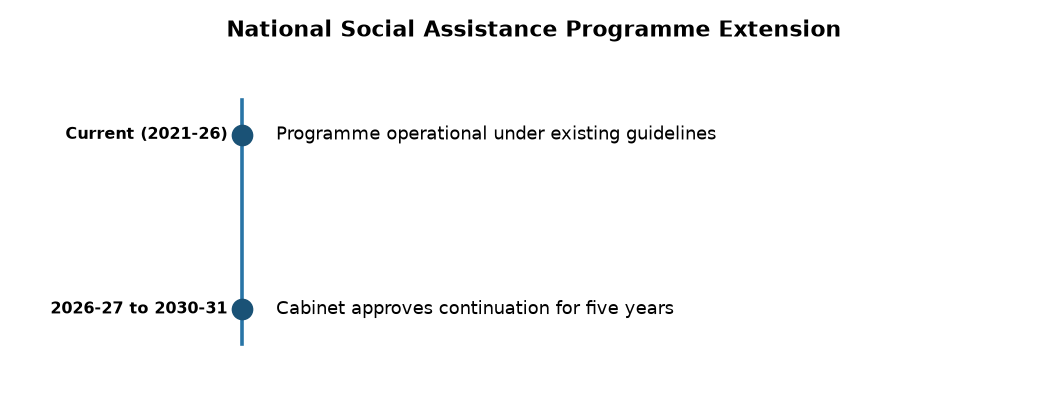
The Union Cabinet has approved the continuation of the National Social Assistance Programme (NSAP) for a five-year period from 2026-27 to 2030-31. This decision underscores the government’s commitment to providing non-contributory social security pensions to the elderly, widows, and persons with disabilities, aligning with constitutional directives and Sustainable Development Goals (SDG 1: No Poverty). The extension is significant as it ensures continuity of welfare support amid evolving demographic and economic challenges.
Background
- NSAP was launched in 1995 as a centrally sponsored scheme to provide financial assistance to the most vulnerable sections of society, including the elderly below the poverty line, widows, and persons with severe disabilities.
- The programme operates under the Ministry of Rural Development and is implemented through the State Governments and Union Territory Administrations.
- NSAP comprises five components: Indira Gandhi National Old Age Pension Scheme (IGNOAPS), Indira Gandhi National Widow Pension Scheme (IGNWPS), Indira Gandhi National Disability Pension Scheme (IGNDPS), National Family Benefit Scheme (NFBS), and Annapurna Scheme.
- The scheme is a non-contributory, unconditional cash transfer programme aimed at reducing poverty and vulnerability by providing a safety net to marginalised groups.
- NSAP is a key instrument for achieving the constitutional mandate under Article 41 of the Directive Principles of State Policy, which calls upon the State to ensure public assistance in cases of unemployment, old age, sickness, and disablement.
What is the National Social Assistance Programme (NSAP)?
- NSAP is a centrally sponsored welfare scheme designed to provide financial assistance to Below Poverty Line (BPL) households, including the elderly, widows, and persons with disabilities, to mitigate the adverse effects of poverty.
- The scheme is implemented as a non-contributory, unconditional cash transfer programme, ensuring that beneficiaries receive direct financial support without any requirement for prior contributions.
- NSAP consists of five sub-schemes: IGNOAPS (for elderly BPL individuals aged 60+ years), IGNWPS (for widows aged 40+ years), IGNDPS (for persons with severe disabilities aged 18+ years), NFBS (for families below the poverty line in case of death of the primary breadwinner), and Annapurna (for providing food security to indigent senior citizens).
- The financial assistance under NSAP is provided by the central government and disbursed through the State Governments and Union Territory Administrations, leveraging the Direct Benefit Transfer (DBT) mechanism for transparency and efficiency.
- The eligibility criteria for NSAP are determined by the State Governments based on BPL thresholds, with the central government providing 100% funding for the scheme.
- NSAP is a critical component of India’s social security architecture, complementing other welfare initiatives such as the Mahatma Gandhi National Rural Employment Guarantee Scheme (MGNREGS) and the Public Distribution System (PDS).
- The scheme aligns with global commitments, including the Sustainable Development Goals (SDG 1: No Poverty), and contributes to the reduction of multidimensional poverty by providing a safety net for vulnerable populations.
- The extension of NSAP until 2030-31 ensures policy continuity and provides a stable framework for long-term planning by State Governments in addressing social security challenges.
Key Features
| Feature | Significance |
|---|---|
| Continuation Period | Extends the National Social Assistance Programme (NSAP) for five years (2026-27 to 2030-31), ensuring sustained financial support to eligible beneficiaries under the scheme. |
| Financial Outlay | The continuation is contingent on the approved financial allocation, ensuring budgetary commitment for social welfare expenditures during the extended period. |
| Target Beneficiaries | Maintains coverage for indigent senior citizens, widows, disabled individuals, and families of deceased primary breadwinners, aligning with the scheme’s original mandate. |
| Implementation Framework | Reaffirms the existing administrative and institutional mechanisms for disbursement, monitoring, and grievance redressal under NSAP. |
| Policy Continuity | Demonstrates the government’s commitment to social protection as a long-term policy priority, ensuring stability in welfare delivery. |
Why it Matters
Social Protection
- Reinforces the state’s obligation under Directive Principles of State Policy (Article 41) to provide public assistance in cases of unemployment, old age, sickness, and disablement.
- Ensures income security for vulnerable sections, reducing poverty and social exclusion among marginalised groups.
- Contributes to achieving Sustainable Development Goal 1 (No Poverty) and Goal 10 (Reduced Inequalities) by addressing structural vulnerabilities.
Fiscal Policy
- Signals long-term fiscal planning in social sector expenditures, aiding macroeconomic stability by pre-committing resources for welfare schemes.
- Enhances predictability for state governments in budgetary allocations for social assistance, fostering cooperative federalism.
Governance
- Strengthens the institutional capacity of the Ministry of Rural Development in implementing and monitoring welfare programmes across states and union territories.
- Facilitates data-driven governance through periodic beneficiary identification and updation processes.
Human Development
- Supports human capital formation by mitigating the adverse effects of poverty on health, education, and nutrition outcomes among beneficiaries.
- Acts as a safety net, enabling vulnerable households to invest in productive assets and livelihood opportunities.
Challenges
1. Targeting and Exclusion Errors
- Risk of inclusion of non-poor households due to outdated beneficiary lists or inadequate verification mechanisms.
- Potential exclusion of deserving beneficiaries due to administrative delays or lack of awareness among target groups.
UPSC Link: GS-II: Welfare schemes for vulnerable sections
2. Financial Sustainability
- Long-term fiscal viability of NSAP depends on budgetary allocations aligning with inflation and demographic changes.
- Competing demands on the exchequer may necessitate prioritisation of welfare expenditures.
UPSC Link: GS-III: Fiscal policy and resource mobilisation
3. Implementation Gaps
- Variations in state-level execution capacity may lead to disparities in benefit disbursement and monitoring.
- Weak grievance redressal mechanisms in some states could undermine the scheme’s effectiveness.
UPSC Link: GS-II: Government policies and interventions
4. Digital Divide
- Limited digital literacy among elderly and rural beneficiaries may hinder access to Aadhaar-based authentication and direct benefit transfers.
- Dependence on digital infrastructure for disbursement could exclude marginalised groups without bank accounts or smartphones.
UPSC Link: GS-II: E-governance and digital inclusion
5. Monitoring and Evaluation
- Lack of real-time data systems to track utilisation of funds and outcomes at the grassroots level.
- Absence of robust impact assessment frameworks to measure the scheme’s contribution to poverty reduction and social mobility.
UPSC Link: GS-II: Social sector initiatives and their outcomes
Challenges — UPSC Perspective
| Issue | Concern |
|---|---|
| Beneficiary Identification | Risk of errors in determining eligibility due to outdated socio-economic surveys or lack of updated data. |
| Fund Disbursement | Delays in release of funds to states or beneficiaries, leading to gaps in welfare delivery. |
| State Capacity | Variations in administrative and technical capacity across states affecting efficient implementation. |
| Awareness Campaigns | Inadequate outreach to inform eligible individuals about their entitlements and application processes. |
| Grievance Redressal | Limited accessibility of complaint mechanisms for beneficiaries facing delays or denials in benefits. |
| Inflation Adjustment | Failure to index benefit amounts to inflation, eroding the real value of assistance over time. |
Government Initiatives — Must-Memorise for Prelims
- National Social Assistance Programme (NSAP)
- Indira Gandhi National Old Age Pension Scheme (IGNOAPS)
- National Family Benefit Scheme (NFBS)
- Annapurna Scheme (for indigent senior citizens)
- State-level social assistance schemes that complement NSAP
Way Forward
- Conduct periodic socio-economic surveys to update beneficiary lists and reduce exclusion errors.
- Strengthen state-level capacity through training programmes for officials and digital infrastructure upgrades.
- Enhance awareness campaigns using local languages and community-based outreach mechanisms.
- Integrate NSAP with other welfare schemes (e.g., Ayushman Bharat, PM-KISAN) for convergence and efficiency.
- Develop a real-time monitoring dashboard to track fund utilisation and beneficiary feedback.
- Establish a dedicated grievance redressal portal with multi-lingual support and escalation mechanisms.
- Index benefit amounts to inflation to maintain the real value of assistance over time.
- Promote financial inclusion by facilitating access to bank accounts and digital payment systems for beneficiaries.
UPSC Value Addition
Keywords for Mains Answer-Writing
National Social Assistance Programme (NSAP) · Indira Gandhi National Old Age Pension Scheme (IGNOAPS) · National Family Benefit Scheme (NFBS) · National Maternity Benefit Scheme (NMBS) · Lakshmi Bai National Mahila Samriddhi Yojana (LNMSY) · Direct Benefit Transfer (DBT) · Constitutional Directive Principles · Article 41 of the Indian Constitution · Social Security · Poverty alleviation · Union-State fiscal transfers · Welfare expenditure · Sustainable Development Goals (SDGs) 1.3 and 3.8 · Right to Social Security · Targeted welfare delivery · Fiscal federalism
Constitutional & Policy Linkages
- Article 41: Directive Principle of State Policy regarding public assistance in cases of unemployment, old age, sickness, and disablement.
- Article 46: Promotion of educational and economic interests of Scheduled Castes, Scheduled Tribes, and other weaker sections.
Concept Flow
Identification of vulnerable groups (elderly, widows, disabled, bereaved families) → Design of targeted welfare schemes (NSAP) → Allocation of financial resources → Implementation through state governments → Beneficiary identification and authentication → Disbursement of benefits → Monitoring and evaluation → Feedback and course correction → Impact assessment and policy refinement → Long-term sustainability and social protection.
Prelims Practice Questions
Q1. Consider the following statements regarding the National Social Assistance Programme (NSAP):
1. NSAP is a centrally sponsored scheme providing non-contributory social security benefits.
2. The programme includes five components: IGNOAPS, NFBS, NMBS, LNMSY, and Annapurna.
3. NSAP benefits are disbursed through Direct Benefit Transfer (DBT) to ensure transparency.
4. The scheme is funded entirely by the state governments with no central assistance.
How many of the above statements are correct?
- Only one
- Only two
- Only three
- All four
Answer: Only three — Statements 1, 2, and 3 are correct. NSAP is a centrally sponsored scheme with five components (IGNOAPS, NFBS, NMBS, LNMSY, and Annapurna), and benefits are disbursed via DBT. Statement 4 is incorrect as NSAP is funded jointly by the Centre and states.
Q2. Assertion (A): The National Social Assistance Programme (NSAP) is designed to provide social security to the most vulnerable sections of society.
Reason (R): The scheme is aligned with the constitutional directive under Article 41, which mandates the state to secure public assistance in cases of unemployment, old age, sickness, and disablement.
In the context of the above two statements, which one of the following is correct?
- Both A and R are true, and R is the correct explanation of A
- Both A and R are true, but R is not the correct explanation of A
- A is true, but R is false
- A is false, but R is true
Answer: Both A and R are true, and R is the correct explanation of A — Both A and R are true. NSAP provides social security to vulnerable groups (A), and Article 41 of the Constitution mandates state action in this regard (R). R correctly explains A as the scheme operationalises the constitutional directive.
Q3. Match the following components of the National Social Assistance Programme (NSAP) with their respective target beneficiaries:
Column I (Component) Column II (Beneficiary)
A. Indira Gandhi National Old Age Pension Scheme (IGNOAPS) 1. Pregnant women
B. National Family Benefit Scheme (NFBS) 2. Below Poverty Line (BPL) families
C. National Maternity Benefit Scheme (NMBS) 3. BPL widows aged 40-64
D. Annapurna 4. BPL senior citizens aged 60+
Select the correct match:
- A-4, B-2, C-1, D-3
- A-3, B-2, C-1, D-4
- A-4, B-1, C-2, D-3
- A-3, B-1, C-2, D-4
Answer: A-4, B-2, C-1, D-3 — Correct matches: A (IGNOAPS) targets BPL senior citizens aged 60+; B (NFBS) targets BPL families; C (NMBS) targets pregnant women; D (Annapurna) targets BPL widows aged 40-64.
Mains Practice Question
✍ Critically examine the role of the National Social Assistance Programme (NSAP) in addressing socio-economic vulnerabilities in India. How far has the programme succeeded in ensuring inclusive social security, and what structural challenges persist? (15 Marks)
Approach: MODEL-ANSWER SKELETON:
1. **Introduction**: Define NSAP as a centrally sponsored scheme under the Ministry of Rural Development, operationalised since 1995, aligning with Article 41 of the Constitution (Directive Principles of State Policy).
2. **Components and Coverage**:
– List the five components: IGNOAPS (old age pension), NFBS (family benefit on death of primary breadwinner), NMBS (maternity benefit), LNMSY (women’s self-help group linkage), and Annapurna (food security for indigent senior citizens).
– Highlight eligibility criteria (BPL status, age thresholds) and benefit amounts (as per state norms).
3. **Achievements**:
– **Inclusive Coverage**: Expansion to 100% districts; coverage of ~3.5 crore beneficiaries (2023-24 data).
– **Direct Benefit Transfer (DBT)**: Reduction in leakages and delays via Aadhaar-linked payments.
– **Poverty Alleviation**: Contribution to SDGs 1.3 (social protection systems) and 3.8 (universal health coverage).
– **Empowerment**: LNMSY links women to microfinance and livelihoods.
4. **Structural Challenges**:
– **Exclusion Errors**: BPL targeting flaws (e.g., exclusion of deserving households due to outdated surveys).
– **Inadequate Benefits**: Nominal pension amounts (e.g., ₹200–₹1,000/month) insufficient for basic needs; no indexation to inflation.
– **State Disparities**: Variations in benefit amounts, coverage gaps, and administrative delays across states.
– **Fiscal Federalism**: Centre-state cost-sharing (90:10 for NE states; 60:40 for others) creates fiscal imbalances.
– **Data Gaps**: Lack of real-time beneficiary data for dynamic targeting.
5. **Comparative Perspective**:
– Contrast with global models (e.g., Brazil’s *Bolsa Família*, South Africa’s *Old Age Grant*) where benefits are universal or indexed.
6. **Way Forward**:
– **Universalisation**: Gradual shift to non-BPL-based targeting (e.g., age-based pensions).
– **Benefit Indexation**: Link pensions to Consumer Price Index (CPI) for inflation adjustment.
– **Convergence**: Integrate NSAP with Ayushman Bharat, MGNREGA, and PDS for holistic welfare.
– **Digital Public Infrastructure**: Leverage Jan Dhan-Aadhaar-Mobile (JAM) trinity for real-time monitoring.
– **State Capacity Building**: Strengthen gram panchayat-level monitoring and grievance redressal.
7. **Conclusion**: NSAP is a critical safety net but requires structural reforms to transition from poverty alleviation to sustainable social security, aligning with constitutional ideals and SDG commitments.
Source: PIB (Press Information Bureau)
Generated by AanyaAi for educational purpose.
Related guides on our sites
- How to prepare for GS paper 1 for UPSC CSE mains exam
- Best sociology optional coaching for upsc
- Which is best sociology optional coaching for upsc
- Best teacher of sociology optional for upsc

- बालिका तस्करी: NHRC का स्वतः संज्ञान, मानवाधिकार उल्लंघन पर रिपोर्ट तलब - November 3, 2026
- Bihar-MoRTH MoU: Scientific Desilting for NH Projects - November 3, 2026
- आदित्य-एल1: सौर विस्फोट के असमान फैलाव की नई खोज - November 3, 2026

No Comments