


11 Aug CAG Flags ₹1.60 Lakh Crore Unverified Spends in Jharkhand: UPSC Analysis
✎ Utilization Certificates are statutory instruments under the Government Accounting Rules, 1990, mandating proof of purpose-specific expenditure; their absence in Jharkhand for ₹1.60 lakh crore raises concerns about financial…
Subject Relevance — Where This Topic Fits
- GS Paper III — Government Budgeting and Financial Management | GS Paper III — Public Sector Undertakings and Accountability
- Prelims: Utilization Certificate, Comptroller and Auditor General (CAG), Financial Accountability, Government Expenditure Audit, Treasury Advances (AC/ DC Bills)
- Essay: Role of Institutions in Ensuring Governance Accountability
Quick Revision: Utilization Certificates are statutory instruments under the Government Accounting Rules, 1990, mandating proof of purpose-specific expenditure; their absence in Jharkhand for ₹1.60 lakh crore raises concerns about financial transparency and institutional accountability.
Why is this in the news?
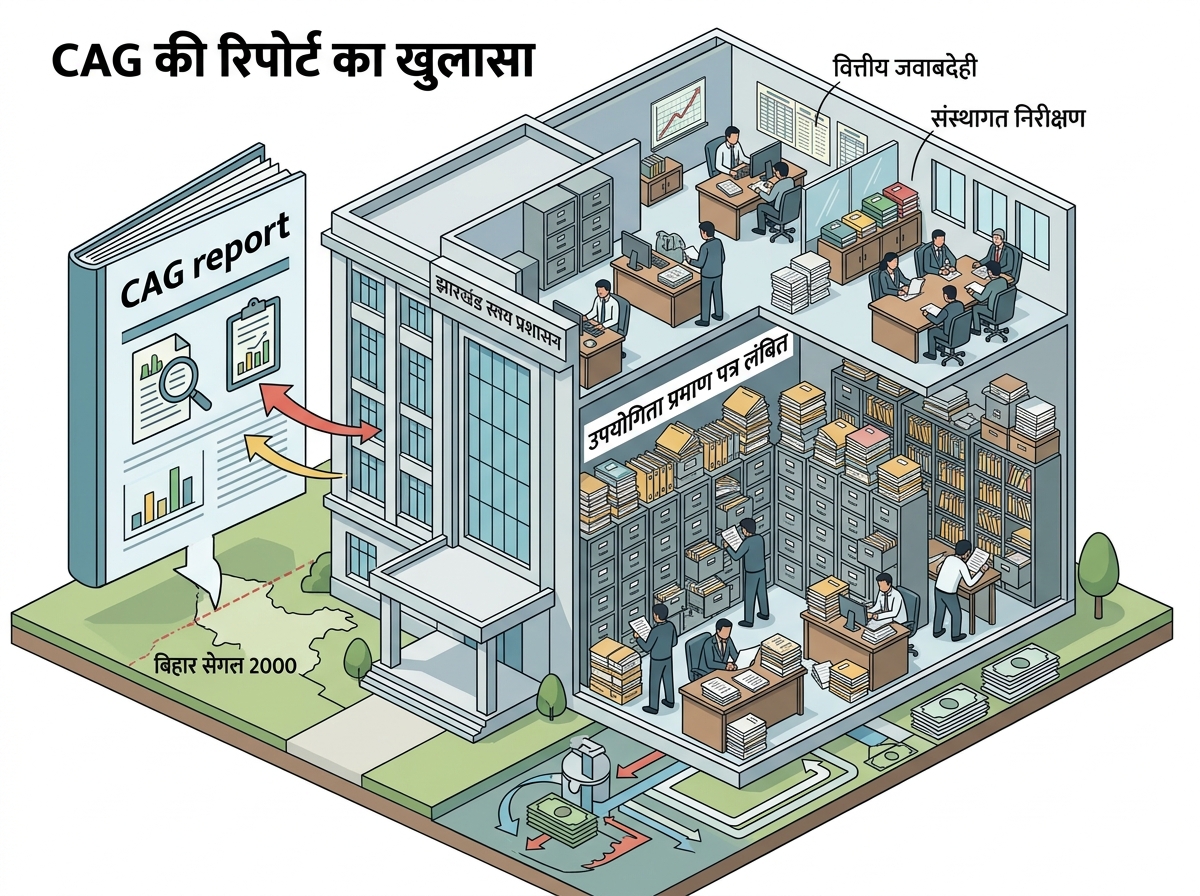
The Comptroller and Auditor General (CAG) of India’s report has highlighted that Jharkhand has pending utilization certificates amounting to ₹1.60 lakh crore as of 31 March 2025, raising concerns about financial accountability, transparency, and the efficacy of institutional oversight mechanisms in the state’s public financial management system.
Background
- The state of Jharkhand was carved out of Bihar on 15 November 2000 under the Bihar Reorganisation Act, 2000, and has since operated under a federal fiscal framework governed by constitutional provisions such as Articles 279A (GST Council) and 280 (Finance Commission).
- Utilization Certificates (UCs) are mandatory financial instruments prescribed under the Government Accounting Rules, 1990, to validate that funds released for specific schemes or projects have been utilised for the intended purpose.
- The CAG, as the supreme audit institution of India, conducts compliance audits under Article 149 of the Constitution to ensure adherence to fiscal rules and financial propriety in public expenditure.
- Pending UCs obstruct the audit trail, impede financial reconciliation, and undermine the principles of fiscal discipline enshrined in the Constitution.
What are Utilization Certificates and their role in public financial management?
- A Utilization Certificate (UC) is a statutory document issued by a competent authority to certify that funds released for a specific purpose have been fully and appropriately utilised, with no diversion or misappropriation.
- UCs are mandated under the Government Accounting Rules, 1990, for all grants-in-aid, loans, and advances disbursed by the Union or state governments to implementing agencies, local bodies, or public sector undertakings.
- The primary objective of UCs is to ensure financial accountability, prevent fund diversion, and facilitate compliance with the principle of ‘purpose-specific expenditure’.
- In the context of Jharkhand, the pending UCs for ₹1.60 lakh crore suggest either delays in submission by implementing agencies, lapses in the state’s treasury system, or systemic inefficiencies in financial monitoring.
- The absence of UCs obstructs the CAG’s ability to conduct a comprehensive audit, as it cannot verify the legality, regularity, or propriety of the expenditure, thereby compromising transparency in public finance.
- State governments are required to submit UCs to the CAG within stipulated timelines; delays or non-submission may attract observations in the CAG’s audit report, as seen in Jharkhand’s case.
- The issue underscores the need for robust financial governance frameworks, including real-time digital tracking of funds, automated reconciliation systems, and stringent penalties for non-compliance with UC submission norms.
Key Features
| Feature | Significance |
|---|---|
| Utilization Certificates (UCs) | Mandatory fiscal instrument to validate that government funds have been utilised for the intended purpose, ensuring financial accountability and transparency in public expenditure. |
| Comptroller and Auditor General (CAG) audit | Constitutional oversight mechanism under Article 149 to examine government accounts, report financial irregularities, and uphold fiscal discipline. |
| Advance withdrawals (AC Bills) | Temporary disbursements from the Treasury for urgent expenditures, subject to subsequent reconciliation through Detailed Contingent Bills (DC Bills). |
| Financial accountability | The principle that public funds must be accounted for, audited, and utilised strictly in accordance with legislative appropriations and approved schemes. |
| State financial management | The institutional framework governing revenue, expenditure, and audit processes within a state government, including compliance with fiscal rules and reporting standards. |
Why it Matters
Fiscal Governance
- The pending UCs of ₹1.60 lakh crore indicate a systemic failure in financial reporting, undermining the credibility of state expenditure records.
- Such lapses erode public trust in government financial management and may lead to reputational damage for the state in the eyes of lenders and investors.
- Failure to reconcile advances (₹4,531 crore cited) suggests inadequate internal controls and weak compliance with Treasury norms.
Institutional Oversight
- The CAG’s role as an independent constitutional authority is critical in identifying gaps in financial accountability, as mandated under Article 149.
- The audit report serves as an early-warning system for Parliament/State Legislature, enabling corrective legislative or executive action.
- Persistent non-compliance with UC requirements may necessitate stricter audit scrutiny or legislative interventions to enforce accountability.
Policy Implications
- The situation highlights the need for robust financial management systems, including digital tracking of expenditures and automated UC generation.
- State governments must prioritise reconciliation of advances and timely submission of UCs to avoid audit qualifications and financial penalties.
- The episode underscores the importance of capacity-building in state finance departments to handle complex fiscal reporting requirements.
Challenges
1. Financial Accountability Lapses
- Non-submission of UCs for ₹1.60 lakh crore of expenditure violates the fundamental principle of financial transparency and accountability.
- Lack of reconciliation for advances (₹4,531 crore) indicates weak internal audit mechanisms and poor financial discipline.
- Delayed or absent UCs hinder the legislature’s ability to scrutinise government spending effectively.
UPSC Link: GS-II: Role of CAG and financial accountability
2. Institutional Capacity Constraints
- State finance departments may lack the technical and human resources to manage complex fiscal reporting and audit compliance.
- Inadequate training and outdated financial management systems contribute to delays in UC submission.
- Coordination gaps between line departments, Treasury, and audit authorities exacerbate the problem.
UPSC Link: GS-II: Public financial management in states
3. Risk of Fiscal Misreporting
- Prolonged non-submission of UCs raises concerns about potential misutilisation or diversion of public funds, though direct evidence is not established.
- Audit qualifications on financial irregularities may lead to disallowances, recoveries, or adverse audit opinions, impacting the state’s fiscal health.
- Persistent lapses could trigger stricter audit scrutiny or interventions by the Finance Commission or NITI Aayog.
UPSC Link: GS-II: CAG’s role in fiscal oversight
4. Legislative Scrutiny Gaps
- The legislature’s ability to hold the executive accountable is compromised when UCs are not submitted, limiting its oversight role.
- Delayed or absent UCs reduce the effectiveness of Public Accounts Committees (PACs) in examining government expenditure.
- The situation necessitates stronger legislative mechanisms to enforce timely submission of UCs and other financial documents.
UPSC Link: GS-II: Role of legislature in financial accountability
Challenges — UPSC Perspective
| Issue | Concern |
|---|---|
| Non-submission of Utilization Certificates | Violation of financial transparency norms; undermines credibility of state expenditure records. |
| Reconciliation of Advances (AC/DC Bills) | Lack of timely reconciliation raises risks of misutilisation or financial mismanagement. |
| Weak Internal Audit Mechanisms | Inadequate financial controls and reporting systems hinder effective oversight. |
| Legislative Scrutiny Gaps | Delayed or absent UCs limit the legislature’s ability to scrutinise government spending. |
| Audit Qualifications and Disallowances | Persistent lapses may lead to adverse audit opinions, recoveries, or penalties. |
Way Forward
- Constitute a high-powered committee comprising officials from Finance, Audit, and Planning departments to expedite UC reconciliation and submission.
- Implement a digital financial management system with automated reminders for UC deadlines and real-time tracking of expenditures.
- Conduct capacity-building programmes for state finance officials on financial reporting, audit compliance, and Treasury norms.
- Strengthen the role of the State Public Accounts Committee (PAC) to scrutinise delayed UCs and recommend corrective measures.
- Introduce legislative amendments to impose penalties for non-submission of UCs within stipulated timelines.
- Enhance coordination between line departments, Treasury, and CAG offices to streamline financial reporting and audit processes.
- Publish quarterly progress reports on UC reconciliation and financial accountability to improve transparency and public trust.
UPSC Value Addition
Keywords for Mains Answer-Writing
Comptroller and Auditor General of India (CAG) · Utilisation Certificates (UCs) · Fiscal accountability · Financial governance · Public expenditure audit · Financial transparency · Government accountability · Public Finance Management · Audit reports · State finances · Exchequer control · Fiscal discipline · Government auditing standards · Public accountability mechanisms · State-level financial irregularities
Constitutional & Policy Linkages
- [‘Article 149’, ‘CAG’s audit powers over government accounts’]
- [‘Article 266’, ‘Consolidated Funds of India/State and financial accountability’]
- [‘Article 151’, ‘CAG’s reports to the Governor/State Legislature’]
Concept Flow
Government allocates funds for schemes/projects → Expenditure incurred by departments → Departments submit claims for advances (AC Bills) → Expenditure incurred but Utilization Certificates (UCs) not submitted → CAG audit identifies lapses → Audit report highlights non-compliance → Legislative scrutiny hampered → Financial accountability compromised → Need for systemic reforms in financial management.
Prelims Practice Questions
Q1. Consider the following statements regarding the Comptroller and Auditor General (CAG) of India:
1. The CAG is appointed by the President of India and holds office for a term of six years or until the age of 65, whichever is earlier.
2. The CAG audits all receipts and expenditure of the Union and State governments.
3. The CAG can only audit the accounts of the Union government and not those of the State governments.
4. The CAG submits its audit reports to the President of India, who then places them before Parliament.
How many of the above statements are correct?
- Only one
- Only two
- Only three
- All
Answer: Only three — Statements 1 and 2 are correct. Statement 3 is incorrect because the CAG audits both Union and State governments’ accounts. Statement 4 is incorrect as the CAG submits audit reports to the President, who places them before Parliament for the Union, and before the respective State Legislatures for State governments.
Q2. Assertion (A): Utilisation Certificates (UCs) are mandatory for all government expenditures to ensure financial accountability.
Reason (R): UCs certify that funds allocated for specific purposes have been utilised for those purposes only.
Options:
A. Both A and R are true, and R is the correct explanation of A.
B. Both A and R are true, but R is not the correct explanation of A.
C. A is true, but R is false.
D. A is false, but R is true.
Answer: ? — Both Assertion (A) and Reason (R) are true, and R correctly explains A. UCs are indeed mandatory for certifying that funds have been utilised for their intended purposes, thereby ensuring financial accountability.
Q3. Match the following pairs related to financial governance in India:
Column I (Institution/Body) Column II (Function)
A. Comptroller and Auditor General (CAG) 1. Framing financial rules and procedures
B. Public Accounts Committee (PAC) 2. Auditing receipts and expenditure of governments
C. Finance Commission 3. Examining audit reports and ensuring accountability
D. Department of Expenditure 4. Recommending principles governing grants-in-aid to States
Options:
A-2, B-3, C-4, D-1
A-1, B-4, C-3, D-2
A-3, B-2, C-1, D-4
A-4, B-1, C-2, D-3
- A-2, B-3, C-4, D-1
- A-1, B-4, C-3, D-2
- A-3, B-2, C-1, D-4
- A-4, B-1, C-2, D-3
Answer: A-2, B-3, C-4, D-1 — The correct matching is: A-2 (CAG audits receipts and expenditure), B-3 (PAC examines audit reports), C-4 (Finance Commission recommends principles for grants-in-aid), D-1 (Department of Expenditure frames financial rules).
Mains Practice Question
✍ The Comptroller and Auditor General (CAG) report on Jharkhand has highlighted a significant delay in the submission of Utilisation Certificates (UCs) for ₹1.60 lakh crore of public expenditure. Critically examine the implications of this lapse on fiscal governance, accountability, and financial transparency in India. Also, outline the constitutional and statutory mechanisms available to address such financial irregularities. (15 Marks)
Approach: MODEL-ANSWER SKELETON:
1. **Introduction (2 marks)**
– Define Utilisation Certificates (UCs) and their purpose in ensuring financial accountability.
– Briefly state the CAG’s constitutional mandate under Article 149 and 151.
2. **Implications of Delayed UCs (6 marks)**
– **Fiscal Governance**: Erosion of exchequer control, lack of real-time financial monitoring, and potential misuse of funds.
– **Accountability**: Undermining parliamentary and legislative oversight mechanisms (e.g., Public Accounts Committee, State Legislatures).
– **Financial Transparency**: Violation of the principle of ‘sunlight as the best disinfectant’; erodes public trust in government spending.
– **Constitutional Framework**: Breach of the doctrine of ‘financial propriety’ and ‘fiduciary responsibility’ of the executive.
3. **Constitutional and Statutory Mechanisms (5 marks)**
– **Constitutional Provisions**:
– Article 149 (CAG’s audit powers), Article 151 (CAG reports to Governors/Union Government).
– Article 283 (Consolidated Funds of India/State) and Article 284 (Public Account) for fund management.
– **Statutory Mechanisms**:
– Public Accounts Committee (PAC) and Committee on Public Undertakings (COPU) at the Union and State levels.
– Integrated Financial Advice (IFA) system under the Department of Expenditure.
– Treasury controls (AC Bills and DC Bills) to prevent unauthorised expenditure.
– **Judicial Safeguards**: Writ jurisdiction under Article 32/226 for aggrieved citizens or PILs for systemic lapses.
4. **Way Forward (2 marks)**
– Strengthening digital auditing (e.g., PRAGATI platform, e-governance initiatives).
– Time-bound submission of UCs with penalties for non-compliance.
– Capacity-building in audit departments and training for officials on financial discipline.
Balance of views: Acknowledge that while delayed UCs do not conclusively prove misuse, they indicate systemic weaknesses requiring urgent corrective action.
Source: amarujala.com
Generated by AanyaAi for educational purpose.

- यूएस-चीन एआई हॉटलाइन: क्यों शी जिनपिंग-ट्रम्प शिखर वार्ता में टैरिफ से आगे बढ़ा ‘सुपर इंटेलिजेंस’ का मुद्दा - September 26, 2026
- US-China AI Hotline: Xi-Trump Summit’s Game-Changing AI Dialogue Explained - September 26, 2026
- आईसीएआर द्वारा स्वच्छता अभियान: गणेश विसर्जन से पर्यावरण संरक्षण तक - September 26, 2026

No Comments