


04 Sep CARA’s Pune Workshop Boosts Adoption of Special Needs Children in West Zone
✎ CARA, established under the Juvenile Justice Act, 2015, is the nodal agency for adoption in India, promoting family-based care and non-institutional rehabilitation for children with special needs through statutory monitoring, and…
Subject Relevance — Where This Topic Fits
- GS Paper I — Social Justice: Issues relating to development and management of Social Sector/Services relating to Health, Education, Human Resources | GS Paper II — Governance, Constitution, Polity, Social Justice and International relations (Institutional mechanisms for protection of vulnerable sections) | GS Paper III — Environment and Disaster Management (Inclusive rehabilitation of children with disabilities)
- Prelims: Central Adoption Resource Authority (CARA), Juvenile Justice (Care and Protection of Children) Act, 2015, Specialised Adoption Agency (SAA), State Adoption Resource Agency (SARA), Child Care Institutions (CCIs), District Child Protection Units (DCPUs), Permanency Planning for Children, Non-Institutional Care, Child Protection Policy, UN Convention on the Rights of the Child, Rights of Persons with Disabilities Act, 2016
- Essay: Inclusive development: Balancing institutional care with family-based rehabilitation for vulnerable children, The role of governance in ensuring dignity and opportunity for every child
Quick Revision: CARA, established under the Juvenile Justice Act, 2015, is the nodal agency for adoption in India, promoting family-based care and non-institutional rehabilitation for children with special needs through statutory monitoring, and multi-stakeholder consultations.
Why is this in the news?
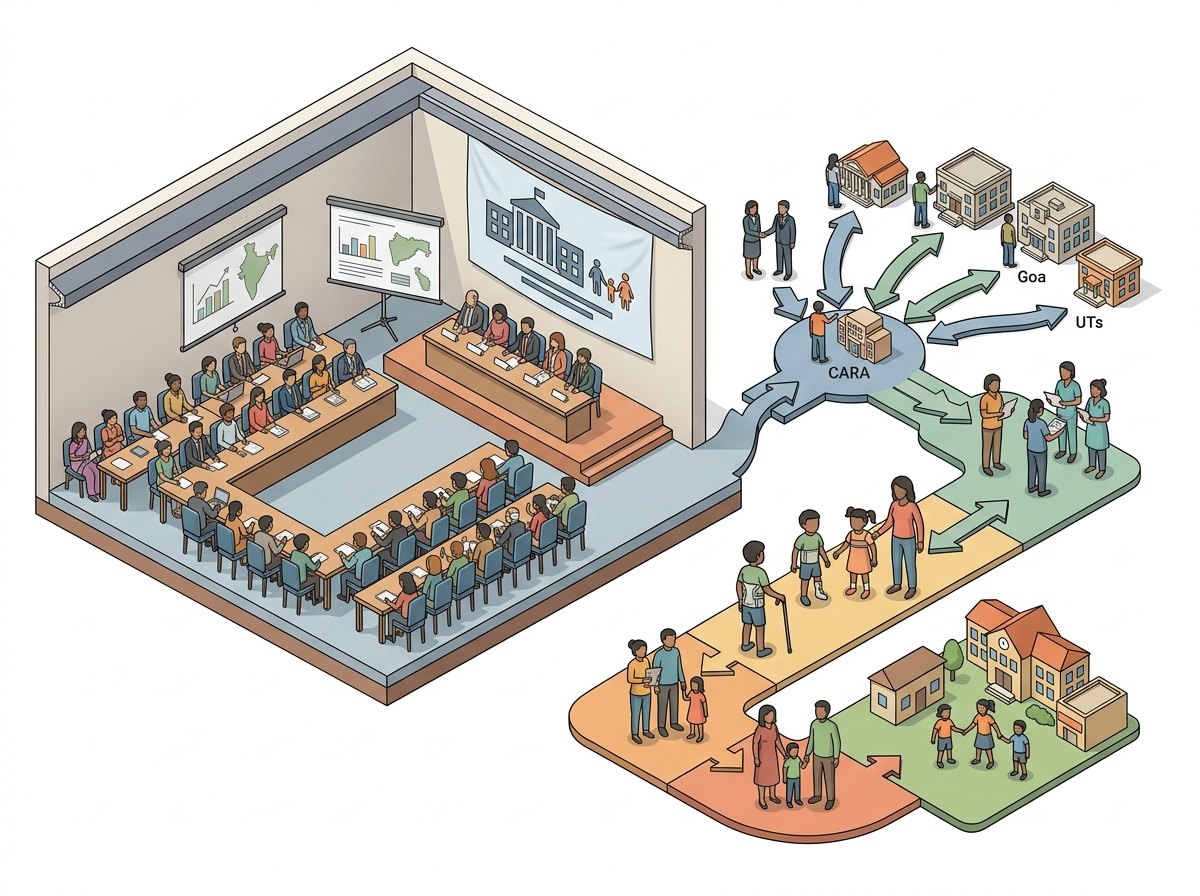
The Central Adoption Resource Authority (CARA), under the Ministry of Women and Child Development, Government of India, organised the fourth Western Zone Consultative Workshop in Pune, Maharashtra on 3 September 2026. The workshop brought together 150 stakeholders from over 74 districts across Maharashtra, Gujarat, Goa, and the Union Territories of Dadra and Nagar Haveli and Daman and Diu to deliberate on strengthening regional cooperation for adoption and rehabilitation of children with special needs. The event underscores CARA’s ongoing commitment to promoting family-based care and non-institutional rehabilitation under the ‘Adoption Awareness Campaign 2025’, aligning with constitutional and statutory provisions for child protection and inclusive development.
Background
- The Juvenile Justice (Care and Protection of Children) Act, 2015 (JJ Act) mandates family-based care as the preferred alternative to institutionalisation for children in need of care and protection, including those with disabilities.
- The Rights of Persons with Disabilities Act, 2016 (RPWD Act) recognises the right of children with disabilities to live with dignity and access inclusive rehabilitation services within family units.
- CARA, established under the JJ Act, functions as the nodal agency for adoption of orphaned, abandoned, and surrendered children, including those with special needs, ensuring compliance with the Hague Adoption Convention.
- State Adoption Resource Agencies (SARAs) and Specialised Adoption Agencies (SAAs) are statutory bodies designated to facilitate adoption processes at the state and district levels.
- The UN Convention on the Rights of the Child (UNCRC) and Sustainable Development Goal 16.2 emphasise the elimination of institutional care for children and the promotion of family environments.
What is the Central Adoption Resource Authority (CARA) and its role in adoption of children with special needs?
- CARA is a statutory body constituted under the Juvenile Justice (Care and Protection of Children) Act, 2015, functioning under the Ministry of Women and Child Development, Government of India.
- It serves as the nodal agency for adoption of orphaned, abandoned, and surrendered children in India, including those with special needs, ensuring adherence to the Hague Adoption Convention.
- The authority monitors and regulates adoption agencies, including Specialised Adoption Agencies (SAAs) and State Adoption Resource Agencies (SARAs), to ensure ethical and child-centric adoption practices.
- CARA promotes family-based care and non-institutional rehabilitation for children with disabilities through awareness campaigns, capacity-building, and stakeholder consultations, such as the Western Zone Consultative Workshop.
- It facilitates inter-state and inter-district coordination to streamline adoption processes and ensure timely placement of children with special needs in permanent family environments.
- CARA collaborates with medical, legal, and social welfare institutions to address challenges in medical evaluation, legal compliance, and post-adoption support for children with disabilities.
- The authority advocates for the rights of children with special needs under the Rights of Persons with Disabilities Act, 2016, ensuring their inclusion in family-based care systems.
Key Features
| Feature | Significance |
|---|---|
| Regional Consultative Workshop (Western Zone) | A platform for inter-state coordination among stakeholders to address adoption and rehabilitation challenges for children with special needs. |
| Family-based Care Promotion | Emphasises deinstitutionalisation and placement of children with disabilities in nurturing family environments for holistic development. |
| Multi-stakeholder Participation | Includes SARAs, SAAs, CCIs, DCPUs, medical professionals, and child protection experts for integrated problem-solving. |
| Awareness Campaign 2025 | Aims to sensitise stakeholders and the public on adoption processes for children with disabilities, reducing institutional dependency. |
| Geographical Coverage | Encompasses Maharashtra, Gujarat, Goa, and Union Territories, addressing regional disparities in adoption infrastructure. |
Why it Matters
Governance & Institutional Framework
- Strengthens the implementation of the Juvenile Justice (Care and Protection of Children) Act, 2015, particularly Section 56-59 on adoption procedures.
- Enhances the role of CARA as the nodal agency under the Ministry of Women and Child Development for monitoring and facilitating adoptions.
- Promotes inter-departmental collaboration between health, legal, and social welfare systems for seamless service delivery.
Social Development & Inclusion
- Advances the rights of children with disabilities under the Rights of Persons with Disabilities Act, 2016, ensuring equitable access to family-based care.
- Reduces institutionalisation, aligning with global best practices for child welfare and deinstitutionalisation policies.
- Fosters societal awareness on inclusive adoption practices, reducing stigma and discrimination.
Policy Implementation & Monitoring
- Provides a feedback mechanism for stakeholders to identify gaps in adoption processes for children with special needs.
- Supports the National Policy for Children, 2013, by ensuring the right to family environment for all children.
- Facilitates data-driven policy adjustments through regional consultations and case studies.
Challenges
1. Medical and Diagnostic Delays
- Prolonged medical assessments for children with disabilities delay the adoption process, affecting their placement in families.
- Lack of standardised protocols for disability assessments in adoption cases leads to inconsistencies.
- Inadequate coordination between medical institutions and adoption agencies exacerbates delays.
UPSC Link: GS-II: Social Justice
2. Legal and Procedural Complexities
- Complexities in the Juvenile Justice Act’s adoption clauses deter prospective adoptive parents, especially for children with disabilities.
- Variations in state-level adoption rules create confusion and hinder seamless inter-state adoptions.
- Lengthy court procedures for consent waivers and guardianship orders prolong institutional stays.
UPSC Link: GS-II: Governance
3. Financial and Logistical Constraints
- High costs associated with medical care, therapy, and post-adoption support deter potential adoptive families.
- Limited funding for specialised adoption agencies (SAAs) and childcare institutions (CCIs) hampers service delivery.
- Transportation and accessibility challenges in rural and remote areas delay family reunification or adoption.
UPSC Link: GS-II: Social Justice
4. Awareness and Stigma
- Low public awareness about the adoption process for children with disabilities perpetuates institutionalisation.
- Societal stigma and misconceptions about disability reduce the pool of prospective adoptive parents.
- Lack of targeted awareness campaigns at the grassroots level limits community engagement.
UPSC Link: GS-II: Social Justice
5. Inter-departmental Coordination Gaps
- Poor coordination between health, legal, and social welfare departments leads to fragmented service delivery.
- Inconsistent data sharing between agencies results in duplication of efforts and inefficiencies.
- Absence of a unified digital platform for tracking adoption cases complicates monitoring and accountability.
UPSC Link: GS-II: Governance
Challenges — UPSC Perspective
| Issue | Concern |
|---|---|
| Medical Delays | Prolonged assessments and lack of standardised protocols delay adoptions. |
| Legal Complexities | Variations in state rules and court procedures deter adoptive parents. |
| Financial Barriers | High costs and limited funding restrict access to support services. |
| Awareness Gaps | Stigma and misinformation reduce adoption rates for children with disabilities. |
| Coordination Failures | Fragmented systems and poor data sharing hinder efficient service delivery. |
Government Initiatives — Must-Memorise for Prelims
- Juvenile Justice (Care and Protection of Children) Act, 2015
- Rights of Persons with Disabilities Act, 2016
Way Forward
- Establish standardised medical assessment protocols for children with disabilities to expedite adoption processes.
- Develop a unified digital platform for real-time tracking of adoption cases across states and agencies.
- Launch targeted awareness campaigns in collaboration with local governments to dispel myths about adopting children with disabilities.
- Strengthen funding mechanisms for SAAs and CCIs to improve post-adoption support and rehabilitation services.
- Conduct periodic regional workshops to assess progress and address emerging challenges in adoption practices.
- Enhance inter-departmental coordination through joint training programs for health, legal, and social welfare officials.
- Promote public-private partnerships to expand financial assistance schemes for prospective adoptive families.
- Incorporate disability-inclusive adoption guidelines into state-level child protection policies.
UPSC Value Addition
Keywords for Mains Answer-Writing
Central Adoption Resource Authority (CARA) · Juvenile Justice (Care and Protection of Children) Act, 2015 · Adoption Regulations, 2017 · Children with Special Needs (CWSN) · Family-based care · Institutional care vs. non-institutional care · District Child Protection Units (DCPU) · State Adoption Resource Agencies (SARA) · Child Protection Committees · UN Convention on the Rights of the Child (UNCRC) · Sustainable Development Goal 16.2 · Inclusive adoption policies
Concept Flow
Identification of children with special needs in institutional care → Medical and legal assessments under JJ Act, 2015 → Coordination between SARAs, SAAs, and DCPUs for adoption eligibility → Public awareness and stigma reduction campaigns → Family-based placement and post-adoption support → Monitoring and feedback through regional consultations
Prelims Practice Questions
Q1. Consider the following statements regarding the Central Adoption Resource Authority (CARA):
1. CARA is a statutory body under the Ministry of Women and Child Development.
2. It functions as the nodal agency for the implementation of the Juvenile Justice (Care and Protection of Children) Act, 2015, in matters related to adoption.
3. CARA is responsible for regulating inter-country adoptions in India.
4. CARA operates under the administrative control of the National Commission for Protection of Child Rights (NCPCR).
How many of the above statements are correct?
- Only one
- Only two
- Only three
- All four
Answer: Only three — Statements 1, 2, and 3 are correct. CARA is indeed a statutory body under the Ministry of Women and Child Development, functions under the Juvenile Justice Act for adoption matters, and regulates inter-country adoptions. Statement 4 is incorrect as CARA does not operate under NCPCR.
Q2. Assertion (A): The Juvenile Justice (Care and Protection of Children) Act, 2015, prioritizes family-based care over institutional care for children in need of protection.
Reason (R): The Act mandates the establishment of Child Care Institutions (CCIs) as the primary mode of care for children with special needs, including those with disabilities.
- Both A and R are true, and R is the correct explanation of A
- Both A and R are true, but R is NOT the correct explanation of A
- A is true, but R is false
- A is false, but R is true
Answer: A is true, but R is false — Assertion (A) is correct as the Act prioritizes family-based care. However, Reason (R) is incorrect because the Act does not mandate CCIs as the primary mode of care; instead, it encourages deinstitutionalization and family-based solutions.
Q3. Match the following pairs related to adoption and child protection in India:
Column I (Institution/Body)
A. Central Adoption Resource Authority (CARA)
B. State Adoption Resource Agency (SARA)
C. District Child Protection Unit (DCPU)
D. Child Care Institution (CCI)
Column II (Function)
1. Implements adoption policies at the district level and coordinates with CCIs
2. Regulates and monitors adoptions, both domestic and inter-country
3. Provides institutional care for children in need of protection
4. Facilitates adoption processes at the state level and acts as a link between CARA and prospective adoptive parents
Select the correct match:
- A-2, B-4, C-1, D-3
- A-1, B-3, C-2, D-4
- A-3, B-2, C-4, D-1
- A-4, B-1, C-3, D-2
Answer: A-2, B-4, C-1, D-3 — The correct matches are: A-2 (CARA regulates adoptions), B-4 (SARA facilitates adoption at the state level), C-1 (DCPU implements policies at the district level), and D-3 (CCI provides institutional care).
Mains Practice Question
✍ The Central Adoption Resource Authority (CARA) has been actively promoting family-based care for children with special needs through regional consultative workshops. Critically examine the legal and institutional framework governing adoption in India, with particular reference to the provisions for children with special needs. Also, discuss the challenges in ensuring their family-based care and suggest measures for improvement. (15 Marks)
Approach: MODEL-ANSWER SKELETON:
1. **Legal Framework**:
– Juvenile Justice (Care and Protection of Children) Act, 2015: Sections 2(14), 41, 42, and 56-60 (adoption provisions).
– Adoption Regulations, 2017: Detailed procedures for domestic and inter-country adoptions.
– CARA’s role as the nodal agency under Section 61 of the JJ Act.
– UN Convention on the Rights of the Child (UNCRC) and SDG 16.2: Right to family environment.
2. **Institutional Framework**:
– CARA: Statutory body under the Ministry of Women and Child Development.
– State Adoption Resource Agencies (SARAs): State-level facilitators.
– District Child Protection Units (DCPUs): Ground-level implementation.
– Child Care Institutions (CCIs): Last resort for institutional care.
3. **Provisions for Children with Special Needs (CWSN)**:
– Section 42 of the JJ Act: Priority for family-based care.
– Adoption Regulations, 2017: Special provisions for CWSN (e.g., reduced eligibility criteria for prospective adoptive parents).
– CARA’s ‘Awareness Campaign 2025’: Focus on deinstitutionalization and family-based care.
4. **Challenges**:
– Stigma and societal attitudes toward CWSN.
– Lack of awareness among stakeholders (e.g., medical professionals, legal authorities).
– Inadequate coordination between DCPUs, SARAs, and CCIs.
– Resource constraints in rural and remote areas.
– Legal and procedural delays in adoption processes.
5. **Measures for Improvement**:
– Strengthening DCPU-SARA-CARA coordination through regional workshops (e.g., the Pune workshop).
– Capacity-building for medical professionals on CWSN adoption.
– Awareness campaigns targeting communities, schools, and healthcare providers.
– Streamlining adoption procedures for CWSN (e.g., faster medical clearances).
– Leveraging technology (e.g., digital adoption platforms) to reduce delays.
6. **Conclusion**:
– Balancing institutional and family-based care while ensuring the best interests of the child.
– Aligning with global standards (UNCRC) and domestic laws (JJ Act).
Source: PIB (Press Information Bureau)
Maharashtra PCS (MPSC) — State PCS Practice
Prelims: As per the recent Western Zone Consultative Workshop organized by CARA in Pune, which of the following is a key objective of strengthening regional cooperation for adoption of children with special needs?
- A. To promote inter-state adoption of children with special needs without proper documentation
- B. To ensure faster and smoother adoption processes for children with special needs through regional collaboration
- C. To reduce the number of children with special needs in institutional care by mandating international adoption
- D. To prioritize adoption of children with special needs by foreign parents over Indian parents
Answer: B. To ensure faster and smoother adoption processes for children with special needs through regional collaboration — The workshop aimed to enhance regional cooperation to streamline adoption processes for children with special needs, ensuring faster and smoother procedures.
Mains: Analyze the significance of regional cooperation in adoption processes for children with special needs, as highlighted in the Western Zone Consultative Workshop organized by CARA in Pune. Discuss the role of state governments, NGOs, and other stakeholders in Maharashtra in ensuring effective implementation of such initiatives. (250 words)
Generated by AanyaAi for educational purpose.

- India-Australia AUSTRAHIND 2026 Exercise: Key Highlights for UPSC & State PCS - October 22, 2026
- एससीओ बैठक में भारत का आतंकवाद विरोध: क्षेत्रीय सहयोग पर जोर - October 22, 2026
- SEC Directs Strict SC Order Compliance for Andhra ULB Polls - October 22, 2026

No Comments