


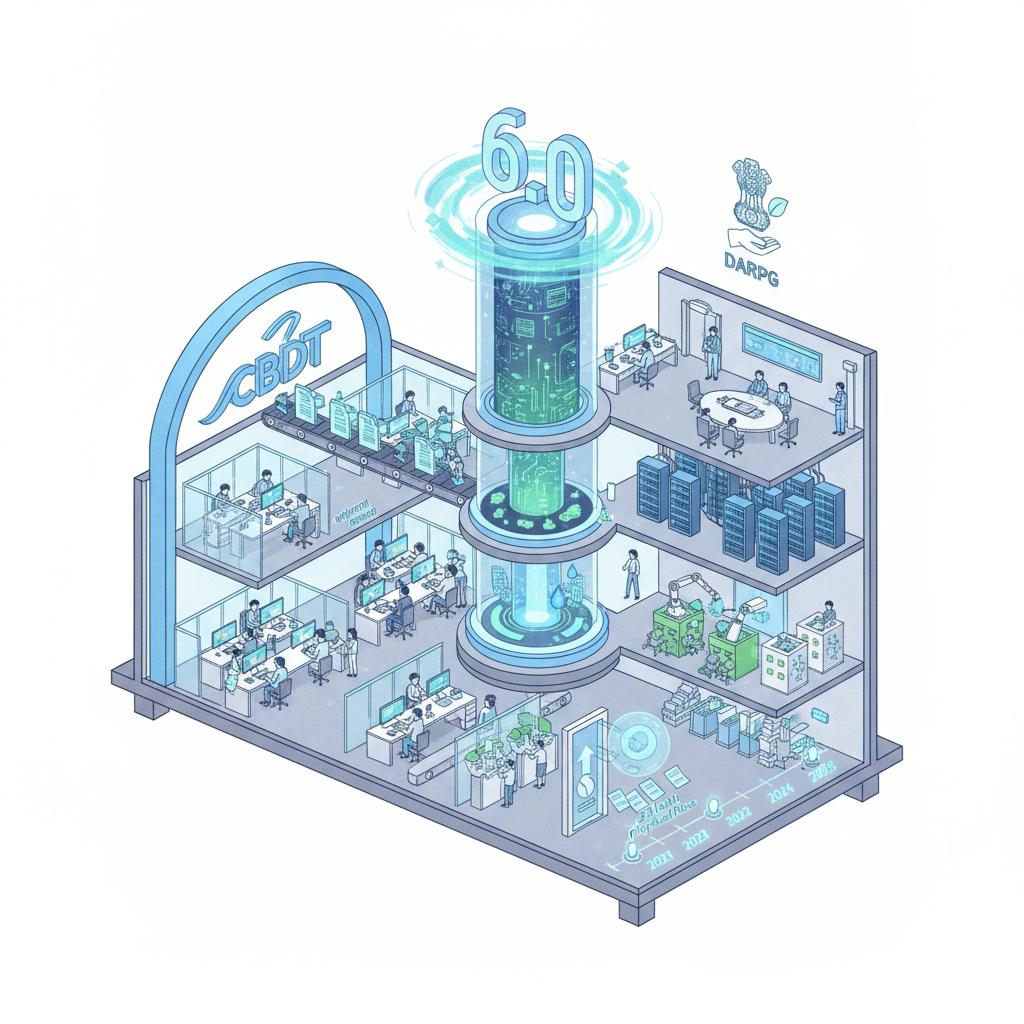
17 Sep CBT and offices to launch Swachhata Abhiyan 6.0 for efficiency & cleanliness
✎ Special Campaign 6.0, led by DARPG, aims to institutionalise cleanliness, efficiency, and citizen-centric governance in government offices from 2 to 31 October 2026, focusing on e-waste disposal, record management, office space…
Subject Relevance — Where This Topic Fits
- GS Paper II — Governance, Transparency and Accountability | GS Paper III — Administrative Reforms and E-Governance
- Prelims: Special Campaign 6.0, CBIT, DARPG, Administrative Reforms, E-waste Management, Citizen Grievance Redressal, Digital Transformation in Government, Sustainable Development Goals (SDGs)
- Essay: Governance and institutional reforms as enablers of public service delivery, The role of technology in transforming administrative efficiency
Quick Revision: Special Campaign 6.0, led by DARPG, aims to institutionalise cleanliness, efficiency, and citizen-centric governance in government offices from 2 to 31 October 2026, focusing on e-waste disposal, record management, office space optimisation, and expeditious grievance redressal.
Why is this in the news?
This initiative, led by the Department of Administrative Reforms and Public Grievances (DARPG), builds on the achievements of Special Campaign 5.0, which demonstrated significant progress in physical and digital file disposal, office space utilisation, e-waste management, and grievance redressal. The campaign aligns with the government’s broader objectives of digital transformation and sustainable development, reinforcing the principles of transparency, accountability, and responsive administration.
Background
- The Department of Administrative Reforms and Public Grievances (DARPG) has been spearheading Special Campaigns since 2021 to promote cleanliness, efficiency, and citizen-centric governance in government offices.
- Special Campaign 5.0 (2025) achieved notable milestones, including disposal of 23 lakh physical files, 10,000+ e-files, and resolution of over 21,000 public grievances, alongside significant office space optimisation and revenue generation from waste disposal.
- The campaigns are part of a larger government-wide effort to align administrative practices with the Sustainable Development Goals (SDGs), particularly SDG 12 (Responsible Consumption and Production) and SDG 16 (Peace, Justice, and Strong Institutions).
- Digitisation and e-governance initiatives, such as the Digital India programme, provide the technological foundation for these campaigns, enabling efficient record management and service delivery.
- Public grievance redressal mechanisms, including the Centralised Public Grievance Redress and Monitoring System (CPGRAMS), are integral to the success of these campaigns, ensuring transparency and accountability in governance.
What is Special Campaign 6.0?
- The campaign will be conducted from 2 to 31 October 2026 and focuses on four key areas: e-waste disposal, record management, optimal utilisation of office space, and office beautification alongside expeditious grievance redressal.
- The campaign aligns with the broader objectives of the Digital India programme and the Sustainable Development Goals (SDGs), particularly SDG 12 and SDG 16, by promoting sustainable practices and efficient governance.
- Special Campaign 6.0 emphasises the institutionalisation of cleanliness and efficiency, ensuring that administrative reforms are embedded in the day-to-day functioning of government offices rather than being ad-hoc measures.
- The campaign also underscores the importance of citizen-centric service delivery, with a focus on reducing pendency, improving transparency, and enhancing the quality of public services.
Key Features
| Feature of Special Campaign 6.0 | Significance for Governance |
|---|---|
| E-waste disposal | Reduces environmental footprint of government offices and aligns with Sustainable Development Goals (SDG 12). |
| Physical and e-file management | Enhances record-keeping efficiency, reduces pendency, and improves transparency in administrative processes. |
| Optimal utilisation of office space | Maximises resource efficiency, reduces operational costs, and supports digital transformation. |
| Office beautification and aesthetic improvement | Creates a conducive work environment, enhances public perception of government offices, and promotes citizen-centric service delivery. |
| Expeditious grievance redressal | Strengthens citizen trust in government mechanisms and ensures compliance with the Right to Information (RTI) Act. |
Why it Matters
Administrative Efficiency
- Reduces pendency of physical and digital files, thereby accelerating decision-making processes in tax administration.
- Enhances transparency through systematic record management and disposal of redundant documents.
- Improves office space utilisation, reducing maintenance costs and enabling better resource allocation.
Environmental Sustainability
- Promotes responsible e-waste management, aligning with India’s commitments under the Basel Convention.
- Encourages paperless governance, reducing deforestation and carbon footprint of government operations.
- Generates revenue through recycling and waste-to-wealth initiatives, as demonstrated in Special Campaign 5.0.
Citizen-Centric Governance
- Strengthens grievance redressal mechanisms, ensuring timely resolution of public complaints under the CPGRAMS framework.
- Enhances public trust in government institutions by institutionalising cleanliness and efficiency.
- Facilitates easier access to records and services, reducing bureaucratic delays for taxpayers.
Digital Transformation
- Accelerates the transition to e-governance by prioritising digital record management and disposal.
- Supports the objectives of the Digital India initiative through systematic digitisation of legacy records.
- Enhances data security and accessibility, reducing risks of loss or tampering of physical documents.
Challenges
1. Data Security and Privacy Risks
- Risk of unauthorised access or leakage of sensitive taxpayer data during digitisation of physical records.
- Need for robust cybersecurity protocols to prevent breaches during e-file disposal.
UPSC Link: GS3: Cyber Security and Data Governance
2. Resistance to Change in Bureaucratic Culture
- Inertia in adopting digital workflows among older officials accustomed to physical file-based systems.
- Requirement for extensive training and capacity-building to ensure smooth transition.
UPSC Link: GS4: Ethical Governance and Probity
3. Logistical and Financial Constraints
- High costs associated with e-waste disposal and office beautification in large-scale government setups.
- Need for inter-departmental coordination to ensure equitable resource allocation.
UPSC Link: GS3: Resource Mobilisation and Public Expenditure
4. Monitoring and Evaluation Gaps
- Ensuring real-time tracking of progress in grievance redressal and file disposal across decentralised offices.
- Risk of superficial compliance without sustained behavioural change among officials.
UPSC Link: GS4: Accountability and Transparency in Governance
5. Public Awareness and Participation
- Limited citizen engagement in reporting grievances or utilising digital platforms for tax-related queries.
- Need for awareness campaigns to educate taxpayers on new digital interfaces and service delivery improvements.
UPSC Link: GS2: Citizen Charter and Service Delivery
Challenges — UPSC Perspective
| Governance Challenge | Potential Impact on Campaign Objectives |
|---|---|
| Inadequate training for officials on digital tools | Delays in adoption of e-governance systems, leading to incomplete digitisation of records. |
| Lack of inter-departmental coordination | Fragmented implementation, resulting in uneven progress across CBTD’s subordinate offices. |
| Insufficient funding for e-waste management | Non-compliance with environmental norms, risking legal penalties under the E-Waste (Management) Rules. |
| Poor public feedback mechanisms | Reduced citizen participation in grievance redressal, undermining the campaign’s transparency goals. |
| Bureaucratic red tape in file disposal | Prolonged pendency of legacy records, negating the efficiency gains targeted by the campaign. |
Way Forward
- Establish a multi-tiered monitoring framework with real-time dashboards to track progress in file disposal, grievance redressal, and e-waste management across all subordinate offices.
- Conduct mandatory training programmes for officials on digital record-keeping, cybersecurity, and e-governance tools to ensure seamless adoption.
- Institute a reward-and-recognition system for offices demonstrating exemplary performance in cleanliness, efficiency, and grievance resolution.
- Strengthen public grievance portals (CPGRAMS) with AI-driven triage to prioritise and resolve complaints within stipulated timelines.
- Collaborate with state pollution control boards to ensure compliant e-waste disposal and recycling, leveraging public-private partnerships where feasible.
- Integrate the campaign’s objectives with the Digital India initiative by mandating the use of e-office platforms for all administrative processes by 2027.
- Publish quarterly transparency reports on file disposal rates, grievance resolution timelines, and environmental impact metrics to foster accountability.
- Launch nationwide awareness campaigns to educate taxpayers on digital tax services and the importance of timely grievance reporting.
UPSC Value Addition
Keywords for Mains Answer-Writing
Special Campaign 6.0 · Central Board of Direct Taxes (CBDT) · Administrative Reforms and Public Grievances Department (DARPG) · Swachh Bharat Mission · E-governance · Digital transformation in taxation · Sustainable Development Goals (SDGs) · Citizen-centric governance · File management in government offices · Public grievance redressal · Office space optimization · E-waste management · Institutionalizing cleanliness · Accountable governance · Transparency in administration
Constitutional & Policy Linkages
- Article 39A (Equal justice and free legal aid) – Ensures equitable access to tax administration services.
- Article 41 (Right to work and public assistance) – Aligns with citizen-centric service delivery in government offices.
- Article 51A(g) (Fundamental duty to protect environment) – Mandates sustainable practices in government operations.
Concept Flow
Government announces Special Campaign 6.0 → CBTD and subordinate offices implement cleanliness and efficiency measures → Digitisation of physical records accelerates → Pendency of files and grievances reduces → Transparency and accountability in tax administration improves → Public trust in government institutions enhances → Sustainable development goals (SDG 12) are advanced → Digital India initiative gains momentum → Long-term institutionalisation of clean governance practices
Prelims Practice Questions
Q1. Consider the following statements regarding Special Campaign 6.0:
1. It is launched by the Central Board of Direct Taxes (CBDT) in collaboration with the Department of Administrative Reforms and Public Grievances (DARPG).
2. The campaign focuses on four key areas: e-waste disposal, record management, space optimization, and grievance redressal.
3. The campaign is scheduled to be conducted from 2 to 31 October 2026.
How many of the above statements are correct?
- Only one
- Only two
- All three
- None
Answer: All three — Statements 1 and 3 are correct. Statement 2 is incorrect as the campaign focuses on four key areas: e-waste disposal, record management, space optimization, and office beautification, not grievance redressal.
Q2. Assertion (A): The Central Board of Direct Taxes (CBDT) has been actively involved in the Swachh Bharat Mission through Special Campaigns.
Reason (R): The CBDT operates under the Ministry of Finance and is responsible for direct tax administration in India.
In the context of the above two statements, which one of the following is correct?
- Both A and R are true, and R is the correct explanation of A.
- Both A and R are true, but R is not the correct explanation of A.
- A is true, but R is false.
- A is false, but R is true.
Answer: A is true, but R is false. — Both A and R are true, but R is not the correct explanation of A. While the CBDT is responsible for direct tax administration (R), its involvement in the Swachh Bharat Mission through Special Campaigns (A) is a separate initiative aimed at institutionalizing cleanliness and efficiency.
Q3. Match the following initiatives with their respective outcomes as reported under Special Campaign 5.0 by the CBDT:
Column I (Initiative) | Column II (Outcome)
—————————————————|—————————————————
A. Swachhata Abhiyan | 1. 167 lakh sq. ft. office space vacated
B. Physical file disposal | 2. 21,251 public grievances resolved
C. E-file disposal | 3. 23 lakh physical files disposed
D. Public grievance redressal | 4. 10,000+ e-files disposed
Select the correct match:
- A-1, B-3, C-4, D-2; A-2, B-4, C-3, D-1; A-3, B-1, C-2, D-4; A-4, B-2, C-1, D-3
- answer_explaination_for_json_only_do_not_use_this_line_keep_it_blank_so_skip_this_line
Answer: A-1, B-3, C-4, D-2; A-2, B-4, C-3, D-1; A-3, B-1, C-2, D-4; A-4, B-2, C-1, D-3 —
Mains Practice Question
✍ Critically examine the significance of Special Campaign 6.0 in institutionalising cleanliness and efficiency in government offices. How does this initiative align with the broader objectives of the Swachh Bharat Mission and the Sustainable Development Goals (SDGs)? (15 Marks)
Approach: MODEL-ANSWER SKELETON:
1. **Introduction (2 Marks)**:
– Define Special Campaign 6.0: A nationwide initiative launched by the Central Board of Direct Taxes (CBDT) in collaboration with DARPG, scheduled for 2–31 October 2026, aimed at institutionalising cleanliness, efficiency, and citizen-centric governance in government offices.
– Contextualise within the Swachh Bharat Mission and SDGs (Goal 6: Clean Water and Sanitation, Goal 11: Sustainable Cities and Communities, Goal 12: Responsible Consumption and Production).
2. **Key Components and Objectives (3 Marks)**:
– **E-waste disposal**: Aligns with SDG 12 (responsible consumption and production) and the E-waste (Management) Rules, 2022.
– **Record management**: Focus on digitisation and disposal of physical/e-files to reduce redundancy and improve transparency (SDG 16: Peace, Justice, and Strong Institutions).
– **Space optimization**: Maximising utilisation of office space to reduce operational costs and carbon footprint (SDG 11 and 13: Climate Action).
– **Office beautification and grievance redressal**: Enhancing citizen experience and trust in public institutions (SDG 16).
3. **Institutionalising Cleanliness and Efficiency (4 Marks)**:
– **Swachh Bharat Mission (SBM) Link**: SBM 2.0 (2020–2025) emphasises cleanliness in public spaces, including government offices. Special Campaign 6.0 operationalises this by mandating cleanliness drives, waste segregation, and disposal of redundant records.
– **Administrative Reforms**: The campaign aligns with the Department of Administrative Reforms and Public Grievances (DARPG) mandate to improve governance efficiency and reduce pendency (e.g., disposal of 23 lakh physical files and 10,000+ e-files in Special Campaign 5.0).
– **Citizen-Centric Governance**: Emphasis on grievance redressal (e.g., resolution of 21,251+ grievances in Special Campaign 5.0) and transparency in service delivery.
4. **Challenges and Critiques (3 Marks)**:
– **Sustainability**: Ensuring long-term compliance beyond the campaign period; risk of relapse into pre-campaign practices.
– **Resource Constraints**: Limited manpower, infrastructure, or training for e-waste management and digitisation in some offices.
– **Data Privacy**: Risks associated with digitisation and disposal of physical records (e.g., compliance with the Right to Information Act, 2005).
5. **Conclusion and Way Forward (3 Marks)**:
– **Conclusion**: Special Campaign 6.0 represents a proactive step towards institutionalising cleanliness and efficiency, aligning with SBM and SDGs. Its success hinges on sustained political will, inter-departmental coordination, and citizen participation.
– **Way Forward**:
– Institutionalise campaign outcomes through Standard Operating Procedures (SOPs) and periodic audits.
– Leverage technology (e.g., AI-driven grievance redressal systems) to enhance efficiency.
– Conduct capacity-building programs for government staff on e-waste management and record digitisation.
– Publicise outcomes to build citizen trust and encourage voluntary participation.
Source: PIB (Press Information Bureau)
Generated by AanyaAi for educational purpose.
Related guides on our sites
- Best PSIR optional coaching for upsc
- Best PSIR optional teacher for upsc
- Best teacher of PSIR optional for upsc
- Best PSIR optional coaching in delhi for UPSC

- UN Debate on AI Governance: Power, Trust & Inclusion for UPSC Aspirants - October 1, 2026
- मोदी सरकार की नीतियों से भारत का क्वांटम इकोसिस्टम हुआ मजबूत: जानिए कैसे! - October 1, 2026
- NCM 2.0 Guidelines: ₹767 Cr Scheme for Coastal States & UTs - October 1, 2026

No Comments