


08 Aug Centre releases ₹2,597 crore to Kerala as additional tax devolution instalment
✎ Tax devolution under Article 270 of the Indian Constitution is a constitutional mechanism for distributing net proceeds of Union taxes to States, with the Finance Commission determining the principles of distribution to ensure…
Subject Relevance — Where This Topic Fits
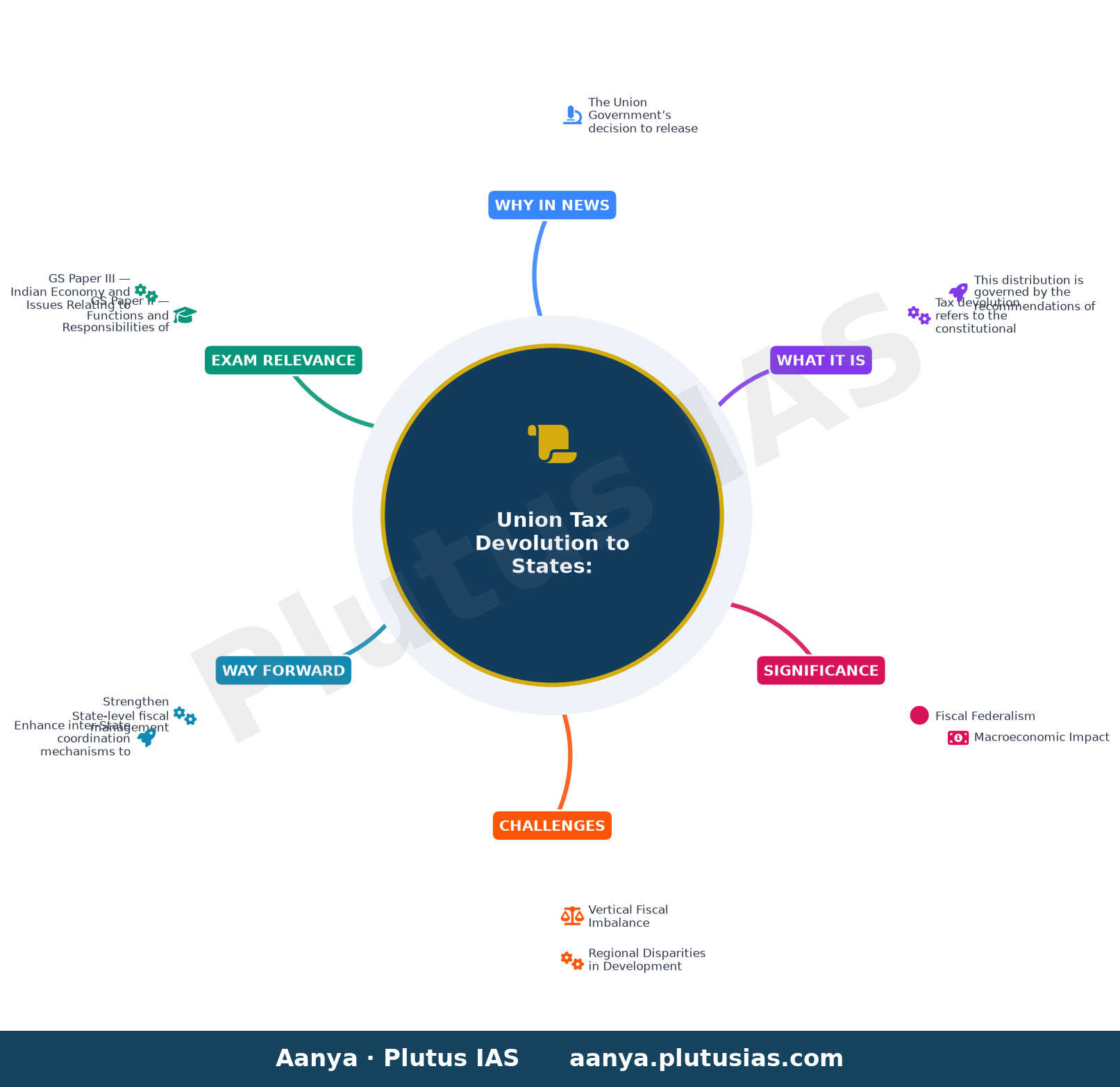
- GS Paper II — Functions and Responsibilities of the Union and the States, Issues and Challenges Pertaining to the Federal Structure, Devolution of Powers and Finances up to Local Levels | GS Paper III — Indian Economy and Issues Relating to Planning, Mobilisation of Resources, Growth, Development and Employment
- Prelims: Article 270 of the Constitution, Finance Commission, Tax Devolution, Gross Tax Revenue, Revenue Deficit Grants, Fiscal Federalism, Capital Expenditure, Net Proceeds of Union Taxes and Duties, State Finances, Union Budget
- Essay: Fiscal Federalism in India: Balancing Autonomy and Accountability, The Role of Finance Commissions in India’s Economic Governance
Quick Revision: Tax devolution under Article 270 of the Indian Constitution is a constitutional mechanism for distributing net proceeds of Union taxes to States, with the Finance Commission determining the principles of distribution to ensure fiscal federalism and inter-state equity.
Why is this in the news?
The Union Government’s decision to release an additional instalment of ₹2,597 crore to Kerala as part of tax devolution, over and above the routine monthly devolution, underscores the Centre’s emphasis on augmenting state-level capital expenditure. This move, aligned with the Centre’s broader fiscal strategy to strengthen state finances, is particularly significant in the context of India’s federal fiscal architecture, where tax devolution constitutes a critical instrument for resource redistribution and developmental financing. The timing of this release, ahead of the routine monthly devolution scheduled for August 10, highlights the Centre’s proactive approach to addressing liquidity constraints in states, especially those facing developmental challenges.
Background
- The Constitution of India, under Article 270, mandates the distribution of net proceeds of Union taxes and duties between the Union and the States, with a fixed percentage (currently 41%) allocated to States as tax devolution.
- The Finance Commission, a constitutional body, determines the principles governing this distribution, including the horizontal devolution formula among states based on criteria such as population, income distance, and area.
- States utilise tax devolution for both revenue expenditure (e.g., salaries, pensions) and capital expenditure (e.g., infrastructure, asset creation), with the latter being critical for long-term economic growth.
- The Union Government’s release of an ‘advance instalment’ of ₹1,09,019 crore to States on August 1, 2026, reflects a strategic shift towards front-loading devolution to address liquidity constraints and stimulate capital spending.
- Kerala, a high-income state with significant developmental needs, often faces challenges in mobilising resources for capital-intensive projects, necessitating timely and adequate fiscal transfers from the Centre.
What is Tax Devolution under the Indian Constitution?
- Tax devolution refers to the constitutional mechanism under Article 270 of the Indian Constitution, whereby a fixed percentage (currently 41%) of the net proceeds of Union taxes and duties is distributed to States.
- This distribution is governed by the recommendations of the Finance Commission, which assesses the fiscal capacity and needs of States to ensure equitable resource allocation.
- The Finance Commission’s terms of reference include assessing the impact of the Union Government’s fiscal policies on the finances of States, including the quantum of tax devolution.
- The Union Government releases tax devolution in multiple instalments throughout the financial year, with routine monthly releases supplemented by additional tranches as required.
- States utilise tax devolution for both revenue and capital expenditure, with capital expenditure being critical for infrastructure development, asset creation, and long-term economic growth.
- The 15th Finance Commission (2020-2025) recommended maintaining the tax devolution ratio at 41%, with additional grants for local bodies and revenue deficit grants for certain States.
- Kerala, despite its high per capita income, receives tax devolution due to its developmental needs, particularly in sectors such as health, education, and infrastructure.
Key Features
| Feature | Significance |
|---|---|
| Additional instalment of tax devolution | Provides Kerala with ₹2,597 crore as an advance release from the net proceeds of Union taxes and duties, enabling accelerated capital expenditure beyond routine monthly devolution. |
| Advance instalment mechanism | Distributes ₹1,09,019 crore across States as an advance from Union tax revenues to front-load developmental and capital spending, aligning with Centre’s fiscal strategy. |
| Routine monthly devolution | Ensures predictable, periodic transfer of 41% of Union tax collections to States, maintaining fiscal stability and budgetary planning consistency. |
| Purpose of capital spending boost | Aims to stimulate State-level infrastructure development, job creation, and economic growth by augmenting liquidity for high-impact projects. |
| Union Finance Ministry oversight | Facilitates transparent, rule-based distribution of tax devolution funds, ensuring adherence to constitutional provisions and fiscal federalism principles. |
Why it Matters
Fiscal Federalism
- Reinforces the constitutional principle of cooperative federalism by ensuring timely and adequate resource transfer to States, particularly Kerala, to address developmental deficits.
- Demonstrates Centre’s commitment to mitigating vertical fiscal imbalances through advance devolution, reducing States’ reliance on debt for capital expenditure.
- Highlights the Centre’s role in macroeconomic stabilisation by front-loading funds to States during periods of subdued private investment or economic slowdown.
Macroeconomic Impact
- Enhances Kerala’s fiscal space for capital projects, potentially boosting GDP growth through multiplier effects in construction, allied industries, and employment generation.
- Supports counter-cyclical fiscal policy by injecting liquidity into the economy, countering deflationary pressures or economic slowdowns.
- Contributes to the Union’s overall fiscal consolidation goals by distributing tax revenues more evenly across States, reducing regional disparities in development.
State Development
- Accelerates implementation of critical infrastructure projects (e.g., roads, bridges, public transport) in Kerala, addressing long-standing bottlenecks in connectivity and urban mobility.
- Facilitates State-led initiatives in sectors such as healthcare, education, and renewable energy, aligning with national priorities like the Sustainable Development Goals.
- Empowers Kerala to address climate resilience and disaster mitigation through targeted capital investments in flood management, coastal protection, and renewable energy.
Institutional Mechanisms
- Illustrates the operationalisation of the Finance Commission’s recommendations on tax devolution, ensuring predictability and fairness in resource allocation.
- Demonstrates the efficacy of the Goods and Services Tax (GST) regime in generating stable tax revenues for equitable distribution to States.
- Showcases the Centre’s use of advance instalments as a tool for fiscal governance, balancing immediate developmental needs with long-term fiscal discipline.
Challenges
1. Vertical Fiscal Imbalance
- Persistent mismatch between the Centre’s revenue-raising capacity and States’ expenditure responsibilities, necessitating frequent advance devolution to bridge gaps.
- Risk of over-reliance on advance instalments, which may distort States’ budgetary planning and lead to fiscal mismanagement if not aligned with revenue receipts.
UPSC Link: https://www.constitutionofindia.net/constitution_of_india/73rd_amendment_act_1992
2. Regional Disparities in Development
- Uneven distribution of tax devolution funds across States, with some regions receiving disproportionately higher allocations due to historical, demographic, or economic factors.
- Potential for Kerala’s capital spending boost to exacerbate inter-State competition for central funds, straining fiscal federalism dynamics.
UPSC Link: https://niti.gov.in/planningcommission.gov.in/docs/reports/genrep/bkpap2023/1_1.pdf
3. Fiscal Discipline and Debt Sustainability
- Risk of States using advance devolution funds for revenue expenditure rather than capital projects, undermining the intended purpose of long-term asset creation.
- Pressure on Kerala’s fiscal deficit targets, particularly if the additional funds are not matched by corresponding increases in State revenue or expenditure rationalisation.
UPSC Link: https://finmin.nic.in/sites/default/files/2023-07/Fiscal%20Responsibility%20and%20Budget%20Management%20Act%2C%202003.pdf
4. Implementation Bottlenecks
- Delays in project execution due to bureaucratic hurdles, land acquisition challenges, or environmental clearances, limiting the impact of capital spending.
- Lack of capacity in State agencies to absorb and utilise additional funds efficiently, leading to underutilisation or suboptimal outcomes.
UPSC Link: https://dopt.gov.in/sites/default/files/Capacity_Building.pdf
Challenges — UPSC Perspective
| Issue | Concern |
|---|---|
| Vertical Fiscal Imbalance | Persistent mismatch between Centre’s revenue and States’ expenditure responsibilities, requiring advance devolution to bridge gaps. |
| Regional Disparities | Uneven allocation of funds may exacerbate inter-State competition and neglect of less-developed regions. |
| Fiscal Discipline | Risk of States diverting funds to revenue expenditure, undermining capital asset creation and debt sustainability. |
| Implementation Gaps | Bureaucratic delays, land acquisition issues, and capacity constraints may limit the efficacy of capital spending. |
| Macroeconomic Stability | Over-reliance on advance instalments could distort fiscal planning and exacerbate inflationary pressures if not managed prudently. |
Way Forward
- Strengthen State-level fiscal management frameworks to ensure advance devolution funds are earmarked exclusively for capital expenditure, with robust monitoring mechanisms.
- Enhance inter-State coordination mechanisms to address regional disparities and promote equitable development, including through the Finance Commission’s recommendations.
- Accelerate bureaucratic reforms in Kerala to streamline project approvals, land acquisition, and environmental clearances, reducing implementation bottlenecks.
- Conduct periodic reviews of the advance devolution mechanism to assess its impact on fiscal federalism, macroeconomic stability, and State development outcomes.
- Promote public-private partnerships (PPPs) in Kerala’s infrastructure sector to leverage additional funds for high-impact projects with sustainable revenue models.
- Integrate climate resilience and disaster mitigation into Kerala’s capital spending plans, aligning with national priorities like the National Disaster Management Plan.
- Enhance transparency in fund utilisation through real-time tracking systems and public disclosures, fostering accountability and citizen engagement.
UPSC Value Addition
Keywords for Mains Answer-Writing
Tax Devolution to States · Finance Commission · Article 270 of the Constitution · Union-State Financial Relations · Capital Expenditure by States · Net Proceeds of Union Taxes and Duties · Devolution Criteria · Fiscal Federalism in India · Kerala’s Fiscal Position · Article 280 of the Constitution · 15th Finance Commission · Gross Tax Revenue of the Union
Constitutional & Policy Linkages
- {‘Article 270’: ‘Taxes and duties shared between Centre and States under Article 270.’}
- {‘Article 275’: ‘Grants-in-aid to States under Article 275 for developmental expenditure.’}
- {‘Article 280’: ‘Finance Commission’s role in determining tax devolution and grants.’}
Concept Flow
Union tax collection → Net proceeds of Union taxes and duties → Advance instalment mechanism (₹1,09,019 crore) → Additional ₹2,597 crore to Kerala → Capital expenditure boost → Infrastructure development → Economic growth and job creation → Enhanced fiscal federalism.
Prelims Practice Questions
Q1. Consider the following statements regarding the tax devolution mechanism in India:
1. The Finance Commission determines the principles governing the distribution of net proceeds of Union taxes and duties among States.
2. The current devolution formula allocates 41% of the gross tax revenue of the Union to States.
3. The Union government can release additional instalments of tax devolution to States to boost capital expenditure.
How many of the above statements are correct?
- Only one
- Only two
- All three
- None
Answer: All three — Statements 1 and 3 are correct. Statement 2 is incorrect as the 41% devolution figure refers to the share of net proceeds of Union taxes and duties, not gross tax revenue. The Finance Commission (under Article 280) determines the devolution formula.
Q2. Assertion (A): The Union government released ₹2,597 crore to Kerala as an additional instalment of tax devolution to boost capital spending.
Reason (R): The Constitution of India mandates that the Union government must release tax devolution to States in a single lump-sum payment annually.
Options:
A. Both A and R are true, and R is the correct explanation of A.
B. Both A and R are true, but R is not the correct explanation of A.
C. A is true, but R is false.
D. A is false, but R is true.
Answer: ? — Assertion (A) is true as reported. Reason (R) is false because the Constitution does not mandate a single lump-sum payment; devolution is released in multiple instalments as per the Finance Commission’s recommendations.
Q3. Match the following columns regarding the Finance Commission and tax devolution:
Column I (Provision/Article) | Column II (Description)
1. Article 270 | a. Establishment of Finance Commission
2. Article 280 | b. Distribution of net proceeds of Union taxes and duties
3. 15th Finance Commission | c. Recommendations on grants-in-aid to States
4. Article 275 | d. Tax devolution criteria and principles
Options:
A. 1-b, 2-a, 3-d, 4-c
B. 1-a, 2-b, 3-c, 4-d
C. 1-d, 2-a, 3-b, 4-c
D. 1-b, 2-d, 3-a, 4-c
- A
- B
- C
- D
Answer: A — Correct matches: 1-b (Article 270 deals with distribution of net proceeds), 2-a (Article 280 establishes the Finance Commission), 3-d (15th FC recommends tax devolution criteria), 4-c (Article 275 deals with grants-in-aid).
Mains Practice Question
✍ The Union government’s decision to release an additional instalment of ₹2,597 crore to Kerala as part of tax devolution underscores the evolving dynamics of fiscal federalism in India. Critically examine the constitutional and institutional framework governing tax devolution to States, with particular reference to the role of the Finance Commission and the principles of fiscal federalism. Also, analyse the implications of such additional instalments for State-level capital expenditure and macroeconomic stability. (15 Marks)
Approach: MODEL-ANSWER SKELETON:
1. Constitutional Basis (2 marks):
– Article 270: Distribution of net proceeds of Union taxes and duties.
– Article 280: Establishment and functions of the Finance Commission (FC).
– 15th Finance Commission (2021-26) recommendations: 41% devolution.
2. Principles of Fiscal Federalism (3 marks):
– Vertical imbalance: Union collects more than States need.
– Horizontal imbalance: Equalisation principle (need-based devolution).
– Criteria: Population, area, fiscal capacity, forest cover, demographic change.
– Recent debates: Need for revisiting criteria (e.g., inclusion of demographic dividend).
3. Role of Finance Commission (3 marks):
– Advisory body under Article 280; recommendations are not binding but accepted.
– Determines devolution formula and grants-in-aid (Article 275).
– Recent FCs: 14th FC (2015-20) introduced performance-based incentives; 15th FC (2021-26) retained 41% but adjusted criteria.
4. Additional Instalments and Capital Expenditure (4 marks):
– Purpose: Boost State capital expenditure (e.g., infrastructure, health, education).
– Mechanism: Advance instalments from net proceeds (as in the Kerala case).
– Implications:
– Short-term: Addresses liquidity constraints for States.
– Long-term: Risk of fiscal profligacy if not tied to performance.
– Macroeconomic stability: May lead to inflation if unproductive spending rises.
5. Challenges and Criticisms (3 marks):
– Lack of autonomy for States in determining expenditure priorities.
– Over-reliance on Union transfers vs. own tax revenue (e.g., GST compensation).
– Political economy: Centre may use additional instalments for electoral gains.
– Need for institutional safeguards (e.g., independent fiscal council).
Balance of Views:
– Proponents: Additional instalments are necessary to address developmental gaps.
– Critics: May erode fiscal discipline and distort federal balance.
Source: The Hindu
Generated by AanyaAi for educational purpose.

- तमिलनाडु के लिए क्या है ‘एल नीनो’ और उत्तर-पूर्वी मानसून का खतरा? - September 23, 2026
- El Nino & Northeast Monsoon: Impact on Tamil Nadu for UPSC 2026 - September 23, 2026
- हिमाचल में डिजिटल भुगतान क्रांति: बिलासपुर अव्वल, महिलाओं की भागीदारी 93% तक पहुंची - September 23, 2026

No Comments