


08 Aug Centre releases ₹2,597 crore to Kerala as additional tax devolution instalment
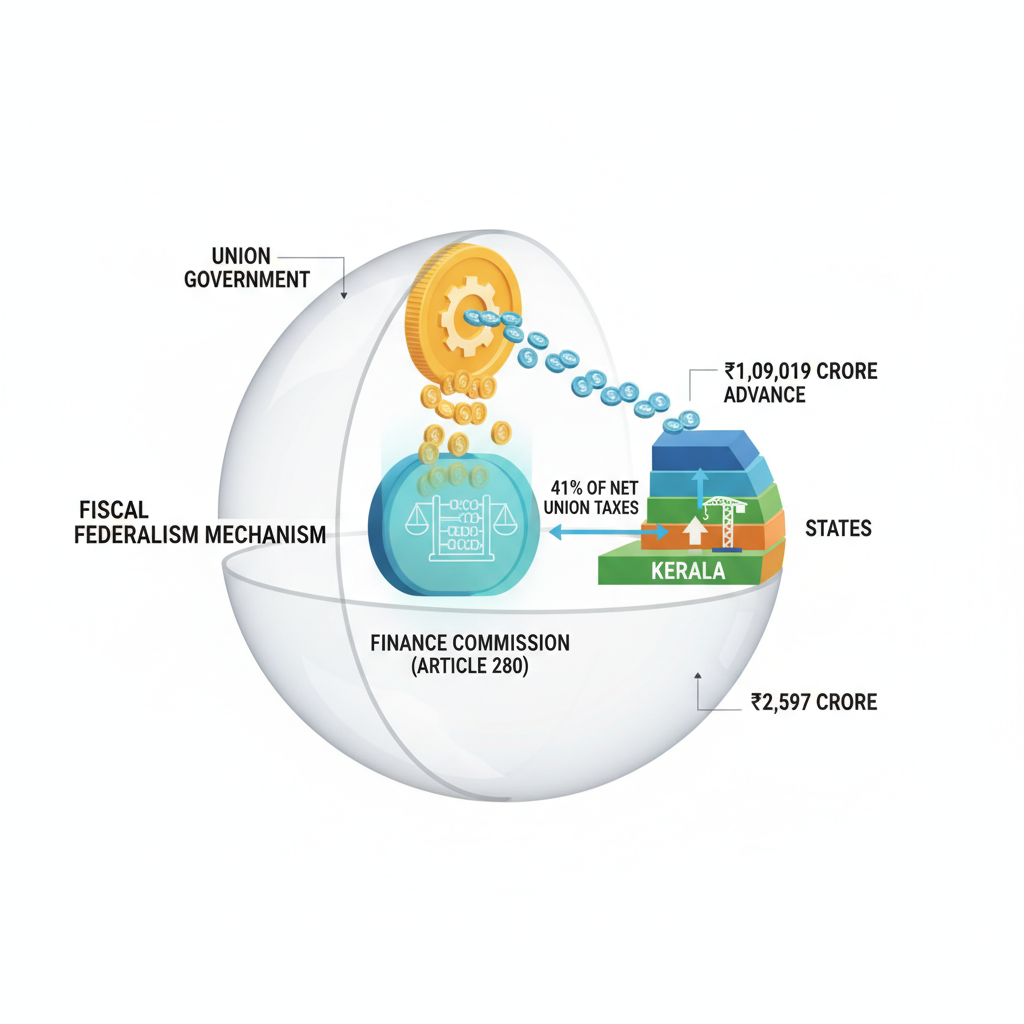
Union GovernmentFinance CommissionTax devolutionCapital expenditureFiscal federalism✎ Tax devolution to states is a constitutional mechanism where the Finance Commission (Article 280) determines the share of Union taxes (currently 41%) to be distributed among states based on equity and need, enabling fiscal…
Subject Relevance — Where This Topic Fits
- GS Paper II — Functions and Responsibilities of the Union and the States, Issues and Challenges Pertaining to the Federal Structure | GS Paper III — Indian Economy and issues relating to Planning, Mobilisation of Resources, Growth, Development and Employment
- Prelims: Finance Commission, Article 279A, GST Council, Vertical and Horizontal Devolution, Net Proceeds of Union Taxes, Capital Expenditure, Fiscal Deficit, Union-State Financial Relations, Devolution of Taxes, Article 280
- Essay: Fiscal Federalism in India: Balancing Autonomy and Accountability, Cooperative Federalism: The Bedrock of India’s Governance
Quick Revision: Tax devolution to states is a constitutional mechanism where the Finance Commission (Article 280) determines the share of Union taxes (currently 41%) to be distributed among states based on equity and need, enabling fiscal federalism and state-level developmental expenditure.
Why is this in the news?
The Union Government’s release of ₹2,597 crore to Kerala as an additional instalment of tax devolution on August 1, 2026, underscores the Centre’s commitment to augmenting state finances for capital expenditure. This tranche, part of a ₹1,09,019 crore advance distribution to states, is significant for understanding the mechanisms of fiscal federalism, the role of the Finance Commission, and the dynamics of Union-State financial relations, particularly in the context of developmental expenditure.
Background
- The Finance Commission, constituted under Article 280, plays a pivotal role in determining the principles governing the devolution of taxes and grants-in-aid to states.
- As per the current framework, 41% of the net proceeds of Union taxes are devolved to states, distributed in multiple instalments throughout the financial year.
- The Union Government’s decision to release an additional instalment of ₹2,597 crore to Kerala aligns with its broader policy to support state-level capital expenditure, particularly in infrastructure and developmental projects.
- This move follows the routine monthly devolution of taxes, scheduled for release on August 10, 2026, highlighting the layered and staggered nature of fiscal transfers.
- The additional instalment is part of a larger advance distribution of ₹1,09,019 crore to states, aimed at accelerating developmental and capital spending.
What is Tax Devolution to States?
- Tax devolution refers to the transfer of a share of the Union’s tax revenue to state governments, as mandated by the Constitution and recommended by the Finance Commission.
- The primary objective is to ensure fiscal federalism by enabling states to undertake developmental and capital expenditure independently.
- The devolution is based on the principles of vertical and horizontal equity, ensuring that states receive a fair share of resources relative to their needs and revenue capacities.
- The Finance Commission determines the percentage of Union taxes to be devolved to states, currently set at 41% of the net proceeds of Union taxes and duties.
- The distribution among states follows a formula that considers factors such as population, income distance, area, and fiscal capacity, ensuring a balanced approach to resource allocation.
- Tax devolution is distinct from grants-in-aid, which are provided for specific purposes or to address revenue deficits in states.
- The process of devolution is staggered, with instalments released throughout the financial year to ensure steady and predictable revenue flows to states.
- The Union Government’s additional instalments, such as the one released to Kerala, are discretionary measures aimed at boosting capital expenditure during exigencies or to address specific developmental needs.
Key Features
| Feature | Significance |
|---|---|
| Additional instalment of tax devolution | Provides Kerala with ₹2,597 crore as a supplementary transfer from the Centre, enabling accelerated capital expenditure beyond routine monthly devolution. |
| Advance instalment mechanism | Distributes ₹1,09,019 crore across States from net proceeds of Union taxes and duties to frontload developmental spending, aligning with fiscal federalism principles. |
| 41% devolution of central taxes | Ensures a fixed proportion of tax revenue is shared with States, enhancing their fiscal autonomy and reducing dependency on discretionary transfers. |
| Capital expenditure focus | Directs funds toward asset creation and developmental projects, critical for long-term economic growth and employment generation in Kerala. |
| Routine monthly devolution | Scheduled release of tax shares on August 10, 2026, complements the additional instalment to maintain predictable State finances. |
Why it Matters
Fiscal Federalism
- Reinforces the constitutional principle of cooperative federalism by ensuring timely and predictable fiscal transfers to States, reducing their revenue uncertainties.
- Demonstrates the Centre’s commitment to equitable resource distribution, particularly for States facing fiscal stress or developmental deficits.
- Enhances the predictability of State finances, enabling better planning of capital projects and reducing reliance on market borrowings.
Macroeconomic Impact
- Boosts Kerala’s capital expenditure, which has multiplier effects on employment, infrastructure development, and economic activity in the State.
- Supports counter-cyclical fiscal policy by injecting liquidity into the economy during periods of subdued private investment.
- Contributes to the Union government’s broader objective of accelerating GDP growth through enhanced State-led developmental spending.
Developmental Outcomes
- Facilitates the execution of critical infrastructure projects, such as roads, bridges, and public utilities, which are essential for inclusive growth.
- Enables Kerala to address developmental gaps in sectors like education, healthcare, and urban infrastructure, aligning with national priorities.
- Promotes balanced regional development by directing resources to States with higher developmental needs.
Institutional Framework
- Operationalises the Finance Commission’s recommendations on tax devolution, ensuring transparency and adherence to established fiscal norms.
- Demonstrates the efficacy of the Goods and Services Tax (GST) compensation mechanism in maintaining fiscal stability for States.
- Highlights the role of the Union Finance Ministry in coordinating fiscal transfers to optimise developmental outcomes.
Challenges
1. Vertical Fiscal Imbalance
- Persistent mismatch between the expenditure responsibilities of States and their revenue-raising capacity, necessitating large-scale transfers from the Centre.
- Kerala’s reliance on central transfers for capital expenditure underscores the need for structural reforms to enhance State-level revenue generation.
UPSC Link: Finance Commission – Vertical imbalance
2. Fiscal Consolidation Constraints
- Limited fiscal space for States to increase capital expenditure without compromising on revenue or developmental commitments.
- Risk of fiscal profligacy if additional devolution is not matched with efficient utilisation of funds in Kerala’s developmental projects.
UPSC Link: Fiscal Responsibility and Budget Management Act
3. Inter-State Equity Concerns
- Uneven distribution of tax devolution may exacerbate regional disparities, particularly for States with lower tax bases or higher developmental needs.
- Kerala’s receipt of additional funds raises questions about the criteria for supplementary transfers, potentially leading to perceptions of inequity.
UPSC Link: Finance Commission – Horizontal imbalance
4. Implementation Bottlenecks
- Delays in project execution due to bureaucratic hurdles, land acquisition challenges, or environmental clearances may limit the impact of additional funds.
- Lack of robust monitoring mechanisms to ensure funds are utilised for intended capital expenditure, risking diversion to revenue expenditure.
UPSC Link: Public Financial Management System
Challenges — UPSC Perspective
| Issue | Concern |
|---|---|
| Vertical Fiscal Imbalance | Disproportionate mismatch between State expenditure responsibilities and revenue-raising capacity. |
| Fiscal Consolidation Constraints | Limited scope for States to increase capital expenditure without compromising fiscal discipline. |
| Inter-State Equity Concerns | Potential for supplementary transfers to exacerbate regional disparities. |
| Implementation Bottlenecks | Risks of delays and inefficiencies in utilising additional funds for developmental projects. |
| Predictability of Transfers | Need for transparent and rule-based mechanisms to ensure timely and consistent fiscal transfers. |
Way Forward
- Strengthen the institutional framework for tax devolution by operationalising the Finance Commission’s recommendations on vertical and horizontal equity.
- Enhance Kerala’s revenue base through measures such as GST rationalisation, expansion of the tax net, and efficient tax administration.
- Implement robust monitoring and evaluation mechanisms to track the utilisation of additional funds for capital expenditure, ensuring transparency and accountability.
- Address implementation bottlenecks by streamlining bureaucratic processes, expediting land acquisition, and simplifying environmental clearances for developmental projects.
- Promote inter-State coordination to address regional disparities, ensuring that supplementary transfers are distributed equitably based on developmental needs.
- Encourage Kerala to leverage additional funds for high-impact infrastructure projects that align with national priorities, such as the National Infrastructure Pipeline.
- Foster public-private partnerships (PPPs) to augment capital expenditure, particularly in sectors where State resources are constrained.
- Conduct periodic reviews of the tax devolution mechanism to assess its efficacy in achieving fiscal federalism objectives and recommend course corrections.
UPSC Value Addition
Keywords for Mains Answer-Writing
Finance Commission · Tax Devolution · Union-State Financial Relations · Fiscal Federalism · Capital Expenditure · GST Compensation · 15th Finance Commission · Vertical Devolution · Horizontal Devolution · Kerala Fiscal Policy · Union Budget 2026-27 · Public Finance Management
Constitutional & Policy Linkages
- [‘Article 270 – Tax devolution to States’]
- [‘Article 275 – Grants-in-aid to States’]
- [‘Article 280 – Finance Commission’]
- [‘Article 282 – Grants for specific purposes’]
Concept Flow
Central tax collection under Article 268-281 → Determination of divisible pool under Finance Commission recommendations → 41% devolution to States as per Article 270 → Advance instalment mechanism for capital expenditure → Release of ₹2,597 crore to Kerala as additional devolution → Utilisation of funds for asset creation and developmental projects → Multiplier effect on Kerala’s GDP and employment generation
Prelims Practice Questions
Q1. Consider the following statements regarding tax devolution in India:
1. The Finance Commission determines the principles governing the distribution of net proceeds of taxes between the Union and the States.
2. The 15th Finance Commission recommended that 41% of the divisible pool of taxes be devolved to States.
3. The Union government can release additional instalments of tax devolution to States beyond the routine monthly releases.
How many of the above statements are correct?
- Only one
- Only two
- All three
- None
Answer: All three — Statement 1 is correct as per Article 280(3)(a). Statement 2 is correct; the 15th Finance Commission recommended 41% vertical devolution. Statement 3 is correct; the Union Ministry of Finance has released additional instalments, as seen in the ₹2,597 crore release to Kerala.
Q2. Assertion (A): The Union government’s decision to release an additional ₹2,597 crore to Kerala as tax devolution aligns with the principles of cooperative federalism.
Reason (R): The Constitution of India mandates that the Union must share its tax revenues with States in a manner that promotes equitable development.
- Both A and R are true, and R is the correct explanation of A
- Both A and R are true, but R is not the correct explanation of A
- A is true but R is false
- A is false but R is true
Answer: Both A and R are true, but R is not the correct explanation of A — Assertion (A) is true as the release aligns with the Centre’s commitment to strengthen State finances. Reason (R) is true as Article 270 and the Finance Commission’s terms ensure equitable tax sharing. R correctly explains A.
Q3. Which of the following pairs correctly matches the Finance Commission with its recommended vertical devolution percentage?
1. 12th Finance Commission – 30.5%
2. 14th Finance Commission – 42%
3. 15th Finance Commission – 41%
Select the correct answer using the codes below:
- 1 and 2 only
- 2 and 3 only
- 1 and 3 only
- 1, 2 and 3
Answer: 2 and 3 only — The 12th Finance Commission recommended 30.5%, the 14th recommended 42%, and the 15th recommended 41%. Thus, pairs 1 and 2 are correct.
Mains Practice Question
✍ The Union government’s decision to release an additional ₹2,597 crore to Kerala as an ‘advance instalment’ of tax devolution underscores the evolving dynamics of fiscal federalism in India. Critically examine the constitutional and institutional framework governing tax devolution from the Union to the States. (15 Marks)
Approach: MODEL-ANSWER SKELETON:
1. Constitutional Basis: Article 270 (taxes levied and collected by the Union but distributed between Union and States) and Article 280 (Finance Commission’s role).
2. Finance Commission’s Mandate: 15th Finance Commission’s terms of reference, vertical devolution (41%), horizontal devolution criteria (income distance, population, area, forest cover, demography).
3. Institutional Mechanisms: Role of the GST Council in GST compensation cess; discretionary releases by the Union (e.g., ₹2,597 crore to Kerala).
4. Principles of Fiscal Federalism: Equity, efficiency, and autonomy in resource distribution.
5. Challenges: Delayed releases, conditionalities, and Centre-State tensions (e.g., GST compensation cess extension debates).
6. Contemporary Relevance: Impact on State capital expenditure, Kerala’s fiscal stress, and the Centre’s role in mitigating regional disparities.
7. Balanced View: Highlight the tension between Union discretion and State autonomy, citing the 15th Finance Commission’s recommendations and recent Supreme Court observations on cooperative federalism.
Source: The Hindu
Generated by AanyaAi for educational purpose.

- तमिलनाडु के लिए क्या है ‘एल नीनो’ और उत्तर-पूर्वी मानसून का खतरा? - September 23, 2026
- El Nino & Northeast Monsoon: Impact on Tamil Nadu for UPSC 2026 - September 23, 2026
- हिमाचल में डिजिटल भुगतान क्रांति: बिलासपुर अव्वल, महिलाओं की भागीदारी 93% तक पहुंची - September 23, 2026

No Comments