


25 Sep Centre Requests 2-Year Extension for OBC Creamy Layer Implementation
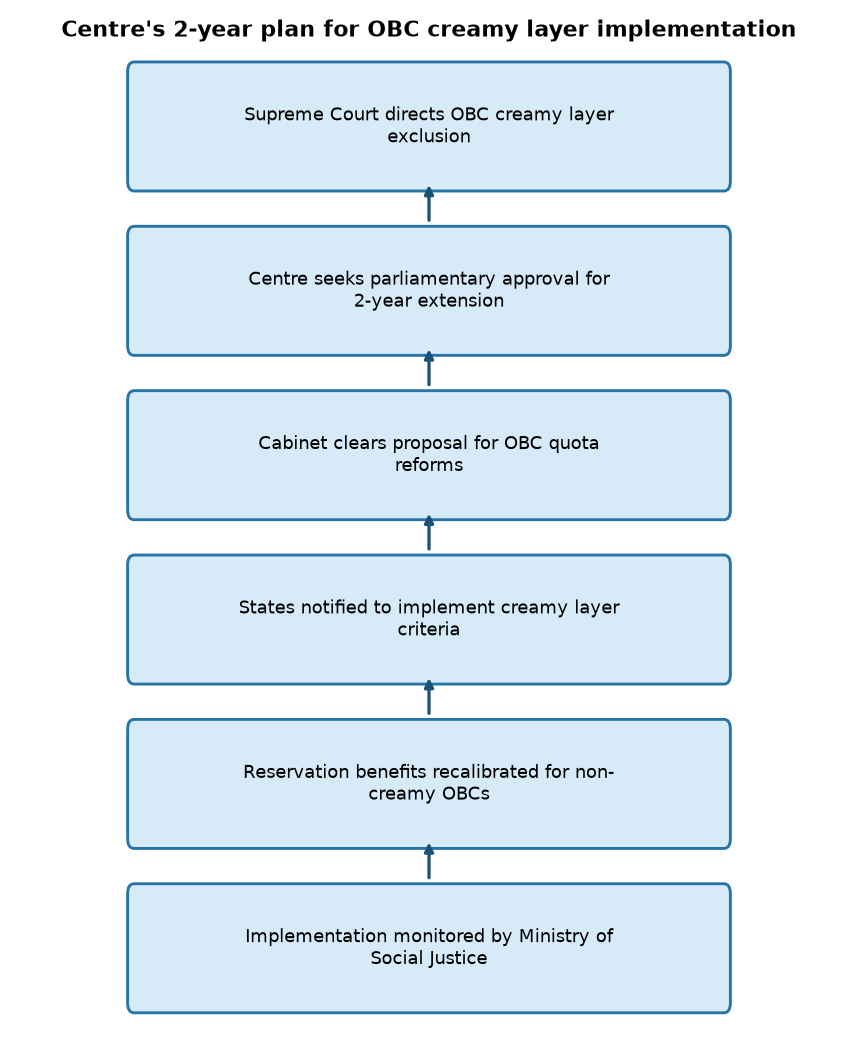
✎ OBC creamy layer exclusion ensures fair reservation benefits by excluding high-income OBCs from quotas.
Relevance for UPSC & State PCS: Polity
The Centre has sought a two-year window from the Supreme Court to implement the top court’s verdict on the creamy layer criterion for Other Backward Classes (OBC) in local body elections, as reported by NDTV. The Union government, in its affidavit, highlighted the need for adequate time to frame rules, conduct surveys, and ensure smooth implementation across states. This request underscores the administrative and logistical challenges in defining and identifying the creamy layer within OBC categories, a process already delayed by political sensitivities and varying state-level interpretations. The Supreme Court, in its 2021 judgment in *Vikas Kishanrao Gawali v. State of Maharashtra*, had directed states to exclude the creamy layer from OBC reservations in local body polls, aiming to ensure equitable representation. The Centre’s plea for an extended timeline reflects the complexity of harmonizing judicial directives with ground realities, particularly in a federal structure where states play a pivotal role in OBC categorization.
For UPSC and State PCS aspirants, this issue is critical as it intersects constitutional provisions (Article 16(4), 340), judicial activism, and federalism. The creamy layer principle, initially applied to central services, was extended to OBC reservations in 1992 (*Indra Sawhney v. Union of India*) to prevent elite capture within backward classes. The Centre’s request for a two-year window highlights the tension between judicial timelines and executive feasibility, a recurring theme in governance studies. Aspirants must analyze how judicial verdicts shape policy implementation, especially in quota systems, and the role of the Union government in mediating between judicial directives and state autonomy. The case also raises questions about the effectiveness of constitutional bodies like the National Commission for Backward Classes (NCBC) in addressing such disputes.
The political economy of OBC reservations further complicates the scenario, as parties often tread cautiously to avoid alienating dominant OBC groups. The Centre’s affidavit suggests that a rushed implementation could lead to legal challenges or administrative bottlenecks, given the lack of a standardized national database for OBC creamy layer demarcation. For State PCS aspirants, understanding state-specific OBC reservation policies—such as Maharashtra’s *Maratha quota* case or Tamil Nadu’s *99% reservation* debate—is essential, as these often become test cases for judicial intervention. The Supreme Court’s strict stance on creamy layer inclusion in local body elections (as seen in the *Gawali* case) also signals a shift toward judicial oversight in quota politics, making it imperative for aspirants to study the interplay between constitutional morality and electoral democracy.
This development is relevant for UPSC’s Prelims and Mains (GS-II: Governance, Polity, and Social Justice) as it tests knowledge of constitutional amendments (102nd CAA), judicial review, and the doctrine of proportionality. For State PCS,
Source: ndtv.com
Practice Questions
Q1. What is the primary reason cited by the Centre for seeking a 2-year window to implement the Supreme Court’s OBC creamy layer verdict?
- To allow state governments sufficient time to conduct fresh OBC surveys and update their lists
- To ensure smooth implementation of the 10% EWS quota for economically weaker sections
- To align the implementation with the upcoming general elections and avoid political backlash
- To provide time for judicial review and potential modifications to the verdict
Answer
To allow state governments sufficient time to conduct fresh OBC surveys and update their lists — The Centre has requested a 2-year window primarily to allow state governments to conduct fresh surveys and update their OBC lists in compliance with the Supreme Court’s verdict on the creamy layer criteria.
Q2. Which constitutional provision or directive principle is the Centre likely relying on to justify the 2-year window for implementing the OBC creamy layer verdict?
- Article 15(4) of the Constitution, which empowers the state to make special provisions for the advancement of socially and educationally backward classes
- Article 340 of the Constitution, which empowers the President to appoint a Commission to investigate the conditions of backward classes
- The Directive Principle of State Policy under Article 46, which promotes the educational and economic interests of weaker sections
- Article 335 of the Constitution, which balances claims of Scheduled Castes and Scheduled Tribes with the maintenance of efficiency in services
Answer
Article 340 of the Constitution, which empowers the President to appoint a Commission to investigate the conditions of backward classes — Article 340 empowers the President to appoint a Commission to investigate the conditions of backward classes, and the Centre may be using this provision to justify the need for a time-bound process to update OBC lists.
Generated by AanyaAi for educational purpose.
Related guides on our sites
- Best PSIR optional coaching for upsc
- Best PSIR optional teacher for upsc
- Best teacher of PSIR optional for upsc
- Best PSIR optional coaching in delhi for UPSC

- PM Modi Praises Youth-Led Nasha Mukt Yuva Abhiyan Momentum - September 27, 2026
- राजनाथ सिंह का बड़ा बयान: भारत किसी की ज़मीन कब्ज़ा नहीं करेगा, लेकिन सुरक्षा पर होगा कठोर - September 27, 2026
- Exercise Tarang Shakti 2026: India’s Mega Multi-Nation Air Power Showcase - September 27, 2026

No Comments