


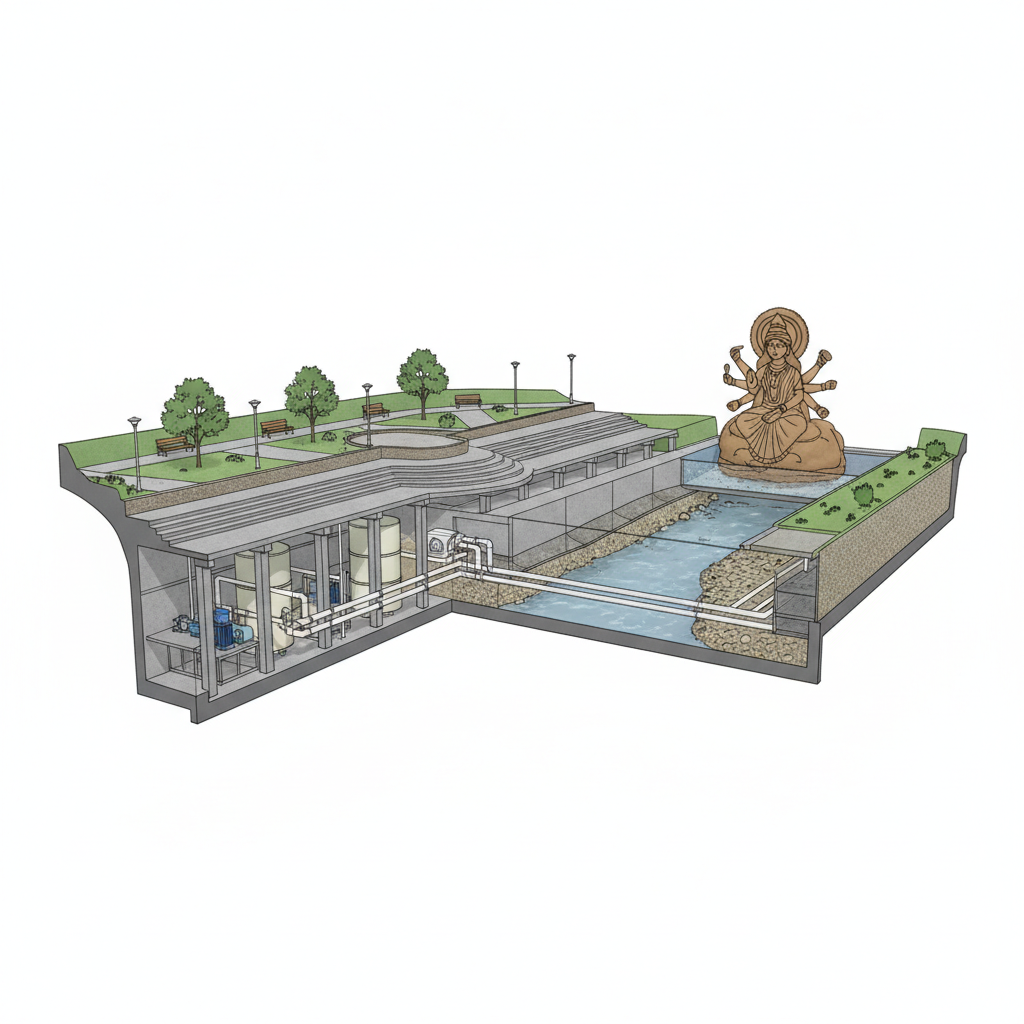
24 Sep Chhattisgarh Finance Minister Launches ₹29.99 Cr Kelo River Cleaning Project
✎ The Kelu River rejuvenation project in Raigarh integrates ecological restoration (Oxyzone afforestation), urban infrastructure (marine drive, underpass), and public participation under the 'Seva Sankalp Abhiyan' to address river…
Subject Relevance — Where This Topic Fits
- GS Paper II — Governance, Transparency and Accountability | GS Paper III — Conservation, Environmental Pollution and Degradation, Environmental Impact Assessment
- Prelims: Kelo River, Raigarh, Kharrighat, Oxyzone, Marine Drive, Box Culvert, Underpass, Riverfront Development, Urban Rejuvenation, E-flow, Riparian Zone, Biodiversity Sensitive Urban Development, Participatory Governance
- Essay: Sustainable Urban Development: Balancing Ecology and Infrastructure, Citizen Participation in Governance: The Role of Awareness and Accountability
Quick Revision: The Kelu River rejuvenation project in Raigarh integrates ecological restoration (Oxyzone afforestation), urban infrastructure (marine drive, underpass), and public participation under the ‘Seva Sankalp Abhiyan’ to address river pollution and enhance urban livability.
Why is this in the news?
The inauguration of a ₹29.99 crore project for the rejuvenation of the Kelu River and Kharrighat area in Raigarh, Chhattisgarh, by the State Finance Minister underscores the integration of river conservation with urban infrastructure development. The initiative, part of the ‘Seva Sankalp Abhiyan’, highlights the government’s commitment to ecological restoration, public health, and community engagement in environmental governance.
Background
- The Kelu River is a tributary of the Mahanadi and serves as the primary water source for Raigarh city, a major urban centre in eastern Chhattisgarh.
- Raigarh is known for its industrial and cultural significance, including the annual Durga Puja celebrations where idol immersion in the Kelu River has historically contributed to water pollution.
- Urban riverfronts in India face dual challenges: ecological degradation due to anthropogenic pressures and the need for recreational and aesthetic infrastructure for urban residents.
- The Chhattisgarh government’s ‘Seva Sankalp Abhiyan’ is a state-wide public outreach initiative aimed at participatory governance, service delivery, and behavioural change in civic matters.
- River rejuvenation projects in India are increasingly adopting multi-dimensional approaches, integrating flood management, biodiversity enhancement, and urban beautification under frameworks such as the National Mission for Clean Ganga (NMCG).
What is the Kelu River and Kharrighat Rejuvenation Project?
- The project is a ₹29.99 crore integrated initiative for the ecological restoration and urban rejuvenation of the Kelu River and Kharrighat area in Raigarh, Chhattisgarh.
- Core components include the construction of an ‘Oxyzone’ — a dense afforestation zone spanning approximately 8.50 acres — designed to enhance oxygen levels, sequester carbon, and restore riparian biodiversity.
- The project involves the strengthening and upgrading of a two-kilometer road from the Shani Temple to Kharrighat, and along with road construction, drains, pedestrian pathways, and riverfront beautification will also be undertaken.
- The Kharrighat ghat will undergo renovation and be connected to a pathway system, with the creation of public spaces for morning and evening walks, family gatherings, and community events.
- Traffic decongestion measures include the widening of the tri-junction near the Shani Temple and the upgradation of the 2 km road from Shani Temple to Kharrighat, including stormwater drains and footpaths.
- The initiative emphasizes participatory governance, with the Finance Minister’s river entry and waste removal activity symbolising citizen-state collaboration in environmental stewardship.
Key Features
| Feature | Significance |
|---|---|
| Riverine Cleanup Initiative | Demonstrates integrated waste management and cultural sensitivity by removing Ganesha idol remnants and other waste from the Kelo River, reinforcing the principle of ‘reduce, reuse, recycle’ in river ecosystems. |
| Oxyszone Development (8.50 acres) | Aims to enhance oxygenation and biodiversity through dense afforestation, supporting ecological restoration and carbon sequestration in an urban riverine setting. |
| Marine Drive & Road Upgradation (2 km) | Improves connectivity, pedestrian safety, and aesthetic appeal along the riverfront, facilitating sustainable urban mobility and tourism. |
| Underpass (Box Culvert) Construction | Ensures safe vehicular and pedestrian movement beneath the existing bridge, mitigating traffic bottlenecks and enhancing riverfront accessibility. |
| Public Amenities (Parking, Gym, Health Facilities) | Provides recreational and wellness infrastructure, promoting community engagement and healthy lifestyles in the riverfront area. |
Why it Matters
Ecological Conservation
- Direct intervention in river pollution control by addressing anthropogenic waste, aligning with the National Mission for Clean Ganga (NMCG) objectives.
- Oxyszone development integrates green infrastructure with urban planning, supporting India’s Nationally Determined Contributions (NDCs) under the Paris Agreement.
- Enhances local biodiversity and ecological resilience in a degraded urban riverine corridor.
Urban Development & Governance
- Demonstrates participatory governance through citizen involvement in river cleanup and maintenance, fostering social accountability.
- Multi-sectoral project integrates infrastructure (roads, underpass), ecology (oxyszone), and public welfare (amenities), reflecting holistic urban planning.
- Expedited project execution under a two-year timeline underscores administrative efficiency in infrastructure delivery.
Cultural & Socio-Economic Linkages
- The Kelo River is integral to Raigarh’s cultural identity, necessitating conservation efforts that balance tradition (Ganesha visarjan) with environmental sustainability.
- Riverfront development can boost local tourism, generating livelihood opportunities in hospitality, retail, and allied sectors.
- Public spaces (morning/night walks) enhance quality of life, addressing urban stress and promoting inclusive urban design.
Climate Resilience
- Oxyszone development contributes to urban heat island mitigation through increased green cover, a critical adaptation strategy for climate-vulnerable cities.
- Improved riverine ecosystems enhance water retention and flood mitigation, reducing urban flood risks.
Challenges
1. Sustainable Waste Management
- Persistent anthropogenic waste (e.g., Ganesha idols, plastics) requires long-term behavioral change and enforcement of the Solid Waste Management Rules, 2016.
- Lack of integrated waste collection systems in Raigarh may hinder the project’s long-term impact without systemic reforms.
UPSC Link: GS3: Environment & Ecology
2. Ecological Restoration Feasibility
- Oxyszone development in a degraded urban riverine zone demands scientific validation of soil, water, and flora suitability.
- Risk of invasive species introduction if afforestation is not carefully planned and monitored.
UPSC Link: GS3: Conservation
3. Urban Infrastructure Bottlenecks
- Land acquisition for riverfront development may face resistance from local stakeholders or legal hurdles under the Right to Fair Compensation and Transparency in Land Acquisition, Rehabilitation and Resettlement Act, 2013.
- Traffic disruptions during construction could impact local businesses and public mobility.
UPSC Link: GS2: Governance
4. Climate Change Adaptation
- Extreme weather events (e.g., floods, heatwaves) may disrupt project timelines or damage infrastructure, necessitating climate-resilient design.
- Rising temperatures could reduce the efficacy of afforestation efforts if not coupled with adaptive species selection.
UPSC Link: GS3: Disaster Management
5. Community Participation & Awareness
- Sustained public engagement is critical for behavioral change in waste disposal and river conservation.
- Cultural practices (e.g., Ganesha visarjan) require awareness campaigns to align with environmental norms without eroding traditions.
UPSC Link: GS2: Social Justice
Challenges — UPSC Perspective
| Issue | Concern |
|---|---|
| Anthropogenic Waste Accumulation | Regular disposal of religious and domestic waste into the river undermines ecological restoration efforts. |
| Land Use Conflicts | Riverfront development may encroach on traditional land uses or informal settlements, requiring equitable resettlement. |
| Funding Sustainability | Long-term maintenance of oxyszone and public amenities depends on consistent budgetary allocations and revenue models. |
| Regulatory Compliance | Adherence to environmental impact assessment (EIA) norms and pollution control laws is essential for project legitimacy. |
| Technical Expertise | Lack of local capacity for ecological restoration and infrastructure maintenance may delay project outcomes. |
Government Initiatives — Must-Memorise for Prelims
- National Mission for Clean Ganga (NMCG)
- Swachh Bharat Mission 2.0 (Urban)
- Atal Mission for Rejuvenation and Urban Transformation (AMRUT) 2.0
Way Forward
- Constitute a multi-stakeholder River Conservation Committee with local authorities, NGOs, and community representatives for continuous monitoring and adaptive management.
- Launch sustained public awareness campaigns in collaboration with religious institutions to promote eco-friendly visarjan practices and waste segregation.
- Integrate solid waste management systems (door-to-door collection, recycling units) in Raigarh to address upstream pollution sources.
- Develop a climate-resilient design framework for oxyszone and riverfront infrastructure, incorporating flood-proofing and heat-resistant landscaping.
- Establish a dedicated urban forestry cell under the Raigarh Municipal Corporation to oversee afforestation, invasive species control, and biodiversity monitoring.
- Create a revenue model for long-term maintenance, such as user fees for public amenities or eco-tourism partnerships.
- Conduct periodic environmental impact audits and publish transparent progress reports to ensure accountability and public trust.
UPSC Value Addition
Keywords for Mains Answer-Writing
Kelo River conservation · Urban river rejuvenation · Oxygenation projects · Public participation in environmental governance · Riverfront development · Chhattisgarh urban infrastructure schemes · National Mission for Clean Ganga (NMCG) · Urban local bodies and environmental management · Sustainable urban development · Public-private partnerships in environmental projects
Constitutional & Policy Linkages
- Article 48A: Directive Principles of State Policy (Protection and improvement of environment and safeguarding of forests and wildlife).
- Article 51A(g): Fundamental Duty (to protect and improve the natural environment).
Concept Flow
Anthropogenic waste (Ganesha idols, plastics) → River pollution → Ecological degradation → Public health risks → Government intervention (cleanup initiative) → Cleanup initiative → Public participation → Administrative commitment (project launch) → Infrastructure development (oxyszone, roads, underpass) → Infrastructure development → Enhanced urban connectivity → Increased footfall → Tourism and economic activity → Revenue generation for maintenance → Oxyszone development → Green cover expansion → Carbon sequestration → Climate change mitigation → Alignment with NDCs → Community engagement → Behavioral change → Sustainable waste management → Long-term river health → Project execution → Timeline adherence → Administrative efficiency → Model for replication in other urban riverine zones
Prelims Practice Questions
Q1. Consider the following statements regarding urban river conservation initiatives in India:
1. The National Mission for Clean Ganga (NMCG) is a centrally sponsored scheme under the Ministry of Jal Shakti.
2. The Namami Gange Programme includes components for riverfront development and urban river rejuvenation.
3. The Kelo River project in Chhattisgarh is funded entirely by the State Government without any central assistance.
4. Oxygenation projects in rivers aim to enhance dissolved oxygen levels to improve aquatic biodiversity.
How many of the above statements are correct?
- Only one
- Only two
- Only three
- All
Answer: All — Statements 1, 2, and 4 are correct. Statement 3 is incorrect as the Kelo River project involves administrative and technical approvals, indicating central involvement or oversight.
Q2. Assertion (A): Urban riverfront development projects often include the construction of parks, walkways, and recreational spaces to enhance public engagement with the river.
Reason (R): The primary objective of such projects is to generate revenue through commercial activities along the riverfront.
In the context of the above two statements, which one of the following is correct?
- Both A and R are true, and R is the correct explanation of A.
- Both A and R are true, but R is not the correct explanation of A.
- A is true, but R is false.
- A is false, but R is true.
Answer: A is true, but R is false. — Assertion (A) is true as urban riverfront projects typically include public spaces for recreation. Reason (R) is false because the primary objective is environmental rejuvenation and public engagement, not revenue generation.
Q3. Which of the following is NOT a component of the Namami Gange Programme?
- Riverfront development
- Construction of sewage treatment plants
- Promotion of cruise tourism on the Ganga
- Afforestation along river banks
Answer: Promotion of cruise tourism on the Ganga — The Namami Gange Programme focuses on river cleaning, conservation, and rejuvenation, including sewage treatment and afforestation. Cruise tourism is not a listed component.
Mains Practice Question
✍ The Kelo River rejuvenation project in Chhattisgarh exemplifies a multi-dimensional approach to urban river conservation, integrating ecological restoration, public infrastructure, and community participation. Critically examine the significance of such projects in the context of India’s urban environmental governance. (15 Marks)
Approach: Define urban river conservation and its importance in sustainable urban development. Mention the Kelo River project as a case study. [{‘ecological_restoration’: [‘Role of oxygenation projects in enhancing dissolved oxygen levels’, ‘Importance of afforestation and riparian buffer zones’, ‘Impact on aquatic biodiversity and water quality’]}, {‘public_infrastructure’: [‘Development of riverfront walkways, parks, and recreational spaces’, ‘Integration of urban mobility solutions (e.g., underpasses, road widening)’, ‘Creation of public amenities (e.g., parking, gymnasiums, health facilities)’]}, {‘community_participation’: [‘Role of citizen engagement in waste management and river cleaning’, ‘Need for sustained public awareness campaigns’, ‘Models of public-private partnerships (PPPs) in project implementation’]}, {‘governance_framework’: [‘Role of urban local bodies (ULBs) in project execution’, ‘Central government schemes (e.g., Namami Gange Programme) and their funding mechanisms’, ‘Inter-state coordination for transboundary river conservation’]}] [‘Challenges in balancing ecological restoration with urban development pressures’, ‘Sustainability of funding and maintenance post-project completion’, ‘Potential conflicts between conservation goals and commercial interests’, ‘Comparative analysis with other urban river projects (e.g., Sabarmati Riverfront, Ganga Action Plan)’] Summarize the transformative potential of such projects while acknowledging the need for long-term commitment and adaptive governance.
Source: amarujala.com
Chhattisgarh PCS (CGPSC) — State PCS Practice
Prelims: छत्तीसगढ़ के किस नदी में वित्त मंत्री ओपी चौधरी द्वारा 29.99 करोड़ रुपये की परियोजना का शुभारंभ किया गया?
- A. महानदी
- B. केलो नदी
- C. शिवनाथ नदी
- D. हसदेव नदी
Answer: B. केलो नदी — वित्त मंत्री ओपी चौधरी ने छत्तीसगढ़ के केलो नदी में 29.99 करोड़ रुपये की परियोजना का शुभारंभ किया।
Mains: छत्तीसगढ़ में केलो नदी पर शुरू की गई 29.99 करोड़ रुपये की परियोजना के उद्देश्यों एवं इसके राज्य की जल संसाधन विकास में भूमिका का वर्णन कीजिए।
Generated by AanyaAi for educational purpose.
Related guides on our sites
- Current affairs for upsc 2026
- Best PSIR optional coaching for upsc
- Best PSIR optional teacher for upsc
- Best teacher of PSIR optional for upsc

- छत्तीसगढ़: ओपी चौधरी ने केलो नदी में उतरकर किया 29.99 करोड़ रुपये के प्रोजेक्ट का उद्घाटन - September 24, 2026
- Chhattisgarh Finance Minister Launches ₹29.99 Cr Kelo River Cleaning Project - September 24, 2026
- UPSC Exam: Coal Ministry’s Special Campaign 6 for E-Waste & Governance Reforms - September 24, 2026

No Comments