


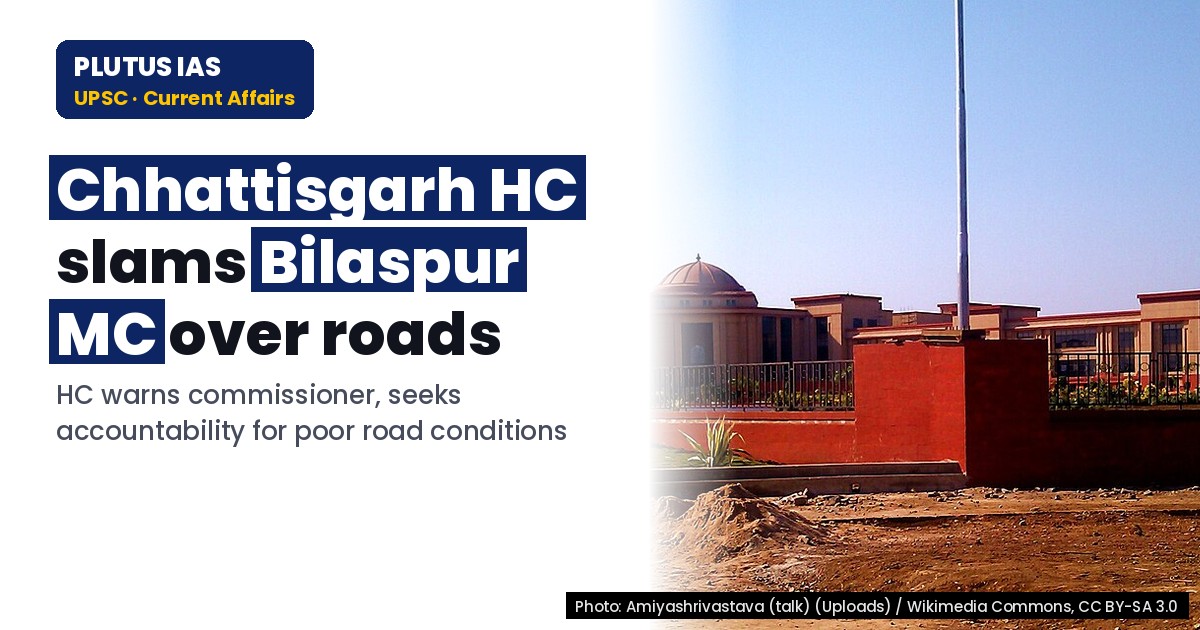
09 Oct Chhattisgarh HC Slams Bilaspur MC Over Dilapidated Roads: Key Facts
✎ The 74th Constitutional Amendment Act, 1992, decentralised urban governance by empowering Municipal Corporations with specific functions, including road maintenance, under Article 243W, while inter-departmental coordination and…
Subject Relevance — Where This Topic Fits
- GS Paper II — Functions and Responsibilities of the Union and the States, Issues and Challenges Pertaining to the Federal Structure | GS Paper III — Infrastructure: Energy, Ports, Roads, Airports, Railways etc.
- Prelims: Public Interest Litigation (PIL), Municipal Governance, Constitutional Provisions (Article 243W, 7th Schedule), Urban Local Bodies (ULBs), Judicial Activism, Public Works Department (PWD), National Highways Authority of India (NHAI), 74th Constitutional Amendment Act
- Essay: Judicial Activism vs. Executive Accountability in Governance, Urban Infrastructure: A Reflection of Governance Quality
Quick Revision: The 74th Constitutional Amendment Act, 1992, decentralised urban governance by empowering Municipal Corporations with specific functions, including road maintenance, under Article 243W, while inter-departmental coordination and fiscal devolution remain critical challenges.
Why is this in the news?
The Chhattisgarh High Court recently expressed severe dissatisfaction with the state of urban roads in Bilaspur, particularly under the jurisdiction of the Bilaspur Municipal Corporation, and issued warnings to the Commissioner for non-compliance with judicial directives. The Court’s intervention highlights systemic failures in municipal governance, inter-departmental coordination, and the implementation of infrastructure projects, raising critical questions about the efficacy of urban local bodies and constitutional mechanisms for urban development.
Background
- The 74th Constitutional Amendment Act, 1992, decentralised urban governance by empowering Municipalities with functions including urban planning, regulation of land use, and public health, including roads and bridges (Article 243W).
- Urban Local Bodies (ULBs) such as Municipal Corporations are statutory bodies established under state municipal laws and are responsible for the maintenance of urban infrastructure, including roads within their jurisdiction.
- The Public Interest Litigation (PIL) mechanism, pioneered by the Supreme Court in the 1980s, allows citizens to approach courts for redressal of public grievances, particularly where executive inaction or maladministration violates constitutional or statutory rights.
- The National Highways Authority of India (NHAI) is a statutory body under the Ministry of Road Transport and Highways, responsible for the development, maintenance, and management of National Highways in India.
- The Public Works Department (PWD) in states is tasked with the construction and maintenance of state highways and major district roads, including those not classified as National Highways.
- The case underscores the recurring challenge of inter-departmental coordination in infrastructure projects, where responsibilities are often ambiguously divided between ULBs, state PWD, and NHAI.
What is the Legal and Governance Framework Governing Urban Roads in India?
- **Constitutional Provisions**: The 74th Constitutional Amendment Act, 1992, inserted Part IX-A into the Constitution, establishing a three-tier system of urban local governance (Municipalities, Municipal Councils, and Nagar Panchayats) and assigning them functions such as urban planning, regulation of land use, and public health (Article 243W). Roads and bridges fall under the ambit of these functions.
- Municipal Corporations are governed by state-specific municipal laws, which define their powers, duties, and financial mechanisms. For instance, the Chhattisgarh Municipal Corporation Act, 1956, empowers the Bilaspur Municipal Corporation to maintain public streets, drains, and other civic amenities within its jurisdiction.
- The **Public Interest Litigation (PIL)** mechanism enables citizens to seek judicial intervention in cases of executive inaction or maladministration that adversely affect public welfare. The Supreme Court, in *S.P. Gupta v. Union of India* (1982), expanded the locus standi rule to allow PILs, reinforcing the judiciary’s role as a guardian of constitutional and statutory rights.
- The **National Highways Authority of India (NHAI)** is a statutory body under the National Highways Authority of India Act, 1998, responsible for the development, maintenance, and management of National Highways. State highways and major district roads are typically maintained by the state’s Public Works Department (PWD).
- The **Public Works Department (PWD)** in states is responsible for the construction and maintenance of state highways and major district roads. However, ambiguity in project handover processes (e.g., from PWD to NHAI) often leads to delays and neglect, as highlighted in the Bilaspur case.
- Judicial activism in infrastructure governance has evolved to include **continuing mandamus**, where courts monitor compliance with their orders over time. This ensures that executive bodies adhere to timelines and deliver on commitments, as seen in the Chhattisgarh High Court’s directives for road repairs and project completion.
- The **74th Amendment Act** also mandates the establishment of State Finance Commissions to recommend the devolution of financial resources to ULBs, ensuring their fiscal autonomy and capacity to execute infrastructure projects.
- The **Constitution (Seventy-Fourth Amendment) Act, 1992**, also provides for the establishment of Metropolitan Planning Committees (MPCs) and District Planning Committees (DPCs) to ensure integrated urban planning and coordination among multiple agencies.
Key Features
| Feature | Significance |
|---|---|
| Judicial intervention via Public Interest Litigation (PIL) | Ensures accountability of executive bodies in governance, particularly in urban infrastructure management. |
| High Court’s suo motu observation on dilapidated roads | Highlights systemic failures in maintenance and underscores the judiciary’s role in enforcing constitutional obligations under Article 21 (Right to Life). |
| Municipal Corporation Commissioner’s personal appearance directive | Strengthens judicial oversight of local bodies, ensuring direct accountability for urban governance failures. |
| Project handover delays (e.g., Sendri-Mopka Bypass) | Exposes inter-departmental coordination gaps and inefficiencies in infrastructure project execution. |
| Asphalt price volatility impact on road construction | Demonstrates economic constraints affecting timely completion of civic projects. |
Why it Matters
Urban Governance & Infrastructure
- Exposes systemic deficiencies in municipal and state-level road maintenance, violating citizens’ right to safe and accessible infrastructure under Article 21.
- Highlights the judiciary’s proactive role in addressing governance failures when executive bodies fail to act.
- Underscores the need for integrated urban planning and inter-departmental synergy in infrastructure projects.
Judicial Activism & Public Accountability
- Demonstrates the judiciary’s capacity to intervene in executive lapses, particularly in public welfare matters.
- Reinforces the principle that public funds must be utilised for intended purposes, with strict accountability for delays or mismanagement.
- Sets a precedent for future PILs on civic infrastructure, ensuring judicial scrutiny of executive inaction.
Economic & Administrative Implications
- Economic costs of delayed projects (e.g., asphalt price fluctuations) directly impact budgetary allocations and civic development timelines.
- Inter-departmental disputes (e.g., NHAI vs. State PWD) highlight inefficiencies in project handover and maintenance responsibilities.
- Urban mobility crises during festivals (e.g., upcoming puja season) pose risks to public safety and economic activity.
Challenges
1. Inter-departmental Coordination Failures
- Delays in project handover between state PWD and NHAI impede timely execution of critical infrastructure (e.g., Sendri-Mopka Bypass).
- Lack of clarity in roles and responsibilities exacerbates project stagnation and resource wastage.
- Requires institutional mechanisms for real-time monitoring and conflict resolution in multi-agency projects.
UPSC Link: GS-II: Centre-State Relations
2. Judicial Overreach vs. Executive Autonomy
- Balancing judicial intervention with executive autonomy remains a constitutional challenge in governance oversight.
- Directives for personal appearance of officials risk overstepping administrative boundaries while ensuring accountability.
- Need for structured frameworks to delineate judicial and executive roles in public welfare matters.
UPSC Link: GS-II: Separation of Powers
3. Urban Infrastructure Maintenance Gaps
- Persistent neglect of municipal roads violates citizens’ right to safe and dignified urban living.
- Lack of preventive maintenance and periodic audits leads to accelerated deterioration of civic assets.
- Urgent need for capacity-building in municipal bodies to manage infrastructure sustainably.
UPSC Link: GS-II: Urban Local Governance
4. Economic Constraints in Civic Projects
- Volatility in material costs (e.g., asphalt) disrupts project timelines and budgetary planning.
- Insufficient financial allocations for maintenance and repairs hinder long-term infrastructure sustainability.
- Requires innovative financing models (e.g., public-private partnerships) for resilient urban infrastructure.
UPSC Link: GS-III: Infrastructure Financing
5. Public Safety Risks from Poor Road Conditions
- Dilapidated roads increase accident risks, particularly during high-traffic periods (e.g., festivals).
- Prolonged exposure to unsafe conditions violates citizens’ right to life and personal liberty under Article 21.
- Urgent need for emergency repair mechanisms to mitigate risks during critical periods.
UPSC Link: GS-II: Fundamental Rights
Challenges — UPSC Perspective
| Issue | Concern |
|---|---|
| Project Handover Delays | Lack of clarity in NHAI-State PWD roles delays Sendri-Mopka Bypass completion. |
| Executive Inaction | No tangible improvements in road conditions despite PIL pending since 2021. |
| Judicial Directives vs. Autonomy | Personal appearance directives may conflict with administrative discretion. |
| Economic Volatility | Rising asphalt costs disrupt budgetary allocations for civic projects. |
| Public Safety Risks | Poor road conditions pose accident risks during festival seasons. |
Way Forward
- Establish a **State-Level Infrastructure Monitoring Authority** to track project progress and resolve inter-departmental disputes in real time.
- Mandate **periodic audits** of municipal roads by independent agencies to identify maintenance gaps proactively.
- Introduce **performance-based funding** for municipal bodies, linking allocations to measurable infrastructure improvements.
- Develop **contingency plans** for high-risk periods (e.g., festivals) to ensure emergency repairs and public safety.
- Strengthen **capacity-building initiatives** for municipal officials in project management and financial planning.
- Enhance **transparency** by publishing quarterly reports on road maintenance and project timelines on official portals.
- Explore **public-private partnerships (PPPs)** for road maintenance to leverage private sector efficiency and funding.
- Conduct **citizen feedback mechanisms** (e.g., mobile apps) to report road hazards and monitor repair progress.
UPSC Value Addition
Keywords for Mains Answer-Writing
Public Interest Litigation · Judicial activism in governance · Municipal governance and accountability · Constitutional remedies for civic infrastructure · Judicial writ jurisdiction under Article 226 · Urban local bodies and civic services · Judicial directions for public welfare · Constitutional obligations of state governments · Judicial review of executive inaction · Civic infrastructure and public health · Judicial activism vs. separation of powers · Constitutional writs and their scope
Constitutional & Policy Linkages
- Article 21 (Right to Life) – Safeguarding citizens’ right to safe and accessible infrastructure.
- Article 40 (DPSP) – Duty of State to ensure local governance and infrastructure development.
Concept Flow
Dilapidated municipal roads → Public Interest Litigation (PIL) filed in High Court → Judicial scrutiny of executive inaction → Observation of systemic failures in maintenance and project execution → Directives for accountability (e.g., personal appearance of officials) → Inter-departmental disputes exposed (e.g., NHAI vs. State PWD) → Economic constraints (e.g., asphalt costs) further delaying projects → Public safety risks emerge during high-traffic periods → Urgent need for structural reforms in urban governance.
Prelims Practice Questions
Q1. Consider the following statements regarding the jurisdiction of the High Court under Article 226 of the Constitution of India:
1. The High Court can issue directions, orders, or writs for the enforcement of any of the Fundamental Rights or for any other purpose.
2. The jurisdiction under Article 226 is discretionary and cannot be claimed as a matter of right.
3. The High Court can issue writs only against the Government and its instrumentalities.
4. The High Court can issue writs suo motu without any petition being filed.
How many of the above statements are correct?
- Only one
- Only two
- Only three
- All
Answer: Only three — Statements 1, 2, and 4 are correct. Statement 3 is incorrect as the High Court can issue writs against any person or authority, including private entities, if they are performing public functions. The jurisdiction under Article 226 is discretionary, and the High Court can act suo motu.
Q2. Which of the following writs is most appropriate to compel a Municipal Corporation to perform its statutory duty of maintaining public roads in a dilapidated condition?
- A. Habeas Corpus
- B. Mandamus
- C. Certiorari
- D. Prohibition
Answer: B. Mandamus — The writ of Mandamus is issued to direct a public authority to perform a statutory duty. In this case, the High Court can direct the Bilaspur Municipal Corporation to fulfill its obligation to maintain roads under municipal governance laws.
Q3. Assertion (A): The High Court can issue directions to the State Government for the improvement of civic infrastructure under its writ jurisdiction.
Reason (R): The Constitution of India empowers the High Court to issue writs for the enforcement of Fundamental Rights and for any other purpose, including public welfare measures.
Options:
A. Both A and R are true, and R is the correct explanation of A.
B. Both A and R are true, but R is not the correct explanation of A.
C. A is true, but R is false.
D. A is false, but R is true.
Answer: ? — Both the Assertion (A) and Reason (R) are true. The High Court’s writ jurisdiction under Article 226 empowers it to issue directions for public welfare, including civic infrastructure improvement. The Reason (R) correctly explains the Assertion (A).
Mains Practice Question
✍ The High Court of Chhattisgarh has expressed strong displeasure over the dilapidated condition of roads in Bilaspur, issuing stern directions to the state government and the Bilaspur Municipal Corporation. In this context, critically examine the role of the judiciary in ensuring governance accountability for civic infrastructure. Also, assess the constitutional and legal provisions that empower the judiciary to intervene in such matters. (15 Marks)
Approach: MODEL-ANSWER SKELETON:
1. **Introduction (2 marks)**: Define judicial activism and its relevance in governance, citing Article 226 of the Constitution of India, which empowers High Courts to issue writs for enforcement of Fundamental Rights and other purposes.
2. **Judicial Role in Governance Accountability (5 marks)**:
– Discuss the concept of judicial activism in India, with reference to landmark cases such as *Bandhua Mukti Morcha v. Union of India* (1984) and *Vineet Narain v. Union of India* (1996).
– Explain the doctrine of judicial review and its application in ensuring executive accountability for public welfare.
– Highlight the judiciary’s role in directing governments to fulfill statutory obligations, as seen in the present case.
3. **Constitutional and Legal Provisions (5 marks)**:
– Article 226: Writ jurisdiction of High Courts for enforcement of Fundamental Rights and other purposes.
– Article 40: Directive Principle of State Policy (DPSP) emphasizing the organization of village panchayats and local self-governance.
– 74th Constitutional Amendment Act, 1992: Empowering Urban Local Bodies (ULBs) and mandating their functional domains, including civic infrastructure.
– Municipal Acts of respective states: Legal framework governing municipal corporations and their duties.
4. **Challenges and Limitations (3 marks)**:
– Critique the judiciary’s intervention in executive functions, citing concerns of separation of powers.
– Discuss the limitations of judicial activism, such as overreach and lack of expertise in technical domains.
– Highlight the need for coordination between the judiciary, executive, and legislature for sustainable governance solutions.
Source: amarujala.com
Chhattisgarh PCS (CGPSC) — State PCS Practice
Prelims: छत्तीसगढ़ उच्च न्यायालय द्वारा बिलासपुर नगर निगम आयुक्त को सड़कों की बदहाली पर जारी नोटिस के संदर्भ में, निम्नलिखित में से कौन-सा कथन सही है?
- उच्च न्यायालय ने आयुक्त को सड़कों की मरम्मत के लिए 15 दिनों का समय दिया है।
- उच्च न्यायालय ने आयुक्त को सड़कों की बदहाली पर लिखित जवाब 7 दिनों के भीतर प्रस्तुत करने का निर्देश दिया है।
- उच्च न्यायालय ने आयुक्त को निजी ठेकेदारों से सड़कों की मरम्मत कराने का आदेश दिया है।
- उच्च न्यायालय ने आयुक्त को सड़कों की बदहाली पर कोई कार्रवाई नहीं करने की चेतावनी दी है।
Answer: उच्च न्यायालय ने आयुक्त को सड़कों की बदहाली पर लिखित जवाब 7 दिनों के भीतर प्रस्तुत करने का निर्देश दिया है। — उच्च न्यायालय ने बिलासपुर नगर निगम आयुक्त को सड़कों की बदहाली पर लिखित जवाब 7 दिनों के भीतर प्रस्तुत करने का निर्देश दिया है।
Mains: छत्तीसगढ़ में नगरीय निकायों द्वारा सड़कों की बदहाली के कारण उत्पन्न जन-जीवन की समस्याओं एवं उच्च न्यायालय द्वारा जारी निर्देशों के प्रभाव का मूल्यांकन करते हुए, सुधारात्मक उपायों पर अपने विचार लिखिए।
Generated by AanyaAi for educational purpose.
Related guides on our sites
- Current affairs for upsc 2026
- How to prepare for GS paper 1 for UPSC CSE mains exam
- Best UPSC coaching for IFOS exam
- Best mentorship programme for upsc


No Comments