


27 Jul Chhattisgarh PSC Ex-Chairman Arrested in Recruitment Scam & Money Laundering Case
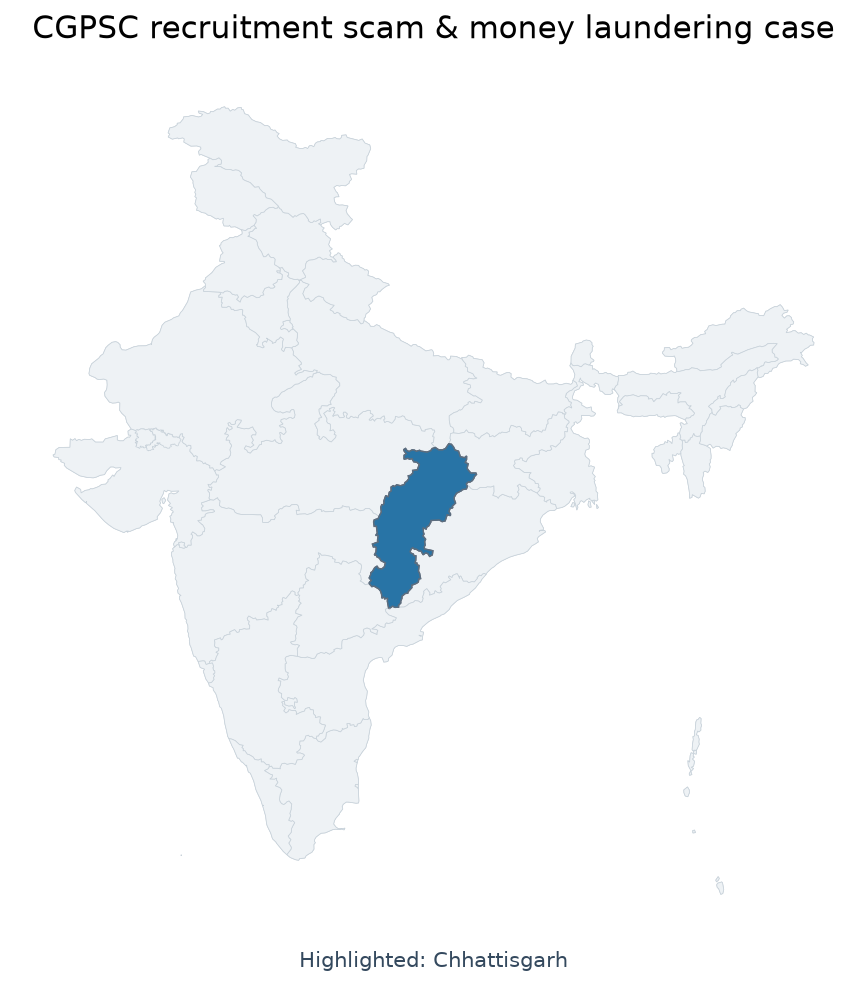
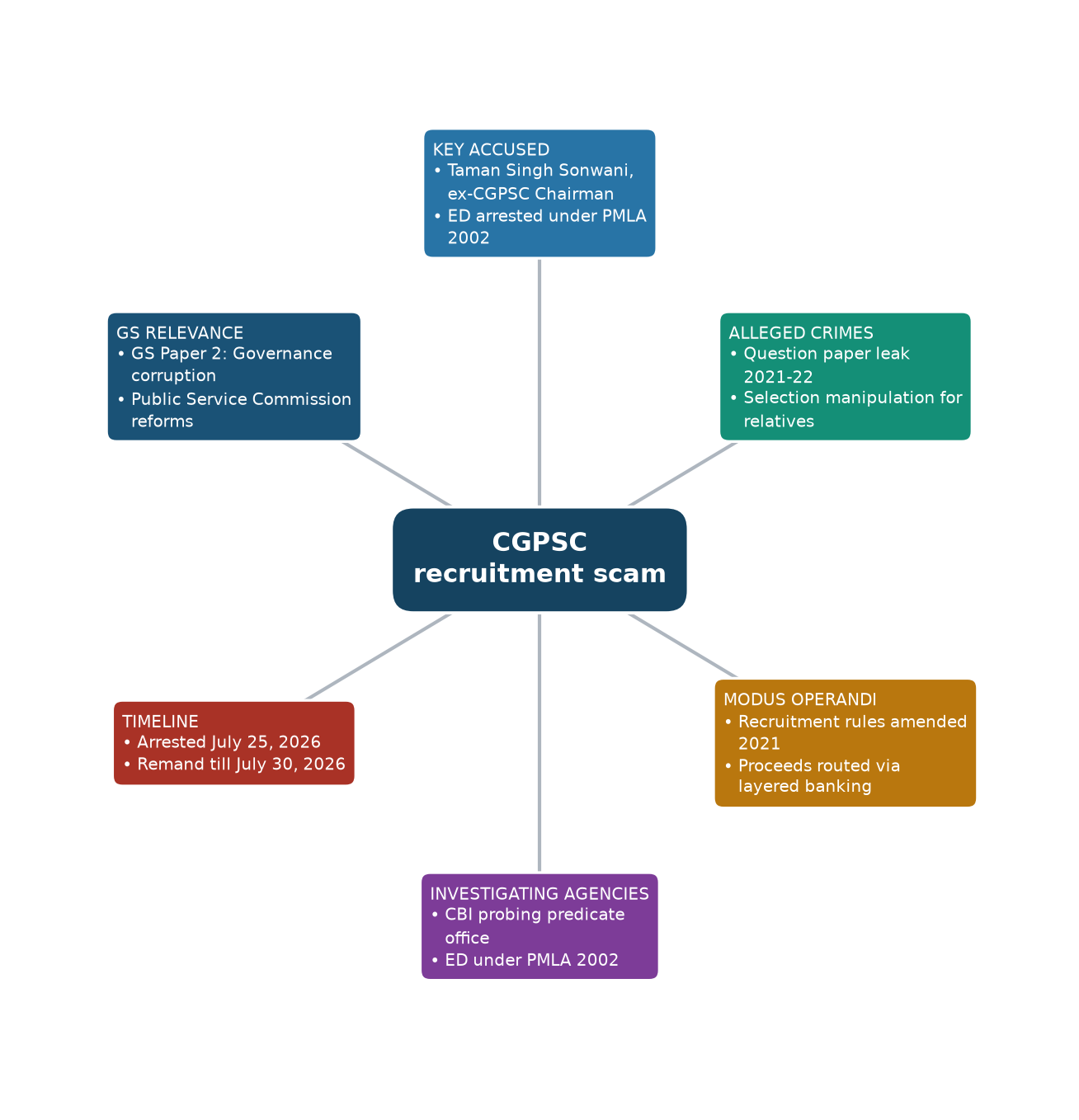
Map & concept mind-map: CGPSC recruitment scam & money laundering case
Subject Relevance — Where This Topic Fits
- GS Paper II — Functions and Responsibilities of the Union and the States, Issues and Challenges Pertaining to the Federal Structure | GS Paper IV — Ethics and Integrity in Governance
- Prelims: Chhattisgarh Public Service Commission (CGPSC), Prevention of Money Laundering Act (PMLA), 2002, Section 19 of PMLA, Section 50 of PMLA, Directorate of Enforcement (ED), State Service Examinations, Money Trail, Predicate Offence, Judicial Custody, Constitutional Provisions on Public Service Commissions (Article 315-323)
- Essay: Ethical Governance: The Imperative of Transparency in Public Institutions, The Role of Institutions in Upholding Democratic Values
Quick Revision: The Prevention of Money Laundering Act (PMLA), 2002, empowers the Directorate of Enforcement (ED) to investigate money laundering cases linked to predicate offences such as corruption in public service commissions.
Why is this in the news?
The arrest of Taman Singh Sonwani, former Chairman of the Chhattisgarh Public Service Commission (CGPSC), by the Directorate of Enforcement (ED) under the Prevention of Money Laundering Act (PMLA), 2002, for alleged involvement in a recruitment scam highlights systemic vulnerabilities in public service examinations. The case underscores the nexus between institutional corruption, money laundering, and the manipulation of selection processes to benefit relatives and influential individuals, raising critical questions about the integrity of recruitment mechanisms in state public service commissions.
Background
- The Chhattisgarh Public Service Commission (CGPSC) is a constitutional body established under Article 315 of the Constitution, responsible for conducting recruitment examinations for state civil services.
- Public service commissions in India are mandated to ensure transparency, fairness, and meritocracy in the selection of candidates for civil services, as enshrined in Articles 315–323 of the Constitution.
- The alleged scam pertains to recruitment examinations conducted in 2021 and 2022, during which Taman Singh Sonwani served as Chairman of the CGPSC.
- The Central Bureau of Investigation (CBI) had earlier arrested Sonwani and other accused in connection with the predicate offence of corruption and question-paper leaks.
- The ED’s involvement was necessitated by the use of layered banking transactions and cash to launder proceeds from the alleged scam, warranting investigation under the PMLA, 2002.
- The case has political implications, as it was highlighted during the 2023 Assembly elections, reflecting the broader challenge of corruption in governance.
What is the Chhattisgarh PSC Recruitment Scam and Money Laundering Nexus?
- The Chhattisgarh PSC recruitment scam involves allegations of question-paper leaks, manipulation of selection processes, and the fraudulent selection of candidates for senior public posts.
- Taman Singh Sonwani, the former Chairman of the CGPSC, is accused of conspiring with public servants and private individuals to facilitate these irregularities in exchange for illegal gratification.
- The scam allegedly enabled the selection of Sonwani’s relatives and other influential persons to senior posts, such as Deputy Collector, through compromised recruitment processes.
- The recruitment rules of the CGPSC were allegedly amended in 2021 to redefine the term ‘family,’ removing the word ‘nephew,’ which facilitated the selection of Sonwani’s relatives.
- The proceeds of crime were partly collected in cash and partly routed through layered banking transactions, necessitating the ED’s intervention under the PMLA, 2002.
- The ED’s investigation aims to trace the money trail, establish the nexus between corruption and money laundering, and identify other persons involved in the conspiracy.
- The case exemplifies the challenges in ensuring transparency and accountability in public institutions, particularly in the context of state public service commissions.
- The scam also highlights the role of political oversight, as the allegations surfaced during a period of heightened scrutiny of the state government’s functioning.
Key Features
| Feature | Significance |
|---|---|
| Alleged Conspiracy to Leak Question Papers | Undermines the integrity of the civil services examination system, eroding public trust in merit-based recruitment processes. |
| Manipulation of Recruitment Rules (2021 Amendment) | Facilitated the removal of ‘nephew’ from the definition of ‘family’, enabling the fraudulent selection of relatives and associates. |
| Layered Banking Transactions and Cash Proceeds | Obscures the money trail, complicating forensic investigations and asset recovery under the PMLA, 2002. |
| Involvement of Influential Persons | Exposes systemic collusion between public officials and private individuals, amplifying the scale of the scam. |
| Multi-Agency Investigation (ED, CBI) | Demonstrates inter-agency coordination in tackling corruption, though delayed enforcement raises questions about institutional vigilance. |
Why it Matters
Institutional Integrity
- The alleged scam strikes at the core of the civil services recruitment system, which is designed to ensure meritocracy and fairness in public employment.
- The involvement of a high-ranking public official (CGPSC Chairman) in such malpractices highlights the vulnerability of institutional mechanisms to corruption.
- The incident raises concerns about the efficacy of existing safeguards, including the role of oversight bodies and the judiciary in preventing such malfeasance.
Legal and Procedural Implications
- The application of the Prevention of Money Laundering Act (PMLA), 2002, underscores the financial dimensions of corruption, extending beyond mere procedural violations.
- The amendment to the CGPSC recruitment rules in 2021 exemplifies how legal frameworks can be exploited to serve vested interests, necessitating stricter regulatory oversight.
- The ED’s invocation of Section 19 of the PMLA for arrest reflects the stringent provisions available to combat financial crimes linked to corruption.
Political and Governance Impact
- The timing of the scam’s exposure (2023 Assembly elections) highlights the weaponisation of corruption allegations in electoral politics, complicating objective governance.
- The alleged scam occurred during the tenure of the Congress-led government, yet its investigation persisted under the BJP-led administration, raising questions about political continuity in anti-corruption efforts.
- The incident reinforces the perception of systemic corruption in public institutions, potentially eroding citizen confidence in governance structures.
Economic Consequences
- The diversion of public funds through illegal gratification and money laundering represents a direct economic loss to the exchequer, diverting resources from developmental priorities.
- The erosion of institutional credibility may deter meritorious candidates from pursuing civil services careers, impacting the quality of public administration in the long term.
Challenges
1. Institutional Corruption and Collusion
- The alleged conspiracy involved multiple stakeholders, including public servants and private individuals, indicating deep-rooted systemic failures.
- The amendment to recruitment rules suggests premeditated efforts to subvert institutional safeguards, necessitating structural reforms in rule-making processes.
UPSC Link: GS2: Role of Civil Services in Democracy
2. Financial Crime and Money Laundering
- The use of layered banking transactions and cash proceeds complicates forensic investigations, delaying asset recovery and prosecution.
- The ED’s challenge lies in tracing the full extent of the money trail, particularly where transactions span multiple jurisdictions or involve shell entities.
UPSC Link: GS3: Money Laundering and its Impact
3. Politicisation of Anti-Corruption Efforts
- The timing of the scam’s exposure and subsequent investigations risks being perceived as politically motivated, undermining public trust in anti-corruption agencies.
- The involvement of opposition parties in highlighting the scam during elections underscores the need for depoliticised enforcement mechanisms.
UPSC Link: GS2: Pressure Groups and Political Parties
4. Judicial and Enforcement Delays
- The prolonged investigation and delayed arrests (e.g., Sonwani’s prior judicial custody) raise questions about the efficiency of enforcement agencies in high-profile cases.
- The remand period under the PMLA is limited (7 days), which may constrain the ED’s ability to gather comprehensive evidence in complex financial crimes.
UPSC Link: GS2: Judiciary and its Functions
5. Public Perception and Governance Erosion
- Repeated scandals in public institutions (e.g., CGPSC, NEET, UPSC) risk normalising corruption in the eyes of the public, fostering cynicism toward governance.
- The selection of relatives and associates for senior posts undermines the principle of equal opportunity, exacerbating social inequities in public employment.
UPSC Link: GS4: Ethics in Governance
Challenges — UPSC Perspective
| Issue | Concern |
|---|---|
| Exploitation of Legal Loopholes | Amendments to recruitment rules to favour specific individuals highlight vulnerabilities in procedural safeguards. |
| Multi-Layered Financial Transactions | Obscures the origin and destination of illicit funds, complicating asset recovery and prosecution. |
| Collusion Among Stakeholders | Involvement of public servants, private individuals, and influential persons suggests systemic complicity. |
| Political Weaponisation of Corruption | Allegations and investigations tied to electoral cycles risk undermining the objectivity of anti-corruption efforts. |
| Institutional Credibility Erosion | Repeated scandals in public institutions (e.g., CGPSC, NEET) erode public trust in merit-based recruitment systems. |
Way Forward
- Strengthen institutional oversight mechanisms for civil services examinations, including independent audits of recruitment processes and real-time monitoring of question paper handling.
- Enhance transparency in rule-making by subjecting amendments to public scrutiny and parliamentary/legislative review, particularly for recruitment-related regulations.
- Improve inter-agency coordination between the ED, CBI, and state anti-corruption bodies to expedite financial crime investigations and asset recovery.
- Implement mandatory whistle-blower protection mechanisms and anonymous reporting channels to encourage insider disclosures of malpractices.
- Conduct periodic reviews of recruitment rules to identify and rectify ambiguities or loopholes that could be exploited for corrupt purposes.
- Promote ethical governance through mandatory ethics training for civil servants, with a focus on integrity, conflict-of-interest management, and anti-corruption protocols.
- Establish a national-level task force to investigate systemic corruption in public institutions, with powers to recommend structural reforms and policy changes.
UPSC Value Addition
Keywords for Mains Answer-Writing
Public Service Commission (PSC) recruitment scam · Prevention of Money Laundering Act (PMLA), 2002 · question paper leak in civil services examinations · criminal conspiracy in recruitment processes · proceeds of crime and money trail · Section 19 of PMLA and remand provisions · Section 50 of PMLA and evasive statements · ethical governance in public institutions · influence peddling in civil services · institutional integrity of PSCs · layered banking transactions in corruption · amendment of recruitment rules for nepotism
Concept Flow
Alleged collusion among public officials and private individuals → Amendment of recruitment rules to favour relatives → Leakage of question papers and manipulation of selection process → Illegal gratification and financial transactions → Money laundering through layered banking systems → Arrest under PMLA, 2002 → Multi-agency investigation (ED, CBI) → Political and public scrutiny → Institutional reforms and ethical governance initiatives.
Prelims Practice Questions
Q1. Which statutory provision was invoked by the Directorate of Enforcement (ED) to arrest the former Chairman of the Chhattisgarh Public Service Commission (CGPSC) in the money laundering case?
- Section 131 of the Code of Criminal Procedure, 1973
- Section 19 of the Prevention of Money Laundering Act (PMLA), 2002
- Section 4 of the Indian Penal Code, 1860
- Section 12 of the Right to Information Act, 2005
Answer: Section 19 of the Prevention of Money Laundering Act (PMLA), 2002 — The ED arrested Taman Singh Sonwani under Section 19 of the Prevention of Money Laundering Act (PMLA), 2002, which empowers the agency to arrest a person accused of money laundering. This provision is distinct from the IPC or procedural laws.
Q2. What was the alleged purpose of the amendment to the CGPSC recruitment rules in 2021?
- To increase transparency in the selection process
- To facilitate the selection of relatives of the Chairman by removing the term ‘nephew’ from the definition of ‘family’
- To standardise the examination syllabus across states
- To introduce digital evaluation of answer sheets
Answer: To facilitate the selection of relatives of the Chairman by removing the term ‘nephew’ from the definition of ‘family’ — The ED alleged that the amendment to the CGPSC recruitment rules in 2021 removed the term ‘nephew’ from the definition of ‘family,’ thereby enabling the Chairman’s relatives to be selected through manipulated processes.
Q3. Under which section of the PMLA, 2002, was Taman Singh Sonwani’s statement recorded during the investigation?
- Section 16
- Section 19
- Section 50
- Section 67
Answer: Section 50 — Sonwani’s statement was recorded under Section 50 of the PMLA, 2002, which pertains to the power of the ED to examine individuals in connection with money laundering investigations.
Mains Practice Question
✍ Examine the institutional, legal, and ethical dimensions of the Chhattisgarh Public Service Commission (CGPSC) recruitment scam. How does such corruption undermine the integrity of civil services examinations in India? Suggest measures to restore public trust in the selection processes of Public Service Commissions.
Approach: Begin by outlining the alleged irregularities in the CGPSC scam, including question paper leaks, manipulation of recruitment rules, and money laundering. Analyse the legal framework under the Prevention of Money Laundering Act (PMLA), 2002, and the role of the ED. Discuss the ethical implications of nepotism and influence peddling in public institutions. Conclude with systemic reforms such as transparent recruitment processes, digital evaluation, and strict enforcement of anti-corruption laws to restore institutional credibility.
Source: The Hindu
Generated by AanyaAi for educational purpose.


No Comments