


26 Sep China-US Agree to New AI Safety Channel: UPSC Exam Insights for 2026
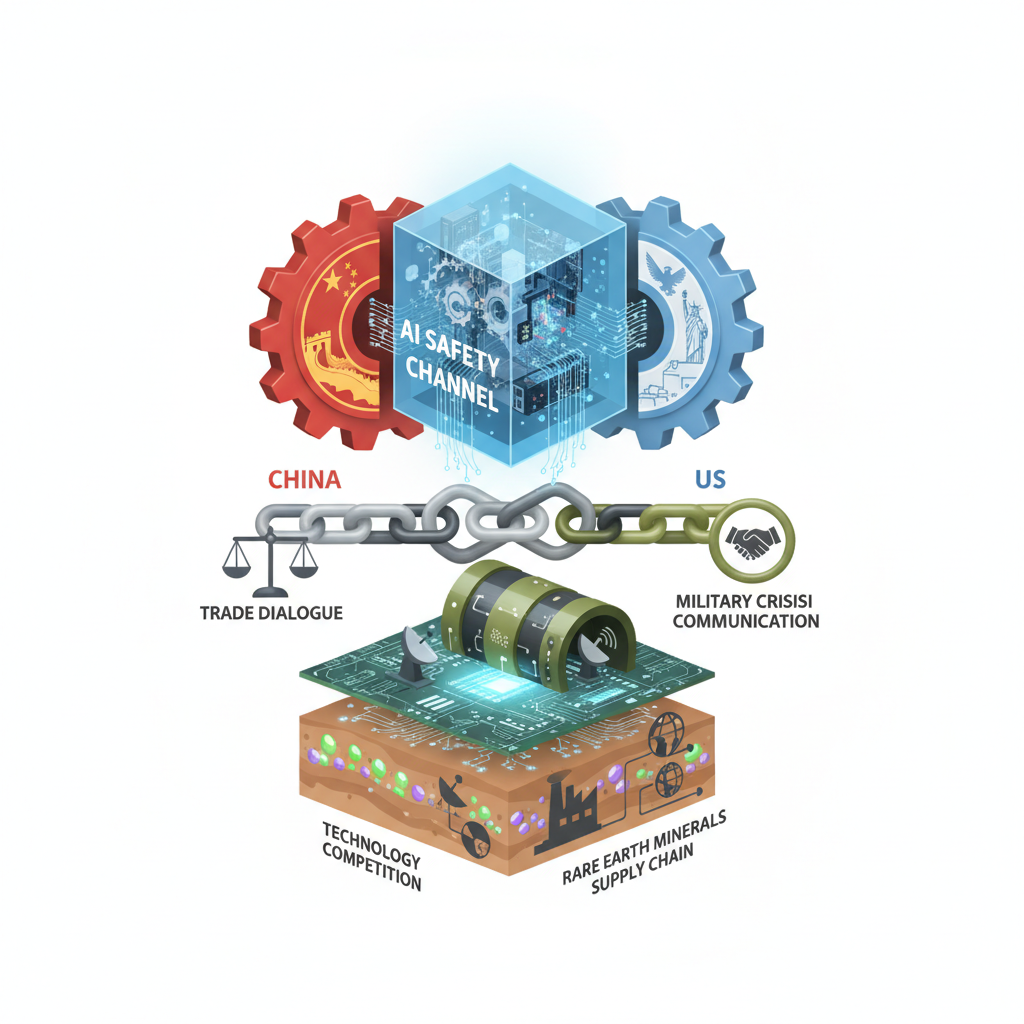
✎ The US-China AI Safety Channel represents an institutionalised effort to manage risks in emerging technologies while sustaining dialogue on trade and military crisis communications, highlighting the need for global governance…
Subject Relevance — Where This Topic Fits
- GS Paper II — International Relations: Bilateral, Regional and Global Groupings and Agreements involving India and/or affecting India’s interests | GS Paper II — Effect of Policies and Politics of Developed and Developing Countries on India’s interests | GS Paper III — Indian Economy and issues relating to Planning, Mobilisation of Resources, Growth, Development and Employment: Trade and Commerce | GS Paper III — Science and Technology — Developments and their Applications and Effects in Everyday Life: Artificial Intelligence
- Prelims: Artificial Intelligence (AI), AI safety, AI governance, US-China bilateral relations, rare earth minerals, fentanyl, Strait of Hormuz, crisis communication mechanisms, trade truce, tariff reduction, Asia-Pacific Economic Cooperation (APEC), G20, export controls
- Essay: The evolving architecture of global governance in the 21st century: Can multilateralism survive great-power rivalry?, Technology as a double-edged sword: Balancing innovation with ethical and security imperatives
Quick Revision: The US-China AI Safety Channel represents an institutionalised effort to manage risks in emerging technologies while sustaining dialogue on trade and military crisis communications, highlighting the need for global governance frameworks in an era of strategic competition.
Why is this in the news?
The recent US-China summit in Washington has established a new bilateral channel for managing risks associated with artificial intelligence, alongside commitments to enhance military crisis communication mechanisms and sustain dialogue on trade. This development is significant as it reflects an attempt to institutionalise cooperation on emerging technologies and security concerns amid ongoing geopolitical tensions, with potential implications for global governance, supply chains, and strategic stability.
Background
- The US-China relationship has been marked by strategic competition, particularly in technology, trade, and military domains, since the early 2010s.
- China’s dominance in the rare earth minerals supply chain has been leveraged as a strategic tool in trade negotiations, given their critical role in modern manufacturing, including electronics and defence.
- The summit follows a pattern of periodic high-level engagements aimed at managing competition and preventing unintended escalation between the two powers.
What is the US-China AI Safety Channel and Related Agreements?
- The **AI Safety Channel** is a bilateral communication mechanism established to address risks and benefits associated with artificial intelligence, including incident response, ethical concerns, and alignment of governance frameworks.
- The channel will facilitate **structured dialogue** between US and Chinese officials, researchers, and policymakers, with a dedicated AI-specific dialogue scheduled for November 2026.
- The agreement builds on existing **crisis communication mechanisms** between the two militaries, aiming to prevent accidental escalation in the context of AI-driven defence systems and autonomous technologies.
- Both countries have committed to **continuing trade negotiations**, including the reduction of reciprocal tariffs on non-sensitive goods such as agricultural products and holiday decorations.
- The US-China **Board of Trade** has been operationalised to address selected bilateral trade issues, signalling a partial thaw in trade relations following a period of heightened tensions.
- Both sides reaffirmed their commitment to ensuring freedom of navigation in international waterways such as the Strait of Hormuz.
Key Features
| Feature | Significance |
|---|---|
| AI Safety Communication Channel | Establishes a dedicated mechanism for managing risks and incidents related to artificial intelligence, reducing the likelihood of unintended escalation due to AI-driven misunderstandings or errors. |
| Military Crisis Communication Mechanism | Creates structured dialogue pathways to prevent and manage military crises, enhancing strategic stability and reducing the risk of accidental conflict. |
| Trade Truce Extension | Temporarily reduces trade tensions by extending the truce, allowing continued negotiations on tariff reductions and market access without immediate escalation. |
| Rare Earths Supply Dialogue | Reinitiates discussions on rare earths exports, addressing supply chain vulnerabilities critical for high-tech industries and defence manufacturing. |
| Fentanyl Precursor Export Controls | China’s commitment to control additional fentanyl precursors aligns with global efforts to curb illicit drug trafficking and public health crises. |
Why it Matters
Geopolitical Stability
- Demonstrates a pragmatic approach to managing bilateral tensions through structured dialogue, reducing the risk of unintended escalation in an era of rapid technological and military advancement.
- The establishment of communication channels reflects a recognition of mutual vulnerabilities in AI, trade, and military domains, fostering a more predictable international environment.
- Serves as a case study for crisis prevention in great-power relations, highlighting the importance of institutionalised dialogue over ad-hoc negotiations.
Economic Interdependence
- The trade truce and discussions on tariff reductions underscore the deep economic linkages between the US and China, despite ongoing strategic competition.
- Rare earths supply chain discussions address critical dependencies in high-tech and defence industries, particularly for the US, which relies heavily on Chinese exports.
- The agreement to import 10 million metric tons of US coal by 2027-2028 signals a partial easing of trade restrictions, though the scale remains modest compared to total bilateral trade.
Technological Governance
- The AI safety channel represents an early attempt to regulate emerging technologies through international cooperation, addressing risks such as autonomous weapons, misinformation, and algorithmic bias.
- The dialogue on AI risks aligns with global efforts to establish norms for responsible AI development, as seen in initiatives like the Global Partnership on AI (GPAI).
- The mechanism could serve as a model for other major powers to collaborate on AI governance, balancing innovation with safety and ethical considerations.
Military Confidence-Building
- The military crisis communication mechanism is a step toward reducing the risk of miscalculation or accidental conflict, particularly in the Indo-Pacific region where US-China interactions are frequent.
- Such mechanisms are part of broader confidence-building measures (CBMs) that have historically reduced tensions in other regions, such as the Cold War-era hotline between the US and USSR.
- The agreement complements existing dialogues like the Military Maritime Consultative Agreement (MMCA) but focuses specifically on crisis prevention in the context of emerging technologies.
Global Supply Chain Resilience
- The rare earths dialogue highlights the fragility of global supply chains for critical minerals, which are essential for technologies ranging from smartphones to electric vehicles and military equipment.
- China’s dominance in rare earths production (accounting for ~60% of global supply) makes supply chain diversification a strategic priority for the US and other nations.
- Efforts to stabilise supply chains through dialogue reduce the risk of coercive measures, such as export controls, which can disrupt industries and geopolitical stability.
Challenges
1. Institutionalising Trust in AI Governance
- Defining clear protocols for AI incident reporting and response remains a challenge, as AI systems operate with varying degrees of autonomy and opacity.
- Divergent regulatory approaches between the US (emphasis on innovation) and China (state-led oversight) may hinder consensus on AI safety standards.
- The lack of binding agreements risks making the AI safety channel a symbolic gesture rather than an effective governance tool.
UPSC Link: GS3: Science & Technology – AI Governance
2. Balancing Trade Competition and Cooperation
- Structural trade imbalances and strategic competition (e.g., semiconductor restrictions, export controls) create persistent friction despite temporary truces.
- Domestic political pressures in both countries may undermine commitments, particularly if hardline factions gain influence.
- The modest scale of tariff reductions (USD 30 billion) and coal imports (10 million metric tons) suggests limited economic relief amid broader trade tensions.
UPSC Link: GS3: Indian Economy – Trade Policies
3. Mitigating Rare Earths Dependency
- China’s near-monopoly in rare earths production (e.g., neodymium for magnets, lanthanum for batteries) creates leverage that could be weaponised in future disputes.
- Developing alternative supply chains (e.g., Australia, Vietnam, or recycling) requires significant investment and time, leaving the US vulnerable in the short term.
- Export controls on rare earths remain a potential tool for coercive diplomacy, despite ongoing dialogues.
UPSC Link: GS3: Mineral Security – Critical Minerals
4. Preventing Military Miscalculation
- The absence of a formal treaty or verification mechanism for the military crisis communication channel may limit its effectiveness in preventing accidents.
- Rapid advancements in AI-driven military systems (e.g., autonomous drones, hypersonic weapons) increase the risk of unintended escalation.
- Regional flashpoints (e.g., South China Sea, Taiwan Strait) remain potential triggers for conflict, even with improved dialogue.
UPSC Link: GS2: International Relations – Conflict Prevention
5. Addressing Illicit Drug Trafficking
- China’s control of fentanyl precursors is a positive step, but enforcement challenges persist due to transnational criminal networks and weak regulatory oversight in some regions.
- The US-China agreement must be complemented by global cooperation (e.g., UNODC frameworks) to tackle the fentanyl crisis effectively.
- Demand-side factors (e.g., opioid addiction in the US) require parallel domestic policy responses.
UPSC Link: GS3: Internal Security – Drug Trafficking
Challenges — UPSC Perspective
| Issue | Concern |
|---|---|
| AI Governance Divergence | Differing regulatory philosophies between the US and China may hinder the development of universally accepted AI safety standards. |
| Trade Protectionism | Persistent structural imbalances and strategic competition could undermine the temporary truce, leading to renewed trade barriers. |
| Rare Earths Monopoly | China’s dominance in rare earths production creates leverage that could be exploited in future geopolitical disputes. |
| Military Accidents | The absence of binding agreements for the crisis communication mechanism may fail to prevent miscalculation in high-stakes scenarios. |
| Illicit Drug Supply Chains | Transnational criminal networks may circumvent precursor controls, requiring robust international enforcement mechanisms. |
Way Forward
- Strengthen the AI safety channel by formalising protocols for incident reporting, risk assessment, and joint mitigation strategies to ensure accountability.
- Expand the scope of trade negotiations to include broader tariff reductions and non-tariff barriers, addressing structural imbalances beyond temporary truces.
- Accelerate efforts to diversify rare earths supply chains through investment in mining, recycling, and alternative sources to reduce dependency on China.
- Institutionalise the military crisis communication mechanism with clear escalation paths, verification measures, and regular joint exercises to build trust.
- Enhance international cooperation on fentanyl precursor controls by sharing intelligence, harmonising regulations, and supporting demand-reduction programmes.
- Encourage third-party mediation (e.g., via ASEAN, UN) to supplement bilateral dialogues, ensuring a multilateral framework for crisis prevention.
- Develop common AI safety standards through platforms like the Global Partnership on AI (GPAI) to align US-China approaches with global norms.
- Monitor compliance with commitments (e.g., coal imports, tariff reductions) through transparent reporting mechanisms to maintain momentum.
UPSC Value Addition
Keywords for Mains Answer-Writing
Artificial Intelligence governance · bilateral diplomatic channels · crisis communication mechanisms · trade diplomacy · military confidence-building measures · export controls on critical minerals · fentanyl precursor regulation · nuclear non-proliferation commitments · global supply chain resilience · strategic stability in international relations
Concept Flow
Rapid advancements in AI and military technologies → Increased risk of unintended escalation → Recognition of mutual vulnerabilities → Establishment of communication channels → Structured dialogue to manage risks → Potential for broader governance frameworks.
Prelims Practice Questions
Q1. Consider the following statements regarding the recent US-China agreement on Artificial Intelligence (AI):
1. Both countries agreed to establish a dedicated communication channel for handling AI-related incidents.
2. The agreement includes a legally binding treaty to reduce tariffs on all goods traded between the two nations.
3. The US and China pledged to enhance military crisis communication mechanisms.
How many of the above statements are correct?
- Only one
- Only two
- All three
- None
Answer: Only two — Statement 1 is correct as the agreement explicitly mentions setting up a communication mechanism for AI-related incidents. Statement 2 is incorrect because the agreement focuses on reducing tariffs on selected bilateral trade issues, not all goods. Statement 3 is correct as both sides agreed to strengthen crisis communications between their militaries.
Q2. Assertion (A): The recent US-China agreement includes provisions for China to import 10 million metric tons of coal from the US in 2027 and 2028.
Reason (R): The agreement aims to reduce reciprocal tariffs on approximately USD 30 billion worth of goods, primarily non-sensitive items such as agricultural products.
Options:
A. Both A and R are true, and R is the correct explanation of A.
B. Both A and R are true, but R is not the correct explanation of A.
C. A is true, but R is false.
D. A is false, but R is true.
Answer: ? — Assertion (A) is true as the agreement explicitly mentions China’s commitment to import coal. Reason (R) is also true as it correctly describes the tariff reduction focus, but it does not explain the coal import commitment, which is a separate trade concession.
Q3. Match the following initiatives agreed upon in the recent US-China summit with their respective domains:
Column I (Initiative) | Column II (Domain)
———————————————–|—————————————-
A. AI safety communication channel | 1. Trade and economic cooperation
B. Reduction of tariffs on USD 30 billion goods| 2. Military and strategic stability
C. Military crisis communication mechanism | 3. Artificial Intelligence governance
D. Export controls on fentanyl precursors | 4. Drug regulation and law enforcement
Options:
A. A-3, B-1, C-2, D-4
B. A-1, B-2, C-3, D-4
C. A-4, B-3, C-2, D-1
D. A-2, B-1, C-3, D-4
Answer: ? — A-3: AI safety communication channel relates to Artificial Intelligence governance. B-1: Reduction of tariffs relates to trade and economic cooperation. C-2: Military crisis communication mechanism relates to military and strategic stability. D-4: Export controls on fentanyl precursors relate to drug regulation and law enforcement.
Mains Practice Question
✍ The establishment of dedicated bilateral channels for crisis communication, including those related to Artificial Intelligence (AI) and military affairs, reflects a growing recognition of the need for structured mechanisms to manage emerging risks in contemporary international relations. Critically examine the significance of such channels in maintaining strategic stability and preventing escalation in an era of rapid technological advancement and geopolitical competition. (15 Marks)
Approach: MODEL-ANSWER SKELETON:
1. **Introduction (2 marks)**: Define strategic stability and its relevance in contemporary international relations, highlighting the role of crisis communication channels.
2. **Rationale for Dedicated Channels (4 marks)**:
– **AI Governance**: Discuss the risks posed by AI (misalignment, autonomous systems, dual-use technologies) and the need for structured dialogue to prevent unintended escalation.
– **Military Crisis Communication**: Explain the historical context of military-to-military communication mechanisms (e.g., hotlines, confidence-building measures) and their role in preventing miscalculation.
– **Precedents**: Cite examples of existing mechanisms (e.g., US-Russia deconfliction in Syria, India-Pakistan hotline agreements).
3. **Challenges and Limitations (4 marks)**:
– **Trust Deficit**: Discuss the inherent skepticism between major powers (US, China) and the difficulty in sustaining such channels.
– **Technological Complexity**: Highlight the challenges in defining AI-related risks and the lack of standardized frameworks for AI governance.
– **Asymmetric Interests**: Note that while both sides may agree on the need for communication, their strategic objectives may diverge, limiting the effectiveness of such channels.
4. **Broader Implications (3 marks)**:
– **Global Governance**: Discuss how bilateral channels can complement multilateral efforts (e.g., UN, G20, AI Safety Summits) in establishing norms for AI and military technologies.
– **Supply Chain Resilience**: Link the discussion to trade and economic cooperation (e.g., rare earths, fentanyl regulation) as part of a broader confidence-building agenda.
– **Precedent for Other Powers**: Argue that such mechanisms could set a precedent for other major powers (e.g., India, EU) to adopt similar frameworks.
5. **Conclusion (2 marks)**: Summarize the significance of these channels while acknowledging their limitations, and emphasize the need for sustained engagement and institutionalization.
Source: orissapost.com
Generated by AanyaAi for educational purpose.
Related guides on our sites
- Current affairs for upsc 2026
- How to prepare for GS paper 1 for UPSC CSE mains exam
- Best UPSC coaching for IFOS exam
- Best mentorship programme for upsc

- China-US Agree to New AI Safety Channel: UPSC Exam Insights for 2026 - September 26, 2026
- EC का बड़ा बयान: सभी SIR फैसले सर्वसम्मति से, कैबिनेट सचिव को पत्र नीति से संबंधित नहीं - September 26, 2026
- EC clarifies SIR decisions unanimous, denies policy disputes in UPSC exam context - September 26, 2026

No Comments