


13 Aug Chittoor’s Rising Elephant Population: Human-Wildlife Conflict Analysis for UPSC
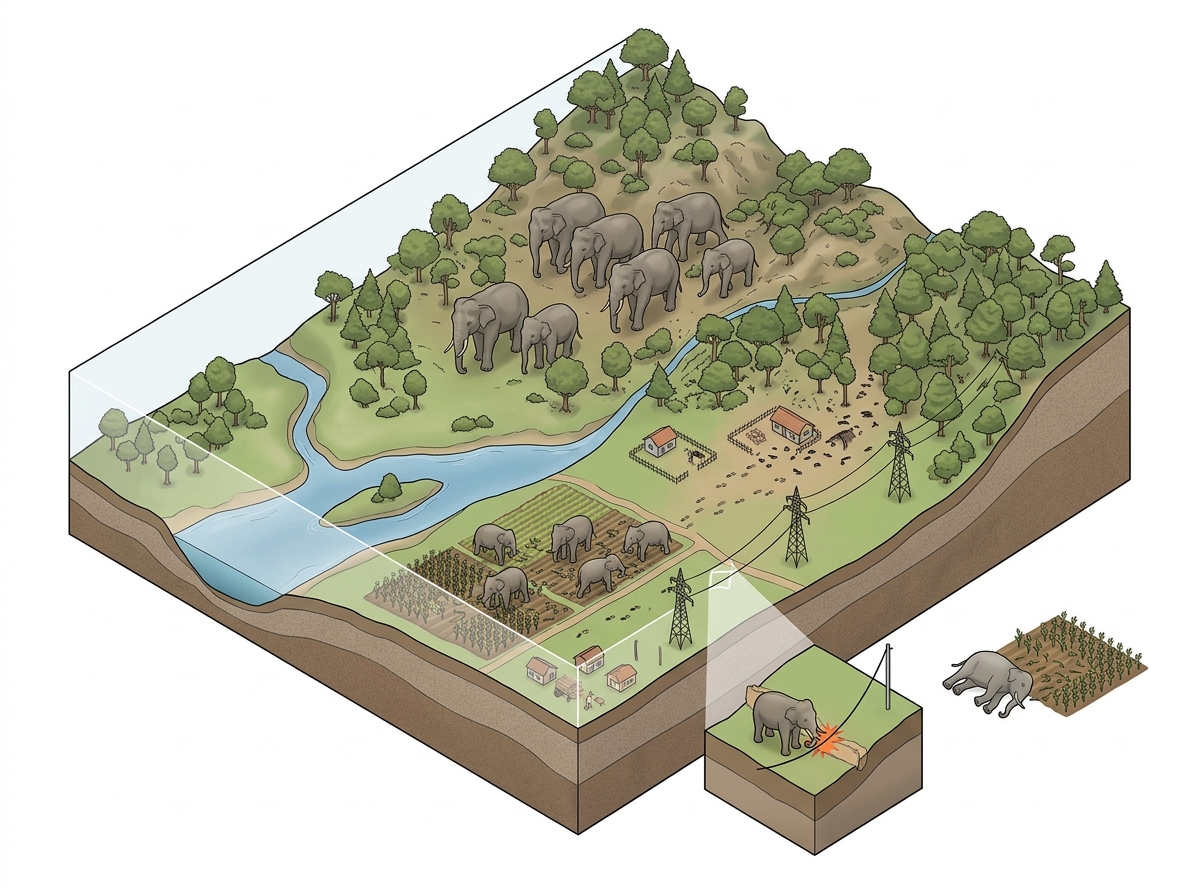
Elephant populationHuman settlementsCrop fieldsMigratory corridors✎ Human-elephant conflict in Chittoor stems from the restoration of ecological connectivity in the Koundinya Wildlife Sanctuary and Rayala Elephant Corridor, necessitating integrated management strategies that balance conservation…
Subject Relevance — Where This Topic Fits
- GS Paper III — Environment, Ecology, Biodiversity and Climate Change | GS Paper III — Disaster Management
- Prelims: Asian elephant (Elephas maximus), Kumki elephants, Koundinya Wildlife Sanctuary, Rayala Elephant Corridor, human-wildlife conflict, electrocution mortality, migratory corridors, Seshachalam ranges, Forest Rights Act 2006, Wildlife Protection Act 1972, Protected Area Network
- Essay: Biodiversity conservation vs. human livelihoods: Balancing ecological imperatives with socio-economic realities, The paradox of conservation success: When recovery of endangered species intensifies human-wildlife conflict
Quick Revision: Human-elephant conflict in Chittoor stems from the restoration of ecological connectivity in the Koundinya Wildlife Sanctuary and Rayala Elephant Corridor, necessitating integrated management strategies that balance conservation imperatives with agricultural livelihoods and infrastructure safety.
Why is this in the news?
The rising population of Asian elephants in Chittoor district of Andhra Pradesh has led to an escalation in human-wildlife conflicts, including increased crop depredation, human casualties, and elephant mortality due to electrocution. This development necessitates a re-evaluation of conservation strategies that balance ecological connectivity with the safety of local communities and agricultural livelihoods, particularly as elephants utilise migratory corridors that traverse human-dominated landscapes.
Background
- The Asian elephant (Elephas maximus) was historically present in the Chittoor region but disappeared for over two centuries before re-emerging in the 1980s near Kuppam, marking a significant conservation milestone.
- The reappearance of elephants led to the creation and strengthening of the Koundinya Wildlife Sanctuary, which spans Palamaner and Kuppam Assembly constituencies and serves as a focal zone for elephant conservation in Andhra Pradesh.
- The sanctuary is part of the Rayala Elephant Corridor, a critical migratory pathway facilitating seasonal movements of elephant herds between Tamil Nadu, Karnataka, and Andhra Pradesh.
- Chittoor district’s landscape offers ecological connectivity, enabling the establishment of a resident and migratory elephant population of over 140 individuals, the only sustained presence of wild elephants in Andhra Pradesh.
- The migratory routes of elephants extend through agricultural fields, mango and banana plantations, increasing interactions with human settlements.
- Electrocution from power lines and agricultural electrification has emerged as a leading cause of elephant mortality in the region, with over 20 elephant deaths and a dozen human casualties reported in the past decade.
Human-Elephant Conflict: Causes, Consequences, and Management Strategies in Chittoor
- **Ecological Connectivity and Migratory Corridors**: The Chittoor landscape, including the Koundinya Wildlife Sanctuary and the Rayala Elephant Corridor, forms a critical link in the transboundary migratory network of Asian elephants. These corridors are essential for genetic flow and seasonal resource utilisation but also bring elephants into proximity with human settlements.
- **Human-Wildlife Interface**: The expansion of agriculture, particularly mango and banana plantations, and the presence of linear infrastructure (e.g., national highways) have fragmented habitats and increased the frequency of human-elephant encounters, leading to crop raiding and property damage.
- **Electrocution Mortality**: The proliferation of uninsulated power lines, improperly installed electrical fencing, and agricultural electrification in proximity to elephant habitats has resulted in a high incidence of elephant electrocution, posing a severe threat to the population’s sustainability.
- **Crop Depredation and Livelihood Impacts**: Farmers in Chittoor experience significant economic losses due to elephant raids on standing crops, particularly during harvest seasons, exacerbating rural distress and fuelling resentment towards conservation efforts.
- **Kumki Elephants as a Mitigation Tool**: Trained captive elephants (Kumkis) are deployed by the Forest Department to guide wild elephant herds away from human settlements and agricultural areas. In Chittoor, six Kumkis stationed at the Musallamadugu forest camp have been utilised in over a dozen operations in the past five years to manage conflict scenarios.
- **Community-Based Conservation Challenges**: The coexistence of human settlements with elephant habitats requires participatory approaches, including the promotion of eco-friendly agricultural practices, community-based early warning systems, and compensation mechanisms for crop and property damage, to foster tolerance and reduce retaliatory actions.
Key Features
| Feature | Significance |
|---|---|
| Koundinya Wildlife Sanctuary | Established in 1990 as a focal zone for elephant conservation in Andhra Pradesh, spanning Palamaner and Kuppam Assembly constituencies. |
| Asian Elephant Migratory Path | Connects Mudumalai and Bannerghatta to Koundinya sanctuary and Rayala Elephant Corridor, facilitating seasonal movements. |
| Kumki Elephants | Trained elephants deployed by the Forest Department to manage human-elephant conflict through controlled interventions. |
| Electrocution Risk | Agricultural power lines and installations pose lethal hazards to elephants, accounting for over 20 deaths in the last decade. |
| Seshachalam Landscape | Adjacent to Koundinya sanctuary, this region supports a growing elephant population with established migratory routes. |
Why it Matters
Ecological Significance
- Restoration of Asian elephant habitat in Chittoor after a hiatus of over two centuries, demonstrating successful conservation efforts.
- Maintenance of ecological connectivity between fragmented forests, supporting biodiversity and ecosystem services.
- Preservation of the Rayala Elephant Corridor, a critical linkage for elephant movement between Tamil Nadu and Andhra Pradesh.
Socio-Economic Significance
- Agricultural livelihoods in Chittoor district are directly impacted by crop raids, leading to economic losses for farmers.
- Human casualties from encounters with wild elephants pose public health and safety challenges.
- Tourism potential in wildlife sanctuaries, if managed sustainably, could contribute to local economies.
Administrative Significance
- Demonstrates the challenges of balancing conservation with human development in shared landscapes.
- Highlights the role of forest departments in mitigating human-wildlife conflict through innovative strategies like Kumki elephants.
- Showcases the need for inter-state coordination in managing migratory species across administrative boundaries.
Challenges
1. Human-Elephant Conflict (HEC)
- Escalation in crop raiding and property damage due to expanding elephant ranges and shrinking habitats.
- Increased risk of human casualties from direct encounters or retaliatory actions.
- Strain on forest department resources to manage conflict zones effectively.
UPSC Link: GS3: Environment & Biodiversity
2. Electrocution and Infrastructure Hazards
- High mortality rate among elephants due to contact with power lines and agricultural electrification.
- Frequent human fatalities from accidental electrocution during conflict mitigation efforts.
- Need for retrofitting power lines and implementing safer agricultural practices.
UPSC Link: GS3: Environment & Biodiversity
3. Habitat Fragmentation and Connectivity Loss
- Urbanization and linear infrastructure (e.g., highways, expressways) disrupt traditional migratory routes.
- Reduced ecological connectivity threatens long-term survival of elephant populations.
- Requires landscape-level planning to restore and maintain wildlife corridors.
UPSC Link: GS3: Environment & Biodiversity
4. Resource Constraints in Forest Management
- Limited availability of trained Kumki elephants and personnel to address conflict zones.
- Inadequate funding for habitat restoration, compensation schemes, and community engagement.
- Need for capacity-building and technological interventions (e.g., early warning systems).
UPSC Link: GS3: Environment & Biodiversity
5. Inter-State Coordination Gaps
- Migratory elephants traverse multiple states, necessitating coordinated conservation strategies.
- Differences in wildlife protection policies and enforcement across state boundaries.
- Lack of standardized protocols for managing transboundary wildlife movements.
UPSC Link: GS2: Federalism & Inter-State Relations
Challenges — UPSC Perspective
| Issue | Concern |
|---|---|
| Crop Raiding | Economic losses for farmers and retaliatory killings of elephants. |
| Human Casualties | Fatalities from direct encounters or electrocution during conflict. |
| Habitat Fragmentation | Disruption of migratory routes due to infrastructure development. |
| Electrocution Risk | High mortality rate among elephants from power line contact. |
| Resource Constraints | Insufficient trained personnel and funding for conflict mitigation. |
| Policy Coordination | Gaps in inter-state collaboration for transboundary conservation. |
Government Initiatives — Must-Memorise for Prelims
- Project Elephant (Government of India scheme for elephant conservation)
- Compensatory Afforestation Fund Management and Planning Authority (CAMPA) for habitat restoration
Way Forward
- Implement wildlife-friendly infrastructure designs (e.g., underpasses, overpasses) to mitigate highway-related conflicts.
- Strengthen power line safety measures through underground cabling or insulated wires in high-risk zones.
- Expand the deployment of Kumki elephants and train additional personnel for conflict management.
- Develop community-based early warning systems to alert farmers during elephant movements.
- Enhance compensation mechanisms for crop and property damage to reduce retaliatory actions.
- Promote agroforestry and alternative livelihoods to reduce dependency on crops vulnerable to raids.
- Establish a multi-state coordination mechanism for managing transboundary elephant populations.
- Invest in habitat restoration and corridor connectivity projects to support long-term conservation.
UPSC Value Addition
Keywords for Mains Answer-Writing
Human-wildlife conflict · Asian elephant conservation · Koundinya Wildlife Sanctuary · Rayala Elephant Corridor · Seshachalam Biosphere Reserve · Kumki elephants · Wildlife Protection Act 1972 · Elephant corridors · Human-elephant mitigation strategies · Biodiversity conservation · Wildlife habitat fragmentation · Electrocution of wild elephants · Protected area network · Conservation governance
Concept Flow
Historical absence of elephants in Chittoor → Reappearance in 1980s due to ecological recovery → Establishment of Koundinya Wildlife Sanctuary (1990) → Expansion of elephant population → Increased human-wildlife interactions → Escalation of crop raids and human casualties → Deployment of Kumki elephants and power line safety measures → Persistent challenges due to habitat fragmentation and infrastructure development → Need for integrated conservation strategies.
Prelims Practice Questions
Q1. Consider the following statements regarding the Asian elephant (Elephas maximus) in India:
1. The Asian elephant is listed as ‘Endangered’ on the IUCN Red List.
2. The Wildlife Protection Act, 1972, provides the legal framework for the protection of elephants in India.
3. The Rayala Elephant Corridor connects the Koundinya Wildlife Sanctuary with the Seshachalam Biosphere Reserve.
4. Kumki elephants are wild elephants trained to assist in human-wildlife conflict mitigation.
How many of the above statements are correct?
- Only one
- Only two
- Only three
- All
Answer: All — Statements 1, 2, and 3 are correct. The Asian elephant is classified as ‘Endangered’ by IUCN. The Wildlife Protection Act, 1972, governs the protection of elephants. The Rayala Elephant Corridor connects Koundinya Wildlife Sanctuary with Seshachalam Biosphere Reserve. Statement 4 is incorrect; Kumki elephants are domesticated elephants trained to assist in conflict mitigation, not wild elephants.
Q2. Assertion (A): The establishment of wildlife corridors is essential for the long-term survival of elephant populations in fragmented landscapes.
Reason (R): Elephants require large home ranges and corridors facilitate their movement between habitats, reducing human-wildlife conflict.
Options:
A. Both A and R are true, and R is the correct explanation of A.
B. Both A and R are true, but R is not the correct explanation of A.
C. A is true, but R is false.
D. A is false, but R is true.
Answer: ? — Both the assertion (A) and reason (R) are true. Wildlife corridors are critical for elephant conservation as they enable movement between habitats, which is essential for their survival in fragmented landscapes. The reason (R) correctly explains the assertion (A).
Q3. Match the following pairs related to elephant conservation in India:
Column I
1. Koundinya Wildlife Sanctuary
2. Rayala Elephant Corridor
3. Seshachalam Biosphere Reserve
4. Kumki elephants
Column II
A. Trained elephants used for conflict mitigation
B. Protected area in Andhra Pradesh
C. Connects Koundinya with Seshachalam
D. Part of Eastern Ghats landscape
Answer: ? —
Mains Practice Question
✍ Human-wildlife conflict involving elephants has intensified in recent years due to habitat fragmentation and expanding human settlements. Critically examine the ecological, legal, and governance challenges in managing human-elephant conflict in India, with particular reference to the situation in Chittoor district. (15 Marks)
Approach: MODEL-ANSWER SKELETON:
1. **Ecological Challenges (4 points)**
– Habitat fragmentation and loss of corridors (e.g., Rayala Elephant Corridor, Seshachalam landscape) due to agriculture, infrastructure, and settlements.
– Increasing elephant populations (e.g., 140+ in Chittoor) leading to pressure on limited resources.
– Seasonal migration patterns (e.g., herds from Mudumalai/Bannerghatta) exacerbating conflicts during harvest seasons.
– Ecological connectivity vs. human safety trade-offs in conservation planning.
2. **Legal and Policy Framework (4 points)**
– Wildlife Protection Act, 1972: Provisions for protected areas, Schedule I species, and penalties for harming elephants.
– National Wildlife Action Plan (2017-2031): Emphasizes habitat connectivity and human-wildlife conflict mitigation.
– Forest Rights Act, 2006: Balancing tribal rights with wildlife conservation in buffer zones.
– Challenges in enforcement (e.g., electrocution deaths due to unregulated power lines in agricultural fields).
3. **Governance and Mitigation Strategies (4 points)**
– Role of Forest Department: Use of Kumki elephants (e.g., 6 Kumkis in Palamaner camp) for conflict mitigation.
– Community-based approaches: Compensation schemes for crop/life losses (e.g., Andhra Pradesh’s compensation policy).
– Technological interventions: Early warning systems, solar fencing, and alternative livelihoods for farmers.
– Inter-state coordination: Need for collaboration between Andhra Pradesh, Karnataka, and Tamil Nadu for corridor management.
4. **Critical Analysis and Way Forward (3 points)**
– Balancing conservation goals with human safety: Is the current approach sustainable?
– Need for integrated land-use planning to restore corridors (e.g., Chennai-Bengaluru Expressway corridor impacts).
– Role of judicial activism (e.g., Supreme Court directives on elephant corridors) and public participation in conflict resolution.
Source: The Hindu
Generated by AanyaAi for educational purpose.

- मद्रास उच्च न्यायालय में ‘वेट्ट्री पयणम’ योजना को असंवैधानिक घोषित करने की मांग - October 4, 2026
- Gurugram’s groundwater extraction exceeds limit by 212%; HC seeks ban - October 4, 2026
- स्वतंत्रता सेनानी श्यामजी कृष्ण वर्मा की जन्म जयंती पर पीएम का श्रद्धांजलि - October 4, 2026

No Comments