


07 Aug Congress Issues Whip for FCRA Bill: Key Polity Updates for UPSC 2026
✎ The Bill seeks to tighten regulations on foreign funding for NGOs in India by mandating stricter utilisation norms, enhanced reporting, and reduced timelines for compliance, amid debates on national security and civil society…
Subject Relevance — Where This Topic Fits
- GS Paper II — Polity and Governance (Parliamentary Procedures, Whip System) | GS Paper III — Economy (Non-Governmental Organisations, Foreign Funding Regulations)
- Prelims: Foreign Contribution (Regulation) Act, 2010, FCRA Amendment Bill, 2025, Whip System in Parliament, Parliamentary Whip, INDIA Bloc, Delimitation, Constitution Amendment Bill
- Essay: The role of parliamentary whips in democratic governance: Ensuring party discipline versus individual conscience, Balancing national security and civil society space: The FCRA debate
Quick Revision: The Bill seeks to tighten regulations on foreign funding for NGOs in India by mandating stricter utilisation norms, enhanced reporting, and reduced timelines for compliance, amid debates on national security and civil society autonomy.
Why is this in the news?
The Congress party has issued a whip to its Members of Parliament (MPs) to ensure their presence during the discussions on the Foreign Contribution (Regulation) Amendment Bill in the Monsoon Session of Parliament. This move underscores the political significance of the Bill, which seeks to amend the Foreign Contribution (Regulation) Act, 2010, and reflects broader debates on foreign funding, transparency, and the autonomy of non-governmental organisations (NGOs) in India.
Background
- The Foreign Contribution (Regulation) Act, 2010, regulates the acceptance and utilisation of foreign contributions or donations by individuals, associations, and companies in India to ensure that such contributions do not compromise national security or public interest.
- The Congress party’s issuance of a whip to its MPs highlights the Bill’s contentious nature and the party’s intent to present a united front during parliamentary debates.
- The INDIA Bloc, an opposition coalition, has been actively engaging in parliamentary proceedings, and the Congress’s directive to its allies to ensure MP presence suggests a coordinated opposition strategy.
- The Bill’s introduction coincides with broader discussions on delimitation, another contentious issue that may be deliberated in the same session, further intensifying parliamentary dynamics.
- The Monsoon Session of Parliament is a critical period for legislative business, with multiple Bills and discussions on national importance scheduled for debate.
What is the Foreign Contribution (Regulation) Amendment Bill?
- The Bill seeks to amend the Foreign Contribution (Regulation) Act, 2010, which governs the acceptance and utilisation of foreign contributions by individuals and organisations in India.
- Key proposed amendments include stricter utilisation norms for foreign funds, mandatory opening of FCRA accounts in designated banks (State Bank of India branches in New Delhi), and enhanced reporting requirements for NGOs receiving foreign contributions.
- The Bill introduces provisions for the suspension of FCRA registration for non-compliance, with a reduced timeline for adjudication of violations from 180 days to 90 days, aiming to expedite disciplinary action against errant entities.
- The Bill also proposes to prohibit the transfer of foreign contributions to other organisations, ensuring that funds are utilised strictly as per the stated purpose and by the registered entity.
- The amendments aim to address concerns related to national security, transparency, and accountability in the utilisation of foreign funds, particularly in the context of NGOs and civil society organisations.
- The Bill has been criticised by civil society groups for potentially curtailing the operational freedom of NGOs and restricting their ability to receive and utilise foreign funds for legitimate activities.
- The government has defended the Bill as a necessary measure to prevent misuse of foreign funds and ensure that such contributions do not compromise India’s sovereignty or public interest.
- The Bill’s introduction follows a broader global trend of regulating foreign funding, with several countries tightening oversight of NGOs and civil society organisations to prevent foreign interference.
Key Features
| Feature | Significance |
|---|---|
| Whip Issuance by Congress | Ensures party discipline and unified stance during parliamentary proceedings, particularly on contentious bills like the FCRA Amendment Bill. |
| FCRA Amendment Bill | Proposes amendments to the Foreign Contribution (Regulation) Act, 2010, aimed at tightening regulations on foreign funding for NGOs and associations. |
| Monsoon Session of Parliament | A critical legislative session where key bills and amendments are discussed, debated, and potentially passed. |
| INDIA Bloc Coordination | Demonstrates inter-party cooperation among opposition groups to present a united front against government proposals. |
| Parliamentary Whip System | A constitutional mechanism to ensure party members adhere to the party line during voting or debates. |
Why it Matters
Legislative Impact
- The FCRA Amendment Bill, if passed, could significantly alter the regulatory framework governing foreign contributions, affecting NGOs, civil society organizations, and international partnerships.
- Tightened regulations may impact funding sources for advocacy groups, research institutions, and grassroots organizations, particularly those working on human rights, environmental, or social justice issues.
- The bill’s passage could influence India’s global image as a destination for foreign funding and international collaboration.
- Debates on the bill may highlight tensions between governmental oversight and civil society autonomy, a recurring theme in democratic governance.
Political Dynamics
- The issuance of a whip by Congress underscores the opposition’s intent to oppose the FCRA Amendment Bill, reflecting broader political strategies ahead of upcoming elections.
- Coordinated opposition from the INDIA bloc signals a potential challenge to the government’s legislative agenda, particularly on issues perceived as encroaching on democratic freedoms.
- The move could intensify political polarization, with the ruling party and opposition framing the debate in terms of national security versus democratic rights.
Constitutional and Legal Implications
- The FCRA, originally enacted in 1976 and amended in 2010, is rooted in the constitutional directive to regulate foreign contributions to maintain sovereignty and public order (Article 29(2) of the Constitution).
- Amendments to the FCRA may intersect with the Right to Freedom of Association (Article 19(1)(c)) and the Right to Equality (Article 14), raising questions about proportionality and judicial review.
- The bill’s provisions could be tested against the doctrine of ‘reasonable restrictions’ under fundamental rights, a key judicial principle in constitutional law.
Challenges
1. Balancing Regulatory Oversight and Civil Society Autonomy
- The government’s objective to prevent misuse of foreign funds must be balanced against the need to preserve the autonomy of NGOs and civil society organizations.
- Overly restrictive amendments could stifle legitimate advocacy, research, and humanitarian work, particularly in sectors where state funding is insufficient.
- The challenge lies in defining ‘foreign contribution’ and ‘public interest’ in a manner that does not disproportionately curtail democratic freedoms.
UPSC Link: GS II: Governance, NGOs
2. Political Polarization and Legislative Gridlock
- The opposition’s unified stance against the FCRA Amendment Bill could lead to prolonged debates, delaying the legislative process.
- Polarization may erode cooperative federalism, particularly if state governments align with opposition parties on contentious issues.
- The risk of legislative gridlock could undermine the government’s ability to implement its policy agenda, affecting governance and economic reforms.
UPSC Link: GS II: Parliament
3. Judicial Scrutiny and Legal Challenges
- Any amendments to the FCRA are likely to face legal challenges on grounds of constitutional validity, particularly concerning fundamental rights.
- Judicial review of the bill could set precedents for future regulations on foreign funding, influencing both domestic and international NGOs.
- The Supreme Court’s interpretation of ‘reasonable restrictions’ will be pivotal in determining the bill’s fate.
UPSC Link: GS II: Judiciary
4. Impact on International Relations and Funding
- Tighter FCRA regulations could deter foreign donors, including multilateral organizations and philanthropic foundations, from funding Indian NGOs.
- This may reduce India’s attractiveness as a hub for international development and humanitarian work, affecting global partnerships.
- The move could also strain diplomatic relations with countries whose NGOs or citizens are affected by the amendments.
UPSC Link: GS II: International Relations
5. Operational Challenges for NGOs
- NGOs may face administrative burdens, including increased compliance requirements, audits, and reporting obligations under the amended FCRA.
- Smaller organizations with limited resources could struggle to meet new regulatory standards, leading to consolidation or closure.
- The amendments could disproportionately affect grassroots organizations working in marginalized communities.
UPSC Link: GS II: Governance
Challenges — UPSC Perspective
| Issue | Concern |
|---|---|
| Overly Broad Definitions | Risk of vague or expansive definitions of ‘foreign contribution’ or ‘public interest’ leading to arbitrary enforcement. |
| Administrative Burden | Increased compliance requirements for NGOs could divert resources from core activities to regulatory adherence. |
| Judicial Backlog | Legal challenges to the FCRA Amendment Bill could clog the judicial system, delaying resolution of other critical cases. |
| Funding Disruptions | Sudden changes in funding regulations could disrupt ongoing projects, particularly in sectors like education, health, and environment. |
| Political Weaponization | Potential for the FCRA to be used as a tool to target dissenting voices, including activists and opposition-aligned organizations. |
| International Repercussions | Foreign governments and donors may perceive the amendments as restrictive, affecting diplomatic and funding relationships. |
Way Forward
- Conduct a comprehensive impact assessment of the FCRA Amendment Bill on NGOs, civil society, and grassroots organizations to identify potential unintended consequences.
- Engage in multi-stakeholder consultations with NGOs, legal experts, and policymakers to refine the bill’s provisions and address concerns about overreach.
- Establish a transparent and accessible mechanism for NGOs to seek clarifications or exemptions under the amended FCRA to mitigate operational disruptions.
- Strengthen parliamentary oversight through standing committees to ensure that legislative amendments do not infringe upon fundamental rights or democratic freedoms.
- Encourage the judiciary to expedite constitutional challenges to the FCRA Amendment Bill to provide clarity on its validity and scope.
- Promote awareness campaigns among NGOs and civil society to ensure compliance with new regulations while advocating for necessary amendments.
- Foster dialogue between the government and opposition to reduce polarization and explore consensus-driven solutions to legislative impasses.
- Monitor the implementation of the FCRA Amendment Bill to assess its impact on funding flows, project continuity, and organizational sustainability.
UPSC Value Addition
Keywords for Mains Answer-Writing
Foreign Contribution Regulation Act (FCRA), 2010 · FCRA Amendment Bill, 2026 · Parliamentary Whip · Monsoon Session of Parliament, 2026 · Foreign Contributions (Regulation) Act · NGO regulation · Foreign funding of NGOs · Parliamentary procedures · Anti-defection law · Constitution Amendment Bill on delimitation · INDIA bloc alliance · Rajya Sabha and Lok Sabha proceedings · Chief Whip of Congress · Parliamentary affairs · Government business in Parliament
Constitutional & Policy Linkages
- Article 19(1)(c): Right to form associations
- Article 29(2): Regulation of foreign contributions
- Article 14: Equality before law and equal protection
- Article 21: Right to livelihood (via association)
- Article 19(1)(g): Right to practice any profession
Concept Flow
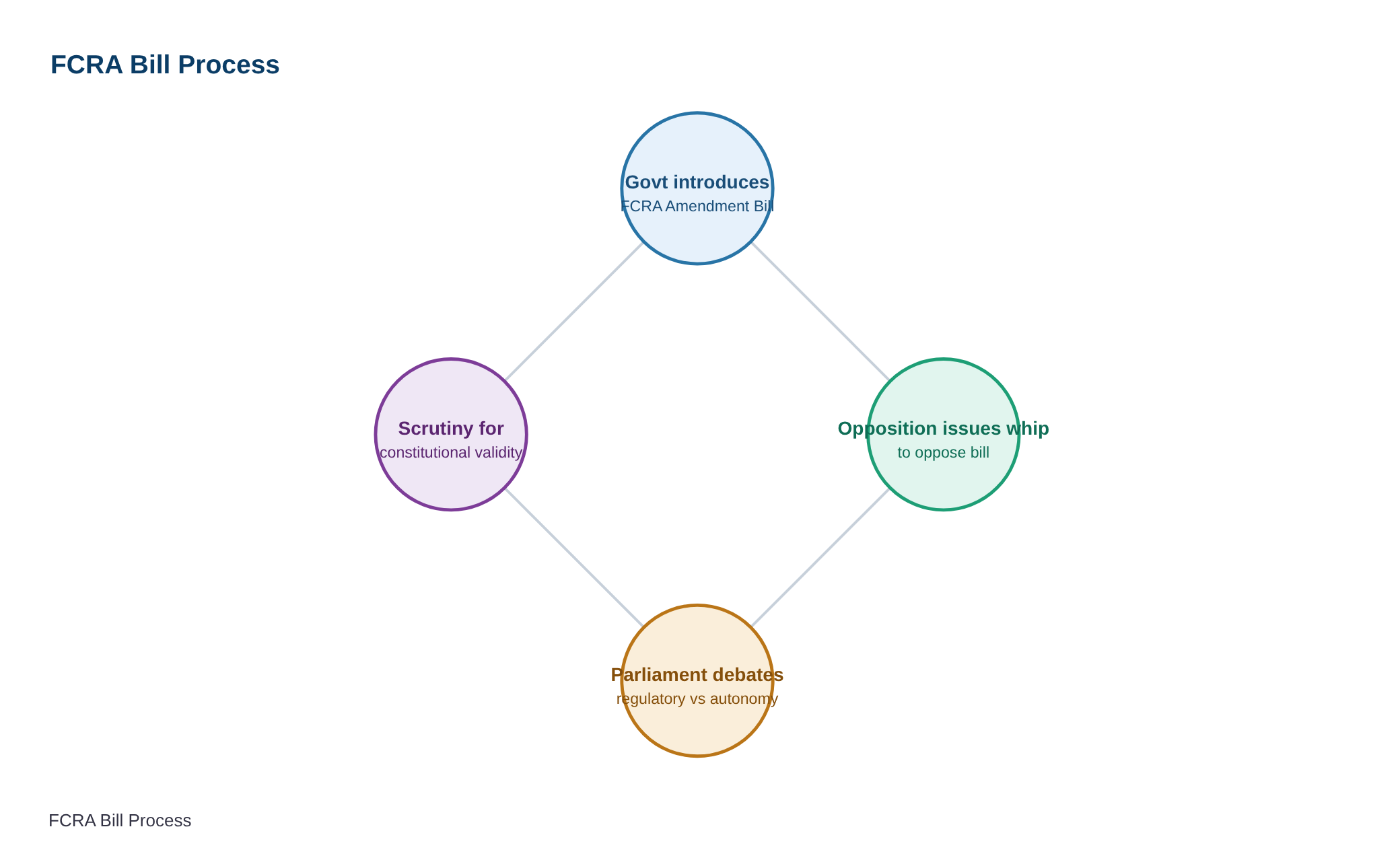
Government introduces FCRA Amendment Bill to Parliament → Opposition parties, led by Congress, issue whip to MPs to oppose the bill → Debate on regulatory oversight vs. civil society autonomy intensifies → Bill’s provisions scrutinized for constitutional validity → Potential legal challenges filed in Supreme Court → NGOs and civil society assess impact on funding and operations → Government and opposition engage in political negotiations → Bill passed or amended based on consensus or judicial intervention → Implementation phase begins, with monitoring for unintended consequences
Prelims Practice Questions
Q1. Consider the following statements regarding the Foreign Contribution (Regulation) Act (FCRA), 2010:
1. It regulates the acceptance and utilisation of foreign contributions by individuals, associations, and companies.
2. The Act mandates that foreign contributions can only be received through designated banks.
3. The Act prohibits the transfer of foreign contributions to any other person or association.
4. The Act empowers the Union Government to prohibit the utilisation of foreign contributions for activities detrimental to the public interest.
How many of the above statements are correct?
- Only one
- Only two
- Only three
- All
Answer: All — Statements 1, 2, and 4 are correct as per the FCRA, 2010. Statement 3 is incorrect because the Act permits the transfer of foreign contributions under certain conditions, subject to prior approval.
Q2. Assertion (A): The Chief Whip of a political party in Parliament issues a whip to ensure party discipline and attendance during critical legislative discussions.
Reason (R): The whip is a constitutional provision that empowers the Chief Whip to enforce anti-defection laws under the Tenth Schedule of the Constitution.
- Both A and R are true, and R is the correct explanation of A.
- Both A and R are true, but R is NOT the correct explanation of A.
- A is true, but R is false.
- A is false, but R is true.
Answer: A is true, but R is false. — The Chief Whip issues a whip to enforce party discipline and ensure attendance, but this is not a constitutional provision under the Tenth Schedule. The Tenth Schedule deals with anti-defection laws, whereas the whip is an internal party mechanism.
Q3. Match the following parliamentary terms with their correct descriptions:
Column I
A. Whip
B. Adjournment Motion
C. Calling Attention Notice
D. Zero Hour
Column II
1. A device to draw the attention of the House to a matter of urgent public importance.
2. A motion to suspend the business of the House for a specified period.
3. A notice given by a member to call the attention of a minister to a matter of public importance.
4. A directive issued by a political party to its members to vote in a particular manner.
- A-4, B-2, C-1, D-3
- A-4, B-2, C-3, D-1
- A-2, B-4, C-3, D-1
- A-1, B-3, C-2, D-4
Answer: A-4, B-2, C-3, D-1 — A whip (A) is a directive issued by a political party to its members (4). An adjournment motion (B) suspends the business of the House (2). A Calling Attention Notice (C) draws attention to a matter of public importance (3). Zero Hour (D) is a time slot for matters of urgent public importance (1).
Mains Practice Question
✍ The proposed amendments to the Foreign Contribution (Regulation) Act (FCRA), 2010, reflect a growing trend of tightening regulations on foreign funding for non-governmental organisations (NGOs) in India. Critically examine the constitutional and administrative implications of such amendments, particularly in the context of parliamentary procedures and the balance of power between the executive and civil society. (15 Marks)
Approach: MODEL-ANSWER SKELETON:
1. **Introduction**: Define FCRA, 2010 and its objectives (regulation of foreign contributions to ensure transparency and accountability).
2. **Key Provisions of FCRA Amendment Bill, 2026**: Highlight the proposed changes (e.g., stricter limits on administrative expenses, mandatory Aadhaar for office-bearers, prior approval for transfer of funds).
3. **Constitutional Implications**:
– Article 19(1)(c) (right to form associations) vs. reasonable restrictions under Article 19(2) (public order, sovereignty, integrity).
– Doctrine of proportionality (test of necessity and least restrictive means).
– Judicial precedents (e.g., Indian Express Newspapers v. Union of India, 1985; PUCL v. Union of India, 2013).
4. **Administrative Implications**:
– Role of the Ministry of Home Affairs (MHA) in granting and renewing FCRA registrations.
– Impact on NGOs working in critical sectors (e.g., human rights, environment, health).
5. **Parliamentary Procedures**:
– Role of the Chief Whip and party discipline in ensuring attendance during debates (as seen in the Monsoon Session, 2026).
– Anti-defection law (Tenth Schedule) and its interplay with whip issuance.
6. **Balance of Power**:
– Executive overreach vs. autonomy of civil society.
– Need for a balanced approach to prevent misuse while safeguarding democratic freedoms.
7. **Conclusion**: Weigh the necessity of regulation against the potential chilling effect on NGOs and suggest measures for a balanced framework.
Source: Times of India
Generated by AanyaAi for educational purpose.

- बिहार सरकार का बड़ा कदम: 25 हजार परिवारों को सौर ऊर्जा सहायता, 534 प्रखंडों में सोलर मार्ट खोले जाएंगे - September 23, 2026
- Bihar Launches Mega Solar Scheme: 25,000 Families to Benefit, 534 Solar Marts - September 23, 2026
- सुपर एल नीनो से भारत में 15,800 अतिरिक्त गर्मी से मौतें: जानिए पूरा मामला - September 23, 2026

No Comments