


13 Aug Congress MP Urges Telangana to Oppose Trans Law Amendments in SC
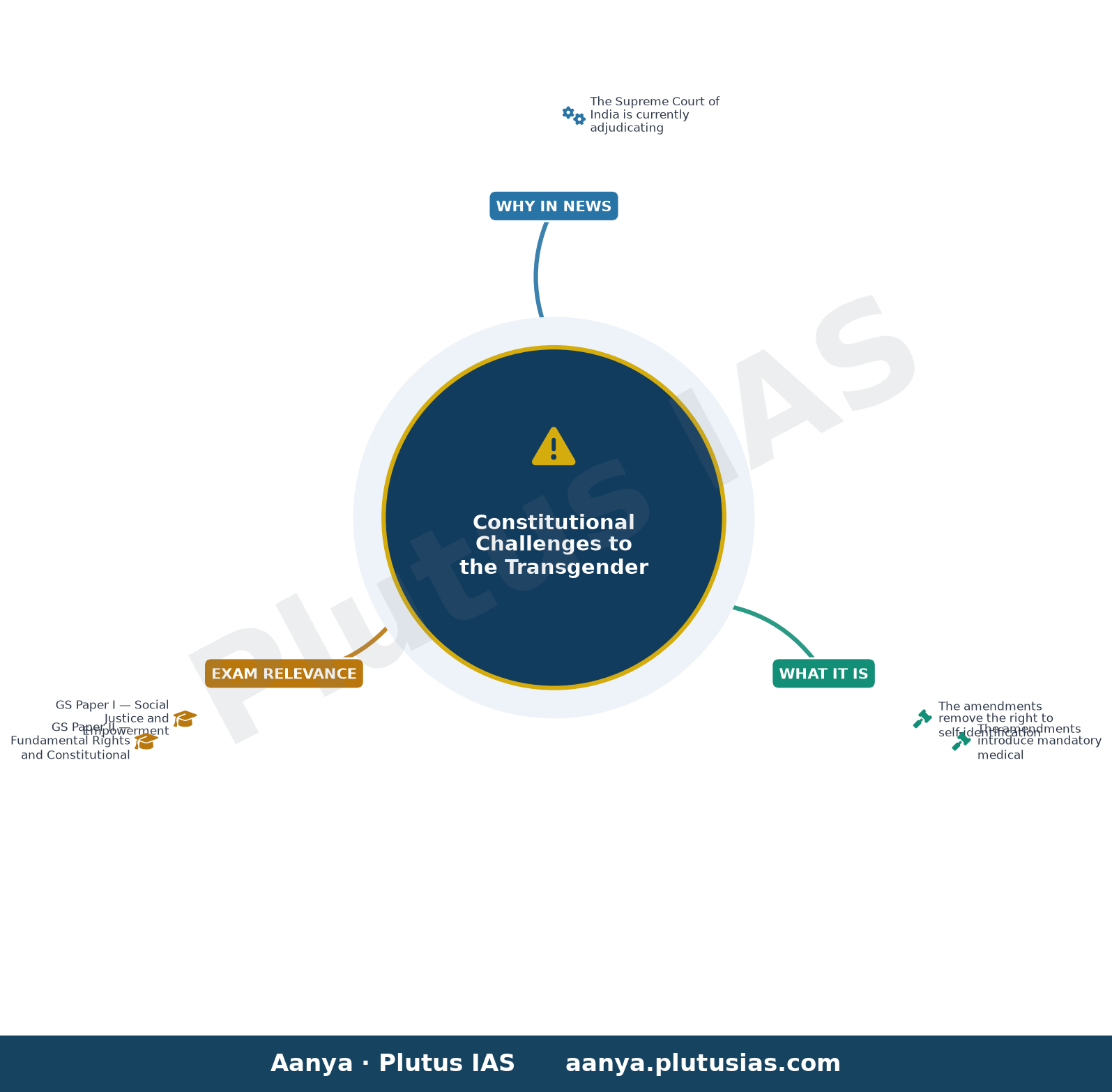
✎ The amendments to the Transgender Rights law remove the right to self-identification of gender identity and introduce mandatory medical certification, raising constitutional questions on its compatibility with Articles 14, 15…
Subject Relevance — Where This Topic Fits
- GS Paper I — Social Justice and Empowerment | GS Paper II — Fundamental Rights and Constitutional Provisions | GS Paper III — Social Sector and Governance
- Prelims: Transgender Persons (Protection of Rights) Act, 2019, Transgender Persons (Protection of Rights) Amendment Act, 2026, Self-identification of gender, Article 14 (Right to Equality), Article 15 (Prohibition of Discrimination), Article 19 (Freedom of Expression), Article 21 (Right to Life and Personal Liberty), National Council for Transgender Persons, Supreme Court’s NALSA Judgment (2014), Gender-Affirmative Care
- Essay: The Intersection of Constitutional Morality and Social Justice: A Case Study of Transgender Rights in India, Balancing Legislative Intent and Judicial Precedents: The Challenge of Amending Social Legislation
Quick Revision: The amendments to the Transgender Rights law remove the right to self-identification of gender identity and introduce mandatory medical certification, raising constitutional questions on its compatibility with Articles 14, 15, 19, and 21 of the Constitution.
Why is this in the news?
The Supreme Court of India is currently adjudicating constitutional challenges to the Transgender Rights law amendments, which remove the right to self-identification of gender identity and mandate medical certification. The Telangana government has been urged by a Member of Parliament to support these challenges, citing conflicts with existing welfare architecture and constitutional guarantees. This development underscores the ongoing debate between legislative amendments and judicial precedents on transgender rights in India.
Background
- The Transgender Persons (Protection of Rights) Act, 2019 was enacted to protect the rights of transgender persons and provide for their welfare, following the Supreme Court’s landmark judgment in *National Legal Services Authority (NALSA) v. Union of India* (2014), which recognised the right to self-identify gender.
- The 2019 Act introduced provisions for self-identification of gender, recognition of transgender persons, and establishment of a National Council for Transgender Persons to advise the government on welfare measures.
- The amendments to the Transgender Rights law have faced widespread protests from the transgender community, civil society organisations, and legal experts, who argue that it undermines the principles of dignity, equality, and autonomy recognised by the Supreme Court.
- Several members appointed to the National Council for Transgender Persons resigned in protest against the amendments, citing concerns over the dilution of rights and the imposition of medicalised gatekeeping.
- The Supreme Court is currently hearing multiple petitions challenging the constitutional validity of the amended Act, with arguments centred on its compatibility with Articles 14, 15, 19, and 21 of the Constitution.
What are the amendments to the Transgender Rights law?
- The amendments remove the right to self-identification of gender identity, which was a cornerstone of the 2019 Act and recognised by the Supreme Court in the NALSA judgment (2014).
- The amendments introduce mandatory medical certification for gender identity, requiring transgender persons to obtain a certificate from a medical authority to have their gender identity legally recognised.
- The amendments also modify provisions related to the National Council for Transgender Persons, including changes to its composition and functions, which have led to resignations from members protesting the dilution of rights.
- The amendments have been criticised for potentially disrupting gender-affirmative care, as medical certification may impose barriers to access to healthcare, social welfare, and legal recognition for transgender persons.
- The amendments have been challenged in the Supreme Court on grounds of violating constitutional guarantees of equality, non-discrimination, freedom of expression, and the right to life and personal liberty (Articles 14, 15, 19, and 21).
- The amendments have sparked debates on the balance between legislative intent and judicial precedents, particularly the Supreme Court’s recognition of self-identification as a fundamental right.
- The amendments raise questions about the role of the state in protecting the rights of marginalised communities and ensuring their inclusion in welfare architecture.
UPSC Value Addition
Keywords for Mains Answer-Writing
Transgender Persons (Protection of Rights) Act, 2019 · Self-identification of gender identity · Supreme Court of India · Constitutional rights under Articles 14, 15, 19, and 21 · Transgender Rights · Medical certification for gender identity · National Council for Transgender Persons · State government intervention in legal proceedings · Constitutional morality and social justice · Implementation challenges of welfare schemes
Prelims Practice Questions
Q1. Consider the following statements regarding the Transgender Persons (Protection of Rights) Act, 2019:
1. The Act recognises the right to self-identification of gender identity.
2. The Act mandates medical certification for gender identity.
3. The Act establishes a National Council for Transgender Persons.
4. The Act was amended in 2026 to remove the right to self-identification.
How many of the above statements are correct?
- Only one
- Only two
- Only three
- All four
Answer: Only three — Statements 2, 3, and 4 are correct. Statement 1 is incorrect as the original Act of 2019 did not mandate medical certification but the 2026 amendment removed the right to self-identification, making statement 4 correct.
Q2. Assertion (A): The Supreme Court of India has consistently upheld the right to self-identification of gender identity as a fundamental right.
Reason (R): The right to self-identification is derived from Articles 14, 15, 19, and 21 of the Constitution of India.
- Both A and R are true, and R is the correct explanation of A.
- Both A and R are true, but R is not the correct explanation of A.
- A is true, but R is false.
- A is false, but R is true.
Answer: Both A and R are true, and R is the correct explanation of A. — Both the assertion and reason are true. The Supreme Court has affirmed the right to self-identification as a fundamental right through multiple judgments, and this right is grounded in the constitutional guarantees of equality, non-discrimination, freedom, and personal liberty.
Q3. Match the following provisions of the Transgender Persons (Protection of Rights) Act, 2019 with their correct descriptions:
Column I
1. Section 3
2. Section 4
3. Section 8
4. Section 10
Column II
A. Prohibition of discrimination
B. Certificate of identity for transgender persons
C. National Council for Transgender Persons
D. Welfare schemes and other measures
- 1-A, 2-B, 3-C, 4-D
- 1-B, 2-A, 3-D, 4-C
- 1-A, 2-C, 3-B, 4-D
- 1-D, 2-B, 3-A, 4-C
Answer: 1-A, 2-B, 3-C, 4-D — Section 3 prohibits discrimination (A), Section 4 provides for a certificate of identity (B), Section 8 establishes the National Council for Transgender Persons (C), and Section 10 mandates welfare schemes (D).
Mains Practice Question
✍ The Transgender Persons (Protection of Rights) Act, 2019, as amended in 2026, has been constitutionally challenged for removing the right to self-identification of gender identity. Critically examine the constitutional validity of the amendments in the context of Articles 14, 15, 19, and 21 of the Constitution of India. Also, discuss the role of state governments in supporting such constitutional challenges. (15 Marks)
Approach: MODEL-ANSWER SKELETON:
1. **Introduction (2 Marks)**: Briefly introduce the Transgender Persons (Protection of Rights) Act, 2019, and the 2026 amendments that removed the right to self-identification, replacing it with mandatory medical certification.
2. **Constitutional Provisions (3 Marks)**:
– **Article 14 (Right to Equality)**: Discuss how the amendment may violate the principle of equality by imposing a burdensome medical certification process, disproportionately affecting transgender persons.
– **Article 15 (Prohibition of Discrimination)**: Explain how the amendment could perpetuate discrimination by undermining the autonomy and dignity of transgender persons.
– **Article 19 (Freedom of Expression)**: Argue that self-identification is a form of expression protected under Article 19(1)(a).
– **Article 21 (Right to Life and Personal Liberty)**: Highlight how the amendment infringes on the right to privacy and dignity, as recognised in *Justice K.S. Puttaswamy v. Union of India* (2017).
3. **Judicial Precedents (3 Marks)**:
– Cite *NALSA v. Union of India* (2014) and *Joseph Shine v. Union of India* (2018) to underscore the importance of self-identification and autonomy.
– Discuss the Supreme Court’s emphasis on constitutional morality and progressive interpretation of rights.
4. **Role of State Governments (4 Marks)**:
– Explain the constitutional duty of state governments under Article 131 (original jurisdiction of the Supreme Court) and Article 132 (appellate jurisdiction) to intervene in constitutional matters.
– Discuss the moral and legal significance of state support in defending constitutional rights, as highlighted in the letter by Renuka Chowdhury to the Telangana government.
– Reference the doctrine of cooperative federalism and the responsibility of states to uphold fundamental rights.
5. **Implementation Challenges (3 Marks)**:
– Discuss administrative, financial, and implementation implications for states, including conflicts with existing welfare architecture.
– Highlight the need for states to align their policies with constitutional principles and judicial precedents.
6. **Conclusion (2 Marks)**: Summarise the constitutional infirmities in the amendment and reaffirm the importance of state intervention in upholding fundamental rights.
Source: The Hindu
Generated by AanyaAi for educational purpose.

- Gurugram’s groundwater extraction exceeds limit by 212%; HC seeks ban - October 4, 2026
- स्वतंत्रता सेनानी श्यामजी कृष्ण वर्मा की जन्म जयंती पर पीएम का श्रद्धांजलि - October 4, 2026
- KWML’s Feasibility Reports for Water Metro in 18 Cities: UPSC & PCS Insights - October 3, 2026

No Comments