


09 Aug Congress Opposes FCRA Bill 2026, Warns Against 2023 Mass Suspensions
✎ The Foreign Contribution (Regulation) Amendment Bill seeks to tighten regulations on foreign funding for NGOs, with Opposition parties alleging it is a tool to target dissent while avoiding scrutiny of organisations associated…
Subject Relevance — Where This Topic Fits
- GS Paper II — Polity and Governance: Role of Parliament, Parliamentary Procedures, and Opposition Dynamics | GS Paper II — International Relations: Foreign Contributions and Regulatory Frameworks | GS Paper III — Economy: Non-Governmental Organisations (NGOs) and Foreign Funding
- Prelims: Foreign Contribution (Regulation) Act, 2010, Parliamentary Winter Session 2023, Opposition Suspension Rules, Article 105 (Parliamentary Privileges), Article 19(1)(c) (Freedom of Association), Delimitation Commission, JPC (Joint Parliamentary Committee), FCRA Amendment Bill 2026
- Essay: The Erosion of Parliamentary Democracy: A Case Study of Legislative Processes in Contemporary India, Balancing National Security and Civil Liberties: The Role of Regulatory Frameworks in Democratic Governance
Quick Revision: The Foreign Contribution (Regulation) Amendment Bill seeks to tighten regulations on foreign funding for NGOs, with Opposition parties alleging it is a tool to target dissent while avoiding scrutiny of organisations associated with the ruling dispensation.
Why is this in the news?
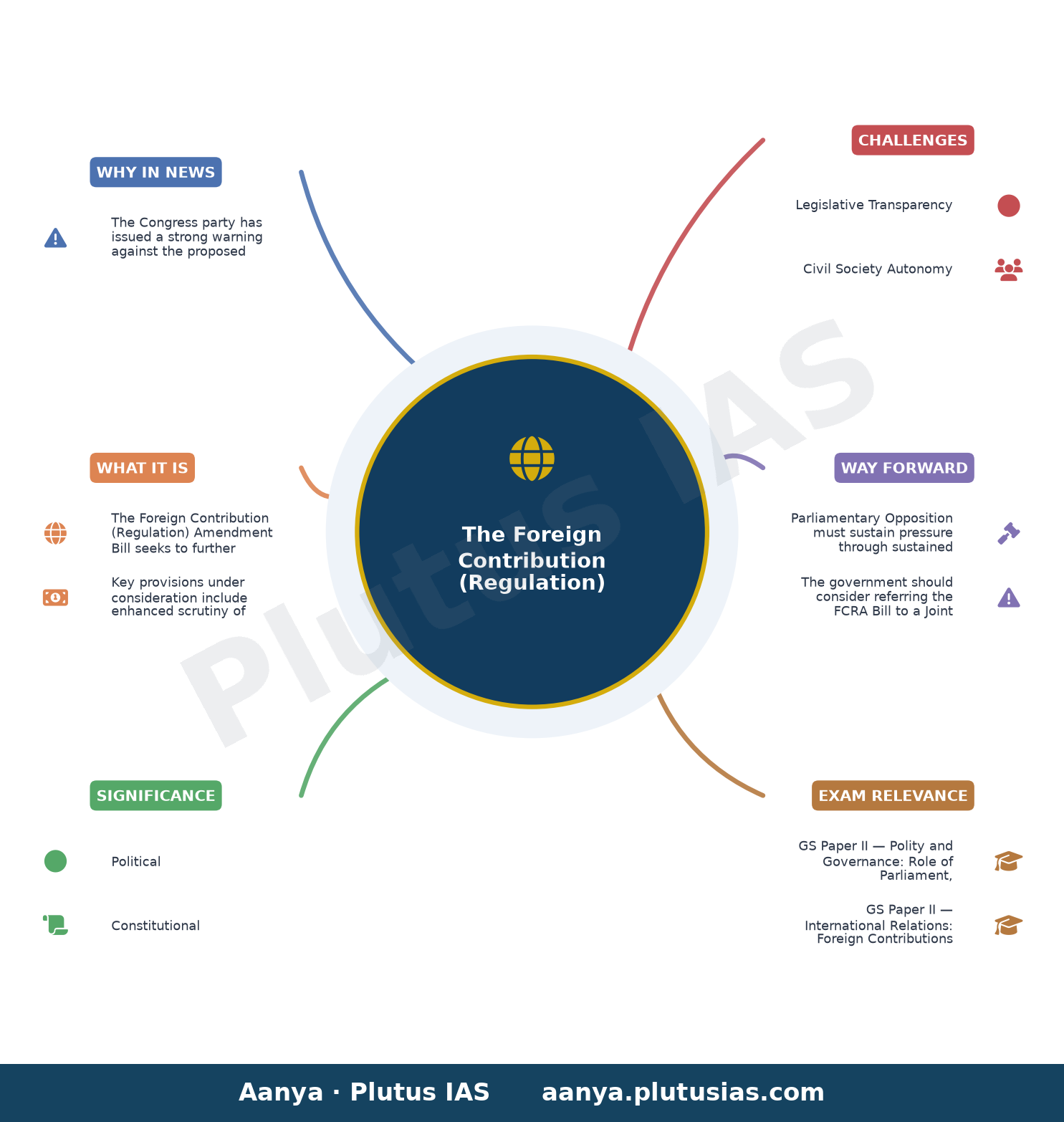
The Congress party has issued a strong warning against the proposed Foreign Contribution (Regulation) Amendment Bill, alleging that the legislation is designed to target minority communities and NGOs while avoiding scrutiny of organisations associated with the ruling dispensation. The opposition has drawn parallels to the December 2023 Winter Session, where 146 Opposition MPs were suspended, enabling the passage of major legislation with minimal resistance. The bill’s introduction during the Monsoon Session has reignited debates on parliamentary decorum, legislative transparency, and the balance between national security imperatives and democratic freedoms.
Background
- The Foreign Contribution (Regulation) Act (FCRA), 2010, regulates the acceptance and utilisation of foreign contributions by individuals, associations, and companies in India, aiming to prevent foreign interference in domestic affairs.
- The FCRA was amended in 2020, introducing stricter provisions such as reduced administrative expenses for NGOs, mandatory Aadhaar linkage for office-bearers, and prior government approval for transfer of funds to other organisations.
- The December 2023 Winter Session of Parliament witnessed the suspension of 146 Opposition MPs (100 in Lok Sabha and 46 in Rajya Sabha) between December 14 and 21, 2023, following disruptions over the Adani-Hindenburg controversy.
- During this period, Parliament passed significant legislation, including the Bharatiya Nyaya Sanhita, 2023; Bharatiya Nagarik Suraksha Sanhita, 2023; and Bharatiya Sakshya Adhiniyam, 2023, replacing colonial-era criminal laws, as well as the Chief Election Commissioner and Other Election Commissioners (Appointment, Conditions of Service and Term of Office) Bill, 2023.
- The Congress party has alleged that the government is attempting to replicate the 2023 episode by introducing the FCRA Amendment Bill during a period of Opposition absence in Parliament.
- The proposed FCRA Amendment Bill is part of a broader legislative agenda, including a potential delimitation exercise, which the Opposition claims penalises States with successful population control measures, particularly in southern and northeastern India.
What is the Foreign Contribution (Regulation) Amendment Bill?
- The Foreign Contribution (Regulation) Amendment Bill seeks to further amend the FCRA, 2010, to introduce stricter regulations on the receipt and utilisation of foreign contributions by NGOs, associations, and individuals in India.
- Key provisions under consideration include enhanced scrutiny of foreign funding sources, mandatory disclosure of foreign contributions in annual reports, and stricter penalties for non-compliance, including cancellation of registration.
- The bill is framed as a measure to prevent foreign interference in India’s domestic affairs and ensure transparency in the utilisation of foreign funds, particularly in sectors such as education, healthcare, and social welfare.
- Opposition parties, particularly the Congress, allege that the bill is selectively targeted at minority communities and NGOs critical of the government, while organisations associated with the ruling dispensation, such as those linked to the RSS, continue to receive foreign funding without scrutiny.
- The bill has been criticised for its potential to stifle civil society organisations (CSOs) and non-governmental organisations (NGOs) that play a crucial role in governance, advocacy, and service delivery, particularly in marginalised communities.
- The government has defended the bill, asserting that it is ‘religion-neutral’ and aimed at ensuring accountability in the receipt and utilisation of foreign contributions, without targeting any specific community or organisation.
- The proposed amendments also include provisions for the central government to suspend or cancel the registration of NGOs receiving foreign contributions if they are deemed to be engaged in activities detrimental to the ‘public interest’ or ‘national security’.
- The bill has raised concerns about the potential misuse of regulatory powers to suppress dissent and limit the space for civil society engagement in policy-making and public discourse.
Key Features
| Feature | Significance |
|---|---|
| Proposed FCRA Amendment Bill, 2026 | Seeks to amend the Foreign Contribution (Regulation) Act, 2010, potentially tightening regulations on foreign funding for NGOs, associations, and individuals, with implications for civil society participation in governance. |
| Congress Opposition Strategy | Congress has issued a three-line whip to its MPs to attend Parliament from August 10–12, 2026, to oppose the FCRA Bill, citing concerns over procedural fairness and historical precedents of legislative passage without adequate Opposition presence. |
| 2023 Mass Suspension Episode | In December 2023, 146 Opposition MPs (100 in Lok Sabha, 46 in Rajya Sabha) were suspended, enabling the passage of key legislations, including the three new criminal laws and the Election Commissioners (Appointment, Conditions of Service and Term of Office) Bill. |
| Delimitation Bill (Implied Link) | Congress alleges the proposed delimitation legislation penalises States with successful population control measures, particularly in southern India and the Northeast, raising concerns over federalism and equitable representation. |
| Home Minister’s Reassurance | Union Home Minister Amit Shah has assured Christian bodies that the FCRA Bill is ‘religion-neutral,’ aiming to dispel perceptions of targeting minorities or NGOs, though Opposition remains skeptical. |
Why it Matters
Political
- The Opposition’s strong stance against the FCRA Bill underscores concerns over legislative transparency and the procedural legitimacy of Parliament, particularly in the context of past instances of Opposition suppression during critical sessions.
- The Congress’s warning reflects broader apprehensions about the government’s use of numerical strength to bypass deliberative processes, potentially eroding democratic norms and parliamentary accountability.
- The demand for a Joint Parliamentary Committee (JPC) reflects a strategic move to delay or scrutinise the Bill, aligning with Opposition efforts to force greater debate and consensus-building.
Constitutional
- The FCRA Amendment Bill intersects with constitutional provisions on freedom of association (Article 19(1)(c)) and the right to receive foreign contributions, subject to reasonable restrictions under Article 19(4).
- The Bill’s potential impact on NGOs and civil society raises questions about the balance between national security interests (Article 51A) and democratic freedoms, particularly under Part IV of the Constitution.
- The delimitation Bill, if linked, implicates Article 82 (readjustment of constituencies) and Article 325 (no discrimination in electoral rolls), raising federalism and equity concerns.
Administrative
- The proposed amendments to the FCRA could centralise administrative control over foreign funding, potentially increasing bureaucratic discretion and reducing the autonomy of NGOs and grassroots organisations.
- The Bill’s passage without adequate Opposition scrutiny risks administrative overreach, particularly in sectors like education, healthcare, and social justice, where NGOs play a critical role.
- The Home Minister’s reassurances to Christian bodies highlight the need for administrative clarity to prevent perceptions of bias or selective enforcement.
Challenges
1. Legislative Transparency
- The Opposition’s fear of a repeat of the 2023 ‘mass suspension’ episode underscores concerns over the transparency and fairness of legislative processes, particularly when Opposition presence is minimal.
- The lack of consensus-building mechanisms risks the passage of contentious Bills without adequate debate, potentially undermining the legitimacy of the legislative process.
UPSC Link: GS2: Parliament—Functions, Conduct of Business, Issues Arising Out of These
2. Civil Society Autonomy
- The FCRA Amendment Bill could impose stricter conditions on foreign funding, potentially stifling the operational independence of NGOs and civil society organisations critical to democratic governance.
- The Bill’s provisions may disproportionately affect organisations working on human rights, minority rights, or social justice, raising concerns about selective targeting.
UPSC Link: GS2: Government Policies and Interventions for Development in Various Sectors
3. Federalism and State Autonomy
- The implied link to the delimitation Bill raises concerns over the Centre’s interference in State-level policies, particularly those related to population control and demographic management.
- If the Bill penalises States for successful population control measures, it could create a perverse incentive structure, discouraging evidence-based governance.
UPSC Link: GS2: Federalism, Issues Arising Between Centre and States
4. Public Trust in Institutions
- The Opposition’s allegations of procedural manipulation and the Home Minister’s avoidance of Parliament erode public trust in democratic institutions, particularly the executive and legislature.
- The perception of selective enforcement or bias in the application of the FCRA could further polarise public opinion and undermine institutional credibility.
UPSC Link: GS2: Role of Civil Services in a Democracy
5. Judicial Scrutiny and Precedents
- The Bill’s passage without adequate Opposition scrutiny may invite judicial review, particularly if it is perceived as violating constitutional freedoms or procedural fairness.
- Past judicial interventions in FCRA-related cases (e.g., Common Cause v. Union of India, 2020) highlight the judiciary’s role in balancing national security and democratic freedoms.
UPSC Link: GS2: Judiciary—Structure, Organisation, Functions; Judicial Activism
Challenges — UPSC Perspective
| Issue | Concern |
|---|---|
| Procedural Fairness in Parliament | Risk of Bills being passed without adequate Opposition presence, undermining democratic deliberation. |
| Civil Society Participation | Potential erosion of autonomy for NGOs and grassroots organisations due to stricter FCRA regulations. |
| Federalism and State Rights | Implied delimitation Bill may penalise States for successful population control measures, raising equity concerns. |
| Perception of Bias | Allegations of targeting minorities or NGOs under the FCRA could polarise public opinion. |
| Judicial Review | Risk of the Bill being challenged in court for violating constitutional freedoms or procedural fairness. |
| Administrative Overreach | Centralisation of control over foreign funding may reduce transparency and accountability in NGO operations. |
Way Forward
- Parliamentary Opposition must sustain pressure through sustained presence, debates, and procedural objections to ensure the Bill undergoes rigorous scrutiny.
- The government should consider referring the FCRA Bill to a Joint Parliamentary Committee (JPC) to address Opposition concerns and build consensus.
- Civil society organisations should proactively engage with policymakers to highlight the Bill’s potential impact on their operations and democratic participation.
- Judicial and constitutional experts should prepare to challenge the Bill if it violates fundamental rights or procedural fairness.
- State governments, particularly those in southern India and the Northeast, should articulate their concerns over the implied delimitation Bill to protect federalism.
- Media and civil society must document and highlight instances of procedural manipulation or bias in the Bill’s application.
- Aspirants should analyse the Bill’s provisions in the context of constitutional freedoms (Article 19) and federalism (Article 246) for UPSC Mains answers.
- Monitoring mechanisms should be established to track the Bill’s implementation and its impact on NGOs and civil society organisations.
UPSC Value Addition
Keywords for Mains Answer-Writing
Foreign Contribution Regulation Act (FCRA) · Parliamentary Opposition · Legislative Process · Suspension of MPs · Criminal Law (Amendment) Bills 2023 · Delimitation Commission · Federalism · NGO Regulation · Constitutional Amendments · Parliamentary Democracy
Constitutional & Policy Linkages
- {‘Article 19(1)(c)’: ‘Freedom of association and right to form unions.’}
- {‘Article 19(4)’: ‘Reasonable restrictions on freedom of association.’}
- {‘Article 51A’: ‘Fundamental duties, including promoting harmony and the spirit of common brotherhood.’}
- {‘Article 82’: ‘Readjustment of constituencies post-census.’}
- {‘Article 325’: ‘No discrimination in electoral rolls.’}
Concept Flow
Congress alleges FCRA Bill targets minorities and NGOs → Opposition warns of repeating 2023 ‘mass suspension’ episode → Government assures Bill is ‘religion-neutral’ → Opposition demands JPC or scrapping of Bill → Implied delimitation Bill raises federalism concerns → Potential judicial review for violating constitutional freedoms → Erosion of public trust in democratic institutions → Need for sustained Opposition pressure and consensus-building.
Prelims Practice Questions
Q1. Consider the following statements regarding the Foreign Contribution (Regulation) Amendment Bill, 2026:
1. The Bill seeks to amend the Foreign Contribution (Regulation) Act, 2010.
2. It proposes to prohibit the transfer of foreign contributions between NGOs.
3. The Bill includes provisions for the suspension of NGOs without prior notice.
How many of the above statements are correct?
- Only one
- Only two
- All three
- None
Answer: All three — Statements 1 and 2 are correct as the Bill amends the FCRA, 2010 and proposes to prohibit transfers of foreign contributions. Statement 3 is incorrect as the Bill does not explicitly provide for suspension without prior notice.
Q2. Assertion (A): The suspension of 146 Opposition MPs in December 2023 was the largest in the history of Indian Parliament.
Reason (R): The suspension was necessitated by the Opposition’s refusal to participate in the legislative process.
- Both A and R are true, and R is the correct explanation of A
- Both A and R are true, but R is not the correct explanation of A
- A is true, but R is false
- A is false, but R is true
Answer: A is true, but R is false — Assertion (A) is true as the suspension of 146 MPs was indeed the largest in Parliament’s history. Reason (R) is false because the suspension was not due to refusal to participate but was a procedural move by the Chair.
Q3. Which of the following Bills was NOT passed during the Winter Session of Parliament in December 2023?
- The Bharatiya Nyaya Sanhita, 2023
- The Bharatiya Nagarik Suraksha Sanhita, 2023
- The Citizenship (Amendment) Act, 2019
- The Chief Election Commissioner and Other Election Commissioners (Appointment, Conditions of Service and Term of Office) Bill, 2023
Answer: The Citizenship (Amendment) Act, 2019 — The Citizenship (Amendment) Act, 2019 was passed in December 2019, not in December 2023. The other three Bills were passed during the Winter Session of 2023.
Mains Practice Question
✍ The proposed amendments to the Foreign Contribution (Regulation) Act (FCRA), 2010, have sparked significant political and constitutional debates. Critically examine the implications of these amendments on the autonomy of NGOs, federalism, and the legislative process in India. Also, discuss the role of parliamentary opposition in ensuring democratic accountability. (15 Marks)
Approach: MODEL-ANSWER SKELETON:
1. **Introduction**: Briefly define FCRA, 2010 and the proposed amendments (2026 Bill). Highlight the political context, including the 2023 ‘mass suspension’ episode and the Opposition’s concerns.
2. **Implications on NGO Autonomy**:
– Discuss the proposed restrictions on foreign funding and transfers between NGOs.
– Analyze how these restrictions may impact the operational independence of NGOs, particularly those working in human rights, social justice, and environmental sectors.
– Reference the Supreme Court’s stance on NGO autonomy (e.g., Puttaswamy judgment on privacy and associational rights).
3. **Federalism and State Autonomy**:
– Examine how the FCRA amendments may encroach upon the federal structure, particularly if the Centre uses FCRA to control State-registered NGOs.
– Discuss the potential conflict with the Seventh Schedule (State List: Entry 10 on ‘Charities and charitable institutions’).
– Cite the example of southern States (e.g., Kerala, Tamil Nadu) where NGOs play a significant role in governance and social welfare.
4. **Legislative Process and Democratic Accountability**:
– Critique the legislative process, including the lack of pre-legislative consultation and the Opposition’s allegations of bypassing democratic norms.
– Discuss the role of parliamentary opposition in holding the executive accountable (e.g., tools like debates, adjournment motions, and judicial review).
– Reference the 2023 suspension episode and its impact on legislative scrutiny.
5. **Constitutional and Legal Safeguards**:
– Analyze the constitutional validity of the amendments under Articles 19(1)(c) (freedom of association) and 21 (right to livelihood).
– Discuss the need for judicial review and the role of the Supreme Court in balancing regulatory oversight with fundamental rights.
6. **Conclusion**: Summarize the key arguments and take a reasoned position on whether the amendments strike a balance between regulatory oversight and democratic freedoms. Highlight the need for broader consultations and transparency.
Source: The Hindu
Generated by AanyaAi for educational purpose.


No Comments