


16 Aug CPI(M) slams ‘Intellectual Naxal’ label as attack on dissent in UPSC prep
✎ The Constitution guarantees freedom of speech (Article 19(1)(a)) and universal adult franchise (Article 326), but these rights are subject to reasonable restrictions.
Subject Relevance — Where This Topic Fits
- GS Paper II — Polity and Governance: Fundamental Rights, DPSP, Electoral Reforms | GS Paper IV — Ethics, Integrity and Aptitude: Civil Servant’s Role in Upholding Democratic Values
- Prelims: Fundamental Rights under Article 19, Article 326, Electoral Rolls, ECI powers, Naxalism, Sedition Law, Special Intensive Revision (SIR) of electoral rolls, voter deletion, migrant workers’ franchise
- Essay: The tension between national security and democratic dissent: A constitutional perspective, Electoral integrity and inclusivity: Balancing administrative efficiency with democratic rights
Quick Revision: The Constitution guarantees freedom of speech (Article 19(1)(a)) and universal adult franchise (Article 326), but these rights are subject to reasonable restrictions. The Election Commission of India must ensure electoral integrity without disenfranchising marginalised groups, and labels like ‘intellectual Naxal’ must not be used to suppress dissent.
Why is this in the news?
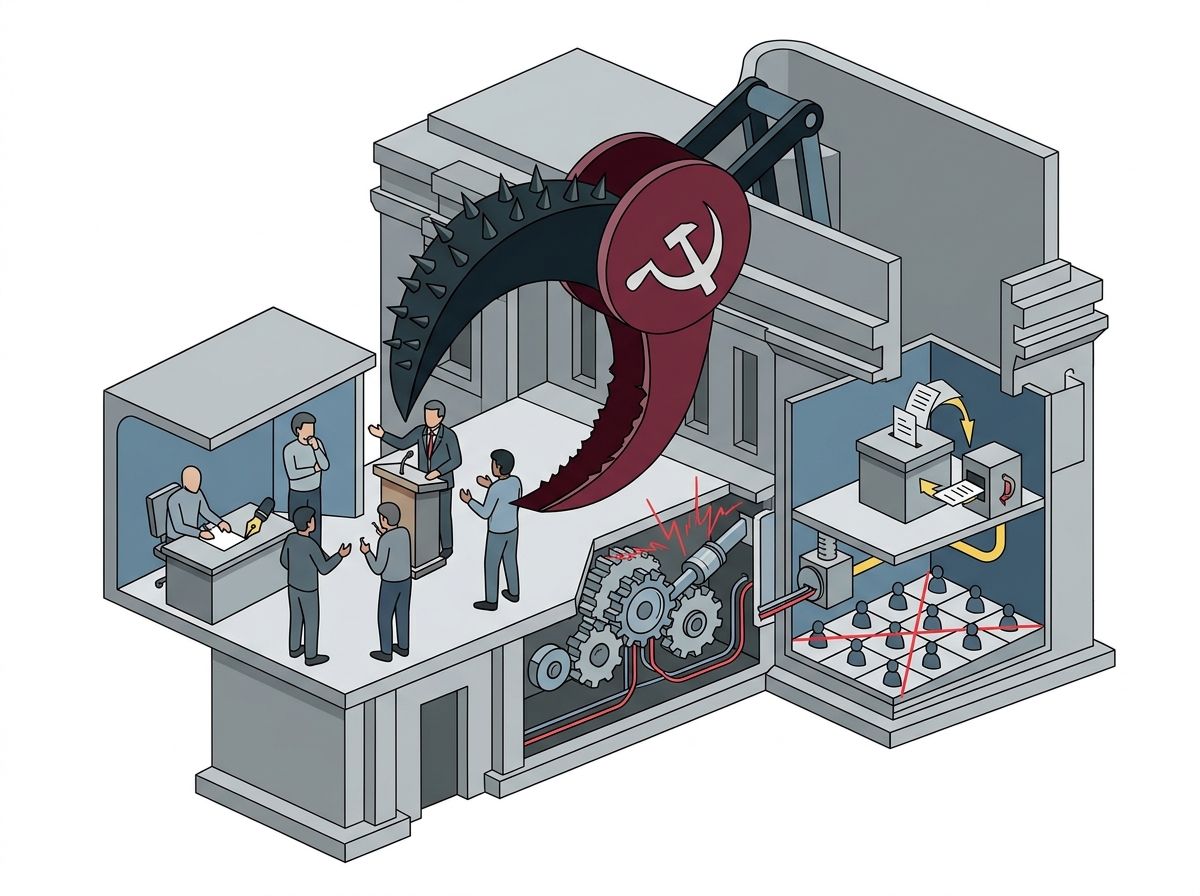
The statement by the CPI(M) Andhra Pradesh secretary alleges that the term ‘intellectual Naxal’ is being used to suppress dissent and intimidate critics, while also raising concerns about the Special Intensive Revision (SIR) of electoral rolls disproportionately affecting migrant workers. These issues intersect with constitutional provisions on fundamental rights, electoral integrity, and the role of the Election Commission of India, warranting analysis.
Background
- The term ‘Naxal’ originates from the Naxalbari uprising in 1967, referring to left-wing extremist groups advocating armed struggle against the state. Over time, the term has been used pejoratively to label ideological opponents, including academics and activists.
- The Constitution of India guarantees freedom of speech and expression under Article 19(1)(a) and the right to vote under Article 326, which mandates universal adult franchise.
- The Election Commission of India (ECI) conducts periodic revisions of electoral rolls to maintain accuracy, including the Special Intensive Revision (SIR), which involves door-to-door verification of voters.
- Concerns about voter deletion have been raised in the past, particularly regarding marginalised groups such as migrant workers, who face challenges in exercising their franchise due to administrative hurdles.
- The use of labels like ‘intellectual Naxal’ has been criticised by civil society and political entities as an attempt to stifle dissent and create a chilling effect on free expression.
- The ECI’s powers and procedures for electoral roll revisions are governed by the Representation of the People Act, 1950, and the Conduct of Elections Rules, 1961.
Constitutional and Institutional Framework Governing Dissent and Electoral Integrity
- **Freedom of Speech and Expression (Article 19(1)(a))**: This fundamental right is not absolute and is subject to reasonable restrictions under Article 19(2), which includes grounds such as public order, decency, and incitement to an offence. The Supreme Court has consistently upheld the right to dissent as a cornerstone of democracy.
- *Case Law*: In *Maneka Gandhi v. Union of India* (1978), the Supreme Court expanded the scope of Article 19(1)(a) by linking it to the right to life and personal liberty under Article 21, reinforcing the protection of dissenting voices.
- *Case Law*: In *Shreya Singhal v. Union of India* (2015), the Supreme Court struck down Section 66A of the IT Act, which was used to curb free speech, underscoring the judiciary’s role in protecting dissent.
- **Universal Adult Franchise (Article 326)**: This provision guarantees the right to vote to all citizens aged 18 and above, irrespective of caste, creed, gender, or economic status. The ECI is constitutionally mandated to ensure the integrity and inclusivity of the electoral process.
- *Institutional Role*: The ECI is an autonomous constitutional body tasked with conducting free and fair elections. Its powers include the preparation and revision of electoral rolls, delimitation of constituencies, and enforcement of the Model Code of Conduct.
- *Electoral Reforms*: The ECI has introduced measures such as the use of Voter Verifiable Paper Audit Trail (VVPAT) machines, the linking of Aadhaar with voter IDs (though constitutionally contentious), and the use of Geographic Information Systems (GIS) for accurate mapping of polling booths.
- **Special Intensive Revision (SIR) of Electoral Rolls**: This process involves door-to-door verification of voters to remove duplicates, deceased individuals, and ineligible voters. However, concerns arise when such revisions disproportionately affect marginalised groups, such as migrant workers, due to administrative inefficiencies or lack of awareness.
- *Challenges*: Migrant workers often face difficulties in retaining their voter registration due to frequent relocations, lack of documentation, or bureaucratic hurdles. The deletion of their names can disenfranchise a significant portion of the electorate.
- *Legal Safeguards*: The Representation of the People Act, 1950, and the Conduct of Elections Rules, 1961, provide for appeals and grievance redressal mechanisms for voters whose names are deleted. However, the onus of proving eligibility often falls on the voter, leading to potential exclusion.
- **Labeling and Suppression of Dissent**: The use of terms like ‘intellectual Naxal’ to label critics or dissenters raises concerns about the criminalisation of dissent and the creation of a chilling effect on free expression. Such labels can be used to intimidate individuals or groups, undermining democratic values.
- *Constitutional Perspective*: The Supreme Court has repeatedly emphasised that dissent is a fundamental aspect of democracy. In *S. Rangarajan v. P. Jagjivan Ram* (1989), the Court held that freedom of speech includes the right to criticise the government and its policies, provided it does not incite violence or public disorder.
- *Institutional Accountability*: The judiciary, media, and civil society play a crucial role in safeguarding dissent. Institutions must ensure that labels or actions do not infringe upon constitutional rights or create an environment of fear.
UPSC Value Addition
Keywords for Mains Answer-Writing
Freedom of speech and expression · Constitutional right to dissent · Article 19(1)(a) · Electoral Rolls Special Intensive Revision (SIR) · Article 326 · Electoral integrity · Suppression of democratic voices · Electoral roll deletions · Constitutional safeguards for voting rights · Electoral reforms
Prelims Practice Questions
Q1. Consider the following statements regarding the right to freedom of speech and expression under the Indian Constitution:
1. Article 19(1)(a) guarantees the right to freedom of speech and expression to all persons.
2. This right is absolute and cannot be restricted by any law.
3. Reasonable restrictions on this right can be imposed under Article 19(2) on grounds such as sovereignty and integrity of India, security of the State, public order, decency or morality.
4. The term “intellectual Naxal” is a legal term defined under the Unlawful Activities (Prevention) Act, 1967.
How many of the above statements are correct?
- Only one
- Only two
- Only three
- All
Answer: Only three — Statements 1 and 3 are correct. Statement 2 is incorrect as the right is not absolute and can be restricted under Article 19(2). Statement 4 is incorrect as ‘intellectual Naxal’ is not a legal term defined in any statute.
Q2. Assertion (A): The Special Intensive Revision (SIR) of electoral rolls is conducted under the supervision of the Election Commission of India.
Reason (R): The SIR process aims to ensure the accuracy and integrity of electoral rolls by identifying and removing ineligible voters.
Options:
A. Both A and R are true, and R is the correct explanation of A.
B. Both A and R are true, but R is not the correct explanation of A.
C. A is true, but R is false.
D. A is false, but R is true.
Answer: ? — Both A and R are true, and R correctly explains A. The Election Commission of India is constitutionally mandated to conduct the SIR process under Article 324 to maintain the purity of electoral rolls.
Q3. Match the following constitutional provisions with their respective subjects:
Column I
1. Article 19(1)(a)
2. Article 324
3. Article 326
4. Article 14
Column II
A. Right to vote
B. Right to equality
C. Freedom of speech and expression
D. Superintendence, direction and control of elections
Answer: ? — 1-C, 2-D, 3-A, 4-B. This question tests the aspirant’s knowledge of fundamental rights and constitutional provisions related to elections.
Mains Practice Question
✍ The term ‘intellectual Naxal’ has been used in contemporary political discourse to describe critics of government policies. In this context, critically examine the constitutional framework governing freedom of speech and expression in India, including the grounds on which this right can be restricted. Also, analyse the implications of using such labels for political dissent in a democratic society. (15 Marks)
Approach: MODEL-ANSWER SKELETON:
1. **Constitutional Framework**:
– Article 19(1)(a) guarantees freedom of speech and expression as a fundamental right.
– This right is not absolute; restrictions can be imposed under Article 19(2) on grounds such as sovereignty and integrity of India, security of the State, public order, decency or morality, contempt of court, defamation, or incitement to an offence.
– The Supreme Court, in cases like Romesh Thapar v. State of Madras (1950) and Shreya Singhal v. Union of India (2015), has interpreted these restrictions narrowly to protect democratic dissent.
2. **Judicial Precedents**:
– The Supreme Court has consistently held that criticism of government policies, even if strident, does not amount to sedition or incitement to violence unless it crosses the threshold of incitement to imminent lawless action (Kedar Nath Singh v. State of Bihar, 1962).
– The use of pejorative labels like ‘intellectual Naxal’ to describe critics may amount to a chilling effect on free speech, as it seeks to stigmatise dissent rather than engage with it on merits.
3. **Democratic Implications**:
– Democratic societies thrive on robust debate and dissent. Labels that equate dissent with extremism or criminality undermine the pluralistic ethos of democracy.
– Such labels can create a climate of fear, discouraging intellectuals, academics, and citizens from participating in public discourse.
4. **Balancing Rights and Restrictions**:
– While the state has a legitimate interest in maintaining public order, the use of vague or politically charged labels to suppress dissent risks overreach and violates the spirit of Article 19(1)(a).
– The onus is on the state to demonstrate that restrictions are proportionate and necessary, not merely convenient for silencing critics.
5. **Conclusion**:
– The constitutional framework protects dissent, but its effectiveness depends on judicial vigilance and the state’s commitment to democratic values. The use of labels like ‘intellectual Naxal’ is antithetical to this framework and undermines democratic governance.
Source: The Hindu
Generated by AanyaAi for educational purpose.

- Gurugram’s groundwater extraction exceeds limit by 212%; HC seeks ban - October 4, 2026
- स्वतंत्रता सेनानी श्यामजी कृष्ण वर्मा की जन्म जयंती पर पीएम का श्रद्धांजलि - October 4, 2026
- KWML’s Feasibility Reports for Water Metro in 18 Cities: UPSC & PCS Insights - October 3, 2026

No Comments