


16 Jul Critical Mineral Blocks Auction: 8th Phase Launched for Strategic Security
Subject Relevance — Where This Topic Fits
- GS Paper I — Geography (Distribution of Key Natural Resources) | GS Paper III — Economy (Resource Mobilisation, Infrastructure, Investment Models) | GS Paper III — Science and Technology (Clean Energy Technologies, Advanced Manufacturing) | GS Paper III — Security (Strategic Minerals, Defence Sector) | GS Paper III — Environment (Sustainable Mining Practices)
- Prelims: Critical Minerals, Strategic Minerals, E-Auction, Mining Reforms, Mineral Security, Clean Energy Transition, Rare Earth Elements (REE), Mines and Minerals (Development and Regulation) Act, 1957, Mineral (Auction) Rules, 2015, India Mining Week
- Essay: The Geopolitics of Resources: India’s Quest for Mineral Autonomy and Sustainable Development, From Import Dependence to Strategic Self-Reliance: The Role of Critical Minerals in India’s ‘Viksit Bharat’ Vision
Quick Revision: India’s critical mineral block auctions are pivotal for strategic security, clean energy transition, and economic growth, aiming to reduce import dependence and foster self-reliance in vital resources.
Why is this in the news?
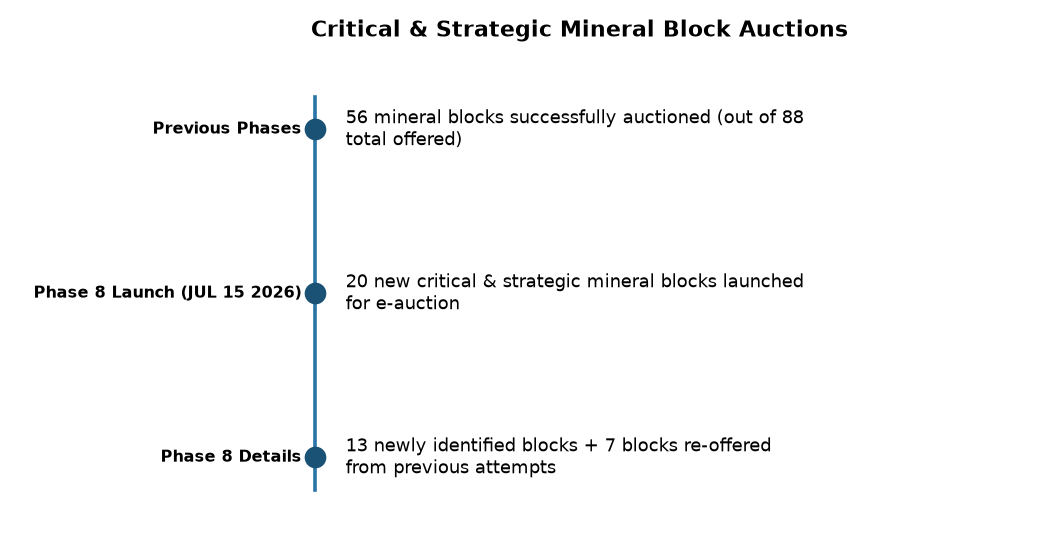
The Ministry of Mines, Government of India, recently launched the eighth phase of e-auction for 20 critical and strategic mineral blocks during the ‘India Mining Week 2026’ curtain raiser event. This initiative underscores the government’s commitment to bolstering India’s mineral security, reducing import reliance, and establishing a robust supply chain for minerals crucial to clean energy, advanced manufacturing, defence, and other strategic sectors, thereby accelerating the nation’s industrial growth and energy transition.
Background
- Critical minerals are essential for economic development and national security, yet their supply chains are often vulnerable to geopolitical risks and market volatility.
- India currently relies heavily on imports for many critical minerals, including Lithium, Cobalt, Nickel, and Rare Earth Elements, which are vital for electric vehicles, renewable energy technologies, and advanced electronics.
- The Mines and Minerals (Development and Regulation) Act, 1957 (MMDR Act), was amended in 2023 to introduce a separate category of ‘critical and strategic minerals’ and empower the Central Government to grant concessions for these minerals.
- The government’s ‘Aatmanirbhar Bharat’ vision emphasizes self-reliance across various sectors, including critical mineral supply, to ensure long-term industrial growth and strategic autonomy.
- Previous phases of critical mineral block auctions have demonstrated industry confidence in India’s reform-based mining sector, with 56 out of 88 blocks successfully auctioned so far.
- The ‘India Mining Week’ is envisioned as an annual global platform to showcase India’s mining potential, promote technology adoption, and strengthen partnerships among governments, industry, and investors.
Understanding Critical and Strategic Minerals
- Critical Minerals are those essential for economic development and national security, whose supply is at risk due to geological scarcity, geopolitical concentration, or lack of processing capacity.
- Strategic Minerals are a subset of critical minerals, specifically vital for defence, aerospace, and other high-tech industries, often having dual-use applications.
- These minerals are indispensable for the transition to a clean energy economy, forming the backbone of electric vehicles (EVs), solar panels, wind turbines, and energy storage systems.
- They are also crucial for advanced manufacturing, including semiconductors, high-performance alloys, and specialized electronics.
- Examples include Lithium, Cobalt, Nickel, Graphite, Rare Earth Elements (REEs), Molybdenum, Vanadium, Gallium, Titanium, Tungsten, and Potash.
- The identification and classification of critical minerals are dynamic, evolving with technological advancements and geopolitical shifts.
- India’s list of critical minerals, as notified under the MMDR Act, includes 30 minerals deemed essential for its economic and security interests.
- The auction mechanism for these blocks is a transparent, two-stage ‘Ascending Forward Auction’ process, ensuring fair value realization and competitive bidding.
Key Features
| Feature | Significance |
|---|---|
| Eighth Phase Launch | Demonstrates sustained government commitment to critical mineral security and a phased approach to resource unlocking. |
| 20 Critical & Strategic Mineral Blocks | Adds to the cumulative 88 blocks offered, expanding the national resource base for key industries. |
| Diverse Mineral Portfolio | Includes Molybdenum, Graphite, Glauconite, Vanadium, Gallium, REEs, Bauxite, Potash, Tungsten, Lithium, Cesium, Rubidium, addressing multiple industrial requirements. |
| Spread Across Nine States | Promotes regional development and diversifies the geographical sourcing of critical minerals within India. |
| Transparent E-Auction Process | Ensures fairness, prevents rent-seeking, and attracts credible domestic and international investors. |
| Dual Offering (New & Re-offered Blocks) | Optimizes resource utilization by re-offering blocks that did not receive adequate bids previously, reflecting market dynamics. |
Why it Matters
Strategic Security and Reduced Import Dependence
- Directly addresses India’s vulnerability to global supply chain disruptions and geopolitical pressures by securing domestic sources of vital minerals.
- Crucial for defence manufacturing, aerospace, and advanced electronics, enhancing national security capabilities and reducing reliance on external powers.
- Supports the ‘Make in India’ initiative by providing indigenous raw materials for high-tech industries, fostering a resilient domestic industrial base.
Economic Growth and Industrial Development
- Attracts significant investment in exploration, mining, and downstream processing, creating employment opportunities and boosting regional economies.
- Provides essential inputs for sunrise sectors like electric vehicles (EVs), renewable energy, and advanced battery manufacturing, driving future economic growth.
- Enhances India’s competitiveness in global manufacturing by ensuring a stable and cost-effective supply of critical raw materials.
Clean Energy Transition and Climate Goals
- Secures minerals like Lithium, Cobalt, and REEs, which are indispensable for achieving India’s ambitious renewable energy targets and climate commitments.
- Facilitates the deployment of solar panels, wind turbines, and energy storage solutions, accelerating the shift away from fossil fuels.
- Positions India as a key player in the global green economy by building a robust domestic ecosystem for clean energy technologies.
Technological Advancement and Innovation
- Stimulates research and development in mineral exploration, extraction, processing, and recycling technologies.
- Encourages collaboration between industry, academia, and government to develop innovative solutions for sustainable mining and value addition.
- Supports the development of indigenous intellectual property and expertise in critical mineral value chains.
Challenges
1. Exploration and Resource Assessment
- Limited high-resolution geological data and deep exploration capabilities for many critical minerals.
- High upfront costs and long gestation periods associated with greenfield exploration projects.
UPSC Link: GS Paper I — Geography; GS Paper III — Economy
2. Technological Gaps in Mining and Processing
- Lack of advanced extraction and beneficiation technologies for complex ores, leading to lower recovery rates.
- Absence of robust domestic processing and refining infrastructure for many critical minerals, necessitating export of raw materials and import of finished products.
UPSC Link: GS Paper III — Science & Technology; GS Paper III — Economy
3. Environmental and Social Concerns
- Potential for significant environmental impact (e.g., land degradation, water pollution) from mining activities, especially for rare earths.
- Challenges in obtaining social license to operate, including issues related to land acquisition, displacement, and benefit sharing with local communities.
UPSC Link: GS Paper III — Environment; GS Paper II — Social Justice
4. Investment and Financing
- High capital intensity and perceived risks associated with critical mineral projects, making it difficult to attract long-term financing.
- Need for policy stability and predictable regulatory frameworks to instill investor confidence.
UPSC Link: GS Paper III — Economy
5. Skill Development and Human Capital
- Shortage of skilled workforce in specialized areas of critical mineral exploration, mining engineering, and metallurgical processing.
- Need for robust training and educational programs to build indigenous capacity.
UPSC Link: GS Paper III — Economy; GS Paper II — Social Justice
Challenges — UPSC Perspective
| Issue | Concern |
|---|---|
| Geological Complexity | Deep-seated deposits, low-grade ores, and polymetallic nature of critical mineral occurrences. |
| Regulatory Hurdles | Inter-ministerial coordination, delays in clearances, and state-level implementation challenges. |
| Global Market Volatility | Price fluctuations and geopolitical control over critical mineral supply chains. |
| Infrastructure Deficiencies | Lack of adequate transport, power, and logistics infrastructure in remote mining areas. |
| Circular Economy Integration | Limited focus on recycling and urban mining of critical minerals from electronic waste. |
Government Initiatives — Must-Memorise for Prelims
- National Mineral Policy, 2019
- Mines and Minerals (Development and Regulation) Act, 1957 (as amended)
- Mineral (Auction) Rules, 2015
- Scheme for Accreditation of Private Exploration Agencies
- National Mineral Exploration Policy, 2016
- Production Linked Incentive (PLI) Schemes (relevant for downstream industries)
- National Mission on Advanced and High-Performance Computing
- FAME India Scheme (for Electric Vehicles)
- Green Hydrogen Mission
- National Policy on Electronics
Way Forward
- Intensify geological exploration using advanced techniques (e.g., airborne surveys, AI/ML) to delineate new critical mineral resources.
- Invest in R&D for indigenous, cost-effective, and environmentally friendly mining and processing technologies for complex ores.
- Develop a robust domestic ecosystem for critical mineral processing, refining, and value addition to reduce reliance on intermediate imports.
- Streamline regulatory clearances and ensure policy stability to attract long-term domestic and foreign investment in the sector.
- Promote circular economy principles, including recycling, urban mining, and material substitution, to reduce primary resource dependence.
- Foster international collaborations and strategic partnerships for technology transfer, joint exploration, and securing diversified supply chains.
- Prioritize skill development and capacity building in critical mineral value chains through specialized educational programs and vocational training.
- Ensure sustainable and responsible mining practices, integrating environmental protection and community engagement from project inception.
UPSC Value Addition
Keywords for Mains Answer-Writing
Critical Mineral Security · Strategic Autonomy · Import Dependence · Clean Energy Transition · Advanced Manufacturing · Resource Mobilisation · Sustainable Mining · Circular Economy · Geopolitical Resilience · Aatmanirbhar Bharat · Value Chain Integration · Technological Leapfrogging
Constitutional & Policy Linkages
- Seventh Schedule, List I (Union List) — Entry 54: Regulation of mines and mineral development.
- Mines and Minerals (Development and Regulation) Act, 1957: Primary legislation governing mineral sector.
- Mineral (Auction) Rules, 2015: Governs auction of mineral concessions.
- National Mineral Policy, 2019: Outlines government’s vision for mineral sector development.
- Article 39(b): Directive Principle of State Policy — equitable distribution of material resources.
Concept Flow
Global Demand for Clean Energy & Tech → Increased Need for Critical Minerals → India’s Import Dependence & Vulnerability → Government Policy & Regulatory Reforms (MMDR Act amendments) → Transparent E-Auctions of Critical Mineral Blocks → Enhanced Domestic Supply & Value Addition → Strategic Security & Economic Resilience
Prelims Practice Questions
Q1. Which of the following statements regarding critical and strategic minerals in India is/are correct?
1. The Mines and Minerals (Development and Regulation) Act, 1957, was amended to include a separate category for critical and strategic minerals.
2. India is largely self-sufficient in the domestic production of Lithium and Cobalt.
3. Rare Earth Elements (REEs) are crucial for clean energy technologies and advanced electronics.
- A. 1 only
- B. 1 and 2 only
- C. 1 and 3 only
- D. 1, 2 and 3
Answer: C. 1 and 3 only — Statement 1 is correct: The MMDR Act was amended in 2023 to introduce this category. Statement 2 is incorrect: India is heavily dependent on imports for Lithium and Cobalt. Statement 3 is correct: REEs are vital for various high-tech and green technologies.
Q2. Consider the following minerals:
1. Molybdenum
2. Glauconite
3. Potash
4. Lithium
Which of the above are considered critical and strategic minerals for India, as per recent government initiatives?
- A. 1, 2 and 3 only
- B. 2 and 4 only
- C. 1, 3 and 4 only
- D. 1, 2, 3 and 4
Answer: D. 1, 2, 3 and 4 — All four minerals listed – Molybdenum, Glauconite, Potash, and Lithium (implied by ‘rare metal’ in West Bengal block) – are part of the diverse portfolio of critical and strategic minerals being auctioned or identified by the government for their importance in various strategic sectors. The news explicitly mentions Molybdenum, Glauconite, Potash, and ‘rare metal (Lithium, Cesium, Rubidium)’.
Mains Practice Question
✍ The recent auction of critical mineral blocks marks a significant step towards strengthening India’s strategic security and achieving its clean energy transition goals. Discuss the multi-faceted significance of these initiatives, highlighting the key challenges that need to be addressed for India to become truly ‘Aatmanirbhar’ in critical minerals. (250 words)
Approach: Begin by briefly introducing the context of critical mineral auctions and their importance. In the first part, elaborate on the multi-faceted significance, covering aspects like strategic security (reduced import dependence, defence), economic growth (investment, job creation, industrial inputs), and clean energy transition (EVs, renewables). In the second part, identify and discuss key challenges such as exploration gaps, technological deficiencies in processing, environmental concerns, investment hurdles, and skill shortages. Conclude with a forward-looking statement emphasizing the need for a comprehensive strategy encompassing policy, technology, and international cooperation to achieve self-reliance.
Source: PIB (Press Information Bureau)

- India-Australia AUSTRAHIND 2026 Exercise: Key Highlights for UPSC & State PCS - October 22, 2026
- एससीओ बैठक में भारत का आतंकवाद विरोध: क्षेत्रीय सहयोग पर जोर - October 22, 2026
- SEC Directs Strict SC Order Compliance for Andhra ULB Polls - October 22, 2026

No Comments