


22 Sep Cross-Border Terrorism: A Global Concern Raised at UNHRC
This article covers “Daily Current Affairs” and Topic details Cross-Border Terrorism: A Global Concern Raised at UNHRC
SYLLABUS MAPPING:
GS– 2– International Relations – Cross-Border Terrorism: A Global Concern Raised at UNHRC
FOR PRELIMS
What is the role of UNHCR in protecting refugees worldwide?
FOR MAINS
What are the main challenges faced by UNHCR in fulfilling its mandate?
Why in the News?
At a photo exhibition in Geneva coinciding with the UN Human Rights Council (UNHRC) session, Indian human rights activist Javed Ahmed Beigh strongly criticized Pakistan’s role in supporting terrorism. He drew attention to the recent Lashkar-e-Toiba attack in Pahalgam, Kashmir and urged the international community to hold Pakistan accountable for fostering cross-border terror groups that threaten regional peace.
1951 Refugee Convention, Article 1(A)(2):
A refugee is a person who, owing to a well-founded fear of being persecuted for reasons of race, religion, nationality, membership of a particular social group or political opinion, is outside the country of his nationality and is unable or, owing to such fear, unwilling to avail himself of the protection of that country.”
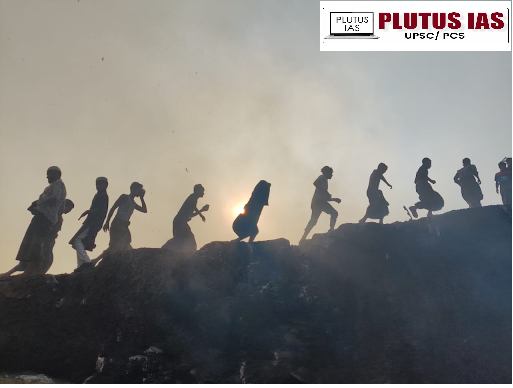
What is UNHCR?
Subsidiary organ of the UN General Assembly (UNGA), established in 1949; began functioning in 1951.
Headquarters: Geneva, Switzerland.
Current High Commissioner: Filippo Grandi (since 2016; term till Dec 2025).
Staff: ~18,800 (91% in the field).
Reports annually to the UNGA.
Structure
High Commissioner → heads the organization.
Executive Committee (ExCom) → 54 members, meets annually, frames policy conclusions.
Members need not be parties to the 1951 Refugee Convention (e.g., India).
Departments → Protection, Operations, Finance, Human Resources, Inspection & Evaluation.
Regional Divisions → coordinate field work.
Mandate of UNHCR
1. Core Mission: Protect and assist refugees, asylum seekers, stateless persons, and others displaced due to conflict or persecution.
2. International Law Role: Promote and monitor implementation of the 1951 Refugee Convention and the 1967 Protocol.
3. Asylum & Protection: Ensure the right of asylum and safeguard against refoulement (forced return).
4. Durable Solutions: Voluntary repatriation, Local integration, Third-country resettlement.
5. Protection Services: Legal aid, identity/travel documents, registration, and advocacy.
6. Humanitarian Assistance: Material and financial support through programs, NGOs, and partnerships.
7. Good Offices Function: Mediate in mass-displacement or non-mandate cases (e.g., IDPs).
8. Global Compact Role: Lead implementation of the 2018 Global Compact on Refugees (GCR) to promote responsibility-sharing.
Successes of UNHCR
1. 1956 Hungarian Uprising → managed refugee flows into Austria.
2. Indo-Chinese refugee crisis (1970s–80s) → resettlement programs.
3. Rwanda & Great Lakes crisis (1990s) → large-scale humanitarian relief.
4. Syrian refugee response (2011 onwards) → shelter, medical aid in Jordan, Lebanon, Turkey.
5. Ukraine crisis (2022) → emergency operations for millions displaced.
6. Nobel Peace Prize (1954 & 1981) → recognition of humanitarian efforts.
India’s Role at UNHCR
1. Member of ExCom, though not party to 1951 Refugee Convention.
2. Hosts Sri Lankan Tamils, Tibetans, Afghans, Rohingya, and Chakma refugees.
3. Provides financial contributions to UNHCR programs.
4. Works with UNHCR on Rohingya documentation & urban refugee support.
5. Supports regional cooperation under SAARC and ASEAN frameworks.
Means of Action
1. Legal Means: Refugee Convention, Statute, UNGA resolutions.
2. Operational Means: Field presence in 137+ countries.
3. Financial Means: ~85% funding from voluntary state contributions, ~11% private donors.
4. Partnerships: NGOs, IGOs, host governments.
5. Global Compact on Refugees: frameworks for burden-sharing & long-term refugee integration.
Criticisms of UNHCR
1. Structure-related
Over-bureaucratization → slow response.
Dependence on voluntary funding → financial instability.
Over-concentration in Geneva HQ vs. field requirements.
2. Actions-related
Failures in Rwanda (1994 genocide) and Srebrenica (Bosnia, 1995).
Inability to protect IDPs effectively due to limited mandate.
Overlap/conflict with other UN agencies (e.g., OCHA, UNICEF).
3. Mandate-related
Refugee definition too narrow (excludes climate refugees, economic migrants).
Refugee status determination left to states, limiting UNHCR’s authority.
Humanitarian neutrality often compromised by political pressures from states.
Suggested Reforms
1. Expand the definition of refugee → include climate-induced and disaster-displaced persons.
2. Strengthen funding mechanisms → more assessed contributions (not only voluntary).
3. Enhance coordination with regional bodies (e.g., AU, EU, SAARC).
4. Decentralize operations → shift more authority/resources to field offices.
5. Increase accountability → stronger monitoring of peacekeeper/aid worker misconduct.
6. Empower UNHCR legally → greater role in refugee status determination & protection guarantees.
7. Focus on durable solutions → not just relief, but long-term integration & development linkages (with UNDP, World Bank).
Conclusion
The UN Human Rights Council remains an essential global platform for the protection and promotion of human rights, but to function effectively it must overcome structural weaknesses, reduce politicization, and enhance impartiality. Strengthening its credibility and efficiency is not just desirable but necessary to ensure that human rights are upheld universally, beyond the influence of power politics.
Prelims question:
Q. Which of the following is/are core principles of the 1951 Refugee Convention?
1. Non-discrimination
2. Non-penalization for illegal entry
3. Non-refoulement
Select the correct answer:
A. 1 and 2 only
B. 2 and 3 only
C. 1 and 3 only
D. 1, 2, and 3
Answer: D
Mains Question:
Q. Discuss the role of UNHCR in addressing global refugee crises. What challenges does it face in ensuring protection and durable solutions?
(250 words)

- RBI’s Shrinking Real-Rate Cushion Amid Rising Inflation and Strong Demand - September 21, 2026
- India’s NGOs at a New Funding Crossroads - September 21, 2026
- Deep-Sea Discovery, Environmental Responsibility - September 19, 2026

No Comments