


08 Aug CWC Rejects Karnataka’s Mekedatu Project DPR Over Water Allocation Violation
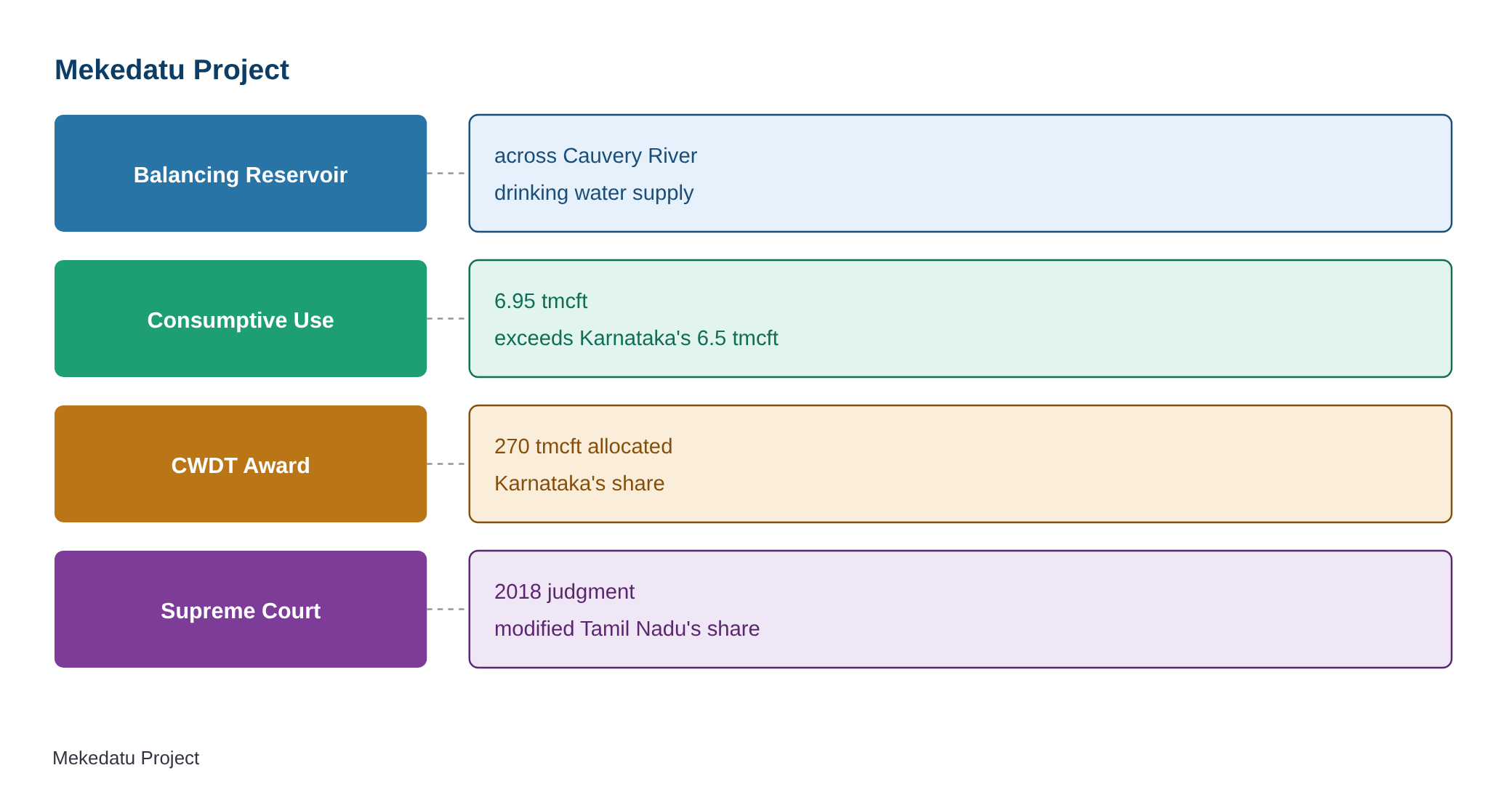
✎ The Mekedatu project’s consumptive water use (6.95 tmcft) must align with Karnataka’s allocated quantum (6.5 tmcft) as per the Supreme Court’s 2018 order on the Cauvery dispute, failing which the DPR will not secure CWC approval.
Subject Relevance — Where This Topic Fits
- GS Paper II — Polity and Governance (Inter-State Water Disputes) | GS Paper III — Environment, Ecology, and Water Resources
- Prelims: Cauvery Water Disputes Tribunal (CWDT) Award, Inter-State River Water Disputes Act, 1956, Karnataka-Tamil Nadu water sharing, Consumptive use of water, Live storage capacity, Central Water Commission (CWC), Supreme Court’s February 16, 2018 order on Cauvery, Mekedatu Balancing Reservoir-cum-Drinking Water Project, Shivanasamudra Run-of-River Power Project, tmcft (thousand million cubic feet)
- Essay: Water security and inter-state cooperation: Lessons from the Cauvery dispute, Balancing development imperatives with ecological sustainability in river basin management
Quick Revision: The Mekedatu project’s consumptive water use (6.95 tmcft) must align with Karnataka’s allocated quantum (6.5 tmcft) as per the Supreme Court’s 2018 order on the Cauvery dispute, failing which the DPR will not secure CWC approval.
Why is this in the news?
The Central Water Commission (CWC) has returned Karnataka’s revised Detailed Project Report (DPR) for the Mekedatu Balancing Reservoir-cum-Drinking Water Project, citing non-compliance with the Cauvery Water Disputes Tribunal (CWDT) Award and Supreme Court directives. The CWC observed that the proposed consumptive use of water (6.95 tmcft) exceeds Karnataka’s allocated quantum (6.5 tmcft), necessitating a revised DPR. This development underscores the persistent challenges in inter-state water governance and the technical scrutiny of river basin projects in India.
Background
- The Cauvery River dispute between Karnataka and Tamil Nadu dates back to the 19th century, with the Cauvery Water Disputes Tribunal (CWDT) constituted in 1990 to adjudicate the matter.
- The CWDT, in its 2007 award, allocated 419 tmcft of water annually among the riparian states, with Karnataka’s share fixed at 270 tmcft for various uses, including drinking water.
- The Supreme Court, in its February 16, 2018 judgment, modified the CWDT award, reducing Tamil Nadu’s share while upholding Karnataka’s allocation for urban and rural water supply.
- Karnataka’s Mekedatu project, first proposed in 2013, aims to augment drinking water supply to Bengaluru and its environs by creating a balancing reservoir across the Cauvery River.
- The project has faced opposition from Tamil Nadu, which argues that the project violates the CWDT award and Supreme Court orders by altering the river’s flow dynamics.
- The CWC, as the nodal technical body for water resource projects, scrutinizes DPRs to ensure compliance with inter-state agreements and ecological sustainability.
What is the Mekedatu Project?
- The Mekedatu Balancing Reservoir-cum-Drinking Water Project is proposed by Karnataka across the Cauvery River.
- The project envisages the construction of a balancing reservoir with a live storage capacity of 59.46 tmcft to regulate water flow and augment drinking water supply to Bengaluru and adjoining areas.
- The revised DPR submitted by Karnataka in April 2026 includes additional components such as the Shivanasamudra Run-of-River Power (SRRP) Project, entailing a diversion weir across the Cauvery River.
- The project aims to provide an additional 4.75 tmcft of consumptive water use, primarily for drinking water, and the proposed consumptive use has also been increased to 6.95 tmcft from earlier 4.75 tmcft in the revised scheme.
- The project is justified by Karnataka on the grounds that significant water volumes (exceeding allocations) have historically flowed to Tamil Nadu during good monsoon years, necessitating storage for equitable distribution.
- The project’s environmental impact, including potential disruption to downstream flows and ecological balance, remains a contentious issue in inter-state negotiations.
- The CWC’s guidelines for project appraisal (2017) mandate adherence to inter-state water-sharing agreements, ecological sustainability, and technical feasibility, which the revised DPR is required to reflect.
- The project’s approval hinges on Karnataka’s ability to reconcile its developmental goals with the legal and technical constraints imposed by the CWDT award and Supreme Court directives.
Key Features
| Feature | Significance |
|---|---|
| Mekedatu Balancing Reservoir-cum-Drinking Water Project | A multipurpose infrastructure initiative by Karnataka to augment drinking water supply to Bengaluru Metropolitan Region and its adjoining areas through regulated storage and diversion of Cauvery River waters. |
| Consumptive Use of Water | Quantified as 6.95 tmcft in the revised DPR, which exceeds the Supreme Court-allocated 6.5 tmcft for Karnataka’s urban and rural water needs, necessitating compliance with judicial and tribunal directives. |
| Shivanasamudra Run-of-River Power Project | Proposed addition to the Mekedatu project, involving a diversion weir across the Cauvery River to generate hydroelectric power, altering the project’s scope beyond water storage. |
| Live Storage Capacity (59.46 tmcft) | Proposed reservoir capacity for the Mekedatu project, questioned by CWC for lack of appropriate justification in the DPR, requiring revised technical and hydrological assessments. |
| Cauvery Water Disputes Tribunal (CWDT) Award Compliance | Mandates equitable apportionment of Cauvery waters among riparian states; Karnataka’s DPR must align with the tribunal’s final allocation and Supreme Court orders. |
Why it Matters
Inter-State Water Governance
- The Mekedatu project exemplifies the complexities of inter-state river water sharing, governed by constitutional provisions (Article 262) and tribunal awards, necessitating multi-stakeholder coordination.
- Karnataka’s initiative reflects its developmental aspirations for Bengaluru, India’s fastest-growing metropolis, but must balance equity with Tamil Nadu’s historical water entitlements under the Cauvery Award.
- The CWC’s intervention underscores the role of technical agencies in resolving disputes, ensuring projects adhere to hydrological and legal constraints.
Urban Water Security
- Bengaluru’s rapid urbanisation has strained existing water resources, making the Mekedatu project critical for long-term potable water supply and mitigating recurrent droughts.
- The project’s consumptive use of 6.95 tmcft, if approved, would address the city’s projected water deficit but risks exacerbating tensions with downstream states.
- Sustainable urban water management requires integrated approaches, combining storage, conservation, and demand-side interventions.
Hydroelectric Energy Generation
- The inclusion of the Shivanasamudra Run-of-River Power Project in the revised DPR introduces a renewable energy component, aligning with India’s climate commitments under the Paris Agreement.
- Hydroelectric projects can provide baseload power and grid stability, but their environmental impact on river ecosystems and sedimentation must be rigorously assessed.
- The project’s dual-purpose design (water + energy) reflects Karnataka’s strategy to optimise infrastructure investments for multi-sectoral benefits.
Challenges
1. Inter-State Water Allocation Disputes
- Karnataka’s proposed consumptive use (6.95 tmcft) exceeds the Supreme Court-allocated 6.5 tmcft, violating the Cauvery Award and risking legal challenges from Tamil Nadu.
- Historical data shows Karnataka has released more water to Tamil Nadu during surplus monsoons, but the revised DPR’s demands may be perceived as unilateral appropriation.
- The CWC’s directive to revise the DPR highlights the need for consensus-building among riparian states to avoid prolonged litigation.
UPSC Link: GS2: Inter-State Relations & Water Disputes
2. Technical and Hydrological Feasibility
- The CWC has questioned the justification for the reservoir’s live storage capacity (59.46 tmcft), indicating potential overestimation of water availability or underestimation of sedimentation risks.
- The inclusion of the Shivanasamudra Power Project alters the project’s hydrological dynamics, requiring re-evaluation of flow regimes and downstream impacts.
- Climate change-induced variability in monsoon patterns further complicates water budgeting, necessitating adaptive management strategies.
UPSC Link: GS3: Water Resources & Environmental Conservation
3. Environmental and Ecological Concerns
- The Mekedatu project’s location in the Cauvery Wildlife Sanctuary raises concerns about biodiversity loss, particularly for endangered species like the Malabar civet and Nilgiri tahr.
- Diversion weirs and reservoirs can disrupt river continuity, affecting fish migration, sediment transport, and downstream delta ecosystems in Tamil Nadu.
- Environmental Impact Assessments (EIAs) must comply with the Environmental Protection Act, 1986, and Forest (Conservation) Act, 1980, to mitigate ecological damage.
UPSC Link: GS3: Environmental Impact & Biodiversity
4. Legal and Procedural Compliance
- The CWC’s directive to revise the DPR in line with the CWDT Award and 2017 guidelines underscores the importance of adherence to procedural norms in large infrastructure projects.
- Delays in compliance can lead to prolonged litigation, as seen in past inter-state water disputes (e.g., Krishna and Godavari tribunals).
- Karnataka’s assertion that the CWC’s notice is ‘procedural’ may reflect political urgency, but technical and legal rigour is essential to avoid setbacks.
UPSC Link: GS2: Constitutional & Legal Framework
5. Public Policy and Stakeholder Engagement
- The project’s benefits for Bengaluru must be weighed against its socio-economic and ecological costs, requiring transparent public consultations under the Right to Information Act, 2005.
- Tamil Nadu’s historical water entitlements and agricultural dependence on the Cauvery necessitate proactive engagement to build trust and avoid adversarial relations.
- Multi-stakeholder platforms, such as the Cauvery Management Board (CMB), can facilitate dialogue and consensus-building among riparian states.
UPSC Link: GS2: Governance & Stakeholder Participation
Challenges — UPSC Perspective
| Issue | Concern |
|---|---|
| Excessive Consumptive Use | Proposed 6.95 tmcft exceeds Supreme Court-allocated 6.5 tmcft, risking non-compliance with the Cauvery Award and inter-state disputes. |
| Reservoir Capacity Justification | Live storage capacity of 59.46 tmcft lacks technical justification, potentially overestimating water availability or underestimating sedimentation. |
| Hydroelectric Component Addition | Inclusion of Shivanasamudra Power Project alters project scope, requiring re-assessment of hydrological and environmental impacts. |
| Ecological Impact on Wildlife Sanctuary | Project location in Cauvery Wildlife Sanctuary threatens biodiversity, necessitating stringent environmental safeguards. |
| Legal and Procedural Delays | Non-compliance with CWC guidelines and CWDT Award may lead to prolonged litigation and project deferment. |
| Climate Variability | Monsoon unpredictability due to climate change complicates water budgeting and reservoir operations. |
Way Forward
- Karnataka must revise the DPR to align with the Supreme Court-allocated 6.5 tmcft, ensuring consumptive use does not exceed judicial and tribunal directives.
- Conduct a comprehensive hydrological and sediment transport study to justify the reservoir’s live storage capacity of 59.46 tmcft.
- Integrate environmental impact assessments (EIAs) with the Forest (Conservation) Act, 1980, and Wildlife Protection Act, 1972, to mitigate biodiversity loss.
- Engage Tamil Nadu through the Cauvery Management Board (CMB) to build consensus on water allocation and project modifications.
- Prioritise demand-side water management in Bengaluru, including rainwater harvesting, wastewater recycling, and leak reduction in distribution systems.
- Leverage multi-stakeholder consultations under the Right to Information Act, 2005, to ensure transparency and public buy-in.
- Explore alternative water sources, such as desalination or inter-basin transfers, to reduce pressure on the Cauvery River system.
- Monitor and adapt to climate change impacts by integrating adaptive management strategies into the project’s design and operations.
UPSC Value Addition
Keywords for Mains Answer-Writing
Mekedatu Project · Cauvery Water Disputes Tribunal (CWDT) Award · Central Water Commission (CWC) · Detailed Project Report (DPR) · consumptive use of water · Supreme Court order on Cauvery · inter-State river water disputes · Karnataka-Tamil Nadu water sharing · balancing reservoir · run-of-river hydroelectric project · Cauvery River basin management · environmental flow requirements
Constitutional & Policy Linkages
- {‘Article 262’: ‘Inter-State Water Disputes Resolution’}
- {‘Seventh Schedule’: ‘Union vs State Legislative Powers on Water’}
- {‘Article 21’: ‘Right to Clean Water and Environmental Protection’}
Concept Flow
Cauvery River’s inter-state water sharing → Karnataka’s developmental aspirations for Bengaluru → Proposal of Mekedatu project → Submission of DPR to CWC → CWC’s observation of excess consumptive use → Revision of DPR to comply with CWDT Award and Supreme Court orders → Environmental and ecological impact assessments → Public consultations and stakeholder engagement → Final approval and implementation → Monitoring and adaptive management
Prelims Practice Questions
Q1. Consider the following statements regarding the Mekedatu Project:
1. The project is proposed by Karnataka to provide drinking water to Bengaluru Metropolitan Region.
2. The Central Water Commission has approved the Detailed Project Report (DPR) without any modifications.
3. The project includes a balancing reservoir and a run-of-river hydroelectric component.
4. The Supreme Court has allocated 6.5 tmcft of water to Karnataka for consumptive use in its 2018 order.
How many of the above statements are correct?
- Only one
- Only two
- Only three
- All four
Answer: Only three — Statements 1 and 3 are correct. Statement 2 is incorrect because the CWC has returned the DPR for revision. Statement 4 is incorrect as the Supreme Court allocated 6.5 tmcft, but Karnataka’s proposed consumptive use exceeds this allocation.
Q2. Assertion (A): The Central Water Commission (CWC) has returned Karnataka’s Detailed Project Report (DPR) for the Mekedatu Project, citing that the proposed consumptive use of water exceeds the allocation stipulated by the Supreme Court.
Reason (R): The Supreme Court, in its 2018 order, allocated 6.5 tmcft of water to Karnataka for consumptive use, which includes both urban and rural populations.
Options:
A. Both A and R are true, and R is the correct explanation of A.
B. Both A and R are true, but R is not the correct explanation of A.
C. A is true, but R is false.
D. A is false, but R is true.
Answer: ? — Both Assertion (A) and Reason (R) are true. The CWC’s observation that the proposed consumptive use exceeds the allocation aligns with the Supreme Court’s 2018 order (R). However, R does not fully explain why the CWC returned the DPR, as the issue also involves compliance with the Cauvery Water Disputes Tribunal Award and technical aspects of the project.
Mains Practice Question
✍ The Central Water Commission’s directive to Karnataka to revise the Detailed Project Report (DPR) for the Mekedatu Balancing Reservoir-cum-Drinking Water Project underscores the complexities of inter-State river water governance in India. Critically examine the legal, technical, and political dimensions of this dispute, with particular reference to the Cauvery Water Disputes Tribunal (CWDT) Award and the Supreme Court’s 2018 order. (15 Marks)
Approach: MODEL-ANSWER SKELETON:
1. **Legal Framework**:
– **Cauvery Water Disputes Tribunal (CWDT) Award (2007)**: Allocated 419 tmcft of water among Karnataka, Tamil Nadu, Kerala, and Puducherry. Karnataka’s share was 270 tmcft, including 22.5 tmcft for environmental flows.
– **Supreme Court’s 2018 Order**: Modified the CWDT Award, reducing Karnataka’s share to 284.75 tmcft and Tamil Nadu’s to 177.25 tmcft. The Court also allocated 6.5 tmcft for Karnataka’s consumptive use (urban and rural).
– **Inter-State Water Disputes Act, 1956**: Governs the adjudication and implementation of inter-State river water disputes.
2. **Technical Issues in the Mekedatu Project**:
– **Consumptive Use**: Karnataka’s revised DPR proposes 6.95 tmcft of consumptive use, exceeding the Supreme Court’s allocation of 6.5 tmcft. The CWC highlights that even the 36-year-old consumptive use of 2.9 tmcft leaves only 3.6 tmcft for additional use.
– **Live Storage Capacity**: The CWC questions the appropriateness of the proposed 59.46 tmcft live storage capacity, indicating a lack of alignment with standard guidelines.
– **Environmental Flows**: The project must ensure compliance with the Supreme Court’s directive to maintain environmental flows in the Cauvery River.
3. **Political Dimensions**:
– **Karnataka’s Justification**: Karnataka argues that the project is necessary to meet Bengaluru’s growing water demands and to address the disproportionate flow of water to Tamil Nadu during good monsoon years.
– **Tamil Nadu’s Opposition**: Tamil Nadu has consistently opposed the project, citing potential reduction in its share of Cauvery waters and violation of the Supreme Court’s order.
– **Federalism and Centre’s Role**: The CWC’s intervention reflects the Centre’s role in mediating inter-State water disputes, though its authority is limited to technical scrutiny rather than final adjudication.
4. **Way Forward**:
– **Revised DPR**: Karnataka must revise the DPR to align with the Supreme Court’s allocation and the CWDT Award, ensuring that the consumptive use does not exceed 6.5 tmcft.
– **Consensus Building**: The Centre must facilitate negotiations between Karnataka and Tamil Nadu to resolve the dispute amicably, possibly through the Cauvery Management Board (CMB) as envisaged in the Supreme Court’s order.
– **Sustainable Water Management**: The project must incorporate measures for water conservation, rainwater harvesting, and efficient distribution to minimize the need for additional consumptive use.
Balance of Views:
– **Pro-Karnataka**: The project is essential for Bengaluru’s water security and equitable distribution of Cauvery waters.
– **Pro-Tamil Nadu**: The project violates the Supreme Court’s order and threatens Tamil Nadu’s water security.
– **Neutral**: The dispute highlights the need for a robust, participatory, and science-based approach to inter-State water governance.
Source: The Hindu
Generated by AanyaAi for educational purpose.

- आरबीआई ने सरकारी प्रतिभूतियों की ओएमओ बिक्री की घोषणा, जानिए पूरा विवरण - September 23, 2026
- RBI to Sell ₹25,000 Crore Govt Securities via OMO on Sept 28, 2026 - September 23, 2026
- भारत-श्रीलंका नौसैनिक अभ्यास ‘स्लाईनेक्स-26’: विशाखापत्तनम में संपन्न, जानें प्रमुख बिंदु - September 23, 2026

No Comments