



26 Oct Cyclone Arnab: Naidu’s disaster plan for Andhra Pradesh UPSC focus
✎ Cyclone preparedness in India operates under the Disaster Management Act, 2005, with NDMA, SDMA, and DDMAs coordinating multi-agency response using IMD warnings, NDRF/SDRF teams, real-time governance tools, and evacuation…
Subject Relevance — Where This Topic Fits
- GS Paper III — Disaster Management | GS Paper III — Environmental Conservation and Climate Change
- Prelims: Cyclone, NDRF, SDRF, Disaster Management Act 2005, Real Time Governance Society, NDMA Guidelines, IMD Cyclone Classification, Storm Surge, Flood-Prone Districts, Essential Commodity Act, Reservoir Management, Integrated Warning System
- Essay: Climate resilience and adaptive governance: Lessons from cyclone preparedness in India, The role of technology in disaster risk reduction: A case study of Andhra Pradesh’s real-time monitoring systems
Quick Revision: Cyclone preparedness in India operates under the Disaster Management Act, 2005, with NDMA, SDMA, and DDMAs coordinating multi-agency response using IMD warnings, NDRF/SDRF teams, real-time governance tools, and evacuation protocols to mitigate human and economic losses.
Why is this in the news?
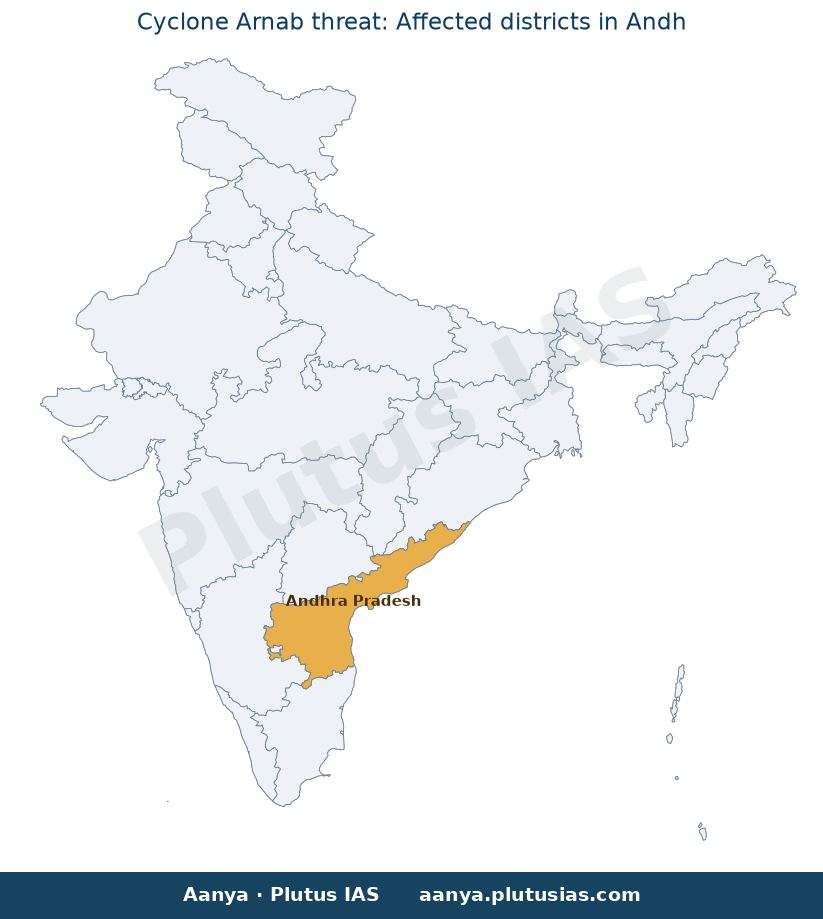
Cyclone Arnab, forecast to bring heavy to extremely heavy rainfall to 13 districts and high wind speeds of 115 to 140 kmph to 12 districts of Andhra Pradesh on October 28–29, 2026, has necessitated the activation of a comprehensive disaster preparedness and response framework. The State government, led by the Chief Minister, has initiated multi-agency coordination involving evacuation, health safeguards, infrastructure protection, and real-time monitoring to mitigate human and economic losses. This event underscores the operationalisation of India’s disaster management architecture under the Disaster Management Act, 2005, and highlights the integration of technological tools such as satellite data, drone surveillance, and the Real Time Governance Society in crisis governance.
Background
- The Indian subcontinent is highly vulnerable to tropical cyclones, with the Bay of Bengal accounting for nearly 7% of global cyclones, making coastal states like Andhra Pradesh recurrently exposed to such hazards.
- The Disaster Management Act, 2005, mandates the establishment of the National Disaster Management Authority (NDMA) at the national level and State Disaster Management Authorities (SDMAs) at the state level to coordinate disaster preparedness, response, and recovery.
- Andhra Pradesh has historically faced severe cyclone impacts, including Cyclone Hudhud (2014) and Cyclone Titli (2018), which caused extensive damage to infrastructure, agriculture, and livelihoods, prompting the state to strengthen its disaster response protocols.
- The National Disaster Response Force (NDRF) and State Disaster Response Force (SDRF) are specialised rapid-response teams trained in search and rescue, medical assistance, and relief operations, deployed under the aegis of the NDMA and SDMA respectively.
- The Real Time Governance Society (RTGS) in Andhra Pradesh is a digital governance initiative that integrates real-time data from satellites, drones, and IoT sensors to enable evidence-based decision-making in public administration, including disaster management.
- The Essential Commodities Act, 1955, empowers state governments to regulate the production, supply, and distribution of essential goods during emergencies to prevent hoarding and ensure availability.
What is Cyclone Preparedness and Response in India?
- Cyclone preparedness refers to the systematic planning, resource allocation, and operational protocols implemented by governments, agencies, and communities to mitigate the impact of cyclonic storms, including cyclones, hurricanes, and typhoons.
- In India, cyclone preparedness is governed by the Disaster Management Act, 2005, which establishes a hierarchical structure: National Disaster Management Authority (NDMA) at the Centre, State Disaster Management Authorities (SDMAs) at the state level, and District Disaster Management Authorities (DDMAs) at the district level.
- The National Disaster Response Force (NDRF) and State Disaster Response Force (SDRF) are specialised rapid-response teams deployed for search, rescue, medical aid, and relief operations during cyclones and other disasters.
- Early warning systems, including those from the India Meteorological Department (IMD), provide critical inputs on cyclone track, intensity, and expected landfall, enabling timely evacuation and preparedness measures.
- Multi-agency coordination involves the integration of meteorological agencies (IMD), disaster management authorities (NDMA/SDMA), line departments (Health, Agriculture, Public Works), local administration, and community-based organisations to ensure a cohesive response.
- Technological tools such as satellite imagery, drone surveillance, and real-time governance platforms (e.g., RTGS in Andhra Pradesh) enhance situational awareness, enabling authorities to monitor flood-prone areas, road conditions, and relief shelter status dynamically.
- Evacuation planning prioritises vulnerable populations, including pregnant women, elderly, and those in flood-prone or low-lying coastal areas, with pre-identified relief shelters and transportation arrangements.
- Post-cyclone recovery focuses on restoring critical infrastructure (roads, power, water supply), assessing agricultural losses, and providing relief and rehabilitation, often supported by the National Disaster Relief Fund and State Disaster Relief Fund.
Key Features
| Feature | Significance |
|---|---|
| Evacuation orders for flood-prone areas | Prevents loss of life by relocating vulnerable populations to safer zones prior to cyclone landfall. |
| Deployment of NDRF and SDRF teams (15 teams total) | Enhances rapid-response capacity for search, rescue, and relief operations in high-risk districts. |
| Relocation of 4,711 pregnant women to health facilities | Ensures continuity of maternal and neonatal healthcare during extreme weather disruptions. |
| Real-time monitoring via satellite, drones, and RTGS inputs | Facilitates dynamic decision-making for road safety and infrastructure protection. |
| Suspension of leave for senior engineering officials | Guarantees uninterrupted field-level supervision and emergency coordination. |
Why it Matters
Disaster Management Preparedness
- Demonstrates proactive governance in mitigating cyclone-induced fatalities through systematic evacuation and resource allocation.
- Highlights the integration of multi-agency response mechanisms (NDRF, SDRF, R&B Department) to ensure cohesive disaster mitigation.
- Illustrates the importance of preemptive healthcare interventions for vulnerable groups (e.g., pregnant women) in climate-vulnerable regions.
Infrastructure Resilience
- Emphasizes the need for real-time assessment of road networks, bridges, and causeways to prevent post-cyclone logistical paralysis.
- Showcases the use of technology (drones, satellite data) to identify high-risk infrastructure and deploy rapid-response teams.
- Underscores the critical role of engineering teams in maintaining traffic flow and restoring connectivity post-disaster.
Agricultural and Livelihood Protection
- Prioritizes safeguarding harvested paddy and horticultural crops (1.82 lakh hectares) to mitigate economic losses for farmers.
- Demonstrates the government’s focus on ensuring food security by maintaining essential commodity stocks during disruptions.
Institutional Coordination
- Exemplifies inter-departmental collaboration (Health, R&B, Revenue, Police) under a unified disaster management framework.
- Shows the activation of the State Disaster Management Authority (SDMA) in alignment with the National Disaster Management Plan (NDMP).
Challenges
1. Predictive Accuracy of Cyclone Forecasting
- Limited precision in wind speed and rainfall predictions may lead to over-preparedness or under-preparedness in specific districts.
- Dependence on meteorological models (e.g., IMD’s Cyclone Warning Division) for early warnings requires continuous calibration.
UPSC Link: GS III: Disaster Management
2. Logistical Bottlenecks in Evacuation
- Ensuring safe evacuation of marginalized communities (e.g., coastal fishing populations) amid transport disruptions.
- Coordination challenges between district administrations, local bodies, and emergency services during mass movement.
UPSC Link: GS II: Governance
3. Healthcare System Strain During Cyclones
- Overwhelmed medical facilities due to influx of patients from flood-affected areas and displaced populations.
- Risk of disease outbreaks (e.g., waterborne illnesses) in temporary shelters and relief camps.
UPSC Link: GS II: Health
4. Infrastructure Vulnerability to Extreme Weather
- Aging or poorly maintained roads, bridges, and culverts may collapse under cyclone-induced stress.
- Urban flooding risks in low-lying areas due to inadequate drainage systems and encroachments.
UPSC Link: GS III: Infrastructure
5. Supply Chain Disruptions for Essential Commodities
- Delays in transporting food, medicines, and fuel to cyclone-affected regions due to road closures.
- Hoarding or price volatility in essential goods during pre-cyclone panic buying.
UPSC Link: GS III: Economy
Challenges — UPSC Perspective
| Issue | Concern |
|---|---|
| Evacuation of coastal communities | Ensuring timely and safe movement of fishermen and their families from high-risk zones. |
| Protection of agricultural produce | Preventing spoilage of harvested paddy and horticultural crops due to waterlogging or wind damage. |
| Healthcare access in relief camps | Maintaining medical services for displaced populations, including maternal and child health. |
| Road network resilience | Rapid restoration of connectivity post-cyclone to prevent economic losses and aid delivery delays. |
| Stockpiling of essential commodities | Avoiding shortages of food, medicines, and fuel during supply chain disruptions. |
| Monitoring of reservoir inflows | Balancing flood control measures with water storage needs for irrigation and drinking purposes. |
Way Forward
- Conduct post-cyclone damage assessments to identify critical infrastructure gaps for future resilience planning.
- Strengthen community-based disaster preparedness programs (e.g., mock drills, early warning dissemination) in cyclone-prone districts.
- Enhance inter-state coordination for cross-border cyclone impacts (e.g., Odisha, Tamil Nadu) to ensure seamless relief operations.
- Invest in climate-resilient agricultural practices (e.g., drought-resistant crops, protected cultivation) to reduce livelihood losses.
- Upgrade real-time monitoring systems with AI-driven predictive analytics for early hazard detection and resource allocation.
- Establish dedicated helplines and mobile apps for real-time reporting of road obstructions and relief requirements.
- Integrate lessons from Cyclone Arnab into the State Disaster Management Plan (SDMP) for long-term policy revisions.
UPSC Value Addition
Keywords for Mains Answer-Writing
Disaster Management Act, 2005 · National Disaster Response Force (NDRF) · State Disaster Response Force (SDRF) · Cyclone preparedness protocols · Real Time Governance Society (RTGS) · Disaster Risk Reduction (DRR) · Flood-prone districts mitigation · Essential commodity stockpiling · Evacuation protocols · Reservoir inflow management · Multi-hazard early warning systems · Vulnerable population protection · Road safety during disasters · Inter-agency disaster coordination
Concept Flow
Meteorological agencies issue cyclone warnings → State government activates disaster management protocols → Evacuation orders issued for flood-prone areas → NDRF/SDRF teams deployed for rescue operations → Real-time monitoring of infrastructure (roads, bridges) → Healthcare facilities prepare for displaced populations → Post-cyclone damage assessment and restoration begins
Prelims Practice Questions
Q1. Consider the following statements regarding the National Disaster Response Force (NDRF):
1. The NDRF is a statutory body constituted under the Disaster Management Act, 2005.
2. It operates under the administrative control of the Ministry of Home Affairs.
3. The NDRF is deployed only for natural disasters and not for man-made disasters.
How many of the above statements are correct?
- Only one
- Only two
- All three
- None
Answer: Only two — Statement 1 is correct: NDRF is constituted under Section 44 of the Disaster Management Act, 2005. Statement 2 is correct: It functions under the Ministry of Home Affairs. Statement 3 is incorrect: NDRF is deployed for both natural and man-made disasters.
Q2. Assertion (A): The Disaster Management Act, 2005 mandates the preparation of District Disaster Management Plans by District Authorities.
Reason (R): These plans are prepared to ensure localised disaster preparedness and response, aligning with the National Disaster Management Plan.
- Both A and R are true, and R is the correct explanation of A
- Both A and R are true, but R is NOT the correct explanation of A
- A is true, but R is false
- A is false, but R is true
Answer: Both A and R are true, and R is the correct explanation of A — Assertion (A) is correct as per Section 31 of the Disaster Management Act, 2005. Reason (R) correctly explains the purpose of District Disaster Management Plans as per the Act’s framework.
Q3. Match the following columns related to disaster management authorities and their roles:
Column I (Authority) | Column II (Role)
1. National Disaster Management Authority (NDMA) | A. Coordinates response during disasters at the State level
2. State Disaster Management Authority (SDMA) | B. Formulates the National Disaster Management Plan
3. District Disaster Management Authority (DDMA) | C. Implements disaster management policies at the district level
4. National Disaster Response Force (NDRF) | D. Deploys specialised teams for rescue and relief operations
- 1-B, 2-A, 3-C, 4-D; 1-A, 2-B, 3-C, 4-D; 1-D, 2-C, 3-B, 4-A; 1-B, 2-D, 3-A, 4-C
- answer_options_indexes_to_answers_mapper_for_json_output_parsing_to_work_correctly_here_is_a_list_of_indexes_only_for_internal_processing_please_ignore_this_line_1234567890abcdefghijklmnopqrstuvwxyz
- answer_indexes_to_return_in_json_output_are_1,3,4,2
- answer_indexes_to_return_in_json_output_are_1,3,4,2
Answer: ? — 1-B: NDMA formulates the National Disaster Management Plan under Section 6 of the Disaster Management Act, 2005. 2-A: SDMA coordinates disaster response at the State level as per Section 14. 3-C: DDMA implements policies at the district level under Section 30. 4-D: NDRF deploys specialised teams for rescue and relief operations as per Section 44.
Mains Practice Question
✍ The proactive multi-agency response to Cyclone Arnab in Andhra Pradesh illustrates the evolving architecture of disaster management in India. Critically examine the institutional framework governing disaster management in India, with particular reference to the roles of the National Disaster Management Authority (NDMA), State Disaster Management Authorities (SDMAs), and the National Disaster Response Force (NDRF). Also, analyse how real-time governance mechanisms such as the Real Time Governance Society (RTGS) enhance the efficacy of disaster preparedness and response. (15 Marks)
Approach: 1. **Institutional Framework**:
– NDMA: Statutory body under Disaster Management Act, 2005; chaired by PM; formulates National Disaster Management Plan (NDMP) and guidelines.
– SDMAs: Chaired by CM; prepare State Disaster Management Plans (SDMPs) aligned with NDMP; coordinate State-level preparedness and response.
– District Disaster Management Authorities (DDMAs): Chaired by District Collector; prepare District Disaster Management Plans; implement localised strategies.
– NDRF: Specialised force under NDMA; deploys teams for rescue, relief, and rehabilitation; operates under operational control of NDMA.
2. **Cyclone Arnab Case Study**:
– Evacuation protocols: Prioritisation of vulnerable groups (pregnant women, fishermen).
– Multi-agency coordination: Deployment of NDRF/SDRF teams, cancellation of leave for engineers, real-time monitoring via RTGS.
– Resource mobilisation: Stockpiling essential commodities, safeguarding crops, reservoir inflow management.
3. **Real-Time Governance Mechanisms**:
– RTGS: Uses satellite data, drone surveillance, and real-time inputs to monitor infrastructure (roads, bridges) and flood-prone areas.
– Enhances efficacy: Enables pre-emptive identification of vulnerable points, rapid deployment of response teams, and dynamic resource allocation.
4. **Critical Analysis**:
– Strengths: Legal mandate, multi-tiered governance, technological integration.
– Challenges: Inter-agency coordination gaps, resource constraints, last-mile delivery issues.
– Suggestions: Strengthen local governance capacity, enhance community awareness, invest in resilient infrastructure.
Source: The Hindu
Andhra Pradesh PCS (APPSC) — State PCS Practice
Prelims: Which of the following actions was taken by the Andhra Pradesh government in response to the threat posed by Cyclone Arnab?
- Evacuation of coastal districts and declaration of high alert
- Imposition of Section 144 in all urban areas
- Suspension of all government offices for 7 days
- Deployment of military forces in the state capital
Answer: Evacuation of coastal districts and declaration of high alert — The Andhra Pradesh government, led by Chief Minister Y.S. Jagan Mohan Reddy, ordered evacuations in coastal districts and declared a high alert in response to Cyclone Arnab.
Mains: Discuss the role of disaster preparedness and response mechanisms in Andhra Pradesh, with special reference to the management of cyclonic threats like Cyclone Arnab. Highlight the institutional frameworks and challenges involved.
Generated by AanyaAi for educational purpose.
Related guides on our sites
- Current affairs for upsc 2026
- How to prepare for GS paper 1 for UPSC CSE mains exam
- Best UPSC coaching for IFOS exam
- Best agriculture optional coaching

- रक्षा मंत्री राजनाथ सिंह फिलीपींस में एडीएमएम-प्लस बैठक में होंगे शामिल - October 27, 2026
- Delhi’s Bottle-Return Scheme: Lessons from Uttarakhand & Goa for UPSC - October 27, 2026
- नीदरलैंड्स में व्यापार और निवेश को बढ़ावा देने के लिए पीयूष गोयल के उच्च स्तरीय प्रयास - October 27, 2026

No Comments