


25 Oct Deendayal Antyodaya Yojana – National Rural Livelihood Mission (DAY–NRLM)
This article covers “Daily Current Affairs” and Deendayal Antyodaya Yojana – National Rural Livelihood Mission (DAY–NRLM)
SYLLABUS MAPPING:
GS- 2– Governance, Social Justice & Welfare Schemes -Deendayal Antyodaya Yojana – National Rural Livelihood Mission (DAY–NRLM)
FOR PRELIMS
What is the main aim of the Deendayal Antyodaya Yojana – National Rural Livelihood Mission (DAY–NRLM)?
FOR MAINS
What challenges does DAY–NRLM face in reaching all poor families?
Why in the News?
The Ministry of Rural Development highlighted the achievements of DAY–NRLM, including ₹11 lakh crore in bank credit disbursed to women Self-Help Groups (SHGs) and the success of entrepreneurs like Heinidamanki Kanai from Meghalaya, who transformed her livelihood through SHG support under the Mission.
What is DAY–NRLM?
DAY–NRLM is a flagship poverty alleviation program of the Government of India, launched in 2010 (as NRLM) and renamed in 2016, implemented by the Ministry of Rural Development.
It aims to reduce rural poverty by enabling poor households to access gainful self-employment and skilled wage employment opportunities, leading to sustainable livelihoods. It is a Centrally Sponsored Scheme, jointly funded by the Centre and States, and is among the world’s largest poverty eradication initiatives.
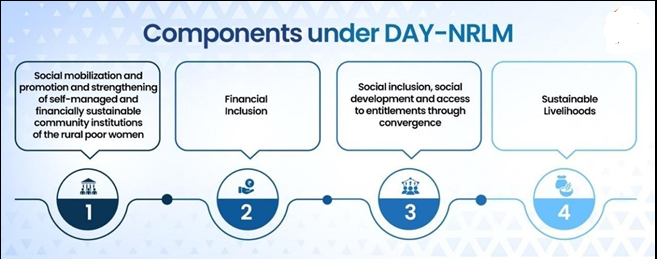
Components of DAY–NRLM
1. Social Mobilization & Institution Building: Formation and strengthening of women-led Self-Help Groups (SHGs) and their federations.
2. Financial Inclusion: Enabling SHGs to access formal credit, insurance, and banking services.
3. Sustainable Livelihood Promotion: Diversifying income sources through farm and non-farm activities.
4. Social Inclusion & Entitlements: Ensuring access to social protection and convergence with other welfare schemes.
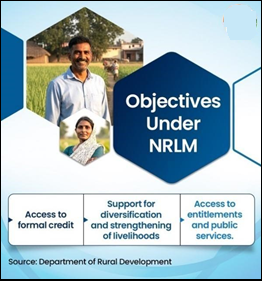
Objectives of DAY–NRLM
1. Build strong community institutions of the rural poor, especially women.
2. Provide access to credit, financial services, and livelihoods.
3. Diversify income sources to ensure economic resilience.
4. Promote social and gender empowerment through awareness on education, nutrition, health, and domestic violence.
5. Train women as Community Resource Persons (CRPs) such as:
Krishi Sakhis – Agricultural extension support
Pashu Sakhis – Livestock service providers
Bank Sakhis – Banking facilitators
Bima Sakhis – Insurance support agents
Empowering Women through DAY–NRLM
a) Financial Empowerment: ₹11 lakh crore disbursed to women Self-Help Groups (SHGs) through formal financial institutions. 98% repayment rate, reflecting high credit discipline and trust in women borrowers.
b) Livelihood Empowerment: 4.62 crore Mahila Kisans engaged in farm-based livelihoods. Promotion of agro-ecological practices through Krishi Sakhis and Pashu Sakhis. Encouragement of micro-enterprises and non-farm livelihoods.
c) Entrepreneurial Empowerment: Under Start-up Village Entrepreneurship Programme (SVEP), 3.74 lakh micro-enterprises supported across 282 blocks. Focus on food processing, handicrafts, and service-based rural industries.
d) Social and Leadership Empowerment: Promotion of entrepreneurship, financial literacy, and collective decision-making among SHG members. Capacity building for leadership and self-reliance through regular training and awareness sessions.
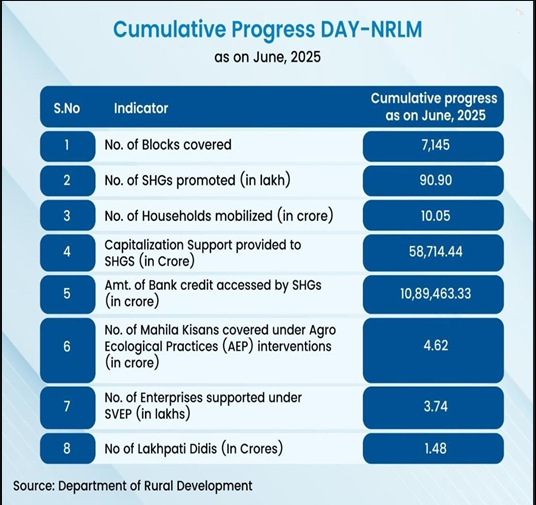
Cumulative Progress under DAY–NRLM
| Category | Key Achievements / Data (as of June 2025) |
|---|---|
| a) SHG Mobilization | • 10.05 crore women mobilized into 90.90 lakh SHGs across 28 States and 6 UTs. |
| b) Human Resource Network | • 3.5 lakh Krishi Sakhis and Pashu Sakhis deployed for last-mile service delivery. • 47,952 Bank Sakhis facilitating SHG credit linkages with formal banks. |
| c) Institutional and Cluster Development | • 6,000 Integrated Farming Clusters formed for sustainable agriculture. • 1.95 lakh Producer Groups established, benefiting over 50 lakh rural women. |
| d) Financial Inclusion | • ₹11 lakh crore in bank loans disbursed to SHGs (2013–2025). • High participation of women in savings and credit activities. |
| e) High-Performing States | SHG Mobilization: Bihar, Uttar Pradesh, Andhra Pradesh.
Financial Inclusion: Sustainable Livelihoods:
|
Skill Development and Employment Initiatives
Advanced and Marketing Training Initiatives
| Initiative | Implementing Agency / Focus | Key Features & Activities | Recent Achievements / Events |
|---|---|---|---|
| a) SARAS Aajeevika Melas | • Organized by Ministry of Rural Development (MoRD) at national and state levels. | • Provide marketing exposure and networking opportunities for SHG products. • Offer hands-on training in marketing, branding, packaging, and sales management. • Facilitate direct buyer-seller interactions and promote “Vocal for Local.” |
• Latest event: New Delhi (5–22 September 2025). • Participation from thousands of SHGs across states showcasing rural products. |
| b) Capacity Building through NIRD&PR | • Conducted by National Institute of Rural Development & Panchayati Raj (NIRD&PR). | • Focus on Training of Trainers (ToT) for marketing and business management. • Enhance entrepreneurial and marketing capacities of SHG members and rural entrepreneurs. |
• 44 ToT programs conducted in the last three years. • Strengthened market readiness and business sustainability of SHG-led enterprises. |
Challenges
a) Institutional and Financial: Regional disparities in SHG performance and credit access. Dependence on limited funding and delayed fund disbursals.
b) Marketing and Infrastructure: Limited market linkages and weak branding of SHG products. Inadequate logistics and lack of e-commerce connectivity.
c) Capacity and Convergence: Insufficient capacity-building and training for SHG members. Poor convergence with other rural development schemes.
d) Technological and Digital Gaps: Low digital literacy among rural women. Limited adoption of technology for business management and marketing.
Way Forward
a) Capacity and Literacy Enhancement: Strengthen digital and financial literacy for all SHG members. Expand entrepreneurship and leadership training.
b) Livelihood and Market Integration: Promote value chain integration for SHG and producer group products. Encourage product diversification and quality improvement.
c) Social and Gender Inclusion: Expand programs on social inclusion, gender sensitization, and rights awareness. Address regional inequalities in SHG outreach and performance.
d) Marketing and E-commerce: Facilitate market access through online platforms and tie-ups with e-commerce giants. Strengthen branding and promotion of rural products.
e) Governance and Monitoring: Enhance monitoring, evaluation, and transparency through data-driven systems. Foster convergence with other government schemes for holistic impact.
Conclusion
The Deendayal Antyodaya Yojana – National Rural Livelihood Mission (DAY–NRLM) stands as a transformative model of inclusive rural development.
By fostering women-led community institutions, enhancing credit access, and promoting sustainable livelihoods, it has significantly strengthened rural entrepreneurship and financial self-reliance. The Mission’s convergence-based, participatory approach continues to drive economic empowerment, social inclusion, and poverty reduction, aligning with India’s broader vision of Atmanirbhar Bharat and inclusive growth.
Prelims question:
Q. Consider the following statements about the Deendayal Antyodaya Yojana – National Rural Livelihood Mission (DAY–NRLM):
1. It was launched in 2010 by restructuring the Swarnajayanti Gram Swarozgar Yojana (SGSY).
2. It is implemented solely by the Ministry of Finance.
3. The Mission primarily focuses on mobilizing rural women into Self-Help Groups (SHGs).
Which of the above statements are correct?
(a) 1 and 3 only
(b) 1 and 2 only
(c) 2 and 3 only
(d) 1, 2, and 3
Answer: A
Mains Question:
Q. The Deendayal Antyodaya Yojana – National Rural Livelihood Mission (DAY–NRLM) has transformed rural livelihoods through social mobilization, financial inclusion, and women empowerment. Discuss the major achievements, challenges, and way forward for ensuring sustainable and inclusive rural development through this Mission.
(250 words)

- A Vision for an Inclusive Bangladesh: Democracy, Minority Rights and India’s Neighbourhood - August 19, 2026
- Employment Guarantee in Limbo: What the VB-G RAM G Transition Means for Rural India - August 19, 2026
- India Is Losing West Asia, but It Is Not Too Late - August 17, 2026

No Comments