


03 Sep Defence Minister Unveils ‘Raksha’ Vision 2036: India’s 10-Year Defence Diplomacy Roadmap
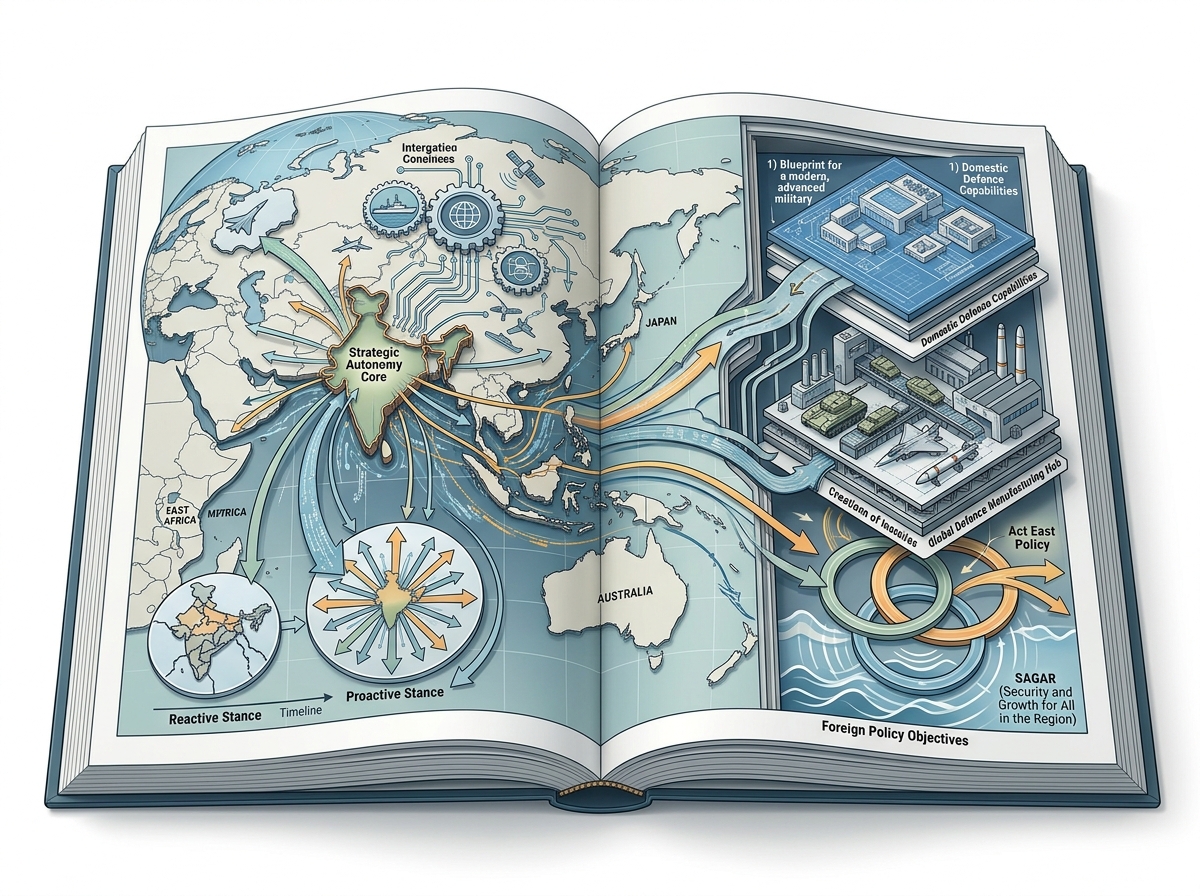
✎ The ‘Raksha’ document is India’s decade-long strategic roadmap for defence diplomacy, integrating indigenous defence manufacturing, maritime security, and multilateral partnerships to enhance global stability and national…
Subject Relevance — Where This Topic Fits
- GS Paper II — International Relations: India’s Foreign Policy, Defence Diplomacy, Strategic Partnerships, Maritime Security | GS Paper III — Internal Security, Defence Technology, Indigenous Defence Production
- Prelims: Defence Diplomacy, Make in India in Defence Sector, SAGAR Initiative, Indigenous Defence Platforms, Maritime Security in Indian Ocean Region, Joint Military Exercises, Defence Export Policy
- Essay: The Role of Defence Diplomacy in India’s Global Standing, Indigenous Defence Manufacturing: A Pillar of National Security and Economic Growth
Quick Revision: The ‘Raksha’ document is India’s decade-long strategic roadmap for defence diplomacy, integrating indigenous defence manufacturing, maritime security, and multilateral partnerships to enhance global stability and national security.
Why is this in the news?
On 3 September 2026, the Union Minister of Defence released a comprehensive defence diplomacy document titled ‘Raksha’, outlining India’s strategic vision for global defence partnerships over the next decade. This initiative marks a paradigm shift in India’s approach to national security by integrating proactive global cooperation with domestic defence capabilities and a credible global defence manufacturing hub.
Background
- India’s defence diplomacy has evolved from a reactive to a proactive stance, particularly in the Indo-Pacific region, to counterbalance geopolitical uncertainties and strengthen strategic autonomy.
- The document ‘Raksha’ aligns with India’s broader foreign policy objectives, as articulated in the ‘Act East Policy’, ‘SAGAR (Security and Growth for All in the Region)’, and the ‘Indo-Pacific Oceans Initiative (IPOI)’.
- India’s defence exports have witnessed a significant rise, with indigenous platforms such as Tejas, BrahMos, and Akash missile systems gaining global recognition.
- The Indian Ocean Region (IOR) is a critical maritime corridor, with over 60% of global oil trade and 40% of container traffic passing through it, necessitating robust maritime security frameworks.
- India has been conducting joint military exercises with strategic partners such as the United States (Malabar), France (Varuna), and Japan (Dharma Guardian), reflecting its commitment to multilateral defence cooperation.
- The ‘Make in India’ initiative in the defence sector has been reinforced by the Defence Production and Export Promotion Policy (DPEPP) 2020, aiming to achieve a defence export target of ₹35,000 crore by 2025.
What is the ‘Raksha’ Document?
- The ‘Raksha’ document is a strategic blueprint released by the Ministry of Defence, India, outlining the country’s vision for defence diplomacy over the next decade (2026–2036).
- It serves as a guiding framework for India’s engagement with global partners to enhance bilateral and multilateral security collaborations, ensuring long-term stability and mutual growth.
- The document identifies four key pillars: (1) Strengthening Strategic Partnerships, (2) Capacity Development through joint military exercises and defence training, (3) Promoting Indigenous Defence Exports to establish India as a global defence manufacturing hub, and (4) Enhancing Maritime Security in the Indian Ocean Region.
- Strategic partnerships under this document focus on deepening defence ties with like-minded nations, including Quad partners (India, USA, Japan, Australia), ASEAN countries, and Gulf states.
- Capacity development initiatives include the expansion of joint military exercises, defence training programs, and knowledge-sharing mechanisms with allied nations to adopt best practices in defence governance.
- The emphasis on indigenous defence exports aligns with the ‘Atmanirbhar Bharat’ (Self-Reliant India) initiative, aiming to reduce import dependence and boost domestic defence manufacturing capabilities.
- Maritime security is prioritised through collaborative frameworks with littoral states in the Indian Ocean Region, ensuring collective action against piracy, illegal fishing, and maritime terrorism.
- The document underscores India’s commitment to a rules-based international order, advocating for adherence to international law, including the United Nations Convention on the Law of the Sea (UNCLOS).
Key Features
| Feature | Significance |
|---|---|
| Strategic Partnerships | Enhances bilateral and multilateral defence cooperation, fostering long-term security alliances and regional stability. |
| Capacity Development | Promotes joint military exercises, training programmes, and exchange of best practices with allied nations to bolster interoperability. |
| Indigenous Defence Exports | Positions India as a reliable global defence manufacturing hub by incentivising domestic defence platforms and technologies. |
| Maritime Security | Reinforces India’s role as a net security provider and first responder in the Indian Ocean Region (IOR), ensuring regional maritime safety. |
| Vision Document (‘Raksha’) | Provides a decade-long strategic roadmap for defence diplomacy, aligning national security objectives with proactive global engagement. |
Why it Matters
Strategic Diplomacy
- Elevates defence diplomacy from transactional engagements to a structured, long-term framework aligned with India’s Act East and Indo-Pacific policies.
- Demonstrates India’s commitment to a rules-based international order and collective security mechanisms.
- Strengthens deterrence through calibrated partnerships with like-minded nations, reducing regional asymmetries.
Economic Security
- Promotes indigenous defence manufacturing, reducing import dependency and enhancing self-reliance (Atmanirbhar Bharat in defence).
- Expands defence exports, generating revenue streams and creating high-skilled employment in the defence industrial base.
- Encourages technology transfer and joint ventures, fostering innovation in dual-use technologies.
Regional Stability
- Reinforces India’s leadership in the Indian Ocean Region (IOR) through capacity-building initiatives and maritime domain awareness.
- Facilitates conflict prevention and crisis management through structured defence dialogues and confidence-building measures.
- Supports multilateral frameworks like the ASEAN Defence Ministers’ Meeting (ADMM-Plus) and Indian Ocean Naval Symposium (IONS).
Institutional Synergy
- Integrates the Ministry of Defence, Ministry of External Affairs, and National Security Council Secretariat into a cohesive defence diplomacy architecture.
- Leverages the Integrated Defence Staff (IDS) and tri-services (Army, Navy, Air Force) for unified strategic messaging.
- Aligns defence diplomacy with India’s broader foreign policy goals, including strategic autonomy and non-alignment 2.0.
Challenges
1. Geopolitical Asymmetries
- Balancing strategic partnerships with major powers (e.g., USA, Russia, EU) without compromising India’s autonomous foreign policy stance.
- Navigating China’s assertive maritime posture in the IOR while avoiding direct confrontation or escalation.
- Mitigating risks of over-dependence on defence imports from a limited set of suppliers.
UPSC Link: GS II: India’s Foreign Policy
2. Indigenous Defence Ecosystem
- Overcoming delays in defence procurement and production due to bureaucratic hurdles and regulatory bottlenecks.
- Addressing skill gaps in the defence manufacturing sector to meet global quality and compliance standards.
- Ensuring cost-competitiveness of indigenous platforms against established foreign alternatives.
UPSC Link: GS III: Defence Manufacturing
3. Maritime Security Gaps
- Limited maritime domain awareness capabilities in the IOR due to inadequate surveillance infrastructure.
- Coordinating responses to non-traditional threats (piracy, illegal fishing, smuggling) with regional partners.
- Addressing underutilisation of India’s naval assets due to logistical and operational constraints.
UPSC Link: GS II: Regional Organisations
4. Diplomatic Coordination
- Ensuring alignment between defence diplomacy initiatives and broader foreign policy objectives across ministries.
- Managing divergent strategic interests among allied nations (e.g., USA’s Indo-Pacific focus vs. Russia’s Eurasian priorities).
- Avoiding duplication of efforts with existing defence cooperation frameworks (e.g., bilateral exercises, UN peacekeeping).
UPSC Link: GS II: International Institutions
5. Resource Allocation
- Balancing defence diplomacy expenditures with domestic security priorities and fiscal constraints.
- Ensuring sustained funding for joint military exercises, training programmes, and technology transfer initiatives.
- Addressing opportunity costs of diverting resources from traditional defence procurement to diplomacy-driven capacity building.
UPSC Link: GS III: Budgetary Allocations
Challenges — UPSC Perspective
| Issue | Concern |
|---|---|
| Defence Procurement Delays | Bureaucratic inertia and regulatory hurdles slow down indigenous defence production and exports. |
| Maritime Surveillance Gaps | Inadequate satellite and sensor networks limit India’s ability to monitor the IOR effectively. |
| Export Market Competition | Established defence exporters (e.g., USA, Russia, Israel) dominate global demand, posing pricing challenges. |
| Strategic Autonomy vs. Alliances | Balancing partnerships with major powers while maintaining India’s non-aligned strategic posture. |
| Technology Transfer Constraints | Intellectual property rights and export control regimes limit access to advanced defence technologies. |
| Inter-Ministerial Coordination | Fragmented governance between MoD, MEA, and NSCS may dilute the efficacy of defence diplomacy. |
Way Forward
- Establish a dedicated Defence Diplomacy Cell within the Ministry of Defence to coordinate and monitor implementation of the ‘Raksha’ roadmap.
- Accelerate procurement reforms (e.g., simplified Make-II procedures) to expedite indigenous defence manufacturing and exports.
- Expand maritime domain awareness through partnerships with QUAD nations, France, and regional littoral states for shared surveillance data.
- Launch a ‘Defence Exports Mission’ to identify high-potential markets, provide export incentives, and streamline certification processes.
- Enhance tri-services jointness by institutionalising annual strategic dialogues with allied nations, focusing on interoperability and technology sharing.
- Invest in cyber and space defence capabilities to align with emerging threats in the digital and extra-atmospheric domains.
- Strengthen defence diplomacy outreach through cultural and academic exchanges (e.g., defence attaché programmes, military academies collaborations).
- Conduct periodic reviews of the ‘Raksha’ roadmap with stakeholders to adapt to evolving geopolitical and technological landscapes.
UPSC Value Addition
Keywords for Mains Answer-Writing
Defence Diplomacy · Strategic Partnerships · Indigenous Defence Manufacturing · Maritime Security · Defence Export Promotion · Capacity Development in Defence · Rule-based International Order · Hind Mahasagar (Indian Ocean Region) · Defence Exercises · Defence Industrial Base · India’s Defence Vision 2036 · Multilateral Security Cooperation · Bilateral Security Alliances · Self-reliance in Defence (Atmanirbhar Bharat)
Concept Flow
India’s evolving security paradigm → Recognition of defence diplomacy as a pillar of foreign policy → Launch of ‘Raksha’ vision document → Strategic pillars: partnerships, capacity, exports, maritime security → Implementation via institutional synergy (MoD, MEA, NSCS) → Alignment with Act East and Indo-Pacific policies → Enhanced regional stability and global standing.
Prelims Practice Questions
Q1. Consider the following statements regarding the recently released defence diplomacy document ‘रक्षा’ by the Ministry of Defence:
1. It outlines a strategic roadmap for India’s defence partnerships over the next decade.
2. The document emphasizes the promotion of indigenous defence manufacturing to establish India as a global defence manufacturing hub.
3. It focuses exclusively on bilateral defence cooperation and excludes multilateral frameworks.
How many of the above statements are correct?
- Only one
- Only two
- Only three
- None
Answer: Only two — Statements 1 and 2 are correct as the document presents a strategic vision for India’s defence partnerships and promotes indigenous defence manufacturing. Statement 3 is incorrect because the document also highlights multilateral security cooperation.
Q2. Assertion (A): The ‘रक्षा’ document released by the Ministry of Defence prioritizes maritime security in the Indian Ocean Region (IOR) as a key pillar of India’s defence diplomacy.
Reason (R): The document explicitly states that India aims to position itself as a net security provider and first responder in the IOR.
- Both A and R are true, and R is the correct explanation of A.
- Both A and R are true, but R is not the correct explanation of A.
- A is true, but R is false.
- A is false, but R is true.
Answer: Both A and R are true, and R is the correct explanation of A. — Both the assertion and reason are correct, and the reason accurately explains the assertion as the document identifies maritime security as a critical pillar and positions India as a net security provider in the IOR.
Q3. Match the following pillars of India’s defence diplomacy as outlined in the ‘रक्षा’ document with their respective descriptions:
Column I (Pillar)
A. Strategic Partnerships
B. Capacity Development
C. Indigenous Export
D. Maritime Security
Column II (Description)
1. Strengthening bilateral and multilateral security cooperation
2. Promoting joint military exercises and defence manufacturing for global markets
3. Enhancing joint military exercises, training programs, and sharing best practices
4. Strengthening India’s role as a net security provider in the Indian Ocean Region
Answer: ? — A-1, B-3, C-2, D-4. The pillars and their descriptions align as follows: Strategic Partnerships (A) focus on bilateral and multilateral cooperation; Capacity Development (B) emphasizes joint exercises and training; Indigenous Export (C) promotes defence manufacturing for global markets; Maritime Security (D) strengthens India’s role in the IOR.
Mains Practice Question
✍ Critically analyse the significance of India’s recently unveiled defence diplomacy document ‘रक्षा’ in shaping the country’s strategic posture over the next decade. How does the document integrate national security objectives with global defence partnerships? Elucidate with reference to the key pillars identified in the document. (15 Marks)
Approach: MODEL-ANSWER SKELETON:
1. **Introduction (2 Marks)**
– Define defence diplomacy and its role in India’s foreign policy.
– Context: Release of the ‘रक्षा’ document by the Ministry of Defence on 3 September 2026, outlining a 10-year strategic roadmap.
2. **Key Pillars of the Document (5 Marks)**
– **Strategic Partnerships**: Emphasis on strengthening bilateral and multilateral security cooperation (e.g., QUAD, ASEAN, bilateral defence pacts).
– **Capacity Development**: Focus on joint military exercises, training programs, and sharing best practices with allied nations.
– **Indigenous Export**: Promotion of India-made defence platforms to position India as a global defence manufacturing hub (link to Atmanirbhar Bharat and ‘Make in India’).
– **Maritime Security**: Strengthening India’s role as a net security provider and first responder in the Indian Ocean Region (IOR), ensuring rule-based order.
3. **Integration of National Security and Global Partnerships (4 Marks)**
– How the document aligns national security objectives (e.g., territorial integrity, counter-terrorism) with proactive global engagement.
– Role of defence diplomacy in fostering long-term stability and mutual development.
– Reference to India’s evolving strategic autonomy and non-alignment 2.0.
4. **Critical Analysis (3 Marks)**
– Strengths: Comprehensive vision, alignment with global trends (e.g., Indo-Pacific strategy), and emphasis on self-reliance.
– Challenges: Implementation hurdles (e.g., bureaucratic delays, funding constraints), balancing partnerships with strategic autonomy, and addressing regional sensitivities.
5. **Conclusion (1 Mark)**
– Reiterate the document’s role in positioning India as a responsible global stakeholder in defence diplomacy.
Source: PIB (Press Information Bureau)
Generated by AanyaAi for educational purpose.
Related guides on our sites
- Best PSIR optional coaching for upsc
- Best PSIR optional teacher for upsc
- Best teacher of PSIR optional for upsc
- Best PSIR optional coaching in delhi for UPSC

- केरल में बच्चों की कुपोषण और उपेक्षा से मृत्यु रोकने की तैयारी, जानिए कैसे - October 24, 2026
- Liechtenstein Prince’s India Visit: Key Agreements & Bilateral Focus - October 24, 2026
- 19वें ‘अर्बन मोबिलिटी इंडिया सम्मेलन 2026’ का उद्घाटन: भुवनेश्वर में हुआ आयोजन - October 24, 2026

No Comments