


05 Feb Democratising Artificial Intelligence in India: Building a Population-Scale AI Stack
This article covers “Daily Current Affairs” and From Democratising Artificial Intelligence in India: Building a Population-Scale AI Stack
SYLLABUS MAPPING
GS-3-Science & Technology- Democratising Artificial Intelligence in India: Building a Population-Scale AI Stack
FOR PRELIMS
What is meant by an AI stack?
FOR MAINS
Why is Artificial Intelligence being viewed as a public good in India?”
Why in the News?
The future of technology in India is guided by a simple yet transformative principle: the democratisation of Artificial Intelligence (AI). AI should not remain the preserve of a few corporations, elite institutions, or technologically advanced countries. Instead, it must evolve as a public good, designed to benefit every citizen and strengthen collective well-being.
This people-centric vision of “AI for Humanity” places human welfare at the core of technological progress. Innovation is not an end in itself; it is a means to enhance access to healthcare, education, livelihoods, justice, and public services. For AI to deliver such population-scale impact, it must function reliably, affordably, and seamlessly across sectors. This is made possible through a robust and integrated AI stack—the foundational architecture that enables AI systems to be built, deployed, and scaled effectively.
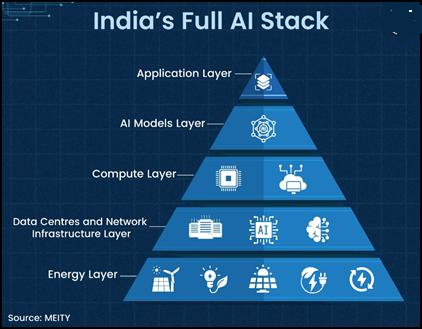
Understanding the AI Stack: Enabling AI at Population Scale
An AI stack refers to the complete ecosystem of hardware, software, platforms, and infrastructure that collectively support AI development and deployment. It enables AI applications ranging from everyday services such as virtual assistants and recommendation systems to advanced use cases in healthcare diagnostics, financial fraud detection, governance, and climate forecasting. The AI stack comprises five interdependent layers—applications, AI models, compute, digital infrastructure, and energy. Together, these layers ensure that AI systems are scalable, reliable, secure, and capable of delivering real-world impact at national scale.
Application Layer: Translating AI into Public Value
The application layer represents the user-facing dimension of the AI stack. It includes AI-powered tools and services such as health diagnostic platforms, agricultural advisory systems, chatbots, language translation applications, and decision-support tools. This layer transforms complex algorithms into simple, accessible, and user-friendly solutions, enabling citizens to interact directly with AI.
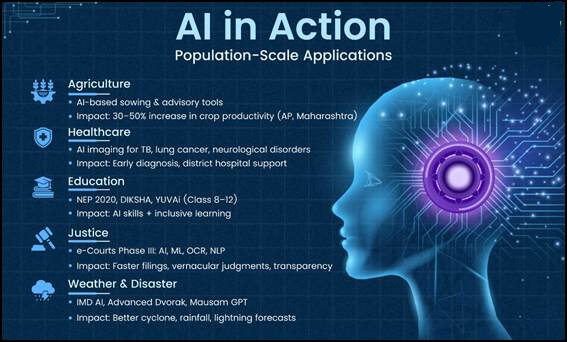
AI Adoption through High-Impact Applications in India
1. Agriculture: AI-driven advisory tools assist farmers in sowing decisions, pest management, and input optimisation. State-level deployments in Andhra Pradesh and Maharashtra have reported productivity gains of 30–50%.
2. Healthcare: AI applications support early detection of tuberculosis, cancer, neurological disorders, and other diseases, strengthening preventive and diagnostic care.
3. Education: Under NEP 2020, AI learning is integrated through CBSE curricula, DIKSHA, and initiatives such as YUVAi, equipping students with future-ready skills.
4. Justice Delivery: e-Courts Phase III deploys AI and machine learning for case management, translation, scheduling, and citizen-facing services, enhancing efficiency and vernacular access.
5. Weather and Disaster Management: The IMD uses AI for advanced forecasting of rainfall, cyclones, fog, and lightning, with tools such as Mausam GPT aiding farmers and disaster response agencies.
AI Model Layer: The Intelligence Core
The AI model layer functions as the brain of AI systems. Models are trained on large datasets to recognise patterns, make predictions, translate languages, and support decision-making. The effectiveness of AI applications depends fundamentally on the relevance, quality, and trustworthiness of these models.
Development of AI Models in India
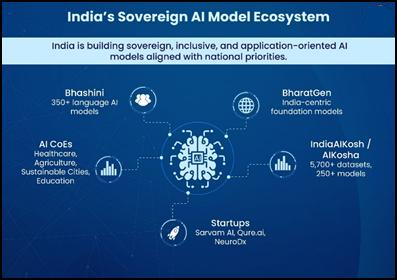
1. India is actively building sovereign and India-centric AI models aligned with national priorities:
2. Under the IndiaAI Mission, 12 indigenous AI models are being developed for India-specific use cases.
3. Startups receive subsidised compute support, with up to 25% of compute costs covered through grants and equity.
4. BharatGen is developing foundation and multimodal models, ranging from billions to trillions of parameters.
5. IndiaAIKosh serves as a national repository, hosting 5,722 datasets and 251 AI models across 20 sectors.
6. Sarvam AI is developing large language and speech models for Indian languages.
7. Bhashini, under the National Language Translation Mission, hosts 350+ AI models, enabling multilingual access to digital services.
Compute Layer: The Muscle Powering AI
India’s Expanding AI Compute Infrastructure
1. ₹10,300+ crore allocated over five years under the IndiaAI Mission.
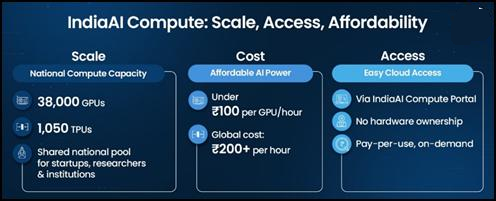
2. The IndiaAI Compute Portal offers shared access to 38,000 GPUs and 1,050 TPUs at subsidised rates below ₹100 per hour.
3. A secure national GPU cluster with 3,000 next-generation GPUs is being established for strategic applications.
4. The India Semiconductor Mission (₹76,000 crore) has approved 10 semiconductor projects, including fabs and ATMP units.
5. Indigenous chip initiatives such as SHAKTI and VEGA processors strengthen domestic AI hardware capabilities.
Data Centres and Network Infrastructure: The Backbone of AI
This layer provides the physical and digital backbone for AI systems. Data centres host AI workloads, while networks such as broadband and 5G enable fast and reliable data transmission.
Status of AI Infrastructure in India
1. Nationwide optical fibre connectivity supports high-speed data movement.
2. 5G coverage is available in 99.9% of districts, covering 85% of the population.
3. India currently accounts for ~3% of global data centre capacity (~960 MW), projected to expand to 9.2 GW by 2030.
4. Major data centre hubs include Mumbai–Navi Mumbai, Bengaluru, Hyderabad, Chennai, and Delhi NCR.
Significant investments include:
1. Microsoft: ₹1.5 lakh crore
2. Amazon: ₹2.9 lakh crore by 2030
3. Google: ₹1.25 lakh crore for a 1 GW AI hub in Vizag
Energy Layer: Sustaining the AI Ecosystem
India’s Energy Readiness for AI
1. Peak power demand of 242.49 GW met in FY 2025–26 with shortages reduced to 0.03%.
2. Total installed capacity reached 509.7 GW (Nov 2025).
3. Non-fossil sources account for over 51% of installed capacity.
Long-term plans include:
1. 100 GW nuclear capacity by 2047
2. 57 GW pumped storage by 2031–32
3. 3,220 MWh battery energy storage
Conclusion
India’s approach to building a robust AI stack reflects both technological ambition and social responsibility. By strengthening every layer—from applications and models to compute, infrastructure, and energy—India is ensuring that AI serves citizens at population scale. Affordable compute access, indigenous model development, secure data infrastructure, and clean energy systems together create an AI ecosystem that is inclusive, sovereign, resilient, and future-ready. Anchored in the vision of AI for Humanity, India’s AI stack positions technology as a powerful instrument for inclusive growth, social equity, and public welfare—advancing welfare for all and happiness for all in the digital age.
Best ias coaching in delhi Best ias coaching in chandigar
Prelims question:
Q. With reference to India’s Artificial Intelligence (AI) ecosystem, consider the following statements:
1. The AI stack consists of applications, AI models, compute, digital infrastructure, and energy.
2. The IndiaAI Compute Portal provides subsidised access to GPUs and TPUs to startups and institutions.
3. Bhashini aims to strengthen multilingual digital access through AI-based language tools.
4. India’s AI strategy focuses exclusively on private-sector innovation without public sector deployment.
Which of the statements given above are correct?
(a) 1, 2 and 3 only
(b) 1 and 4 only
(c) 2 and 3 only
(d) 1, 2, 3 and 4
Answer: A
Q. India is pursuing the democratisation of Artificial Intelligence through the development of a comprehensive AI stack. Discuss how strengthening different layers of the AI stack can enable inclusive, sovereign, and population-scale AI adoption in India.
(250 words)

- RBI’s Shrinking Real-Rate Cushion Amid Rising Inflation and Strong Demand - September 21, 2026
- India’s NGOs at a New Funding Crossroads - September 21, 2026
- Deep-Sea Discovery, Environmental Responsibility - September 19, 2026

No Comments