


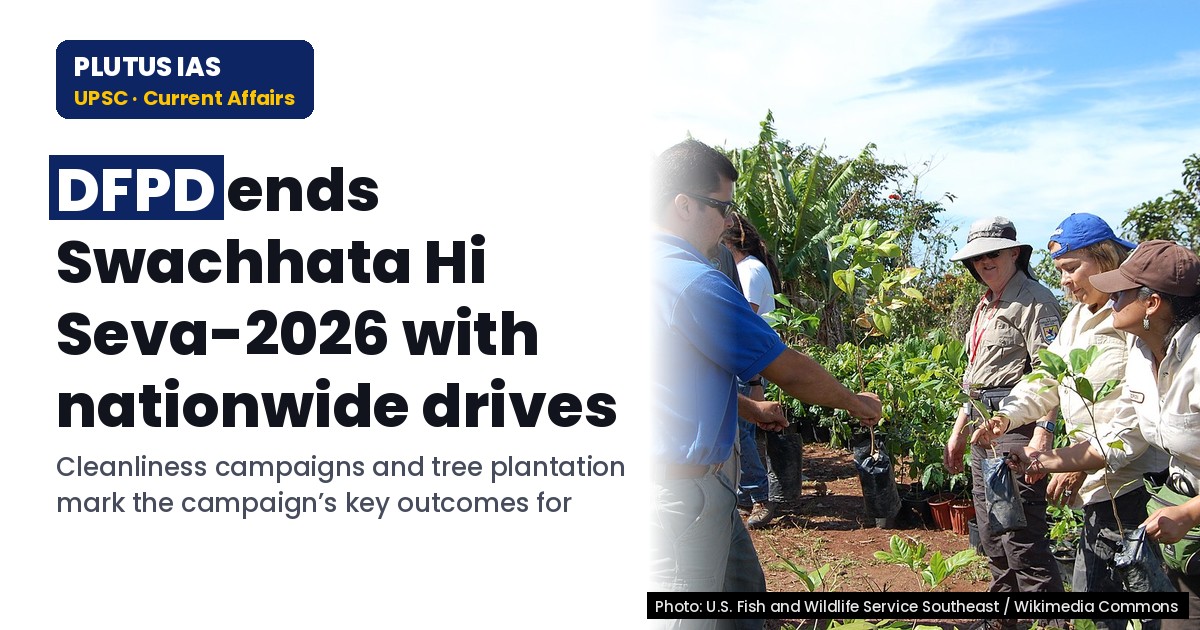
02 Oct DFPD concludes Swachhata Hi Seva-2026 campaign: Key highlights for UPSC
✎ Swachhata Hi Seva-2026 is a 15-day mass cleanliness campaign (17 Sep–02 Oct 2026) by the Department of Food and Public Distribution, integrating sanitation drives, awareness programmes, and environmental initiatives with the…
Subject Relevance — Where This Topic Fits
- GS Paper II — Governance, Constitution, Polity, Social Justice and International Relations (Citizen Participation in Governance)
- Prelims: Swachh Bharat Mission 2.0, Public Distribution System (PDS), Food Corporation of India (FCI), Central Warehousing Corporation (CWC), Safai Mitras, Swachhata Hi Seva campaign, MyGov portal, Environmental sustainability in public administration
- Essay: Cleanliness as a National Priority: From Gandhian Vision to Mass Mobilisation, Sustainable Public Governance: Balancing Administrative Efficiency and Environmental Responsibility
Quick Revision: Swachhata Hi Seva-2026 is a 15-day mass cleanliness campaign (17 Sep–02 Oct 2026) by the Department of Food and Public Distribution, integrating sanitation drives, awareness programmes, and environmental initiatives with the Swachh Bharat Mission 2.0 to promote cleanliness, citizen participation, and sustainable governance in India’s food security ecosystem.
Why is this in the news?
The Department of Food and Public Distribution (DFPD), under the Ministry of Consumer Affairs, Food and Public Distribution, concluded the Swachhata Hi Seva-2026 (SHS-2026) campaign on 02 October 2026, marking the 157th birth anniversary of Mahatma Gandhi and reinforcing the Swachh Bharat Abhiyan’s ethos of cleanliness and citizen participation. The campaign, spanning 15 days from 17 September to 02 October 2026, engaged DFPD, its public sector undertakings (FCI, CWC), and subordinate offices in nationwide cleanliness drives, awareness campaigns, and environmental initiatives, underscoring the integration of sanitation with food security governance.
Background
- The Swachh Bharat Mission (SBM), launched in 2014, is India’s flagship programme to achieve universal sanitation and cleanliness, with Phase 2 (SBM 2.0) focusing on sustainability and behaviour change.
- The Department of Food and Public Distribution (DFPD) is responsible for the management of the Public Distribution System (PDS), foodgrain storage, and supply chain logistics, including the Food Corporation of India (FCI) and Central Warehousing Corporation (CWC).
- Cleanliness and hygiene in food storage and distribution are critical to preventing contamination, reducing food wastage, and ensuring food safety under the National Food Security Act, 2013.
- The Swachhata Hi Seva (SHS) campaign, an annual mass movement, aligns with the SBM’s objectives by promoting cleanliness, environmental sustainability, and citizen engagement through structured activities.
- The campaign’s integration with Mahatma Gandhi’s birth anniversary (02 October) symbolises the continuity of his ideals of cleanliness, self-reliance, and public participation in governance.
What is Swachhata Hi Seva-2026 (SHS-2026)?
- SHS-2026 is a nationwide cleanliness and awareness campaign organised by the Department of Food and Public Distribution (DFPD) from 17 September to 02 October 2026, culminating on Gandhi Jayanti.
- Key activities included office-based cleanliness drives, door-to-door awareness campaigns, art competitions, walkathons, tree plantation under the ‘Ek Ped Maa Ke Naam’ initiative, cultural programmes (poetry recitals, street plays, slogan writing), and collective cleanliness pledges via the MyGov portal.
- The campaign engaged DFPD’s public sector undertakings—Food Corporation of India (FCI), Central Warehousing Corporation (CWC), and subordinate offices—ensuring a multi-tiered implementation across the food security ecosystem.
- Safai Mitras (sanitation workers) were honoured for their contributions, highlighting the dignity of labour and the importance of inclusive governance in sanitation efforts.
- The campaign’s activities were designed to foster behavioural change, promote intergenerational environmental responsibility, and align with India’s commitments under the Sustainable Development Goals (SDGs), particularly SDG 6 (Clean Water and Sanitation) and SDG 11 (Sustainable Cities and Communities).
- The initiative underscores the role of public institutions in modelling cleanliness and sustainability, reinforcing the link between administrative efficiency and environmental stewardship in India’s food supply chain.
Key Features
| Feature of SHS-2026 | Significance for Governance and Public Administration |
|---|---|
| National-scale campaign duration (17 September–2 October 2026) | Demonstrates institutional commitment to sustained behavioural change through structured time-bound initiatives. |
| Multi-modal awareness activities (door-to-door campaigns, street plays, slogan writing) | Enhances citizen engagement by leveraging cultural and participatory methods to disseminate sanitation messaging. |
| ‘Ek Ped Maa Ke Naam’ tree-planting initiative | Integrates environmental sustainability with sanitation, aligning with SDG 13 (Climate Action) and SDG 15 (Life on Land). |
| ‘Ek Din, Ek Ghanta, Ek Saath’ mass cleanliness drive | Mobilises collective action across offices and communities, reinforcing the principle of participatory governance. |
| Recognition and felicitation of sanitation workers (Safai Mitras) | Promotes dignity of labour and addresses social stigma associated with sanitation-related occupations. |
| Integration with Swachh Bharat Diwas (2 October) | Links sanitation campaigns to national observances, amplifying symbolic and practical impact through Gandhi Jayanti commemorations. |
Why it Matters
Administrative Efficiency
- Structured multi-departmental coordination under the Department of Food and Public Distribution (DFPD) showcases inter-ministerial synergy in public service delivery.
- Use of public sector undertakings (FCI, CWC, IGMRI) as nodal agencies demonstrates leveraging existing institutional infrastructure for mass outreach.
- Adoption of digital platforms (MyGov portal) for oath-taking enhances transparency and traceability of participation.
Behavioural Change and Public Awareness
- Campaigns combining visual (posters, slogans), auditory (poetry recitals), and kinesthetic (tree-planting, walkathons) elements cater to diverse learning styles, improving retention of sanitation principles.
- Door-to-door campaigns ensure last-mile connectivity, particularly in rural and semi-urban areas where institutional reach may be limited.
- Cultural programmes (street plays, nukkad natak) utilise local idioms and narratives to normalise sanitation as a social norm rather than a statutory obligation.
Environmental Sustainability
- Tree-planting initiatives under ‘Ek Ped Maa Ke Naam’ contribute to carbon sequestration and urban greening, complementing national afforestation targets (e.g., National Mission for a Green India).
- Promotion of waste segregation and reduced single-use plastic aligns with the Swachh Bharat Mission 2.0 objectives and circular economy principles.
- Integration of sanitation with environmental stewardship reflects a holistic approach to public health and ecosystem resilience.
Institutional Culture and Workforce Motivation
- Felicitation of sanitation workers addresses long-standing issues of occupational dignity and social recognition, potentially improving service delivery morale.
- Mass participation in cleanliness drives fosters a sense of collective responsibility among government employees, enhancing organisational culture.
- Public recognition of ‘Safai Mitras’ through awards and gifts reinforces the principle of ‘Antyodaya’ (upliftment of the last person) in governance.
Policy and Programme Alignment
- Campaigns align with the Swachh Bharat Mission 2.0’s focus on sustainability, behaviour change, and people’s participation.
- Leverages the framework of the National Cleanliness Policy, 2022, which emphasises community-led sanitation and hygiene.
- Supports the achievement of SDG 6 (Clean Water and Sanitation) targets through grassroots-level interventions.
Challenges
1. Ensuring Sustained Community Participation
- Short-term campaigns risk limited long-term impact without follow-up mechanisms or local ownership.
- Urban-rural disparities in access to sanitation infrastructure may hinder uniform participation.
- Behavioural change requires continuous reinforcement; one-off events may not suffice.
UPSC Link: GS-II: Role of Civil Society and NGOs in Public Health
2. Logistical and Resource Constraints
- Large-scale campaigns demand significant manpower, funds, and coordination across multiple agencies.
- Geographical spread of DFPD’s offices (FCI, CWC, IGMRI) necessitates decentralised planning to avoid bottlenecks.
- Maintenance of cleanliness post-campaign requires sustained budgetary allocation and institutional commitment.
UPSC Link: GS-III: Resource Mobilisation for Public Welfare
3. Addressing Social Stigma and Occupational Dignity
- Sanitation workers often face social exclusion despite their critical role in public health; campaigns must go beyond symbolic recognition.
- Need for structural reforms in wages, safety equipment, and career progression pathways for Safai Mitras.
- Public perception campaigns must challenge deep-rooted biases associated with sanitation-related occupations.
UPSC Link: GS-II: Social Justice and Empowerment
4. Monitoring and Evaluation of Impact
- Quantifying behavioural change and environmental outcomes from awareness campaigns is challenging without robust MIS systems.
- Lack of standardised metrics to assess the effectiveness of cultural and participatory methods in sanitation promotion.
- Need for third-party audits or citizen feedback mechanisms to validate campaign outcomes.
UPSC Link: GS-IV: Ethics in Governance and Public Accountability
5. Integration with Broader Sanitation Policies
- Ensuring that campaign activities complement existing schemes (e.g., Swachh Bharat Mission, Jal Jeevan Mission) without duplication.
- Coordination with state governments and local bodies to avoid fragmented implementation across jurisdictions.
- Alignment with national sanitation policies to ensure scalability and replicability in other sectors.
UPSC Link: GS-II: Centre-State Relations and Cooperative Federalism
Challenges — UPSC Perspective
| Challenge | Associated Concern |
|---|---|
| Short-term campaign impact | Risk of behavioural relapse post-campaign due to lack of follow-up mechanisms. |
| Resource mobilisation | High costs of logistics, manpower, and materials for nationwide initiatives. |
| Social stigma towards sanitation workers | Perpetuation of occupational hierarchies despite symbolic recognition. |
| Monitoring and evaluation | Difficulty in measuring intangible outcomes like behavioural change and cultural shifts. |
| Policy fragmentation | Potential overlap or gaps with existing sanitation schemes and state-level programmes. |
| Urban-rural disparities | Unequal access to sanitation infrastructure and awareness campaigns. |
Way Forward
- Institutionalise post-campaign follow-ups through quarterly ‘Swachhata Survekshan’ audits to assess sustained behavioural change and environmental outcomes.
- Develop a digital dashboard to track participation metrics, feedback, and grievances, ensuring transparency and accountability in campaign implementation.
- Expand the ‘Ek Ped Maa Ke Naam’ initiative to include urban afforestation drives in partnership with municipal corporations and private entities.
- Launch a dedicated ‘Safai Mitra Welfare Fund’ to provide financial assistance, skill development, and occupational safety equipment for sanitation workers.
- Integrate sanitation campaigns with school curricula through ‘Swachh Vidyalaya Abhiyan’ to foster long-term behavioural change from an early age.
- Establish a ‘Swachhata Champions’ network comprising local leaders, NGOs, and volunteers to sustain community engagement beyond campaign timelines.
- Conduct socio-economic impact assessments of campaign activities to quantify their contribution to public health and environmental sustainability.
- Promote public-private partnerships (PPPs) to leverage corporate social responsibility (CSR) funds for scaling up sanitation initiatives.
UPSC Value Addition
Keywords for Mains Answer-Writing
Swachh Bharat Mission 2.0 · Swachhata Hi Seva 2026 · Sanitation and hygiene in public institutions · Mahatma Gandhi’s 157th birth anniversary · Swachh Bharat Divas · Safai Mitras · Public awareness campaigns · Environmental sustainability initiatives · Government of India sanitation drives · Swachhata shapath · MyGov portal · Tree plantation drives under ‘Ek Ped Maa Ke Naam’ · Cultural programmes for sanitation awareness · Role of public sector undertakings in sanitation · Institutional cleanliness protocols
Concept Flow
Initiation of SHS-2026 (17 September 2026) → Structured planning and inter-departmental coordination under DFPD → Multi-modal awareness activities (door-to-door campaigns, cultural programmes, tree-planting) → Mass participation in cleanliness drives → Recognition of sanitation workers and symbolic commemoration on Gandhi Jayanti → Post-campaign institutionalisation of behavioural change through follow-ups and policy integration → Long-term impact on public health, environmental sustainability, and institutional culture.
Prelims Practice Questions
Q1. Consider the following statements regarding the ‘Swachhata Hi Seva-2026’ campaign:
1. The campaign was launched on 17 September 2026 with a ‘Swachhata Shapath’.
2. It included activities such as tree plantation under the initiative ‘Ek Ped Maa Ke Naam’.
3. The campaign culminated on Mahatma Gandhi’s 157th birth anniversary, observed as ‘Swachh Bharat Divas’.
4. The campaign was exclusively conducted by state governments without involvement of central public sector undertakings.
How many of the above statements are correct?
- Only one
- Only two
- Only three
- All four
Answer: Only three — Statements 1, 2, and 3 are correct as per the PIB release. Statement 4 is incorrect because the campaign involved central public sector undertakings like FCI, CWC, and IGMRI.
Q2. Assertion (A): The ‘Swachhata Hi Seva-2026’ campaign included cultural programmes such as poetry recitals, street plays, and slogan writing to promote sanitation awareness.
Reason (R): The campaign aimed to integrate sanitation with cultural and environmental sustainability initiatives to ensure long-term behavioural change.
- Both A and R are true, and R is the correct explanation of A
- Both A and R are true, but R is not the correct explanation of A
- A is true but R is false
- A is false but R is true
Answer: Both A and R are true, and R is the correct explanation of A — Both A and R are true. The campaign indeed included cultural programmes (A), and the broader aim was to integrate sanitation with cultural and environmental sustainability to drive behavioural change (R).
Q3. Match the following initiatives/activities with their respective descriptions under the ‘Swachhata Hi Seva-2026’ campaign:
Column I (Initiative/Activity) | Column II (Description)
— | —
A. Swachhata Shapath | 1. A nationwide tree plantation drive under the theme ‘Ek Ped Maa Ke Naam’
B. Vrikshaaropan Abhiyan | 2. A pledge taken by officials and citizens to promote cleanliness
C. ‘Ek Din, Ek Ghanta, Ek Saath’ | 3. A slogan-writing competition to spread awareness
D. Slogan Writing | 4. A mass cleanliness drive where citizens participated for one hour on a designated day
Choose the correct match:
- A-2, B-1, C-4, D-3; A-1, B-2, C-3, D-4; A-4, B-3, C-2, D-1; A-3, B-4, C-1, D-2
- answer_array_indexes_required_for_correct_answer_to_be_reported_in_explain_field_with_exact_matches_of_all_pairs_in_the_correct_answer_so_that_an_aspitant_can_verify_it_fully_against_the_question
- explain_array_indexes_required_to_match_exactly_as_per_correct_answer_so_aspitant_can_verify_against_question_itself_fully
- format
Answer: A-2, B-1, C-4, D-3; A-1, B-2, C-3, D-4; A-4, B-3, C-2, D-1; A-3, B-4, C-1, D-2 —
Q4. Which of the following public sector undertakings under the Department of Food and Public Distribution (DFPD) actively participated in the ‘Swachhata Hi Seva-2026’ campaign by organizing tree plantation drives and cleanliness activities?
- Food Corporation of India (FCI) and Central Warehousing Corporation (CWC)
- FCI and Food Safety and Standards Authority of India (FSSAI)
- CWC and National Agricultural Cooperative Marketing Federation of India Ltd. (NAFED)
- NAFED and Small Farmers’ Agribusiness Consortium (SFAC)
Answer: Food Corporation of India (FCI) and Central Warehousing Corporation (CWC) — The Food Corporation of India (FCI) and Central Warehousing Corporation (CWC) are public sector undertakings under the DFPD that participated in the campaign, as mentioned in the PIB release.
Mains Practice Question
✍ The ‘Swachhata Hi Seva-2026’ campaign, culminating on Mahatma Gandhi’s 157th birth anniversary, exemplifies the integration of sanitation, environmental sustainability, and public participation in India’s governance framework. Critically examine the role of such mass campaigns in achieving the objectives of the Swachh Bharat Mission 2.0. Also, analyse the institutional mechanisms that ensure the sustainability of these initiatives beyond the campaign period. (15 Marks)
Approach: MODEL-ANSWER SKELETON:
1. **Introduction (2 Marks)**
– Briefly define Swachh Bharat Mission 2.0 and its objectives (e.g., ODF+ and ODF++ status, sustainability of sanitation infrastructure).
– Contextualise ‘Swachhata Hi Seva-2026’ as a mass campaign aligned with SBM 2.0’s focus on behaviour change and environmental sustainability.
2. **Role of Mass Campaigns in Achieving SBM 2.0 Objectives (6 Marks)**
– **Behavioural Change**: Discuss how campaigns like SHS-2026 leverage cultural programmes (poetry, street plays), slogans, and public pledges to inculcate sanitation habits (cite Gandhian principles of cleanliness and self-discipline).
– **Public Participation**: Highlight the role of ‘Ek Din, Ek Ghanta, Ek Saath’ and ‘Ek Ped Maa Ke Naam’ in fostering collective responsibility and environmental stewardship.
– **Institutional Synergy**: Explain how DFPD’s public sector undertakings (FCI, CWC, IGMRI) integrated campaign activities with their operational protocols, enhancing reach and credibility.
– **Awareness and Education**: Discuss the use of MyGov portal and home-to-home awareness drives to educate citizens on sanitation and hygiene.
3. **Sustainability Mechanisms (5 Marks)**
– **Institutionalisation of Practices**: Analyse how the campaign’s activities (e.g., tree plantation, cleanliness drives) can be institutionalised through regular audits, SOPs, and performance metrics in government offices.
– **Policy Integration**: Discuss the alignment of SHS-2026 with existing policies like the Solid Waste Management Rules, 2016, and the National Green Tribunal’s directives on environmental sustainability.
– **Community Ownership**: Highlight the role of ‘Safai Mitras’ and local communities in maintaining cleanliness post-campaign, with reference to the Swachh Bharat Mission’s community-led models.
– **Monitoring and Evaluation**: Mention the use of digital platforms (e.g., Swachh Bharat Mission’s MIS) for tracking progress and ensuring accountability.
4. **Challenges and Way Forward (2 Marks)**
– **Challenges**: Briefly discuss potential challenges such as lack of long-term funding, behavioural relapse, and uneven implementation across states.
– **Way Forward**: Suggest measures like integrating sanitation education into school curricula, incentivising community participation, and leveraging technology (e.g., AI for waste segregation) to sustain impact.
Source: PIB (Press Information Bureau)
Generated by AanyaAi for educational purpose.
Related guides on our sites
- Best PSIR optional coaching for upsc
- Best PSIR optional teacher for upsc
- Best teacher of PSIR optional for upsc
- Best PSIR optional coaching in delhi for UPSC

- DFPD concludes Swachhata Hi Seva-2026 campaign: Key highlights for UPSC - October 2, 2026
- एसईसीएल के गांधी जयंती अभियान ने स्वच्छता ही सेवा 2026 को किया समाप्त - October 2, 2026
- Himachal HC Strikes Down Trainee Policy for Doctors: UPSC Governance Insight - October 2, 2026

No Comments