


24 Oct Digital India BHASHINI’s Multilingual AI Solutions for UPSC Research
✎ BHASHINI is MeitY’s multilingual AI initiative under Digital India, designed to make digital services accessible in all Indian languages through AI-driven language technologies, ensuring linguistic inclusivity and governance…
Subject Relevance — Where This Topic Fits
- GS Paper II — Governance, Transparency and Accountability | GS Paper III — Science and Technology, IT and Computers | GS Paper II — Indian Constitution and Polity (Fundamental Duties and Directive Principles)
- Prelims: BHASHINI, Digital India, AI for Social Inclusion, MeitY, ETD-2026, Multilingual AI, Natural Language Processing (NLP), Digital Public Infrastructure
- Essay: The Role of Artificial Intelligence in Bridging Linguistic Divides in a Pluralistic Society, Digital Governance as a Catalyst for Inclusive Development: Challenges and Opportunities
Quick Revision: BHASHINI is MeitY’s multilingual AI initiative under Digital India, designed to make digital services accessible in all Indian languages through AI-driven language technologies, ensuring linguistic inclusivity and governance efficiency.
Why is this in the news?
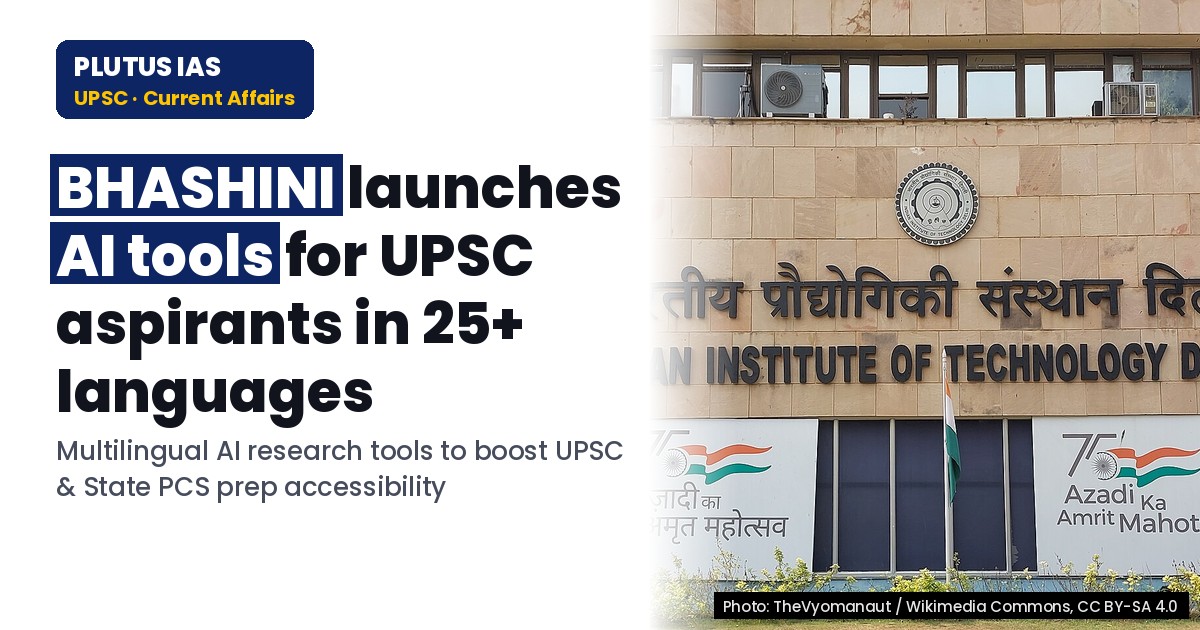
The Digital India BHASHINI Division has showcased its multilingual artificial intelligence (AI) solutions at the Emerging Technologies Dialogue (ETD)-2026, IIT Delhi, highlighting advancements in accessible research through AI-driven language technologies. This initiative underscores India’s commitment to leveraging AI for inclusive governance, linguistic inclusivity, and digital public infrastructure, aligning with the Digital India mission and the broader goal of democratising access to knowledge and services.
Background
- The Digital India BHASHINI Division operates under the Ministry of Electronics and Information Technology (MeitY), Government of India, as part of the Digital India programme.
- BHASHINI is a national-level initiative aimed at developing and deploying AI solutions in Indian languages to enhance accessibility, governance, and service delivery.
- The initiative is part of India’s broader Digital Public Infrastructure (DPI) framework, which seeks to create open, interoperable, and inclusive digital systems for public good.
- Multilingual AI solutions are critical in a linguistically diverse country like India, where only a fraction of the population is proficient in English, and digital services must be accessible in local languages.
- The Emerging Technologies Dialogue (ETD) series, hosted at premier institutions like IIT Delhi, serves as a platform for showcasing cutting-edge research and innovations in emerging technologies, including AI, with a focus on societal impact.
What is Digital India BHASHINI Division?
- BHASHINI is a dedicated division under MeitY, established to develop AI-powered language technologies tailored for Indian languages, ensuring accessibility and usability across diverse linguistic groups.
- The division focuses on the development of Natural Language Processing (NLP) models, machine translation systems, and AI-driven tools for government services, education, and research.
- BHASHINI aims to bridge the digital divide by enabling citizens to access digital services in their native languages, thereby promoting linguistic inclusivity and digital empowerment.
- The initiative aligns with the National Language Translation Mission (NLTM), which seeks to translate government and educational content into Indian languages using AI and machine learning.
- BHASHINI’s solutions are designed to be scalable, interoperable, and compliant with India’s data sovereignty and privacy frameworks, ensuring secure and ethical deployment.
- The division collaborates with academic institutions, research organisations, and industry partners to foster innovation and accelerate the adoption of multilingual AI in governance and public services.
- BHASHINI’s showcasing at ETD-2026 highlights its role in advancing research accessibility, particularly in academic and administrative domains, through AI-driven multilingual tools.
- The initiative is a key component of India’s strategy to position itself as a global leader in AI-driven language technologies, with applications extending beyond governance to education, healthcare, and commerce.
Key Features
| Feature | Significance |
|---|---|
| Multilingual AI models | Enables real-time translation and natural language processing across 22 scheduled Indian languages, enhancing accessibility for non-English speakers in research and governance. |
| BHASHINI Division under Digital India | Serves as the nodal body for AI-driven language technology deployment, aligning with the National Language Translation Mission (NLTM) for digital inclusion. |
| Accessible research interface | Provides AI-powered tools for academic and policy research, reducing language barriers in accessing government reports, research papers, and policy documents. |
| Integration with IIT Delhi’s ETD-2026 | Demonstrates collaboration between academia, government, and industry to showcase indigenous AI solutions in a high-profile forum. |
| Open-source and scalable architecture | Facilitates adoption by state governments, educational institutions, and private entities, ensuring broad-based technological empowerment. |
Why it Matters
Technological Sovereignty
- Reduces dependency on foreign AI language models, fostering self-reliance in critical digital infrastructure.
- Strengthens India’s position in the global AI landscape by promoting indigenous innovation in multilingual technologies.
- Supports the vision of ‘Vocal for Local’ in the digital ecosystem, aligning with the Atmanirbhar Bharat initiative.
Governance and Inclusion
- Bridges the digital divide by ensuring that linguistic diversity does not impede access to public services, education, or research.
- Enhances the efficiency of government-citizen communication by enabling multilingual interfaces for portals, helplines, and grievance redressal systems.
- Facilitates the implementation of the Right to Information (RTI) Act by providing AI-assisted translation of documents in regional languages.
Economic and Educational Impact
- Creates opportunities for local startups and tech firms to develop AI solutions tailored to regional languages, boosting employment and entrepreneurship.
- Supports the National Education Policy (NEP) 2020 by enabling multilingual learning resources and research materials.
- Enhances the competitiveness of Indian academia and researchers in international collaborations by removing language barriers.
Strategic Autonomy
- Reduces vulnerabilities associated with reliance on proprietary language models from foreign entities, ensuring data sovereignty.
- Strengthens India’s soft power by showcasing indigenous technological solutions in global forums like ETD-2026.
- Aligns with the Digital Public Infrastructure (DPI) framework, promoting interoperability and standardization in AI-driven services.
Challenges
1. Language Data Scarcity
- Limited availability of high-quality, annotated datasets in regional languages hampers the training of robust AI models.
- Dialectal variations within languages pose challenges for accurate translation and natural language processing.
- Addressing this requires collaborative efforts between government, academia, and private sector to curate and standardize datasets.
UPSC Link: GS-II: Government policies and interventions for development in various sectors and issues arising out of their design and implementation.
2. Technological Infrastructure Gaps
- Inadequate computational resources in rural and semi-urban areas may limit the adoption of AI-driven solutions.
- Ensuring low-latency, high-bandwidth connectivity is essential for real-time AI applications, particularly in remote regions.
- Public-private partnerships and targeted investments in digital infrastructure are critical to overcoming this challenge.
UPSC Link: GS-III: Science and Technology – developments and their applications and effects in everyday life.
3. Ethical and Privacy Concerns
- The use of AI in language processing raises concerns about data privacy, especially when handling sensitive information in government communications.
- Ensuring transparency in AI decision-making processes is essential to build public trust in these technologies.
- Robust data governance frameworks and ethical guidelines must be established to mitigate risks.
UPSC Link: GS-IV: Ethics and Human Interface – Essence, determinants and consequences of Ethics in human actions; dimensions of ethics.
4. Skill and Awareness Deficits
- There is a significant gap in the availability of skilled professionals trained in AI and multilingual technologies.
- Public awareness campaigns are needed to educate stakeholders about the benefits and limitations of AI-driven language tools.
- Capacity-building initiatives in universities and vocational training centers can address this challenge.
UPSC Link: GS-II: Issues relating to development and management of Social Sector/Services relating to Health, Education, Human Resources.
5. Regulatory and Standardization Hurdles
- The absence of standardized protocols for AI-driven language technologies can lead to interoperability issues.
- Regulatory frameworks must evolve to address issues like bias in AI models, intellectual property rights, and cross-border data flows.
- Collaboration with international bodies like ISO and IEEE can help establish global standards.
UPSC Link: GS-II: Government policies and interventions for development in various sectors and issues arising out of their design and implementation.
Challenges — UPSC Perspective
| Issue | Concern |
|---|---|
| Data scarcity in regional languages | Limited annotated datasets hinder the development of accurate AI models. |
| Dialectal and linguistic diversity | Variations within languages complicate translation and NLP tasks. |
| Digital divide | Inadequate infrastructure in rural areas restricts access to AI-driven tools. |
| Data privacy and ethics | Handling sensitive information raises concerns about misuse and surveillance. |
| Skill gaps | Shortage of professionals trained in AI and multilingual technologies. |
| Regulatory gaps | Lack of standardized protocols and frameworks for AI deployment. |
Way Forward
- Establish a National Language Data Consortium to curate and standardize datasets in regional languages, involving government agencies, academia, and private sector.
- Invest in computational infrastructure, including cloud computing and edge devices, to ensure equitable access to AI tools across regions.
- Develop a robust ethical framework for AI deployment, focusing on transparency, accountability, and data privacy.
- Launch capacity-building programs in universities and vocational training centers to address the skill deficit in AI and multilingual technologies.
- Collaborate with international standards bodies to develop global protocols for AI-driven language technologies.
- Promote public-private partnerships to accelerate the adoption of AI solutions in governance, education, and industry.
- Conduct pilot projects in select states to demonstrate the efficacy of AI-driven language tools in real-world scenarios.
- Integrate AI language tools into existing digital public infrastructure, such as the UMANG app and DigiLocker, to enhance accessibility.
UPSC Value Addition
Keywords for Mains Answer-Writing
Digital India BHASHINI Division · Multilingual AI Solutions · Explainable AI (XAI) · Natural Language Processing (NLP) · Digital Public Infrastructure (DPI) · Accessible Research · Ethics in AI · National Language Translation Mission · Artificial Intelligence (AI) Policy · Digital Governance · Inclusive Technology · AI for Social Good · Language Technology · Digital India Initiative · AI Governance Framework
Concept Flow
Recognition of linguistic diversity as a barrier to digital inclusion and governance efficiency. → Policy push for indigenous AI solutions under the Digital India initiative. → Establishment of the BHASHINI Division to spearhead multilingual AI development. → Collaboration with academic institutions (e.g., IIT Delhi) to showcase and refine AI tools. → Deployment of AI-driven language models in public services, research, and education. → Addressing challenges like data scarcity, infrastructure gaps, and ethical concerns. → Achievement of technological sovereignty and enhanced accessibility for non-English speakers.
Prelims Practice Questions
Q1. Consider the following statements regarding the Digital India BHASHINI Division:
1. It is a dedicated division under the Ministry of Electronics and Information Technology (MeitY).
2. Its primary objective is to develop multilingual AI solutions for accessible research and governance.
3. It operates under the National Language Translation Mission (NLTM).
4. The division focuses exclusively on English and Hindi language technologies.
How many of the above statements are correct?
- Only one
- Only two
- Only three
- All
Answer: Only three — Statements 1, 2, and 3 are correct. Statement 4 is incorrect as the division focuses on developing multilingual AI solutions across multiple Indian languages, not just English and Hindi.
Q2. Assertion (A): The Digital India BHASHINI Division aims to bridge the digital divide by making research and governance accessible in regional languages through AI.
Reason (R): The division is part of the National Language Translation Mission (NLTM), which seeks to translate government documents and research papers into all 22 scheduled Indian languages.
Code:
(A) Both A and R are true, and R is the correct explanation of A.
(B) Both A and R are true, but R is not the correct explanation of A.
(C) A is true, but R is false.
(D) A is false, but R is true.
- A
- B
- C
- D
Answer: A — Both A and R are true, and R correctly explains A. The division’s objective aligns with the NLTM’s goal of translating content into regional languages to enhance accessibility.
Q3. Match the following initiatives with their respective objectives:
Column I (Initiative) | Column II (Objective)
1. Digital India BHASHINI Division | A. Developing multilingual AI models for research and governance
2. National Language Translation Mission (NLTM) | B. Translating government documents into all 22 scheduled Indian languages
3. Explainable AI (XAI) | C. Ensuring transparency and interpretability of AI decision-making processes
4. Digital Public Infrastructure (DPI) | D. Creating a robust digital ecosystem for public service delivery
Options:
1-A, 2-B, 3-C, 4-D
1-B, 2-A, 3-D, 4-C
1-C, 2-D, 3-A, 4-B
1-D, 2-C, 3-B, 4-A
- 1-A, 2-B, 3-C, 4-D
- 1-B, 2-A, 3-D, 4-C
- 1-C, 2-D, 3-A, 4-B
- 1-D, 2-C, 3-B, 4-A
Answer: 1-A, 2-B, 3-C, 4-D — The correct match is: 1-A (Digital India BHASHINI Division focuses on multilingual AI models), 2-B (NLTM translates documents into 22 scheduled languages), 3-C (XAI ensures transparency in AI decisions), and 4-D (DPI creates a digital ecosystem for public services).
Mains Practice Question
✍ The integration of multilingual AI solutions into public governance represents a paradigm shift in making research and administrative processes accessible to all citizens. Critically examine the role of the Digital India BHASHINI Division in this transformation, with reference to its alignment with the National Language Translation Mission (NLTM) and the broader framework of Digital Public Infrastructure (DPI). Also, analyse the challenges in ensuring ethical and inclusive deployment of such AI systems in a linguistically diverse country like India. (15 Marks)
Approach: MODEL-ANSWER SKELETON:
1. **Introduction (2 marks)**
– Define the Digital India BHASHINI Division and its core objectives.
– State the significance of multilingual AI in bridging the digital divide and promoting inclusive governance.
– Mention the alignment with the National Language Translation Mission (NLTM) and Digital Public Infrastructure (DPI).
2. **Role of BHASHINI in Governance and Research Accessibility (5 marks)**
– **Multilingual AI Solutions**: Explain how BHASHINI’s AI models facilitate research and governance in regional languages, citing examples from the ETD-2026 showcase.
– **Alignment with NLTM**: Discuss how BHASHINI’s work complements NLTM’s goal of translating government documents and research into all 22 scheduled Indian languages.
– **Digital Public Infrastructure (DPI)**: Highlight BHASHINI’s contribution to DPI by enabling seamless, language-agnostic public service delivery.
– **Institutional Framework**: Mention the role of MeitY and other stakeholders in supporting BHASHINI’s initiatives.
3. **Ethical and Inclusive Deployment Challenges (5 marks)**
– **Bias and Fairness**: Discuss the risk of algorithmic bias in AI models trained on limited datasets, particularly for low-resource languages.
– **Data Privacy**: Examine concerns regarding the collection and use of regional language data in AI training.
– **Digital Divide**: Address the challenge of ensuring equitable access to AI-driven services across urban and rural populations.
– **Regulatory Gaps**: Identify the absence of a comprehensive AI governance framework in India and its implications for ethical deployment.
4. **Conclusion (3 marks)**
– Summarize the transformative potential of BHASHINI’s initiatives.
– Emphasize the need for a multi-stakeholder approach involving government, academia, and civil society to address challenges.
– Conclude with a forward-looking statement on the role of AI in achieving the goals of Digital India.
Source: PIB (Press Information Bureau)
Generated by AanyaAi for educational purpose.
Related guides on our sites
- Best PSIR optional coaching in delhi for UPSC
- How to prepare for GS paper 1 for UPSC CSE mains exam
- Best UPSC coaching for IFOS exam
- Best mentorship programme for upsc

- Digital India BHASHINI’s Multilingual AI Solutions for UPSC Research - October 24, 2026
- कर्नाटक उच्च न्यायालय का बड़ा फैसला: 34 साल तक दैनिक वेतन पर काम करने वाली महिला टाइपिस्ट की सेवा नियमित करने का आदेश - October 24, 2026
- Karnataka HC: Public Job is Responsibility, Not Leisurely Duty - October 24, 2026

No Comments