


15 Jul Divya Kala Mela: Empowering Divyangjan for Inclusive Nation-Building
Subject Relevance — Where This Topic Fits
- GS Paper I — Social Issues, Poverty and Developmental issues | GS Paper II — Welfare Schemes for Vulnerable Sections of the population by the Centre and States and the Performance of these Schemes; Mechanisms, Laws, Institutions and Bodies constituted for the Protection and Betterment of these Vulnerable Sections. | GS Paper III — Inclusive Growth and issues arising from it.
- Prelims: Divya Kala Mela, Divyangjan empowerment, Ministry of Social Justice and Empowerment, Rights of Persons with Disabilities Act, 2016, NAMASTE Scheme, National Overseas Scholarship Scheme, Self-employment for PwDs, Inclusive nation-building, Accessible India Campaign, PM-DAKSH
- Essay: The imperative of inclusive development for a truly ‘Atmanirbhar Bharat’., From welfare to rights: Redefining the narrative of empowerment for vulnerable sections.
Quick Revision: The Divya Kala Mela symbolizes India’s transformative journey towards a rights-based empowerment model for Divyangjan, fostering economic self-reliance and inclusive nation-building through dedicated platforms for their talents and entrepreneurship.
Why is this in the news?
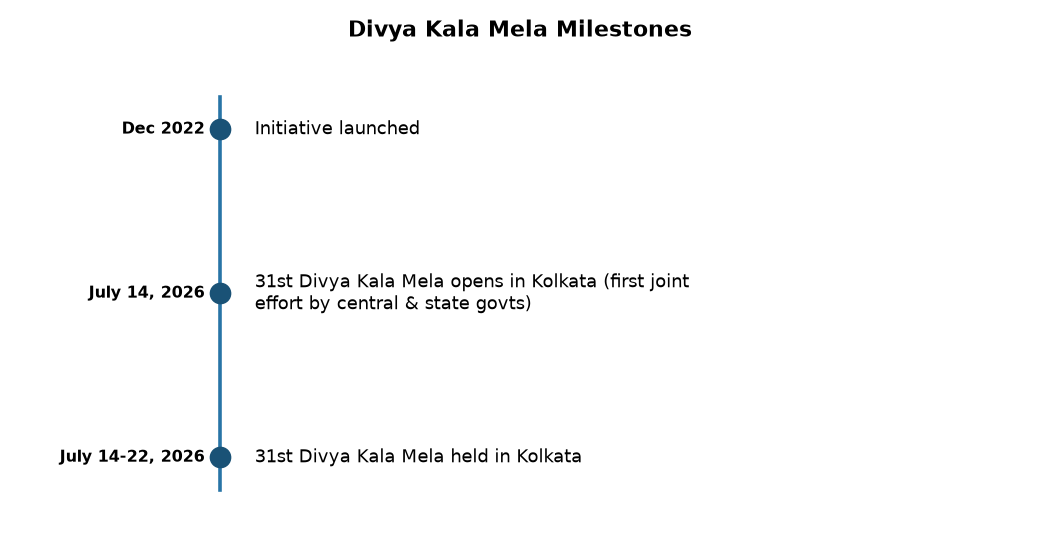
The 31st Divya Kala Mela was inaugurated in Kolkata, marking a significant milestone as the first such event jointly organized by the Government of India and the Government of West Bengal. This initiative, which began in December 2022 and has since expanded nationwide, serves as a dedicated national platform for Divyangjan artisans and entrepreneurs to showcase their products, foster self-confidence, and achieve economic self-reliance, aligning with the vision of ‘Sabka Saath, Sabka Vikas, Sabka Vishwas, Sabka Prayas’ for inclusive nation-building.
Background
- The Divya Kala Mela is an initiative by the Department of Empowerment of Persons with Disabilities (DEPwD) under the Ministry of Social Justice and Empowerment.
- It aims to provide a national platform for Divyangjan artisans, craftspersons, and entrepreneurs to market their products and skills.
- The initiative commenced in December 2022 and has progressively expanded its reach across various cities in India.
- The 31st edition in Kolkata is historic due to the joint organizational efforts of the Central and State governments, signifying enhanced federal cooperation in social welfare.
- The Mela underscores a strategic shift in government policy from a welfare-based model to a rights-based empowerment model for Divyangjan.
- It aligns with the broader national agenda of ‘Atmanirbhar Bharat’ by promoting self-employment and entrepreneurship among persons with disabilities.
What is Divya Kala Mela?
- The Divya Kala Mela is a unique exhibition-cum-sale event organized by the Ministry of Social Justice and Empowerment, Government of India, through the Department of Empowerment of Persons with Disabilities (DEPwD).
- Its primary objective is to provide a dedicated national platform for Divyangjan (persons with disabilities) artisans, craftspersons, and entrepreneurs to showcase and sell their products.
- The Mela facilitates direct market access for Divyangjan, enabling them to connect with domestic and international buyers, thereby promoting economic independence and self-reliance.
- It serves as a powerful medium to transform the confidence of Divyangjan into capability, creativity into livelihood, and aspirations into self-sufficiency.
- Beyond commerce, the Mela functions as a national movement, fostering dignity, self-esteem, and social inclusion for persons with disabilities.
- The event highlights the diverse talents and skills of Divyangjan from various parts of India, promoting cultural exchange and appreciation.
- It embodies the government’s commitment to ‘inclusive growth’ and ensures that Divyangjan are equal partners in India’s developmental journey.
- The Mela also acts as an advocacy platform, raising public awareness about the capabilities of persons with disabilities and challenging societal stereotypes.
Key Features
| Feature | Significance |
|---|---|
| National Platform for Divyangjan | Provides a dedicated, visible marketplace for products made by persons with disabilities, overcoming geographical and logistical barriers. |
| Exhibition-cum-Sale Format | Enables direct interaction between Divyangjan entrepreneurs and consumers, fostering business acumen and immediate economic benefits. |
| Promotion of Self-Employment | Encourages entrepreneurship and skill development, aligning with the ‘Atmanirbhar Bharat’ vision by creating livelihood opportunities. |
| Shift to Rights-Based Model | Reflects a fundamental policy change from welfare handouts to empowering Divyangjan with rights, dignity, and economic agency. |
| Inter-Ministerial/State Cooperation | Joint organization with state governments (e.g., West Bengal) signifies a collaborative approach to social welfare and inclusive development. |
| Pan-India Reach | Expansion from Srinagar to Thiruvananthapuram, Kochi to Guwahati, ensures broad participation and regional diversity in products and skills. |
Why it Matters
Socio-Economic Empowerment
- Fosters economic independence by providing market access and promoting entrepreneurship among Divyangjan, reducing their reliance on welfare.
- Enhances self-esteem and dignity, transforming aspirations into tangible achievements and integrating Divyangjan into the mainstream economy.
Inclusive Nation-Building
- Embodies the ‘Sabka Saath, Sabka Vikas, Sabka Vishwas, Sabka Prayas’ ethos by ensuring Divyangjan are equal partners in India’s growth story.
- Promotes social inclusion by challenging stereotypes and showcasing the diverse talents and capabilities of persons with disabilities.
Policy Paradigm Shift
- Represents a crucial transition from a welfare-oriented approach to a rights-based empowerment model, focusing on entitlements and opportunities.
- Reinforces the government’s commitment to the Rights of Persons with Disabilities Act, 2016, by creating practical avenues for its implementation.
Skill Development and Livelihood
- Encourages skill development and vocational training by providing a platform for artisans to refine their crafts and gain market feedback.
- Facilitates financial assistance and support for self-employment, as evidenced by the significant aid provided to Divyangjan beneficiaries.
Challenges
1. Accessibility Barriers
- Physical infrastructure (transport, venues) often remains inaccessible, limiting participation and reach for many Divyangjan.
- Digital divide and lack of accessible online platforms can hinder broader market access and promotional efforts.
UPSC Link: GS Paper II — Welfare Schemes; GS Paper I — Social Issues
2. Market Linkages and Sustainability
- Ensuring sustained demand and market linkages beyond the Mela duration remains a challenge for long-term economic viability.
- Competition from mass-produced goods and lack of branding/marketing expertise can impede growth for small-scale Divyangjan entrepreneurs.
UPSC Link: GS Paper III — Inclusive Growth; GS Paper II — Government Policies
3. Skill Development and Quality Control
- Variations in skill levels and product quality can affect market acceptance and pricing.
- Need for continuous training and mentorship to upgrade skills and meet evolving market standards.
UPSC Link: GS Paper II — Human Resource Development; GS Paper III — Skill Development
4. Attitudinal Barriers and Social Stigma
- Despite efforts, societal prejudices and lack of awareness about Divyangjan capabilities persist, affecting their social and economic integration.
- Perception of products as ‘charity’ rather than ‘quality’ can undermine fair valuation and market competitiveness.
UPSC Link: GS Paper I — Social Issues; GS Paper II — Vulnerable Sections
5. Financial Inclusion and Credit Access
- Difficulty in accessing formal credit and financial services for business expansion due to perceived risks or lack of collateral.
- Limited awareness about government schemes offering financial assistance for Divyangjan entrepreneurs.
UPSC Link: GS Paper III — Inclusive Growth; GS Paper II — Welfare Schemes
Challenges — UPSC Perspective
| Issue | Concern |
|---|---|
| Limited Reach | Despite expansion, many Divyangjan in remote areas may still lack access to such platforms. |
| Sustainability of Livelihoods | Ensuring consistent income generation and market demand beyond the Mela’s duration. |
| Quality and Standardization | Maintaining product quality and standardization to compete in broader markets. |
| Digital Inclusion | Bridging the digital divide to enable online sales and wider market penetration for Divyangjan entrepreneurs. |
| Awareness and Sensitization | Overcoming societal prejudices and promoting a rights-based perspective among the general public. |
| Infrastructure Gaps | Persistent lack of accessible transportation, venues, and public spaces hindering full participation. |
Government Initiatives — Must-Memorise for Prelims
- Rights of Persons with Disabilities (RPwD) Act, 2016
- Accessible India Campaign (Sugamya Bharat Abhiyan)
- Deendayal Disabled Rehabilitation Scheme (DDRS)
- Assistance to Disabled Persons for Purchase/Fitting of Aids and Appliances (ADIP Scheme)
- National Overseas Scholarship Scheme for Students with Disabilities
- National Action Plan for Skill Development of Persons with Disabilities
- Scheme for Promotion of Self-Employment for Persons with Disabilities
- Pradhan Mantri Dakshta Aur Kushalta Sampann Hitgrahi (PM-DAKSH) Yojana
- NAMASTE Scheme (National Action for Mechanized Sanitation Ecosystem)
- Unique Disability ID (UDID) Project
Way Forward
- Expand the Divya Kala Mela’s reach to tier-2 and tier-3 cities, ensuring greater participation from Divyangjan in remote areas.
- Develop a robust e-commerce platform integrated with the Mela, providing year-round market access and global reach for Divyangjan products.
- Strengthen skill development programs, focusing on market-relevant crafts, digital literacy, and entrepreneurship training for Divyangjan.
- Foster partnerships with private sector entities, NGOs, and corporate social responsibility (CSR) initiatives for mentorship, funding, and market linkages.
- Launch sustained public awareness campaigns to challenge stereotypes, promote inclusivity, and encourage patronage of Divyangjan products.
- Ensure universal accessibility in physical and digital infrastructure, in line with the Accessible India Campaign, to facilitate full participation.
- Streamline access to financial assistance, micro-credit, and insurance schemes for Divyangjan entrepreneurs, simplifying application processes.
- Establish a national registry of Divyangjan artisans and entrepreneurs to facilitate targeted support, marketing, and policy interventions.
UPSC Value Addition
Keywords for Mains Answer-Writing
Divyangjan empowerment · Inclusive growth · Rights-based approach · Atmanirbhar Bharat · Social justice · Economic self-reliance · Skill development · Market linkages · Universal accessibility · Policy paradigm shift · Federal cooperation · Vulnerable sections
Constitutional & Policy Linkages
- Article 14: Equality before law and equal protection of laws.
- Article 15: Prohibition of discrimination on grounds of religion, race, caste, sex, or place of birth (includes disability implicitly).
- Article 21: Protection of life and personal liberty (includes right to live with dignity).
- Article 38: State to secure a social order for the promotion of welfare of the people (Directive Principle).
- Article 41: Right to work, to education and to public assistance in certain cases (Directive Principle, includes disability).
- Rights of Persons with Disabilities Act, 2016: Statutory framework for rights and entitlements of PwDs.
- United Nations Convention on the Rights of Persons with Disabilities (UNCRPD): India is a signatory, guiding national legislation.
Concept Flow
Government Policy Shift (Welfare to Rights) → Divya Kala Mela (National Platform) → Divyangjan Skill Showcase & Market Access → Economic Self-Reliance & Dignity → Inclusive Nation-Building → Social Integration & Attitudinal Change
Prelims Practice Questions
Q1. Which of the following statements regarding the Divya Kala Mela are correct?
1. It is an initiative of the Ministry of Social Justice and Empowerment.
2. The 31st Divya Kala Mela in Kolkata was the first time it was jointly organized by the Central and a State government.
3. The Mela aims to promote a welfare-based model for Divyangjan empowerment.
Select the correct answer using the code given below:
- A. 1 only
- B. 2 only
- C. 1 and 2 only
- D. 1, 2 and 3
Answer: C. 1 and 2 only — Statement 1 is correct: The Divya Kala Mela is an initiative of the Department of Empowerment of Persons with Disabilities (DEPwD) under the Ministry of Social Justice and Empowerment. Statement 2 is correct: The news explicitly states that the 31st Divya Kala Mela in Kolkata was a historic achievement as it was organized for the first time through the joint efforts of the Government of India and the West Bengal Government. Statement 3 is incorrect: The Mela signifies a transformative shift from a welfare-based model to a rights-based empowerment model for Divyangjan.
Q2. Consider the following statements about the NAMASTE Scheme:
1. It aims to promote mechanized sanitation and ensure the safety and dignity of sanitation workers.
2. It provides health insurance and financial assistance to sanitation workers.
3. It is primarily focused on providing assistive devices to Divyangjan.
Which of the statements given above is/are correct?
- A. 1 only
- B. 1 and 2 only
- C. 2 and 3 only
- D. 1, 2 and 3
Answer: B. 1 and 2 only — Statement 1 is correct: The NAMASTE scheme (National Action for Mechanized Sanitation Ecosystem) aims to eliminate unsafe manual scavenging practices and promote mechanized cleaning, ensuring the dignity and safety of sanitation workers. Statement 2 is correct: The scheme provides PPE kits, safety training, health insurance, and financial assistance to sanitation workers. Statement 3 is incorrect: While the news mentions assistive devices for Divyangjan, the NAMASTE scheme is specifically for sanitation workers and does not focus on assistive devices for Divyangjan.
Mains Practice Question
✍ The Divya Kala Mela represents a significant shift in India’s approach to Divyangjan empowerment, moving from a welfare-based model to a rights-based framework. Discuss the implications of this paradigm shift for inclusive nation-building and critically examine the challenges that persist in achieving full socio-economic integration for persons with disabilities in India. (250 words)
Approach: Begin by defining the ‘welfare-based’ vs. ‘rights-based’ models in the context of Divyangjan. Explain how Divya Kala Mela embodies this shift by promoting self-reliance, dignity, and market access. Discuss the positive implications for inclusive nation-building, such as economic empowerment, social inclusion, and adherence to international conventions. Subsequently, critically examine persistent challenges like accessibility barriers (physical, digital), attitudinal prejudices, limited market linkages, and gaps in skill development and financial inclusion. Conclude with a forward-looking statement on the need for sustained multi-stakeholder efforts to overcome these challenges and realize true inclusion.
Source: PIB (Press Information Bureau)

- India-Australia AUSTRAHIND 2026 Exercise: Key Highlights for UPSC & State PCS - October 22, 2026
- एससीओ बैठक में भारत का आतंकवाद विरोध: क्षेत्रीय सहयोग पर जोर - October 22, 2026
- SEC Directs Strict SC Order Compliance for Andhra ULB Polls - October 22, 2026

No Comments