


08 Aug DMK Moves SC Over Karnataka’s Cauvery Water Delay: Key Facts for UPSC
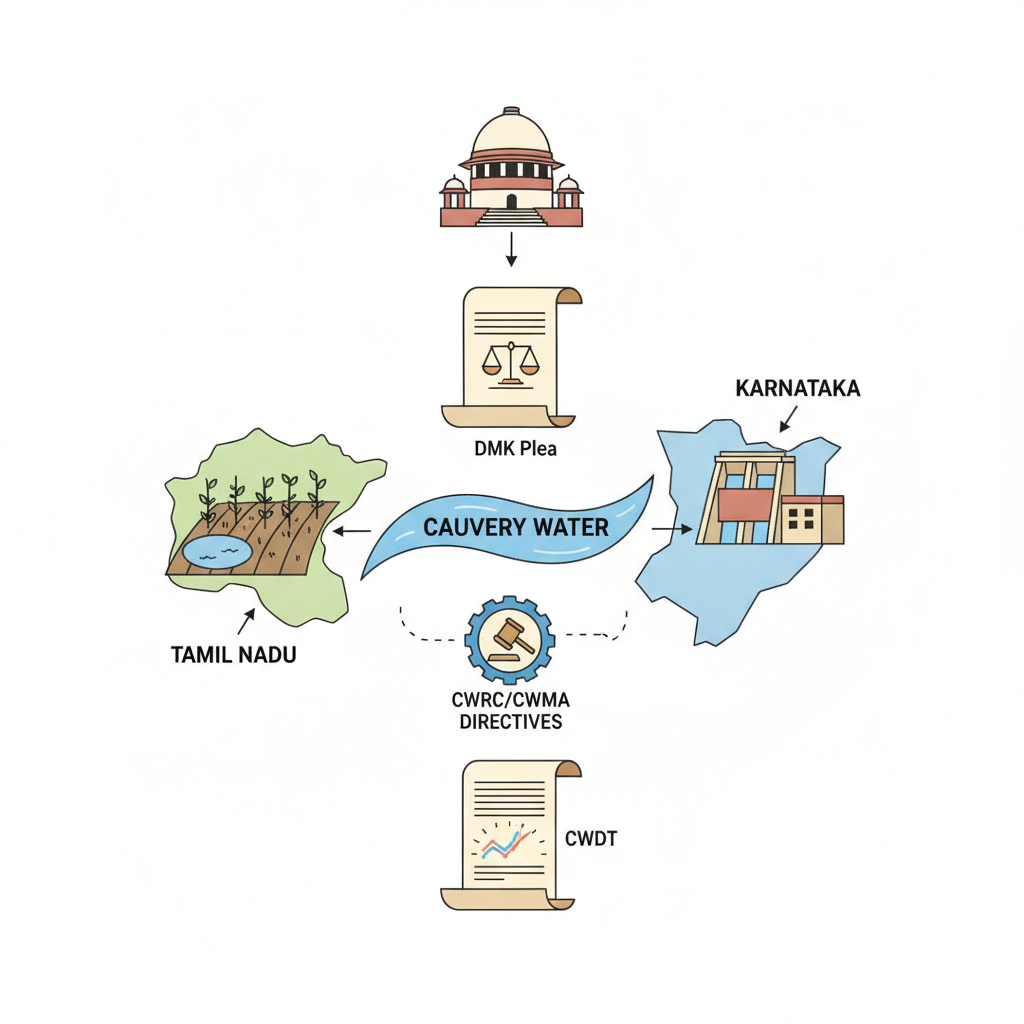
Supreme CourtKarnatakaTamil NaduCauvery waterCWRCCWMA✎ The Cauvery Water Disputes Tribunal’s 2007 award, implemented by the CWMA and monitored by the CWRC; non-compliance by Karnataka risks agricultural distress in Tamil Nadu’s delta districts.
Subject Relevance — Where This Topic Fits
- GS Paper II — Functions and Responsibilities of the Union and the States, Issues and Challenges Pertaining to the Federal Structure, Devolution of Powers and Finances up to Local Levels and Challenges Therein | GS Paper III — Water Resources, Conservation, Issues and Challenges
- Prelims: Cauvery Water Disputes Tribunal (CWDT), Cauvery Water Management Authority (CWMA), Cauvery Water Regulation Committee (CWRC), Inter-State River Water Disputes Act, 1956, Biligundlu, cusecs, TMC (Thousand Million Cubic Feet), Mettur Dam, Kuruvai crop, Southwest Monsoon
- Essay: Federalism in India: Cooperative or Competitive?, Water Security and Agricultural Sustainability in India
Quick Revision: The Cauvery Water Disputes Tribunal’s 2007 award, implemented by the CWMA and monitored by the CWRC; non-compliance by Karnataka risks agricultural distress in Tamil Nadu’s delta districts.
Why is this in the news?
The Dravida Munnetra Kazhagam (DMK) has approached the Supreme Court seeking immediate intervention to direct Karnataka to release Tamil Nadu’s stipulated share of Cauvery water, citing non-compliance with the directives of the Cauvery Water Regulation Committee (CWRC) and Cauvery Water Management Authority (CWMA). The plea highlights the acute agricultural distress in Tamil Nadu’s delta districts due to water scarcity, exacerbated by deficient monsoon flows and Karnataka’s refusal to adhere to binding water-sharing agreements.
Background
- The Cauvery water dispute is a long-standing inter-State conflict between Karnataka and Tamil Nadu, originating from competing claims over the river’s waters for irrigation and drinking purposes.
- The Cauvery Water Disputes Tribunal (CWDT), constituted under the Inter-State River Water Disputes Act, 1956, delivered its final award in 2007, allocating specific water shares to Karnataka, Tamil Nadu, Kerala, and Puducherry.
- The Cauvery Water Management Authority (CWMA) and Cauvery Water Regulation Committee (CWRC) were established to implement the Tribunal’s award and regulate water releases, respectively.
- The dispute has witnessed periodic escalations, particularly during monsoon-deficient years, when downstream states like Tamil Nadu face acute water shortages for agriculture.
- In July 2026, the CWRC directed Karnataka to release 3,500 cusecs of water daily at Biligundlu, and the CWMA confirmed this directive on July 30, 2026.
- Karnataka has publicly stated its refusal to comply with the directives, citing internal water scarcity and prioritising its own agricultural needs.
Cauvery Water Dispute: Legal and Institutional Framework
- The Cauvery Water Disputes Tribunal (CWDT), established in 1990, delivered its final award in 2007, with specific monthly and seasonal allocations.
- The Inter-State River Water Disputes Act, 1956, empowers the Union Government to constitute tribunals for resolving inter-State water disputes and to enforce their awards.
- The Cauvery Water Management Authority (CWMA), constituted in 2018, is tasked with implementing the Tribunal’s award, monitoring water releases, and resolving disputes among riparian states.
- The Cauvery Water Regulation Committee (CWRC), functioning under the CWMA, monitors real-time water flows and issues directives for water releases to ensure compliance with the Tribunal’s award.
- The Biligundlu inter-State contact point is a critical monitoring station where water releases from Karnataka’s reservoirs are measured to determine compliance with the Tribunal’s directives.
- Water allocation is computed in terms of cusecs (cubic feet per second) and TMC (Thousand Million Cubic Feet), with 1 TMC equalling approximately 28.317 billion litres.
- The kuruvai (summer) crop in Tamil Nadu’s delta districts, sown between June and July, is highly dependent on timely water releases from Karnataka, and delays or non-compliance can lead to crop failure and economic losses.
- The dispute underscores the challenges of federalism in India, where water-sharing agreements must balance the rights of upstream and downstream states while addressing regional disparities in water availability.
Key Features
| Feature | Significance |
|---|---|
| Cauvery Water Regulation Committee (CWRC) | A statutory body under the Cauvery Water Management Authority (CWMA) tasked with regulating water releases between riparian states to ensure equitable distribution as per the Cauvery Water Disputes Tribunal (CWDT) award. |
| Cauvery Water Management Authority (CWMA) | A permanent body established under the Inter-State River Water Disputes Act, 1956, to implement the CWDT award and monitor compliance by riparian states. |
| Inter-State Contact Point at Biligundlu | A critical monitoring and release point for Cauvery water flows, serving as the reference for compliance with inter-state water-sharing agreements. |
| Pro-rata/Distress-sharing Basis | A mechanism for adjusting water releases during deficit monsoon conditions, ensuring equitable burden-sharing among riparian states while protecting the interests of lower riparian users. |
| Kuruvai Crop Season | A critical agricultural season in Tamil Nadu’s Cauvery delta, dependent on timely water releases from Karnataka for irrigation; failure risks crop loss and livelihoods. |
Why it Matters
Economic
- Agricultural productivity in Tamil Nadu’s Cauvery delta is directly contingent on timely water releases, with the kuruvai season being pivotal for paddy cultivation and rural livelihoods.
- Failure to release stipulated water volumes risks crop failure, leading to financial losses for farmers and potential food security concerns in the region.
- The delta region supports over 14.913 lakh acres of net sown area, sustaining about 4 million farmers and 10 million agricultural laborers, whose economic stability is at stake.
Legal
- The Supreme Court has historically adjudicated inter-state water disputes, and its intervention is sought to enforce binding directions of the CWRC and CWMA under the Inter-State River Water Disputes Act, 1956.
- The application invokes the doctrine of ‘equitable apportionment’ and the principle of ‘prior appropriation’ to ensure Karnataka complies with its obligations under the CWDT award.
Environmental
- Deficient southwest monsoon conditions exacerbate water scarcity in the Cauvery basin, necessitating strict adherence to inter-state water-sharing agreements to prevent ecological stress on the river ecosystem.
- Unregulated water releases or non-compliance can lead to downstream water scarcity, affecting both agricultural and domestic water supply in Tamil Nadu.
Political
- Inter-state water disputes often become politicized, with state governments adopting populist postures to appease local electorates, complicating consensus-building and compliance with judicial or statutory orders.
- The DMK’s petition reflects the political salience of water-sharing issues in Tamil Nadu, where agricultural communities exert significant electoral influence.
Challenges
1. Non-Compliance by Riparian States
- Karnataka’s refusal to release stipulated water volumes despite binding directions from the CWRC and CWMA undermines the institutional framework for inter-state water governance.
- Public statements by Karnataka’s leadership rejecting water releases contravene the rule of law and set a dangerous precedent for future disputes.
- The accumulation of a backlog of 9.46 TMC (as on July 26, 2026) exacerbates the crisis, requiring immediate corrective action to prevent irreversible damage to standing crops.
UPSC Link: GS-II: Inter-State Relations
2. Institutional Delays and Weak Enforcement
- The CWMA’s inability to enforce compliance without judicial intervention highlights structural weaknesses in the dispute resolution mechanism under the Inter-State River Water Disputes Act, 1956.
- Monitoring mechanisms like the CWRC lack coercive powers, relying on judicial or political pressure to ensure compliance by riparian states.
UPSC Link: GS-II: Statutory Bodies
3. Climate Variability and Water Scarcity
- Deficient southwest monsoon conditions in 2026 have reduced inflows into the Cauvery basin, intensifying the pressure on inter-state water-sharing agreements.
- Long-term climate projections indicate increased variability in monsoon patterns, necessitating adaptive water management strategies to mitigate future conflicts.
UPSC Link: GS-III: Environmental Degradation
4. Equitable Distribution vs. State Autonomy
- The conflict between Karnataka’s assertion of state autonomy and Tamil Nadu’s demand for equitable water distribution reflects broader tensions in federal water governance.
- Balancing state-level water management priorities with basin-wide equity remains a persistent challenge in India’s inter-state water disputes.
UPSC Link: GS-II: Federalism
5. Agricultural Dependence and Rural Livelihoods
- The non-release of water threatens the livelihoods of 4 million farmers and 10 million agricultural laborers in Tamil Nadu’s Cauvery delta, risking social and economic instability.
- Delay in water releases risks the loss of standing kuruvai crops, leading to cascading effects on food security, rural incomes, and local economies.
UPSC Link: GS-III: Agriculture
Challenges — UPSC Perspective
| Issue | Concern |
|---|---|
| Non-compliance by Karnataka | Undermines institutional framework for inter-state water governance and sets a dangerous precedent for future disputes. |
| Institutional Delays | CWMA lacks coercive powers to enforce compliance, necessitating judicial intervention for enforcement. |
| Climate Variability | Deficient monsoon conditions intensify pressure on water-sharing agreements, exacerbating inter-state conflicts. |
| State Autonomy vs. Equity | Tensions between Karnataka’s state-level priorities and Tamil Nadu’s demand for equitable distribution complicate dispute resolution. |
| Agricultural Dependence | Non-release of water threatens livelihoods of millions in Tamil Nadu’s Cauvery delta, risking food security and rural stability. |
| Public Posturing by States | Political statements by state leaders contravene rule of law and undermine trust in inter-state agreements. |
Way Forward
- The Supreme Court should direct Karnataka to immediately release the stipulated 3,500 cusecs per day at Biligundlu, along with the accumulated backlog of 9.46 TMC, to prevent irreversible crop loss in Tamil Nadu’s Cauvery delta.
- The CWMA should strengthen its monitoring mechanisms by deploying real-time water flow sensors at Biligundlu and other critical points to ensure transparency and compliance.
- Riparian states must adopt a basin-wide, cooperative approach to water management, incorporating climate-resilient strategies to mitigate future disputes.
- The Union Government should facilitate inter-state negotiations to amend the Inter-State River Water Disputes Act, 1956, to grant the CWMA greater coercive powers for enforcement.
- State governments should prioritize long-term water conservation measures, including rainwater harvesting, groundwater recharge, and efficient irrigation techniques, to reduce dependence on inter-state water-sharing.
- The CWRC and CWMA should develop a standardized distress-sharing formula to address water scarcity during deficient monsoon years, ensuring predictability and fairness.
- Farmers in the Cauvery delta should be provided with immediate relief measures, including crop insurance and alternative livelihood support, to mitigate the economic impact of delayed water releases.
- The Union Government should convene a high-level inter-state meeting to reaffirm commitments to the Cauvery Water Disputes Tribunal award and explore mechanisms for its effective implementation.
UPSC Value Addition
Keywords for Mains Answer-Writing
Inter-State Water Disputes Act, 1956 · Cauvery Water Management Authority (CWMA) · Cauvery Water Regulation Committee (CWRC) · Inter-State Water Disputes Tribunal (ISWD Tribunal) · Inter-State River Water Disputes (Amendment) Act, 2019 · Doctrine of Prior Appropriation · Equitable apportionment · Inter-State Water Disputes · Riparian rights · Agrarian distress and water scarcity · Supreme Court’s role in inter-state disputes · Federalism and cooperative federalism
Constitutional & Policy Linkages
- Article 262: Inter-State River Water Disputes (Adjudication of disputes by Parliament)
- Seventh Schedule: Entry 56 (Union List – Regulation and development of inter-State rivers)
- Article 131: Original jurisdiction of the Supreme Court in disputes between states
Concept Flow
Deficient southwest monsoon → Reduced inflows into Cauvery basin → Karnataka’s refusal to release stipulated water → Accumulation of backlog at Biligundlu → Threat to kuruvai crops in Tamil Nadu → DMK’s petition to Supreme Court → Court’s direction for compliance → Enforcement challenges due to state autonomy → Institutional delays in CWMA monitoring → Need for basin-wide cooperative water management
Prelims Practice Questions
Q1. Consider the following statements regarding the Cauvery Water Management Authority (CWMA):
1. CWMA was established under the Inter-State River Water Disputes (Amendment) Act, 2019.
2. CWMA is a statutory body with the mandate to implement and monitor the decisions of the Cauvery Water Disputes Tribunal.
3. The CWMA is headed by the Prime Minister of India.
4. The CWMA has the power to issue directions to the States for compliance with its decisions.
How many of the above statements are correct?
- Only one
- Only two
- Only three
- All four
Answer: Only three — Statements 1, 2, and 4 are correct. Statement 3 is incorrect as the CWMA is headed by the Union Minister for Jal Shakti, not the Prime Minister.
Q2. Assertion (A): The doctrine of prior appropriation is a key principle governing inter-State water disputes in India.
Reason (R): It prioritises water usage based on historical usage patterns and the principle of ‘first in time, first in right’.
Options:
A. Both A and R are true, and R is the correct explanation of A.
B. Both A and R are true, but R is not the correct explanation of A.
C. A is true, but R is false.
D. A is false, but R is true.
Answer: ? — Both A and R are true. The doctrine of prior appropriation is indeed a principle applied in some inter-State water disputes, prioritising historical usage. However, the Inter-State Water Disputes Act, 1956, and subsequent tribunals rely more on the principle of equitable apportionment rather than strict prior appropriation.
Q3. Match the following provisions with their respective Acts:
Column I (Provisions)
A. Establishment of a single tribunal for inter-State water disputes
B. Constitution of the Cauvery Water Management Authority (CWMA)
C. Provision for the creation of a Disputes Resolution Committee
D. Empowering the Central Government to frame schemes for the adjudication of disputes
Column II (Acts)
1. Inter-State River Water Disputes Act, 1956
2. Inter-State River Water Disputes (Amendment) Act, 2019
3. Constitution of India, Article 262
4. River Boards Act, 1956
Options:
A. A-1, B-2, C-3, D-4
B. A-3, B-2, C-1, D-4
C. A-2, B-3, C-4, D-1
D. A-4, B-1, C-2, D-3
Answer: ? — A-3: Article 262 of the Constitution empowers Parliament to adjudicate inter-State water disputes. B-2: The Inter-State River Water Disputes (Amendment) Act, 2019, established the CWMA. C-1: The 1956 Act provides for the creation of a tribunal. D-4: The River Boards Act, 1956, empowers the Central Government to frame schemes for dispute resolution.
Mains Practice Question
✍ The Supreme Court has been repeatedly called upon to adjudicate inter-State water disputes, including the Cauvery dispute. Critically examine the constitutional and legal framework governing inter-State water disputes in India, with particular reference to the role of the Supreme Court. Also, analyse the effectiveness of the Cauvery Water Management Authority (CWMA) in resolving the Cauvery dispute. (15 Marks)
Approach: Constitutional Framework (Article 262 and the Inter-State Water Disputes Act, 1956): 1. Article 262(1) bars the Supreme Court from adjudicating inter-State water disputes. 2. Parliament is empowered to provide for the adjudication of such disputes by law (Inter-State Water Disputes Act, 1956). 3. The 2019 Amendment introduced the CWMA and the Cauvery Water Regulation Committee (CWRC) to implement tribunal awards and regulate water sharing. Role of the Supreme Court: 1. While barred from adjudicating disputes, the Supreme Court has interpreted the doctrine of ‘equitable apportionment’ and issued directions for compliance with tribunal awards (e.g., Cauvery Water Disputes Tribunal, 2007). 2. The Court has invoked Article 142 to ensure justice in exceptional circumstances, as seen in the recent DMK petition. 3. Critique: Judicial intervention, while necessary for enforcement, risks overstepping the legislative framework and undermines the institutional autonomy of tribunals. Effectiveness of the CWMA: 1. Structure: CWMA is a statutory body under the 2019 Act, tasked with implementing tribunal awards and monitoring water releases. 2. Challenges: Non-compliance by States (e.g., Karnataka’s refusal to release water), lack of enforcement powers, and delays in tribunal awards. 3. Recent Developments: The CWMA’s confirmation of the CWRC’s July 2026 direction highlights its role, but effectiveness is constrained by political and administrative resistance. Conclusion: 1. The constitutional framework prioritises legislative and tribunal-based resolution, but the Supreme Court’s role remains pivotal for enforcement. 2. The CWMA, while a step forward, requires stronger enforcement mechanisms and political consensus to ensure compliance.
Source: The Hindu
Generated by AanyaAi for educational purpose.

- आरबीआई ने सरकारी प्रतिभूतियों की ओएमओ बिक्री की घोषणा, जानिए पूरा विवरण - September 23, 2026
- RBI to Sell ₹25,000 Crore Govt Securities via OMO on Sept 28, 2026 - September 23, 2026
- भारत-श्रीलंका नौसैनिक अभ्यास ‘स्लाईनेक्स-26’: विशाखापत्तनम में संपन्न, जानें प्रमुख बिंदु - September 23, 2026

No Comments