


19 Jul DRI Intensifies Anti-Smuggling Drive: ₹22 Cr Gold, Silver, Cash Seized
Subject Relevance — Where This Topic Fits
- GS Paper III — Economy (Smuggling, Black Money, Economic Security) | GS Paper III — Internal Security (Organised Crime, Border Management) | GS Paper II — Governance (Role of Government Agencies, Accountability)
- Prelims: Directorate of Revenue Intelligence (DRI), Smuggling, Precious Metals, Economic Offences, Customs Act, 1962, Foreign Exchange Management Act (FEMA), Organised Crime, Hawala Transactions, Anti-Money Laundering
- Essay: The Nexus of Economic Crime and National Security: A Threat to India’s Development Trajectory, Strengthening India’s Economic Borders: The Imperative of Multi-Agency Coordination and Technological Integration
Quick Revision: The DRI’s intensified operations against precious metal smuggling underscore the critical need for robust economic border management, inter-agency coordination, and technological advancements to counter organised crime, revenue loss, and national security threats.
Why is this in the news?
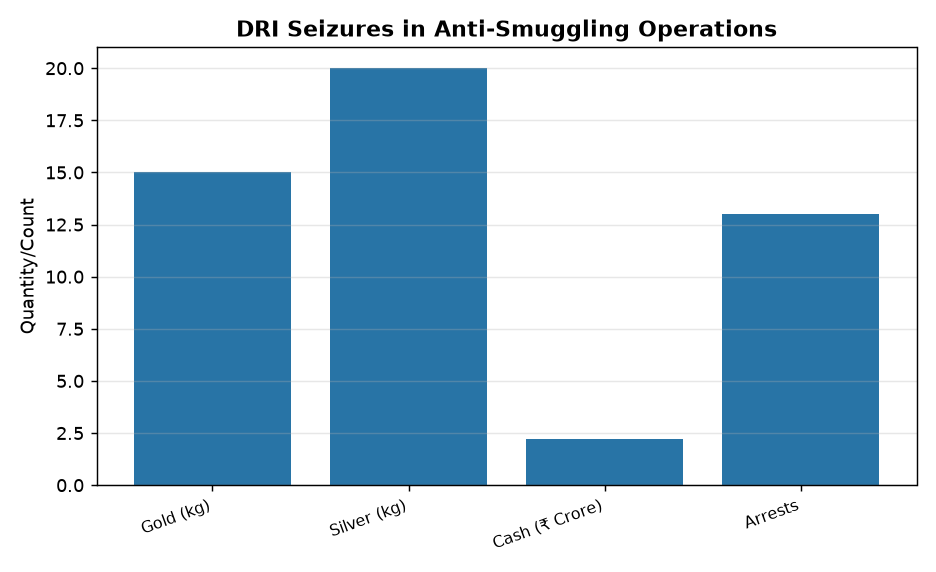
The Directorate of Revenue Intelligence (DRI) has intensified its nationwide operations against the organised smuggling of precious metals, leading to the seizure of 15 kg of foreign-origin gold, 20 kg of silver, and ₹2.20 crore in Indian currency, collectively valued at approximately ₹22 crore. These intelligence-based operations, conducted across various locations including New Delhi, Mumbai, and West Bengal, resulted in the arrest of thirteen individuals, highlighting the persistent threat posed by such illicit activities to India’s economic security and the sophisticated methods employed by smuggling syndicates, often involving corrupt airport personnel.
Background
- India is one of the world’s largest consumers of gold, driven by cultural, religious, and investment demand, making it a lucrative target for smugglers.
- High import duties on gold, aimed at curbing Current Account Deficit (CAD) and discouraging non-essential imports, create a significant price differential between domestic and international markets, incentivising smuggling.
- The porous nature of India’s land borders, extensive coastline, and busy international airports provide multiple avenues for illicit entry of precious metals.
- Smuggling operations are often sophisticated, involving international syndicates, advanced concealment techniques, and a network of facilitators, including corrupt officials.
- The proceeds from precious metal smuggling are frequently linked to other illicit activities such as hawala transactions, money laundering, and financing of organised crime.
- Government agencies, including the DRI, Customs, and Enforcement Directorate (ED), are continuously engaged in intelligence gathering and enforcement to combat these economic offences.
What is the Directorate of Revenue Intelligence (DRI)?
- The Directorate of Revenue Intelligence (DRI) is the apex intelligence and investigative agency for anti-smuggling matters under the Central Board of Indirect Taxes & Customs (CBIC), Ministry of Finance, Government of India.
- Established in 1957, its primary mandate is to prevent and combat smuggling activities across India’s borders, including land, air, and sea.
- DRI functions as the principal agency for enforcing the provisions of the Customs Act, 1962, and other allied laws related to economic offences.
- It gathers intelligence regarding smuggling of contraband goods, narcotics, precious metals, counterfeit currency, and other prohibited items.
- DRI conducts investigations, raids, and seizures based on intelligence, often working in coordination with other national and international law enforcement agencies.
- The agency plays a crucial role in protecting India’s economic frontiers, safeguarding national security, and preventing revenue loss to the exchequer.
- Its operations are often covert and intelligence-driven, targeting organised crime syndicates involved in cross-border illicit trade.
- DRI officers are drawn from the Indian Revenue Service (Customs & Central Excise) and are vested with powers under various statutes, including the Customs Act, NDPS Act, and COFEPOSA.
Key Features
| Feature | Significance |
|---|---|
| Intelligence-Based Operations | Ensures targeted action against organised syndicates, improving efficacy and resource utilisation. |
| Multi-Modal Smuggling Routes | Highlights the adaptability of smugglers using air cargo, passenger baggage, and land routes, necessitating comprehensive surveillance. |
| Sophisticated Concealment Methods | From metal frames to wax-form gold dust in innerwear, demonstrating the need for advanced detection technologies and skilled personnel. |
| Involvement of Corrupt Airport Staff | Underscores the internal vulnerability within critical infrastructure, demanding stringent vetting and accountability mechanisms. |
| Seizure of Cash Proceeds | Indicates the direct link between smuggling and money laundering, revealing the financial ecosystem of illicit trade. |
| Pan-India Network of Smugglers | Suggests a well-established, interconnected criminal enterprise requiring coordinated national and international law enforcement efforts. |
Why it Matters
Economic Implications
- Smuggling of precious metals leads to significant revenue loss for the government due to evasion of customs duties and taxes.
- It contributes to the parallel economy, facilitating black money generation and circulation, which distorts economic data and policy formulation.
- The illicit trade impacts the legitimate domestic jewellery industry by creating unfair competition and undermining market stability.
- Large-scale smuggling can exacerbate the Current Account Deficit (CAD) by increasing unofficial imports and outflow of foreign exchange through hawala channels.
National Security Concerns
- The proceeds from precious metal smuggling are often used to fund other illegal activities, including terrorism, drug trafficking, and arms proliferation, posing a direct threat to national security.
- Organised crime syndicates involved in smuggling often have cross-border linkages, making them a challenge for international law enforcement and intelligence agencies.
- Corruption of officials, as seen in the involvement of airport staff, compromises the integrity of critical infrastructure and national security apparatus.
Governance and Rule of Law
- The prevalence of smuggling undermines the rule of law and public trust in government institutions tasked with maintaining economic order.
- It highlights the challenges in effective border management and the need for continuous upgradation of surveillance, intelligence, and enforcement capabilities.
- Successful crackdowns by agencies like DRI demonstrate the government’s commitment to upholding economic sovereignty and combating illicit trade.
Challenges
1. Porous Borders and Vast Coastline
- India’s extensive land borders with neighbouring countries and a long coastline make comprehensive surveillance and interdiction extremely challenging.
- The diverse terrain, from dense forests to mountainous regions, provides numerous entry points for smugglers, often exploiting local communities.
UPSC Link: GS Paper III — Border Management
2. Sophisticated Smuggling Techniques
- Smugglers constantly innovate concealment methods, from body packing and false bottoms to integrating metals into everyday objects and even converting them into dust or paste forms.
- The use of advanced technology, encrypted communication, and intricate logistics networks makes detection difficult.
UPSC Link: GS Paper III — Challenges to Internal Security
3. Nexus with Organised Crime and Corruption
- Smuggling operations are often backed by well-funded international organised crime syndicates with deep pockets and extensive networks.
- The involvement of corrupt officials, as highlighted in the news, compromises enforcement efforts and provides safe passage for illicit goods.
UPSC Link: GS Paper II — Governance; GS Paper III — Internal Security
4. Demand-Side Factors
- High domestic demand for gold, coupled with significant import duties, creates a strong economic incentive for smuggling.
- Cultural affinity for gold and its role as an investment hedge further fuel demand, making it difficult to curb through duty adjustments alone.
UPSC Link: GS Paper III — Indian Economy
5. Technological Gaps in Detection
- While advancements exist, agencies often face challenges in acquiring and deploying cutting-edge detection technologies (e.g., advanced scanners, AI-driven analytics) across all entry points.
- The sheer volume of cargo and passenger traffic makes 100% physical inspection impractical.
UPSC Link: GS Paper III — Science and Technology
6. Legal and Judicial Delays
- Lengthy investigative processes, complex legal procedures, and judicial backlogs can delay prosecution and conviction, reducing the deterrent effect.
- The challenge of proving ‘mens rea’ (guilty mind) in complex financial crimes can be substantial.
UPSC Link: GS Paper II — Judiciary
Challenges — UPSC Perspective
| Issue | Concern |
|---|---|
| High Import Duties | Creates significant price arbitrage, making smuggling highly profitable. |
| Sophisticated Concealment | Makes detection difficult, requiring advanced technology and skilled human intelligence. |
| Corruption Nexus | Compromises integrity of enforcement agencies and facilitates illicit trade. |
| Cross-Border Syndicates | Requires international cooperation, which can be complex and time-consuming. |
| Money Laundering Linkages | Complicates tracking of funds and prosecution, impacting financial integrity. |
| Lack of Public Awareness | Limited understanding of the broader economic and security implications of smuggling. |
Government Initiatives — Must-Memorise for Prelims
- Customs Act, 1962 (Primary legislation against smuggling)
- Foreign Exchange Management Act (FEMA), 1999 (Regulates foreign exchange transactions)
- Prevention of Money Laundering Act (PMLA), 2002 (Combats money laundering)
- Conservation of Foreign Exchange and Prevention of Smuggling Activities Act (COFEPOSA), 1974 (Provides for preventive detention)
- National Anti-Smuggling Coordination Centre (NASCOC)
- Integrated Check Post (ICP) Scheme (Enhances border infrastructure)
- Border Area Development Programme (BADP) (Aims to develop border regions and engage local populace)
- Customs (Import of Goods at Concessional Rate of Duty) Rules, 2017 (Regulates legitimate imports)
- National Intelligence Grid (NATGRID) (Aims to link intelligence agencies’ databases)
- Centralised Intelligence System (CIS) for Customs (Enhances data sharing and analysis)
Way Forward
- Enhance intelligence gathering and analysis capabilities through advanced data analytics, AI, and human intelligence networks, fostering inter-agency coordination.
- Invest in cutting-edge detection technologies, including advanced scanners, non-intrusive inspection systems, and forensic tools, across all ports of entry.
- Strengthen international cooperation and information sharing with source and transit countries to dismantle cross-border smuggling syndicates.
- Implement stringent vetting processes and enhance accountability mechanisms for personnel working in sensitive areas like airports and border checkpoints to curb corruption.
- Review and rationalise import duties on precious metals periodically, considering their impact on smuggling incentives, while balancing revenue and CAD concerns.
- Launch public awareness campaigns to educate citizens about the adverse economic and security implications of purchasing smuggled goods.
- Fast-track legal proceedings and ensure timely prosecution of offenders to enhance the deterrent effect of anti-smuggling laws.
- Promote formalisation of the gold trade and encourage digital transactions to reduce the scope for black money generation and illicit flows.
UPSC Value Addition
Keywords for Mains Answer-Writing
Economic Security · Smuggling Syndicates · Revenue Intelligence · Organised Crime · Customs Evasion · Black Money · Hawala Networks · Border Management · Inter-Agency Coordination · Corruption Nexus · Financial Integrity · National Security Threat
Constitutional & Policy Linkages
- Article 265: No tax shall be levied or collected except by authority of law (Customs duties)
- Seventh Schedule, List I, Entry 41: Trade and commerce with foreign countries; import and export across customs frontiers; customs duties.
- Customs Act, 1962: Primary legislation for customs administration and anti-smuggling.
- Prevention of Money Laundering Act (PMLA), 2002: Combats illicit financial flows.
- Foreign Exchange Management Act (FEMA), 1999: Regulates foreign exchange transactions.
- COFEPOSA, 1974: Preventive detention for economic offenders.
Concept Flow
High Import Duties on Gold → Price Differential (Domestic vs. International) → Incentive for Smuggling → Formation of Organised Smuggling Syndicates → Illicit Entry of Precious Metals (Gold/Silver) → Generation of Black Money/Hawala Transactions → Funding of Other Illicit Activities (e.g., Terrorism)
Prelims Practice Questions
Q1. With reference to the Directorate of Revenue Intelligence (DRI), consider the following statements:
1. It is the apex intelligence and investigative agency for anti-smuggling matters under the Ministry of Home Affairs.
2. It primarily enforces the provisions of the Customs Act, 1962.
3. Its mandate includes combating the smuggling of narcotics, precious metals, and counterfeit currency.
Which of the statements given above is/are correct?
- A. 1 and 2 only
- B. 2 and 3 only
- C. 1 and 3 only
- D. 1, 2 and 3
Answer: B. 2 and 3 only — Statement 1 is incorrect: DRI functions under the Ministry of Finance, specifically the Central Board of Indirect Taxes & Customs (CBIC). Statement 2 is correct: Its primary role is to enforce the Customs Act, 1962. Statement 3 is correct: DRI’s mandate covers a wide range of contraband, including narcotics, precious metals, and counterfeit currency.
Q2. Which of the following factors primarily contributes to the high incidence of gold smuggling into India?
1. High domestic demand for gold.
2. Significant price differential due to import duties.
3. Porous borders and extensive coastline.
4. Cultural and traditional significance of gold.
Select the correct answer using the code given below:
- A. 1 and 2 only
- B. 2 and 3 only
- C. 1, 2 and 3 only
- D. 1, 2, 3 and 4
Answer: D. 1, 2, 3 and 4 — All four statements are correct. High domestic demand (1) and cultural significance (4) create the underlying market. The significant price differential due to import duties (2) provides the economic incentive. Porous borders and coastline (3) offer the logistical avenues for smuggling. Therefore, all factors collectively contribute to the high incidence of gold smuggling.
Mains Practice Question
✍ The recent intensified crackdown by the Directorate of Revenue Intelligence (DRI) on precious metal smuggling highlights the persistent challenges to India’s economic security. Discuss the multi-faceted implications of such organised illicit trade on the Indian economy and national security. What measures can be adopted to strengthen India’s economic borders and curb this menace effectively?
Approach: Begin by briefly introducing the news context and the role of DRI. In the first part, elaborate on the economic implications, such as revenue loss, black money generation, impact on legitimate trade, and CAD. Subsequently, discuss the national security concerns, including funding of terrorism, organised crime linkages, and corruption. In the second part, suggest comprehensive measures, including enhanced intelligence, technological upgradation, international cooperation, institutional reforms, duty rationalisation, and public awareness campaigns. Conclude by emphasising the importance of a holistic, multi-agency approach to safeguard India’s economic sovereignty.
Source: PIB (Press Information Bureau)
Generated by AanyaAi for educational purpose.

- युगांडा का वन्यजीव फॉरेंसिक्स लैब: हाथीदांत तस्करी पर लगाम - October 3, 2026
- Karnataka HC rules against insurance condition on tractor-trailers for hire/reward use - October 3, 2026
- युवा संगम: सिक्किम-राजस्थान सांस्कृतिक आदान-प्रदान से सीखें विरासत - October 3, 2026

No Comments