


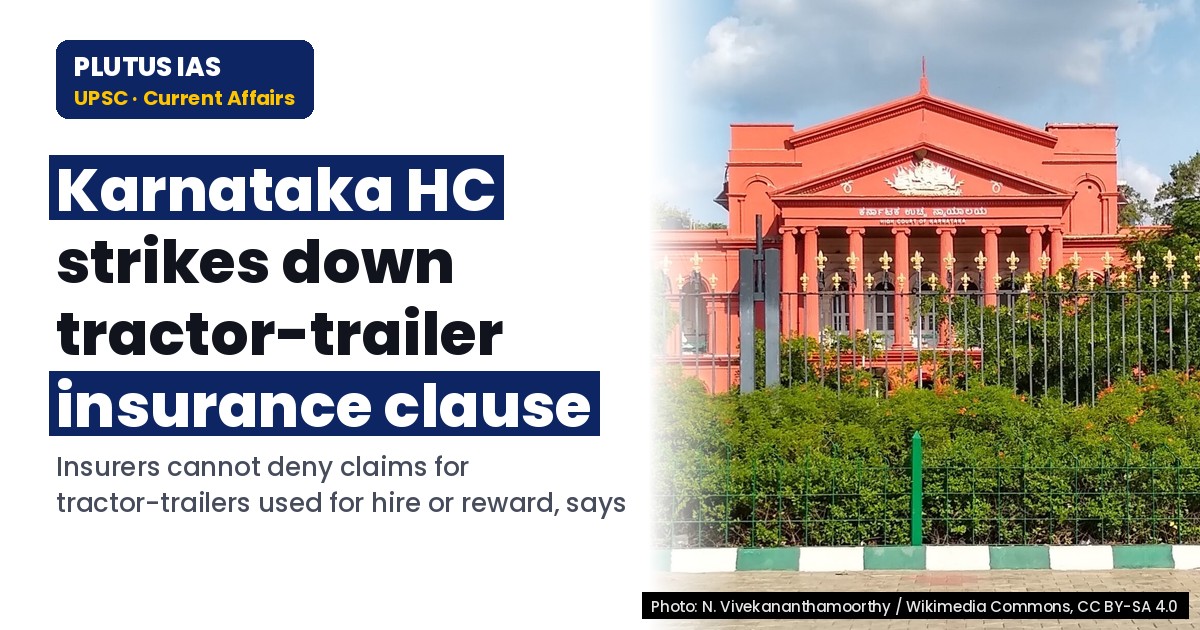
03 Oct Karnataka HC rules against insurance condition on tractor-trailers for hire/reward use
✎ The Karnataka High Court has ruled that insurance policy conditions prohibiting the use of agricultural tractor-trailers for 'hire or reward' are illegal, as they conflict with Section 149(2) of the Motor Vehicles Act, 1988…
Subject Relevance — Where This Topic Fits
- GS Paper III — Infrastructure: Energy, Ports, Roads, Airports, Railways, etc. | GS Paper III — Insurance and Financial Markets
- Prelims: Motor Vehicles Act, 1988, Section 149(2) of MV Act, IRDAI, Certificate of Insurance (Form 51), Motor Accidents Claims Tribunal (MACT), India Motor Tariff, Section 64-UC of Insurance Act, 1938, Rule 141 of Central Motor Vehicles Rules, 1989
- Essay: The interplay between statutory provisions and contractual conditions in insurance law, Balancing farmer welfare with regulatory compliance in motor vehicle insurance
Quick Revision: The Karnataka High Court has ruled that insurance policy conditions prohibiting the use of agricultural tractor-trailers for ‘hire or reward’ are illegal, as they conflict with Section 149(2) of the Motor Vehicles Act, 1988, which mandates third-party insurance for all vehicles used in public places.
Why is this in the news?
The Karnataka High Court has delivered a landmark judgment declaring illegal the standard insurance policy condition that prohibits the use of agricultural tractor-trailers for ‘hire or reward’ activities. The ruling underscores the primacy of the Motor Vehicles Act, 1988, over general insurance provisions and reinforces the legal liability of insurers in motor accident claims, particularly where agricultural machinery is involved in commercial transport. This decision has significant implications for farmers, insurers, and the legal framework governing motor vehicle insurance in India.
Background
- The Motor Vehicles Act, 1988, is the primary legislation governing road safety, vehicle registration, and insurance requirements in India. Section 149(2) mandates that every motor vehicle used in a public place must be insured against third-party risks.
- Agricultural tractor-trailers, while primarily used for farming, are often repurposed for transporting goods for commercial purposes (‘hire or reward’). The legal classification of such vehicles as ‘transport vehicles’ under the MV Act subjects them to the same insurance and liability requirements as other commercial vehicles.
- Insurance policies for agricultural tractor-trailers frequently include clauses prohibiting their use for ‘hire or reward’ to reduce risk exposure for insurers. These clauses have historically been invoked to deny claims in cases of accidents during commercial use.
- The Insurance Regulatory and Development Authority of India (IRDAI) regulates the insurance sector through instruments such as the India Motor Tariff and Section 64-UC of the Insurance Act, 1938, which govern policy terms and premiums.
- Motor Accident Claims Tribunals (MACTs) adjudicate claims arising from road accidents, including disputes over insurance liability. The Karnataka High Court’s ruling directly impacts the functioning of these tribunals by clarifying the legal validity of restrictive insurance conditions.
- The judgment aligns with the broader objective of the MV Act to ensure that all vehicles plying on public roads, regardless of their primary use, are adequately insured to protect third-party interests.
What is the legal and policy context of this judgment?
- The Motor Vehicles Act, 1988, is the apex legislation governing motor vehicle operations in India. Section 149(2) mandates third-party insurance for all vehicles used in public places, ensuring financial protection for victims of motor accidents.
- Agricultural tractor-trailers are classified as ‘transport vehicles’ under the MV Act if used for purposes beyond agriculture, such as transporting goods for commercial gain. This classification subjects them to the same insurance and liability requirements as other commercial vehicles.
- The India Motor Tariff, issued by IRDAI under the Insurance Act, 1938, and Section 64-UC, regulates the terms and conditions of motor insurance policies, including premiums and exclusions. However, these provisions cannot override the mandatory requirements of the MV Act.
- The Certificate of Insurance (Form 51), issued under the Central Motor Vehicles Rules, 1989, serves as prima facie evidence of insurance coverage. Any condition in the policy that conflicts with the provisions of the MV Act or the certificate of insurance is deemed ultra vires (illegal).
- The Karnataka High Court’s ruling interprets Section 149(2) of the MV Act as overriding restrictive insurance conditions that seek to absolve insurers of liability for accidents involving vehicles used for ‘hire or reward’. The Court held that such conditions are contrary to the public policy objective of the MV Act.
- The judgment reinforces the principle that insurers cannot escape liability by invoking policy exclusions that contradict statutory mandates. This ensures that victims of motor accidents receive compensation regardless of the terms of the insurance policy.
- The ruling also highlights the role of the Motor Accident Claims Tribunal (MACT) in adjudicating disputes over insurance liability. MACTs must now consider the primacy of the MV Act when determining the validity of insurance conditions.
- For farmers and rural entrepreneurs, the judgment provides legal clarity on the use of agricultural tractor-trailers for commercial purposes. It ensures that insurance coverage remains valid even if the vehicle is used for ‘hire or reward’, provided it is registered as a transport vehicle.
UPSC Value Addition
Keywords for Mains Answer-Writing
Motor Vehicles Act, 1988 · Section 149(2) of the Motor Vehicles Act · Insurance Regulatory and Development Authority of India (IRDAI) · Certificate of Insurance under Form No. 51 · Motor Accident Claims Tribunal (MACT) · Ultra vires doctrine in administrative law · Doctrine of pith and substance · Hire or reward in motor insurance · Agricultural tractor-trailer as transport vehicle · Doctrine of strict construction of statutes · Motor Vehicles (MV) Rules, 1989 · Rule 141 of MV Rules · Insurance Act, 1938 · Section 64-UC of Insurance Act · Doctrine of harmonious construction · Constitutional validity of insurance policy conditions
Prelims Practice Questions
Q1. Consider the following statements regarding the Motor Vehicles Act, 1988:
1. Section 149(2) mandates that every motor vehicle must be insured against third-party risks.
2. The Act empowers the Central Government to frame rules for the registration of motor vehicles.
3. Rule 141 of the Motor Vehicles Rules, 1989, pertains to the conditions of insurance policies for agricultural tractor-trailers.
How many of the above statements are correct?
- Only one
- Only two
- All three
- None
Answer: Only two — Statement 1 is correct as Section 149(2) of the Motor Vehicles Act, 1988 mandates insurance against third-party risks. Statement 2 is correct as the Act empowers the Central Government to frame rules under Section 111. Statement 3 is incorrect as Rule 141 pertains to the issue of certificates of insurance, not specific conditions for agricultural tractor-trailers.
Q2. Assertion (A): The doctrine of pith and substance is used to determine the constitutional validity of a statute by examining its true nature and character.
Reason (R): The doctrine ensures that the true subject matter of a law is identified to resolve conflicts between central and state legislations.
Options:
A. Both A and R are true, and R is the correct explanation of A.
B. Both A and R are true, but R is not the correct explanation of A.
C. A is true, but R is false.
D. A is false, but R is true.
Answer: ? — The doctrine of pith and substance is indeed used to determine the true nature and character of a statute to resolve conflicts between central and state legislatures. The reason correctly explains the assertion.
Q3. Match the following provisions with their respective enactments:
Column I (Provision)
1. Section 149(2) of the Motor Vehicles Act, 1988
2. Section 64-UC of the Insurance Act, 1938
3. Rule 141 of the Motor Vehicles Rules, 1989
4. Form No. 51 of the Central Motor Vehicles Rules, 1989
Column II (Enactment)
A. Motor Vehicles Act, 1988
B. Insurance Act, 1938
C. Motor Vehicles Rules, 1989
D. Central Motor Vehicles Rules, 1989
- 1-A, 2-B, 3-C, 4-D; 1-B, 2-A, 3-D, 4-C; 1-C, 2-D, 3-A, 4-B; 1-D, 2-C, 3-B, 4-A
- answer_key_mapper_array_for_internal_use_only_ignore_this_array_0_A_1_B_2_C_3_D
- answer_key_mapper_array_for_internal_use_only_ignore_this_array_1_A_2_B_3_C_4_D
Answer: 1-A, 2-B, 3-C, 4-D; 1-B, 2-A, 3-D, 4-C; 1-C, 2-D, 3-A, 4-B; 1-D, 2-C, 3-B, 4-A — Section 149(2) of the Motor Vehicles Act, 1988 pertains to insurance against third-party risks. Section 64-UC of the Insurance Act, 1938 deals with the power of the IRDAI to make regulations. Rule 141 of the Motor Vehicles Rules, 1989 pertains to the issue of certificates of insurance. Form No. 51 of the Central Motor Vehicles Rules, 1989 is the format for the certificate of insurance.
Mains Practice Question
✍ The Karnataka High Court has held that an insurance policy condition barring agricultural tractor-trailers from being used for ‘hire or reward’ is ultra vires Section 149(2) of the Motor Vehicles Act, 1988. In this context, critically examine the legal principles governing the validity of insurance policy conditions under the Motor Vehicles Act, 1988 and the Insurance Act, 1938. Also, discuss the implications of this judgment for the Motor Accident Claims Tribunals (MACT) and the insurance industry. (15 Marks)
Approach: A structured answer must include the following dimensions:
1. **Legal Framework**:
– Section 149(2) of the Motor Vehicles Act, 1988: Mandate for insurance against third-party risks and its overriding effect.
– Section 64-UC of the Insurance Act, 1938: Powers of IRDAI to regulate insurance conditions.
– Rule 141 of the Motor Vehicles Rules, 1989 and Form No. 51: Certificate of insurance requirements.
– Doctrine of ultra vires and harmonious construction in administrative law.
2. **Judicial Reasoning**:
– The Karnataka High Court’s reasoning: Conflict between the Motor Vehicles Act and insurance policy conditions.
– Application of the doctrine of strict construction of statutes in insurance law.
– Precedential value of the judgment in the context of similar disputes.
3. **Implications for MACT and Insurance Industry**:
– Impact on the liability of insurance companies in motor accident claims.
– Changes in policy drafting and underwriting practices.
– Potential for increased litigation and its burden on MACTs.
– Role of IRDAI in standardizing insurance conditions for agricultural tractor-trailers.
4. **Balanced View**:
– Arguments for stricter regulation of agricultural tractor-trailer usage.
– Counter-arguments regarding the commercial viability of insurance for such vehicles.
– Need for a balanced approach to ensure both road safety and economic viability.
5. **Concluding Observations**:
– The judgment reinforces the primacy of the Motor Vehicles Act over general insurance conditions.
– It underscores the need for harmonious construction between the Motor Vehicles Act and the Insurance Act.
– Highlights the role of the judiciary in ensuring that statutory mandates are not circumvented by contractual conditions.
Source: The Hindu
Karnataka PCS (KPSC) — State PCS Practice
Prelims: As per the recent Karnataka High Court ruling, which insurance condition barring agricultural tractor-trailers from ‘hire or reward’ use has been declared illegal?
- Condition excluding coverage for commercial transport of goods
- Condition prohibiting use in ‘hire or reward’ operations
- Condition mandating third-party insurance for private use only
- Condition requiring mandatory registration for agricultural purposes
Answer: Condition prohibiting use in ‘hire or reward’ operations — The Karnataka High Court struck down the insurance condition that prohibited agricultural tractor-trailers from being used for ‘hire or reward’ operations, deeming it illegal.
Mains: Critically analyze the implications of the Karnataka High Court’s ruling declaring the insurance condition barring agricultural tractor-trailers from ‘hire or reward’ use as illegal. Discuss the potential socio-economic impact on farmers, rural transport, and the insurance sector in Karnataka.
Generated by AanyaAi for educational purpose.
Related guides on our sites
- Best PSIR optional coaching for upsc
- Best PSIR optional teacher for upsc
- Best teacher of PSIR optional for upsc
- Best PSIR optional coaching in delhi for UPSC

- Karnataka HC rules against insurance condition on tractor-trailers for hire/reward use - October 3, 2026
- युवा संगम: सिक्किम-राजस्थान सांस्कृतिक आदान-प्रदान से सीखें विरासत - October 3, 2026
- Karnataka Launches Praja Seva Legal Aid Centre for Court Case Resolution - October 3, 2026

No Comments