


19 Jul DU Admissions 2026: Over-Allocation Strategy & Seat Acceptance Trends
Subject Relevance — Where This Topic Fits
- GS Paper II — Social Justice: Issues relating to development and management of Social Sector/Services relating to Education, Human Resources. | GS Paper II — Governance: Government policies and interventions for development in various sectors and issues arising out of their design and implementation.
- Prelims: Delhi University Admissions, CUET UG, Common Seat Allocation System (CSAS), National Testing Agency (NTA), Higher Education Policy, Seat Vacancy Management, Affirmative Action, Equity in Education, Digital Admissions
- Essay: The Role of Technology in Democratising Higher Education Access in India., Balancing Meritocracy and Equity in India’s University Admissions: A Critical Analysis.
Quick Revision: Delhi University’s ‘over-allocation’ strategy, a data-driven approach, aims to minimise seat vacancies in less popular courses, enhancing resource utilisation and access, while the CSAS integrates CUET (UG) scores for a centralised, transparent admission process, though challenges of digital divide and quality maintenance persist.
Why is this in the news?
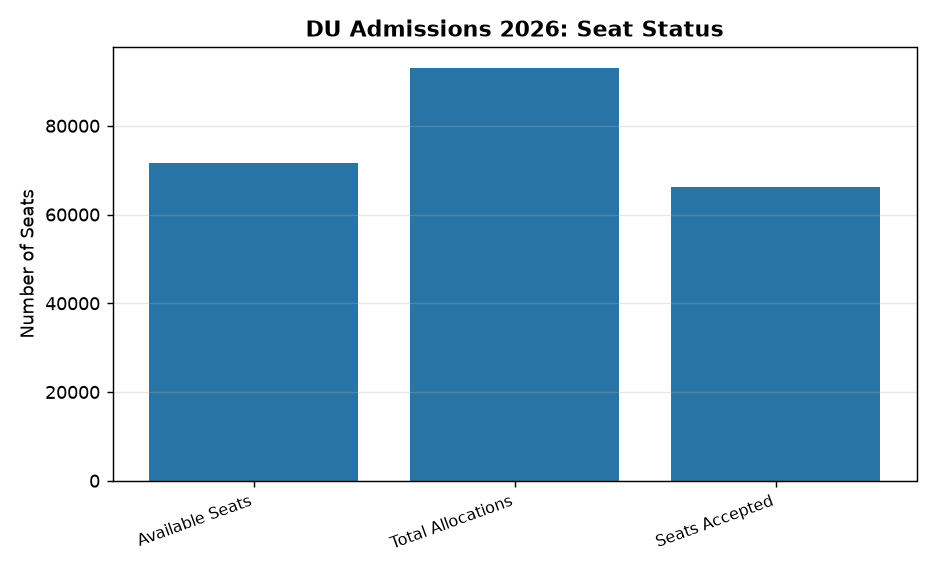
The University of Delhi (DU) has implemented an ‘over-allocation’ strategy for its undergraduate admissions in 2026, making 21,409 extra seat allocations against 71,624 available seats. This decision, based on past admission trends, aims to prevent seat vacancies in specific colleges and courses, while high-demand programmes remain unaffected. This move highlights ongoing efforts to streamline the admissions process and ensure optimal utilisation of educational resources within the Indian higher education landscape.
Background
- The University of Delhi is a premier central university in India, attracting a large number of applicants annually for its undergraduate and postgraduate programmes.
- Admissions to undergraduate courses in DU are conducted through the Common University Entrance Test (CUET) (UG), administered by the National Testing Agency (NTA).
- The Common Seat Allocation System (CSAS) portal is the centralised platform for DU admissions, facilitating registration, preference submission, and seat allocation.
- Historically, DU has faced challenges with seat vacancies in certain courses and colleges after multiple rounds of admissions, leading to underutilisation of capacity.
- The ‘over-allocation’ strategy is a data-driven approach, leveraging past admission trends to project the number of candidates who might not accept or complete their admission.
- The strategy is selectively applied to courses and colleges with a history of vacant seats, ensuring that highly sought-after programmes are not over-allocated.
What is the Delhi University’s Common Seat Allocation System (CSAS)?
- The Common Seat Allocation System (CSAS) is the unified online platform for undergraduate admissions to the University of Delhi, introduced in 2022.
- It integrates the CUET (UG) scores with a centralised application and allocation process, replacing the previous merit-based system based on Class XII board marks.
- The CSAS portal comprises three phases: Phase I involves registration and personal detail submission; Phase II requires candidates to select their preferred programmes and colleges.
- Phase III is the seat allocation and admission process, where candidates are allotted seats based on their CUET scores, preferences, and category.
- The system aims to provide a transparent, equitable, and efficient admission process for all affiliated colleges and departments of DU.
- It allows for multiple rounds of allocation, upgrades, and withdrawals, providing flexibility to candidates to secure their desired course and college.
- The CSAS also incorporates provisions for various reservation policies mandated by the Government of India, including those for SC, ST, OBC (NCL), EWS, PwBD, and other categories.
- The National Testing Agency (NTA) conducts the CUET (UG), the scores of which are fundamental to the CSAS allocation process.
Key Features
| Feature | Significance |
|---|---|
| Over-allocation Strategy | Aims to minimise seat vacancies by making extra offers in courses/colleges with historical under-subscription, ensuring optimal resource utilisation. |
| Data-driven Approach | Based on 4-5 years of admission trends, it reflects a move towards evidence-based policy-making in higher education administration. |
| Selective Application | Only used for courses/colleges where seats typically remain vacant, preventing over-admission in high-demand programmes and maintaining academic quality. |
| Common Seat Allocation System (CSAS) | Centralised online portal for registration, preference submission, and seat allocation, enhancing transparency and accessibility for applicants. |
| CUET (UG) Integration | Ensures a standardised national entrance examination for all participating central universities, promoting a level playing field for diverse student backgrounds. |
| Upgrade Option | Allows candidates to opt for a higher preferred course or college in subsequent rounds, providing flexibility and choice within the allocation system. |
Why it Matters
Optimising Resource Utilisation
- The over-allocation strategy directly addresses the problem of vacant seats, ensuring that valuable educational infrastructure and faculty resources are fully utilised.
- This leads to a more efficient deployment of public funds allocated to higher education institutions, preventing wastage due to under-enrolment.
Enhancing Access and Equity
- By ensuring more seats are filled, the strategy indirectly expands access to higher education for a larger pool of eligible candidates, potentially benefiting those who might have missed out due to initial allocation conservatism.
- It also reduces the anxiety associated with multiple admission rounds for students, as more seats are likely to be filled in earlier rounds.
Streamlining Admission Process
- A data-driven approach to seat allocation can reduce the number of admission rounds required, leading to a more streamlined and predictable admission calendar.
- This efficiency benefits both the university administration and the students, allowing for an earlier start to the academic session.
Policy Innovation in Higher Education
- DU’s strategy represents an innovative administrative solution to a persistent challenge in higher education admissions, potentially serving as a model for other universities.
- It underscores the importance of leveraging data analytics for informed decision-making in public administration.
Challenges
1. Risk of Over-Admission
- Despite data-driven predictions, there remains a slight risk of over-admission if a higher-than-anticipated number of candidates accept their allocated seats.
- This could lead to infrastructural strain, larger class sizes, and potential dilution of the student-teacher ratio, impacting academic quality.
UPSC Link: GS Paper II — Issues relating to development and management of Social Sector/Services relating to Education
2. Maintaining Academic Standards
- While filling seats is important, it must not come at the cost of admitting students who may not meet the minimum academic thresholds, especially in less sought-after courses.
- The balance between access and quality needs careful management to uphold the university’s academic reputation.
UPSC Link: GS Paper II — Human Resources; GS Paper IV — Ethics in Public Administration
3. Digital Divide and Accessibility
- The entire CSAS process is online, which can pose challenges for students from remote areas or those with limited access to digital infrastructure and reliable internet connectivity.
- This digital divide can inadvertently exclude deserving candidates, undermining the goal of equitable access.
UPSC Link: GS Paper II — Vulnerable Sections; GS Paper III — Inclusive Growth
4. Complexity of Preference System
- With 1.59 crore unique programme-college preferences, the system can be complex for applicants, especially those from less privileged backgrounds who may lack adequate guidance.
- Navigating such a vast array of choices requires significant digital literacy and informed decision-making.
UPSC Link: GS Paper II — Governance; GS Paper IV — Probity in Governance
5. Impact on College Autonomy
- While the centralised system ensures uniformity, it might reduce the autonomy of individual colleges in their admission processes, particularly concerning specific course requirements or local considerations.
- Balancing centralisation with institutional flexibility is crucial for effective governance.
UPSC Link: GS Paper II — Structure, organization and functioning of the Executive and the Judiciary
Challenges — UPSC Perspective
| Issue | Concern |
|---|---|
| Potential for Over-Enrolment | Risk of exceeding physical and faculty capacity if acceptance rates are higher than predicted, leading to resource strain. |
| Digital Exclusion | Candidates from rural or socio-economically disadvantaged backgrounds may struggle with the entirely online application and preference submission process. |
| Information Asymmetry | Lack of adequate guidance for students to make informed choices among a vast number of programme-college preferences, especially for first-generation learners. |
| Maintaining Quality vs. Quantity | Pressure to fill seats should not compromise the academic quality or the rigour of the programmes offered, particularly in less popular courses. |
| Grievance Redressal Mechanism | Need for a robust and efficient system to address student grievances arising from allocation discrepancies or technical issues during the admission process. |
| Impact on Lower Preference Choices | Students might accept lower preference seats due to fear of not getting any, potentially leading to dissatisfaction and later withdrawals, creating further vacancies. |
Government Initiatives — Must-Memorise for Prelims
- National Education Policy (NEP) 2020
- Pradhan Mantri Uchchatar Shiksha Abhiyan (PM-USHA)
- National Institutional Ranking Framework (NIRF)
- SWAYAM (Study Webs of Active–Learning for Young Aspiring Minds)
- National Digital Education Architecture (NDEAR)
- Vidya Lakshmi Portal
- National Scholarship Portal
- Skill India Mission
- Digital India Programme
- UGC-CARE List (Consortium for Academic Research Ethics)
Way Forward
- Strengthening Data Analytics: Continuously refine predictive models for seat allocation using advanced data analytics and AI to minimise the risk of over or under-admission.
- Enhancing Digital Infrastructure and Literacy: Invest in digital literacy programmes and establish common service centres (CSCs) in rural areas to assist students with online applications.
- Robust Grievance Redressal: Develop a more accessible and time-bound grievance redressal mechanism for students facing issues during the admission process.
- Counselling and Guidance: Implement comprehensive pre-admission counselling services, both online and offline, to help students make informed choices regarding preferences.
- Flexible Learning Pathways: Explore options for flexible entry and exit points, and credit transfer mechanisms, as envisioned in NEP 2020, to accommodate diverse student needs.
- Capacity Building: Regularly assess and enhance the infrastructural and faculty capacity of colleges to ensure that increased admissions do not dilute academic quality.
- Feedback Mechanisms: Establish formal feedback channels from students and colleges to continuously improve the CSAS and address emerging challenges.
- Promoting Vocational and Skill-Based Courses: Encourage students to explore a wider range of courses, including vocational and skill-based programmes, to diversify demand and reduce pressure on traditional high-demand courses.
UPSC Value Addition
Keywords for Mains Answer-Writing
Higher Education Access · Equitable Admissions · Resource Optimisation · Data-driven Governance · Digital Divide · NEP 2020 Implementation · Quality vs. Quantity · Centralised Admission System · Student Welfare · Institutional Autonomy · Predictive Analytics · Inclusive Education
Constitutional & Policy Linkages
- Article 21A: Right to Education (indirectly, as higher education builds upon foundational education)
- Article 41: Right to education (Directive Principle)
- Article 46: Promotion of educational and economic interests of Scheduled Castes, Scheduled Tribes and other weaker sections (Directive Principle)
- Seventh Schedule (List I, Union List, Entry 66): Coordination and determination of standards in institutions for higher education or research and scientific and technical institutions.
- National Education Policy 2020: Comprehensive policy framework for education in India.
Concept Flow
CUET (UG) Scores Released → Candidates Register on CSAS Portal → Programme-College Preferences Submitted → DU Applies Over-Allocation Strategy (selective) → First Allocation List Released → Candidates Accept/Upgrade/Withdraw → Colleges Verify and Approve → Fee Payment & Admission Completion
Prelims Practice Questions
Q1. Consider the following statements regarding the Common Seat Allocation System (CSAS) for Delhi University admissions:
1. CSAS was introduced in 2020, replacing the previous merit-based system.
2. Admissions through CSAS are based on the scores obtained in the Common University Entrance Test (CUET) (UG).
3. The ‘over-allocation’ strategy is applied uniformly across all colleges and courses to ensure no seats remain vacant.
Which of the statements given above is/are correct?
- A. 1 and 2 only
- B. 2 only
- C. 2 and 3 only
- D. 1, 2 and 3
Answer: B. 2 only — Statement 1 is incorrect; CSAS was introduced in 2022. Statement 2 is correct; CUET (UG) scores are fundamental to CSAS admissions. Statement 3 is incorrect; the ‘over-allocation’ strategy is applied selectively to colleges and courses where seats usually remain vacant, not uniformly across all.
Q2. Which of the following bodies is responsible for conducting the Common University Entrance Test (CUET) (UG)?
- A. University Grants Commission (UGC)
- B. Central Board of Secondary Education (CBSE)
- C. National Testing Agency (NTA)
- D. Ministry of Education
Answer: C. National Testing Agency (NTA) — The National Testing Agency (NTA) is the autonomous organisation responsible for conducting entrance examinations for admission/fellowship in higher educational institutions, including the CUET (UG).
Mains Practice Question
✍ The University of Delhi’s ‘over-allocation’ strategy for undergraduate admissions reflects a broader trend towards data-driven governance in higher education. Critically analyse the potential benefits and challenges of such an approach in ensuring equitable access and optimal resource utilisation, while upholding academic quality in Indian universities. (250 words)
Approach: Begin by briefly explaining DU’s over-allocation strategy and its context. Discuss the benefits, such as improved seat utilisation, reduced vacancies, and enhanced access, linking them to data-driven governance and efficiency. Subsequently, delve into the challenges, including the risk of over-admission, potential strain on infrastructure, impact on academic quality, and issues of digital equity. Conclude by suggesting a balanced way forward that prioritises both access and quality, advocating for robust data analytics, comprehensive counselling, and continuous capacity building in line with the National Education Policy 2020.
Source: The Indian Express
Generated by AanyaAi for educational purpose.

- Shivraj Singh Chouhan launches ‘Khet Bachao Abhiyan’ to save farmland - October 23, 2026
- उत्तराखंड राज्यपाल की पीएम मोदी से महत्वपूर्ण बैठक: जानिए मुख्य बिंदु - October 23, 2026
- How India’s Rs 20,000 Cr CCUS Budget Can Drive Net-Zero Goals - October 23, 2026

No Comments