


28 Mar Earth Hour 2026: From Symbolic Action to Global Climate Movement
This article covers “Daily Current Affairs” and From Earth Hour 2026: From Symbolic Action to Global Climate Movement
SYLLABUS MAPPING
GS-3- Environment & Ecology- Earth Hour 2026: From Symbolic Action to Global Climate Movement
FOR PRELIMS
What is Earth Hour? Explain its objectives
FOR MAINS
What is the main aim of Earth Hour?
Why in the News?
Earth Hour 2026 is being observed on March 28, 2026 (today) across the world. The annual global initiative, organized by World Wide Fund for Nature, encourages individuals, communities, and governments to switch off non-essential lights for one hour to raise awareness about climate change and environmental conservation.
What is Earth Hour?
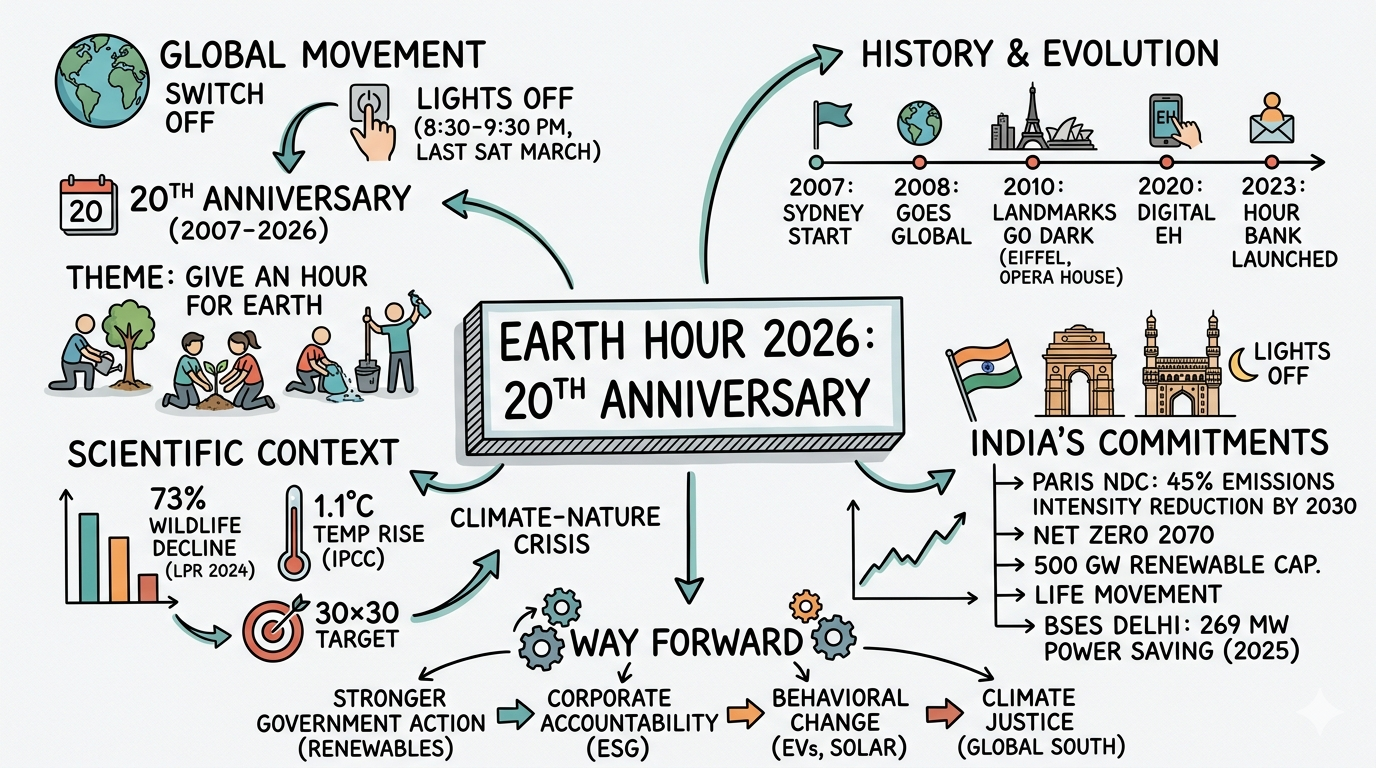
Earth Hour is a global environmental movement organised by the World Wide Fund for Nature. It is observed every year on the last Saturday of March, when people worldwide switch off non-essential lights from 8:30 PM to 9:30 PM to show support for the planet. In 2026, it falls on March 28 and marks the 20th anniversary since it began in Sydney in 2007. The theme is “Give an Hour for Earth”, encouraging people to spend one hour taking positive action for the environment.
Historical Background & Evolution
Origins (2006–2007)
The concept of Earth Hour originated from a 2004 initiative by the World Wide Fund for Nature (Australia) to create a powerful idea highlighting the urgency of climate change. In 2006, in collaboration with Leo Burnett Sydney and Fairfax Media, the idea of a large-scale “lights off” event was developed under the title “The Big Flick”. The Mayor of Sydney, Clover Moore, strongly supported the initiative. On 31 March 2007, the first Earth Hour was held in Sydney, where around 2.2 million homes and businesses switched off their lights, leading to a significant reduction in energy use. Its success led to rapid global expansion, with the event being replicated in San Francisco in October 2007.
Key Milestones Timeline of Earth Hour
| Year | Milestone |
|---|---|
| 2007 | First Earth Hour in Sydney; ~2.2 million participants; ~10.2% energy drop in CBD |
| 2008 | Goes global; 35 countries, 50+ million participants; first UK participation |
| 2009 | Theme: “Vote Earth”; time fixed at 8:30–9:30 PM; 88 countries join |
| 2010 | 400+ cities; landmarks like Eiffel Tower, Big Ben, Sydney Opera House go dark |
| 2012 | 154 countries participate; recognised as a global social movement |
| 2016 | 10th anniversary; 178 countries; focus on renewable energy |
| 2020 | Digital Earth Hour during COVID-19; 190 countries participate virtually |
| 2023 | Theme: “Give an Hour for Earth”; Hour Bank initiative launched |
| 2025 | Nearly 3 million hours pledged; 190+ countries participate |
| 2026 | 20th anniversary; “The Biggest Hour for Earth”; Delhi records ~269 MW power saving |
India’s Participation & Domestic Context
India and Earth Hour — A Growing Imprint
India’s participation in Earth Hour has expanded steadily, coordinated by WWF-India in partnership with governments, companies, and citizens. Major landmarks such as Rashtrapati Bhavan, Akshardham Temple, Gateway of India, India Gate, Charminar and state assemblies switch off lights to support the movement. Delhi has emerged as a key participant. BSES recorded 206 MW power saving in 2024, increasing to 269 MW in 2025. For 2026, it has encouraged 54 lakh consumers and over 2.25 crore residents across Delhi to participate.
India’s Climate Commitments — Contextualising Earth Hour
| Commitment | Details |
|---|---|
| Paris Agreement NDC | Under the Paris Agreement, India aims to reduce emissions intensity of GDP by 45% by 2030 (from 2005 levels) and achieve 50% electricity capacity from non-fossil fuels |
| Net Zero Target | India targets net-zero emissions by 2070, announced at COP26 |
| 500 GW Renewable | Target of 500 GW non-fossil fuel capacity by 2030 under Panchamrit goals |
| National Solar Mission | Part of National Action Plan on Climate Change; solar target 100 GW by 2022 (achieved) and expanding further |
| Lifestyle for Environment (LiFE) | Launched by Narendra Modi at COP26; promotes sustainable lifestyles aligned with Earth Hour |
| BSES Delhi | BSES: 13,000+ rooftop solar connections, 6,300+ EV charging points; aiming 50%+ green power by FY 2026–27 |
Constitutional & Statutory Framework
Conclusion
Earth Hour 2026 — celebrated today, March 28, 2026, as the movement’s 20th anniversary — represents far more than 60 minutes without lights. It is a global referendum on humanity’s willingness to confront the intertwined crises of climate change and biodiversity loss. From a single city of 2.2 million participants in 2007 to over 190 countries today, Earth Hour charts the remarkable scaling of environmental consciousness.
For India, a nation that is simultaneously one of the world’s fastest-growing economies and most climate-vulnerable countries, Earth Hour resonates deeply. India’s constitutional commitment to environmental protection (Articles 48A and 51A(g)), its Panchamrit goals, the LiFE movement, and BSES Delhi’s measurable MW savings collectively demonstrate that symbolic action, when embedded in structural policy, can produce tangible results.
“The Earth does not belong to us — we belong to the Earth.” | Earth Hour 2026: Give an Hour for Earth
Best ias coaching in delhi Best ias coaching in chandigarh
Prelims question:
Q. Consider the following statements regarding ‘Earth Hour’: (UPSC CSE 2014)
1. It is an initiative of UNEP and UNESCO.
2. It is a movement in which the participants switch off the lights for one hour on a certain day.
3. It is a global observance that occurs on the last Saturday of March each year.
Which of the statements given above is/are correct?
(a) 1 and 3 only
(b) 2 only
(c) 2 and 3 only
(d) 1, 2 and 3
Answer: C
Q. Earth Hour is more symbolic than substantive.” Critically examine in the context of global climate action
(250 words)

- Europe’s AI Rules May Become India’s Opportunity - August 14, 2026
- Transparency as the Foundation of Trust in Medicine - August 14, 2026
- A Timely Reset for the Food Security Act: From Foodgrain Security to Nutrition Security - August 13, 2026

No Comments