


05 Aug Ebola Outbreak in DR Congo: New Vaccine Trials Underway for Bundibugyo Strain
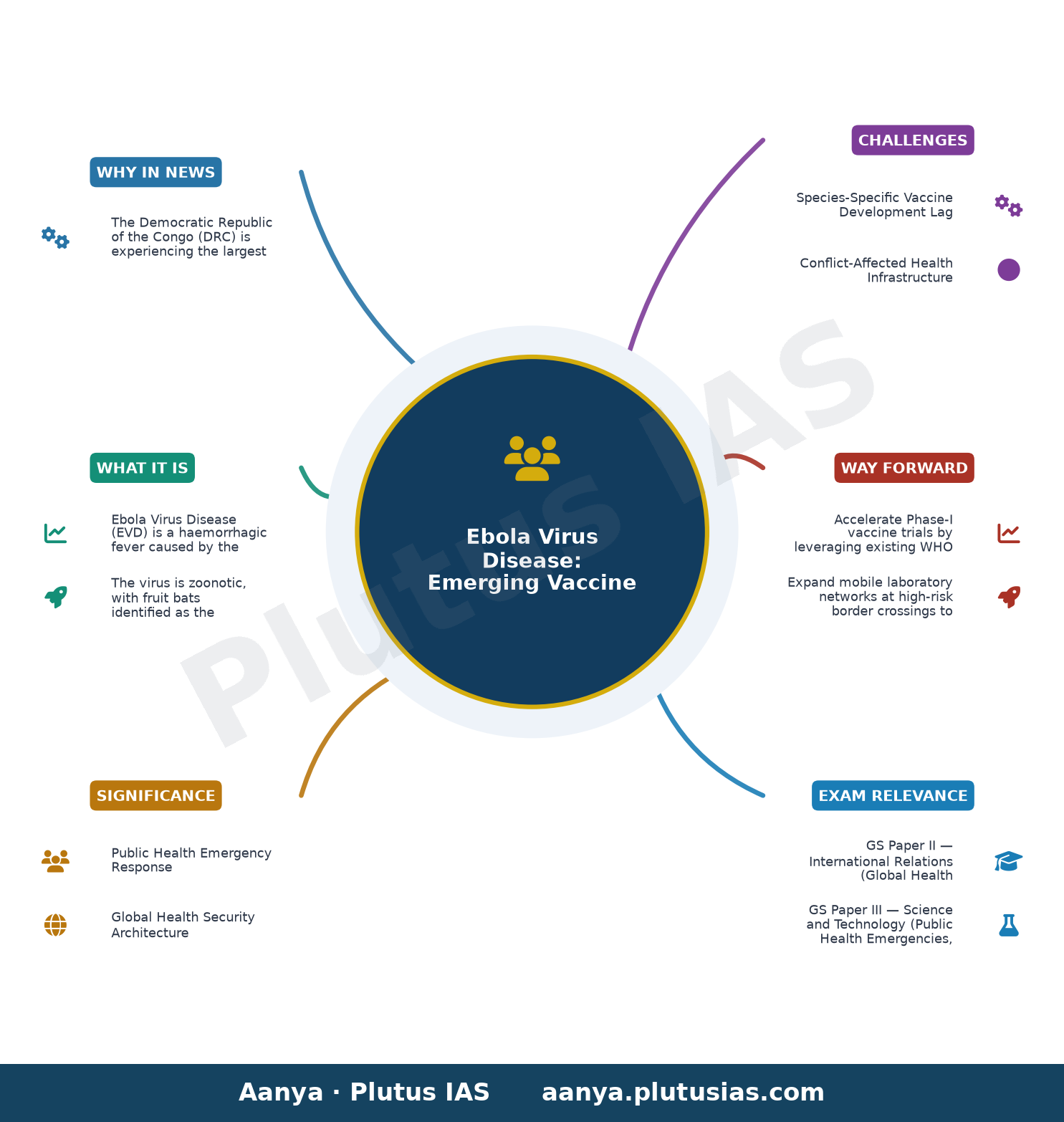
✎ Ebola Virus Disease (EVD) is a zoonotic haemorrhagic fever with high mortality, caused by the Ebola virus; the current DRC outbreak (2026) is the largest on record, prompting accelerated vaccine trials for the previously…
Subject Relevance — Where This Topic Fits
- GS Paper II — International Relations (Global Health Governance, WHO’s Role) | GS Paper III — Science and Technology (Public Health Emergencies, Vaccine Development) | GS Paper III — Disaster Management (Epidemic Response, Inter-Agency Coordination)
- Prelims: Ebola Virus Disease (EVD), Bundibugyo ebolavirus, WHO’s R&D Blueprint, Post-exposure prophylaxis (PEP), Ervebo vaccine, Ituri Province, DRC-Uganda border surveillance, UNOCHA, UNHCR, WFP, Ferret and primate vaccine trials, Phase I clinical trials
- Essay: The interplay between scientific innovation and public health crises in the 21st century, Global solidarity in addressing neglected tropical diseases: Lessons from Ebola
Quick Revision: Ebola Virus Disease (EVD) is a zoonotic haemorrhagic fever with high mortality, caused by the Ebola virus; the current DRC outbreak (2026) is the largest on record, prompting accelerated vaccine trials for the previously unvaccinated Bundibugyo species.
Why is this in the news?
The Democratic Republic of the Congo (DRC) is experiencing the largest recorded outbreak of Ebola Virus Disease (EVD), with 3,748 cases and 1,657 deaths as of 1 August 2026. The outbreak is notable for its scale, the emergence of trials targeting the Bundibugyo species of Ebola—previously without a species-specific vaccine—and the rapid initiation of clinical trials for both vaccines and therapeutics. This development underscores the global health community’s evolving response mechanisms to zoonotic pandemics and the challenges in translating scientific advancements into public health interventions.
Background
- Ebola Virus Disease (EVD) is a severe, often fatal illness caused by the Ebola virus, first identified in 1976 near the Ebola River in the DRC.
- The Bundibugyo ebolavirus species was discovered in 2007 in Uganda and is associated with high mortality rates, though less frequently reported than Zaire ebolavirus.
- The DRC has faced recurrent EVD outbreaks, with the 2018–2020 Kivu outbreak being the second-largest globally, resulting in over 3,400 cases and 2,200 deaths.
- The current outbreak in Ituri Province, DRC, is the largest on record, surpassing prior outbreaks in both case numbers.
- The WHO’s R&D Blueprint, established in 2015, aims to accelerate research and development for diseases with epidemic potential, including EVD.
- The 2026 outbreak has prompted accelerated vaccine trials, including species-specific candidates for Bundibugyo ebolavirus, and post-exposure prophylaxis (PEP) studies.
What is Ebola Virus Disease (EVD)?
- Ebola Virus Disease (EVD) is a haemorrhagic fever caused by the Ebola virus, a member of the Filoviridae family, with a case fatality rate historically ranging from 25% to 90% depending on the strain.
- The virus is zoonotic, with fruit bats identified as the primary natural reservoir, and human transmission occurs through direct contact with bodily fluids of infected individuals or contaminated materials.
- Symptoms include sudden onset of fever, intense weakness, muscle pain, headache, and sore throat, progressing to vomiting, diarrhoea, rash, impaired kidney and liver function, and in severe cases, internal and external bleeding.
- The Bundibugyo ebolavirus species, first identified in Uganda in 2007, is one of six known Ebola virus species, with limited historical outbreaks but high mortality rates.
- Diagnosis is confirmed via reverse transcription-polymerase chain reaction (RT-PCR) or antigen-capture enzyme-linked immunosorbent assay (ELISA) in reference laboratories.
- There is no specific treatment for EVD; supportive care, including rehydration, symptom management, and treatment of secondary infections, remains the cornerstone of clinical management.
- Public health measures such as contact tracing, isolation, safe burials, and community engagement are critical to controlling EVD outbreaks.
Key Features
| Feature | Significance |
|---|---|
| Bundibugyo Ebola Virus Species | First-ever species-specific vaccine trial initiated, addressing a critical gap in Ebola prophylaxis where no licensed vaccine exists. |
| Phase-I Vaccine Trials (UK & Canada) | Early-stage trials on ferrets and monkeys to assess safety and immunogenicity before human trials, leveraging pre-established WHO protocols for rapid deployment. |
| Post-Exposure Prophylaxis Trial (Ituri, DRC) | Oral medication administered to high-risk contacts within 10 days to prevent disease onset, with over 25 patients enrolled in controlled clinical settings. |
| Mobile Laboratory at DRC-Uganda Border | WHO-WFP supported facility delivering Ebola test results within one hour, enhancing surveillance and reducing transmission risks across porous borders. |
| UNHCR Risk Communication Initiatives | Deployment of hygiene kits and infection prevention measures in refugee-hosting areas, mitigating secondary transmission in densely populated settlements. |
Why it Matters
Public Health Emergency Response
- The outbreak represents the largest recorded Ebola epidemic, necessitating rapid vaccine development and treatment trials to curb mortality and transmission.
- WHO’s R&D Blueprint demonstrates global preparedness, with pre-written protocols accelerating research deployment compared to prior outbreaks.
Global Health Security Architecture
- The trial underscores the need for species-specific vaccines, highlighting vulnerabilities in existing Ebola countermeasures which target only select viral strains.
- International collaboration—UK, Canada, DRC, and UN agencies—illustrates the multilateral framework required for pandemic preparedness and response.
Border Management and Surveillance
- The mobile lab at the DRC-Uganda border exemplifies cross-border health security, addressing the challenge of unchecked movement in conflict-affected regions.
- Real-time diagnostics reduce delays in case detection, a critical factor in preventing localized outbreaks from escalating into regional crises.
Refugee Health and Humanitarian Crises
- UNHCR’s interventions in refugee settings highlight the intersection of displacement and infectious disease spread, requiring integrated health and humanitarian strategies.
- Essential hygiene items and risk communication mitigate transmission risks in overcrowded camps, where sanitation infrastructure is often inadequate.
Challenges
1. Species-Specific Vaccine Development Lag
- No licensed vaccine exists for the Bundibugyo species, delaying targeted prophylaxis and increasing reliance on broad-spectrum countermeasures.
- Clinical trials require extended timelines for safety validation, leaving populations at risk during the interim.
UPSC Link: GS-3: Health, Science & Tech
2. Conflict-Affected Health Infrastructure
- Ituri province’s restive conditions hinder the establishment of treatment centers and trial sites, complicating logistical and security arrangements.
- Limited healthcare workforce and resources in conflict zones delay enrollment and monitoring in clinical trials.
UPSC Link: GS-3: Security Challenges
3. Cross-Border Transmission Risks
- Porous borders between DRC and neighboring countries facilitate unmonitored movement, increasing the potential for regional outbreak expansion.
- Mobile laboratories, while effective, require sustained funding and operational support to maintain 24/7 diagnostic capacity.
UPSC Link: GS-2: International Relations
4. Public Trust and Vaccine Hesitancy
- Historical distrust of medical interventions in conflict zones may impede trial enrollment and vaccine acceptance, even after efficacy is demonstrated.
- Misinformation and fear of side effects could undermine public health messaging and uptake of novel treatments.
UPSC Link: GS-4: Ethics & Governance
5. Resource Allocation and Sustainability
- Sustained funding for trials, treatment centers, and surveillance systems remains uncertain, risking premature termination of critical interventions.
- Competing health priorities—malaria, cholera, and COVID-19—may divert attention and resources from Ebola response efforts.
UPSC Link: GS-3: Resource Management
Challenges — UPSC Perspective
| Issue | Concern |
|---|---|
| Vaccine Trial Timelines | Months-long delays in concluding trials may leave populations unprotected during active outbreaks. |
| Conflict Zones and Access | Security threats and logistical barriers hinder the deployment of medical teams and trial infrastructure. |
| Border Surveillance Gaps | Inadequate monitoring of cross-border movement enables undetected transmission of the virus. |
| Clinical Trial Enrollment | Low participation rates due to fear or logistical constraints may compromise trial validity and generalizability. |
| Funding Instability | Unpredictable financial support threatens the continuity of research, treatment, and prevention programs. |
| Public Health Messaging | Ineffective communication strategies may fail to address vaccine hesitancy and misinformation. |
Way Forward
- Accelerate Phase-I vaccine trials by leveraging existing WHO protocols and international partnerships to shorten timelines for human trials.
- Expand mobile laboratory networks at high-risk border crossings to ensure real-time diagnostics and reduce transmission windows.
- Strengthen clinical trial infrastructure in conflict-affected regions through secure funding and inter-agency collaborations (e.g., UNOCHA, WHO, WFP).
- Implement targeted risk communication campaigns in local languages, addressing vaccine hesitancy and misinformation through community engagement.
- Integrate Ebola surveillance and response into broader humanitarian health programs to ensure continuity amid competing priorities.
- Enhance cross-border coordination mechanisms with neighboring countries to standardize screening, quarantine, and data-sharing protocols.
- Invest in local healthcare workforce training to improve trial enrollment, monitoring, and public health response capabilities.
- Establish a dedicated fund for rapid deployment of medical countermeasures during future outbreaks, ensuring sustainability beyond emergency phases.
UPSC Value Addition
Keywords for Mains Answer-Writing
Ebola virus disease · Bundibugyo ebolavirus · vaccine trials · WHO R&D Blueprint · post-exposure prophylaxis · Democratic Republic of Congo · epidemiology of emerging infectious diseases · global health security · One Health approach · public health emergency · clinical trials in zoonotic diseases · UN health initiatives · viral haemorrhagic fevers · international health regulations
Concept Flow
Outbreak Declaration (May 2026) → WHO R&D Blueprint Activation → Species-Specific Vaccine Trial Initiation → Conflict-Affected Health Infrastructure Challenges → Cross-Border Transmission Risks → Mobile Laboratory Deployment → Clinical Trial Enrollment Barriers → Public Trust and Vaccine Hesitancy → Resource Allocation Constraints → Sustained International Collaboration → Long-Term Preparedness Frameworks
Prelims Practice Questions
Q1. Consider the following statements regarding Ebola virus disease (EVD):
1. The Bundibugyo species of Ebola virus is the most recently identified and for which no licensed vaccine exists.
2. The Ervebo vaccine, licensed for another Ebola strain, has shown efficacy against the Bundibugyo species in human trials.
3. Post-exposure prophylaxis trials for EVD are currently underway in the Democratic Republic of Congo.
How many of the above statements are correct?
- Only one
- Only two
- All three
- None
Answer: Only two — Statement 1 is correct as the Bundibugyo ebolavirus is the most recently identified species and no licensed vaccine exists for it. Statement 2 is incorrect because Ervebo targets a different Ebola strain (Zaire ebolavirus) and has not demonstrated efficacy against Bundibugyo. Statement 3 is correct as clinical trials for post-exposure prophylaxis are ongoing in DRC.
Q2. Assertion (A): The World Health Organization’s R&D Blueprint accelerates research and development for epidemic and pandemic-prone diseases.
Reason (R): The R&D Blueprint was established in response to the 2014-2016 West African Ebola outbreak to streamline vaccine and treatment development.
Options:
A. Both A and R are true, and R is the correct explanation of A.
B. Both A and R are true, but R is not the correct explanation of A.
C. A is true but R is false.
D. A is false but R is true.
Answer: ? — Assertion (A) is true as the R&D Blueprint is a global platform to expedite research for epidemic-prone diseases. Reason (R) is also true and correctly explains A, as the Blueprint was indeed created following the 2014-2016 Ebola outbreak to improve preparedness and response.
Q3. Match the following columns regarding Ebola virus species and their characteristics:
Column I (Ebola species)
1. Zaire ebolavirus
2. Sudan ebolavirus
3. Bundibugyo ebolavirus
4. Taï Forest ebolavirus
Column II (Characteristics)
A. First species identified in 1976
B. Most lethal species with high case fatality rate
C. Associated with the largest outbreak in DRC (2014-2016)
D. Most recently identified species
Options:
1. 1-A, 2-B, 3-C, 4-D
2. 1-B, 2-A, 3-D, 4-C
3. 1-C, 2-A, 3-B, 4-D
4. 1-D, 2-C, 3-A, 4-B
Answer: ? — 1-B: Zaire ebolavirus is the most lethal with a high case fatality rate. 2-A: Sudan ebolavirus was first identified in 1976. 3-D: Bundibugyo ebolavirus is the most recently identified species. 4-C: Taï Forest ebolavirus is associated with the 2014-2016 West African outbreak, not DRC.
Mains Practice Question
✍ Ebola virus disease (EVD) outbreaks pose significant challenges to global health security, particularly in resource-limited settings. Critically examine the epidemiological, immunological, and logistical challenges in controlling the Bundibugyo ebolavirus outbreak in the Democratic Republic of Congo (DRC). Also, assess the role of international collaborative frameworks such as the WHO R&D Blueprint in addressing these challenges. (15 Marks)
Approach: MODEL-ANSWER SKELETON:
1. **Epidemiological Challenges** (5 points):
– **Transmission dynamics**: Zoonotic spillover from fruit bats, human-to-human transmission via bodily fluids; high risk in conflict zones (Ituri province).
– **Case fatality rate (CFR)**: Bundibugyo ebolavirus has a CFR of ~50%, higher than Sudan ebolavirus (~40%) but lower than Zaire ebolavirus (~70%).
– **Geographical spread**: DRC’s vast, remote terrain complicates contact tracing and surveillance; porous borders (e.g., DRC-Uganda) increase cross-border transmission risks.
– **Health system fragility**: Weak infrastructure, shortage of healthcare workers, and mistrust in authorities hinder outbreak response.
– **Data gaps**: Underreporting due to stigma, cultural practices, and limited diagnostic capacity.
2. **Immunological Challenges** (3 points):
– **Vaccine gaps**: No licensed vaccine for Bundibugyo ebolavirus; Ervebo (licensed for Zaire ebolavirus) is ineffective against Bundibugyo.
– **Immune evasion**: Ebolaviruses exploit host immune responses (e.g., glycoprotein-mediated immune suppression), complicating vaccine and therapeutic development.
– **Post-exposure prophylaxis (PEP)**: Limited data on efficacy; ongoing trials in DRC aim to evaluate oral PEP for high-risk contacts.
3. **Logistical Challenges** (4 points):
– **Clinical trials**: Require safe monitoring sites (e.g., Bunia treatment centre), ethical approvals, and trained personnel; delays in enrolment due to safety protocols.
– **Supply chain**: Cold chain requirements for vaccines/therapeutics are difficult to maintain in tropical climates.
– **Community engagement**: Cultural practices (e.g., burial rituals) and misinformation fuel resistance to interventions.
– **Conflict and displacement**: Ongoing violence in Ituri province disrupts healthcare delivery and surveillance.
4. **Role of WHO R&D Blueprint** (3 points):
– **Accelerated research**: Pre-written protocols (e.g., for Bundibugyo trials) enabled rapid initiation of vaccine trials in the UK and Canada.
– **Collaborative frameworks**: Unites global stakeholders (academia, pharma, NGOs) to pool resources and share data (e.g., animal studies on Ervebo).
– **Policy recommendations**: Technical advisory groups provide evidence-based guidance for outbreak response (e.g., testing sites, PEP trials).
5. **Conclusion** (1 point):
– While the R&D Blueprint enhances preparedness, sustained funding, equitable access to diagnostics/treatments, and community-centric approaches are critical to curb Bundibugyo outbreaks.
Source: news.un.org
Generated by AanyaAi for educational purpose.

- एल नीनो: दुनिया के सामने जलवायु अनुकूलन की चुनौती - September 23, 2026
- El Niño 2026: A Critical Test for Climate Adaptation in UPSC Mains - September 23, 2026
- हिमाचल में आयुष चिकित्सा का बढ़ता प्रचलन: 57.2% लोगों ने अपनाई आयुष पद्धतियाँ, जानें कारण - September 23, 2026

No Comments