


30 Sep ECI clears Perundurai bypoll; Madras HC to decide on four others
✎ The Election Commission of India (ECI) conducts byelections under Article 324 of the Constitution and Section 151A of the Representation of the People Act, 1951, but its authority is subject to judicial scrutiny, particularly…
Subject Relevance — Where This Topic Fits
- GS Paper II — Polity and Governance: Constitutional and Statutory Provisions | GS Paper II — Constitutional Bodies: Election Commission of India
- Prelims: Byelection, Election Petition, Representation of the People Act, 1951, Article 324 of the Constitution, Model Code of Conduct, Delimitation, Returned Candidate, Section 86(7) of RP Act, 1951
- Essay: The role of constitutional bodies in ensuring democratic continuity: A case study of the Election Commission of India, Balancing electoral expediency and judicial prudence: Lessons from byelection deferrals
Quick Revision: The Election Commission of India (ECI) conducts byelections under Article 324 of the Constitution and Section 151A of the Representation of the People Act, 1951, but its authority is subject to judicial scrutiny, particularly when election petitions are pending under Section 86 of the RP Act, which mandates expeditious disposal within six months.
Why is this in the news?
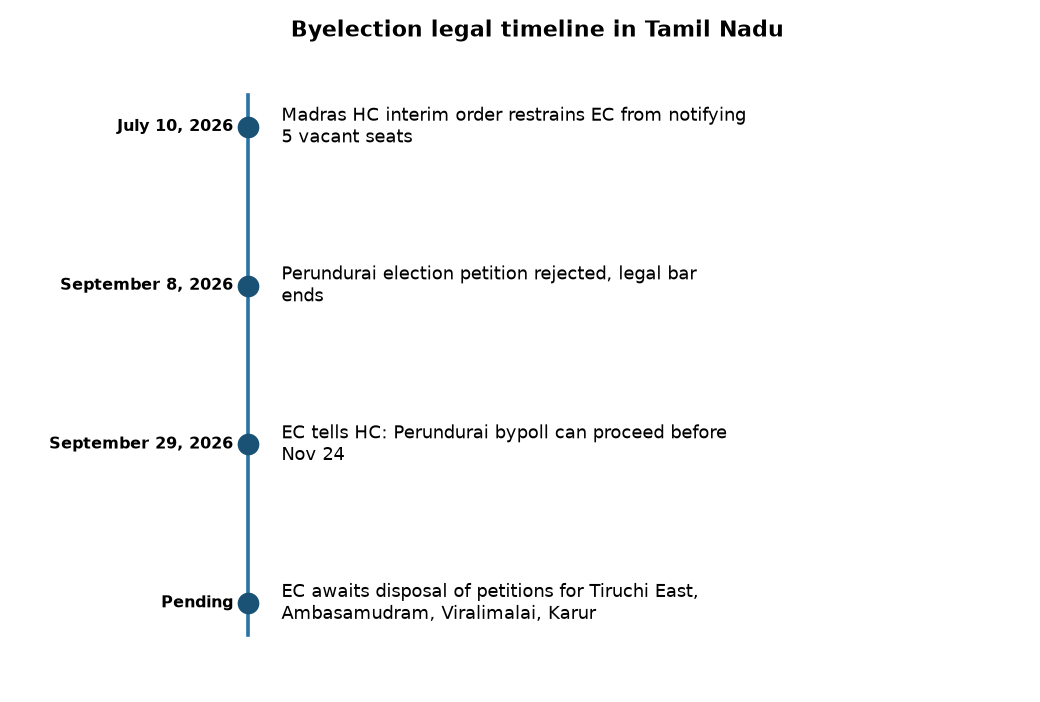
The Madras High Court is currently adjudicating a public interest litigation regarding the deferral of byelections in five Tamil Nadu Assembly constituencies—Tiruchi East, Ambasamudram, Viralimalai, Karur, and Perundurai—due to pending election petitions. The Election Commission of India (ECI) has submitted before the Court that while byelections for Perundurai may proceed after the disposal of the election petition, byelections for the other four constituencies cannot be notified until the respective election petitions are resolved. This case highlights the interplay between electoral expediency, judicial oversight, and statutory timelines under the Representation of the People Act, 1951.
Background
- The Representation of the People Act, 1951 (RP Act) governs the conduct of elections and election petitions in India, including the procedure for byelections.
- Article 324 of the Constitution of India vests the Election Commission of India (ECI) with the superintendence, direction, and control of elections to Parliament and State Legislatures.
- Byelections are conducted to fill vacancies arising in legislative bodies due to resignation, death, or disqualification of members, as per Section 151A of the RP Act.
- Election petitions are filed under Section 80 of the RP Act to challenge the validity of elections or the returned candidate, and are adjudicated by designated High Courts under Section 86.
- Section 86(7) of the RP Act mandates that election petitions be disposed of expeditiously, with an endeavour to conclude the trial within six months of filing.
- The ECI’s role in conducting byelections is subject to judicial scrutiny, particularly when election petitions are pending, to prevent anomalous situations where a constituency may have two representatives.
Byelections and Election Petitions: Constitutional, Statutory, and Procedural Framework
- The Election Commission of India (ECI) is the constitutional authority responsible for conducting byelections, exercising powers under Article 324 to ensure free and fair elections.
- The Representation of the People Act, 1951 (RP Act) provides the statutory framework for byelections, including the procedure for filling casual vacancies under Section 151A.
- **Election Petitions**: These are civil suits filed under Section 80 of the RP Act to challenge the validity of an election or the returned candidate. The jurisdiction to adjudicate election petitions lies exclusively with the High Courts, as per Section 86.
- **Disqualification and Resignation**: Vacancies in legislative bodies may arise due to resignation, death, or disqualification of members. The RP Act specifies the procedure for declaring such vacancies and conducting byelections.
- **Judicial Intervention**: The High Courts, while adjudicating election petitions, may pass interim orders to restrain the ECI from conducting byelections in constituencies where petitions are pending, to avoid conflicts in representation.
- **Statutory Timelines**: Section 86(7) of the RP Act requires election petitions to be disposed of expeditiously, with a statutory mandate to conclude trials within six months of filing, though practical delays often occur due to judicial backlog.
- **Anomalous Situations**: The ECI must ensure that byelections are not conducted in a manner that could lead to a constituency having two representatives simultaneously, which is constitutionally untenable.
- The ECI’s discretion in conducting byelections is subject to judicial review, and the Commission often submits affidavits before High Courts to explain its procedural decisions, as seen in the Madras High Court case.
UPSC Value Addition
Keywords for Mains Answer-Writing
Election Commission of India · byelections under Representation of the People Act, 1951 · election petitions and their disposal · Article 324 of the Constitution · Section 86(7) of the Representation of the People Act, 1951 · Madras High Court · Supreme Court of India · constitutional bar on byelections · returned candidates and anomalies in representation · expeditious disposal of election petitions · Chief Election Commissioner and Election Commissioners · judicial review of election disputes · vacancy in legislative assemblies · interim orders and constitutional provisions
Prelims Practice Questions
Q1. Consider the following statements regarding the Election Commission of India (ECI) and byelections:
1. The ECI can notify a byelection only after the disposal of all election petitions related to the constituency.
2. Section 86(7) of the Representation of the People Act, 1951 mandates that election petitions must be disposed of within six months.
3. The Supreme Court of India has the power to stay the conduct of byelections pending disposal of election petitions.
4. The President of India can declare a constituency vacant and order a byelection under Article 356 of the Constitution.
How many of the above statements are correct?
- Only one
- Only two
- Only three
- All
Answer: Only three — Statements 1, 2, and 3 are correct. Statement 4 is incorrect because the power to declare a vacancy and order a byelection lies with the Election Commission under the Representation of the People Act, 1951, not the President under Article 356.
Q2. Assertion (A): The Election Commission of India (ECI) can conduct a byelection even if an election petition is pending before the High Court.
Reason (R): The ECI is constitutionally obligated under Article 324 to ensure that every constituency is represented without undue delay.
In the context of the above statements, which of the following is correct?
- Both A and R are true, and R is the correct explanation of A.
- Both A and R are true, but R is not the correct explanation of A.
- A is true, but R is false.
- A is false, but R is true.
Answer: A is true, but R is false. — Assertion (A) is true because the ECI can conduct a byelection if the election petition pertains to a constituency where the legal bar has been lifted (e.g., Perundurai in the given case). Reason (R) is true as Article 324 empowers the ECI to ensure representation, but it does not automatically override pending election petitions unless the legal bar is lifted.
Q3. Match the following provisions with their respective contexts:
Column I (Provision)
A. Article 324 of the Constitution
B. Section 86(7) of the Representation of the People Act, 1951
C. Article 192 of the Constitution
D. Section 151 of the Representation of the People Act, 1951
Column II (Context)
1. Disposal of election petitions within six months
2. Power of the Election Commission to superintend, direct, and control elections
3. Declaration of a person as disqualified for being chosen as, and for being, a member of either House of Parliament or of the Legislature of a State
4. Conduct of byelections to fill casual vacancies in legislative bodies
Select the correct match:
- A-2, B-1, C-3, D-4; A-1, B-2, C-4, D-3; A-3, B-4, C-1, D-2; A-4, B-3, C-2, D-1
- answer
- explain
- format
- match
Answer: A-2, B-1, C-3, D-4; A-1, B-2, C-4, D-3; A-3, B-4, C-1, D-2; A-4, B-3, C-2, D-1 —
Q4. Which of the following best describes the legal bar on conducting byelections in a constituency where an election petition is pending?
- The bar is absolute and cannot be lifted until the election petition is disposed of.
- The bar can be lifted if the election petition pertains to a constituency where the returned candidate’s election is not under challenge.
- The bar is lifted only if the Supreme Court grants a stay on the election petition.
- The bar is lifted if the election petition is filed after the resignation of the sitting member.
Answer: The bar can be lifted if the election petition pertains to a constituency where the returned candidate’s election is not under challenge. — The legal bar on conducting byelections in a constituency where an election petition is pending is absolute and can only be lifted after the disposal of the election petition by the High Court, as per Section 86(7) of the Representation of the People Act, 1951.
Mains Practice Question
✍ The Election Commission of India (ECI) has submitted before the Madras High Court that byelections can be conducted in a constituency only after the disposal of election petitions, subject to constitutional and statutory provisions. Critically examine the legal and constitutional framework governing the conduct of byelections in India, with particular reference to the role of the ECI, the Representation of the People Act, 1951, and the Constitution. Also, discuss the implications of delaying byelections on democratic representation. (15 Marks)
Approach: MODEL-ANSWER SKELETON:
1. **Constitutional Framework**:
– Article 324 of the Constitution empowers the ECI to superintend, direct, and control elections, including byelections.
– Article 192 and Article 327 provide the legal basis for disqualifications and electoral laws.
2. **Statutory Provisions**:
– Section 151 of the Representation of the People Act, 1951, mandates the conduct of byelections to fill casual vacancies.
– Section 86(7) of the Act requires election petitions to be disposed of within six months, but does not automatically bar byelections if the legal bar is lifted (e.g., Perundurai case).
3. **Judicial Precedents**:
– Reference to the Supreme Court’s stance on the ECI’s discretion in conducting byelections (e.g., in the context of interim orders and constitutional bar).
– Madras High Court’s role in interpreting the legal bar and the ECI’s submissions.
4. **Implications of Delay**:
– Democratic deficit: Constituencies remain unrepresented, affecting legislative functioning and accountability.
– Legal anomalies: Potential for dual representation if election petitions alter the returned candidate’s status post-byelection.
– ECI’s balancing act: Ensuring expeditious disposal of election petitions while upholding democratic representation.
5. **Balanced View**:
– The ECI’s role as a neutral constitutional authority vs. the need for timely representation.
– The tension between judicial review of election disputes and the urgency of filling vacancies.
6. **Conclusion**:
– The ECI must navigate constitutional obligations, statutory timelines, and judicial orders to ensure both free and fair elections and timely representation.
Source: The Hindu
Generated by AanyaAi for educational purpose.
Related guides on our sites
- Current affairs for upsc 2026
- Best PSIR optional coaching for upsc
- Best PSIR optional teacher for upsc
- Best teacher of PSIR optional for upsc

- एसिमिलिपाल के पास अवैध पत्थर खनन: एनएचआरसी ने रिपोर्ट मांगी - September 30, 2026
- NRIDA-IIM Kolkata MoU to Study PMGSY-IV & PM-JANMAN Impact for 4 Years - September 30, 2026
- जम्मू-कश्मीर: अनुच्छेद 370 से राज्यत्व तक का संवैधानिक सफर - September 30, 2026

No Comments