


27 Jul ED Arrests Ex-CGPSC Chief in Recruitment Scam & Money Laundering Case
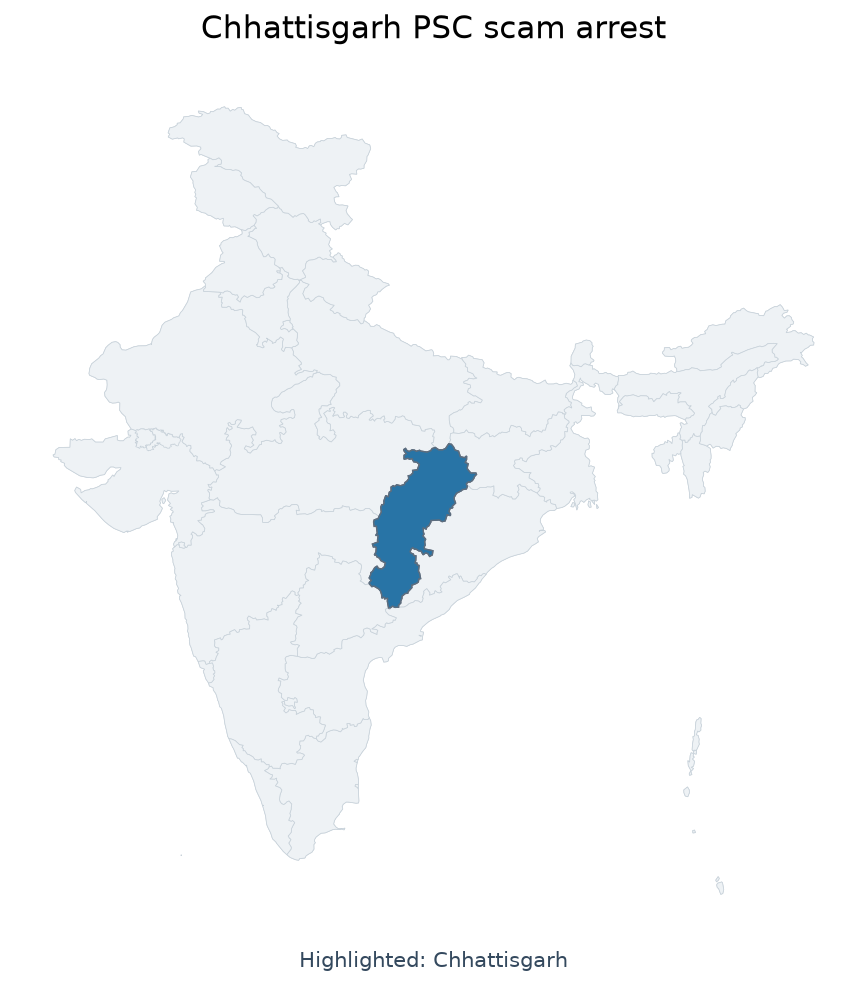
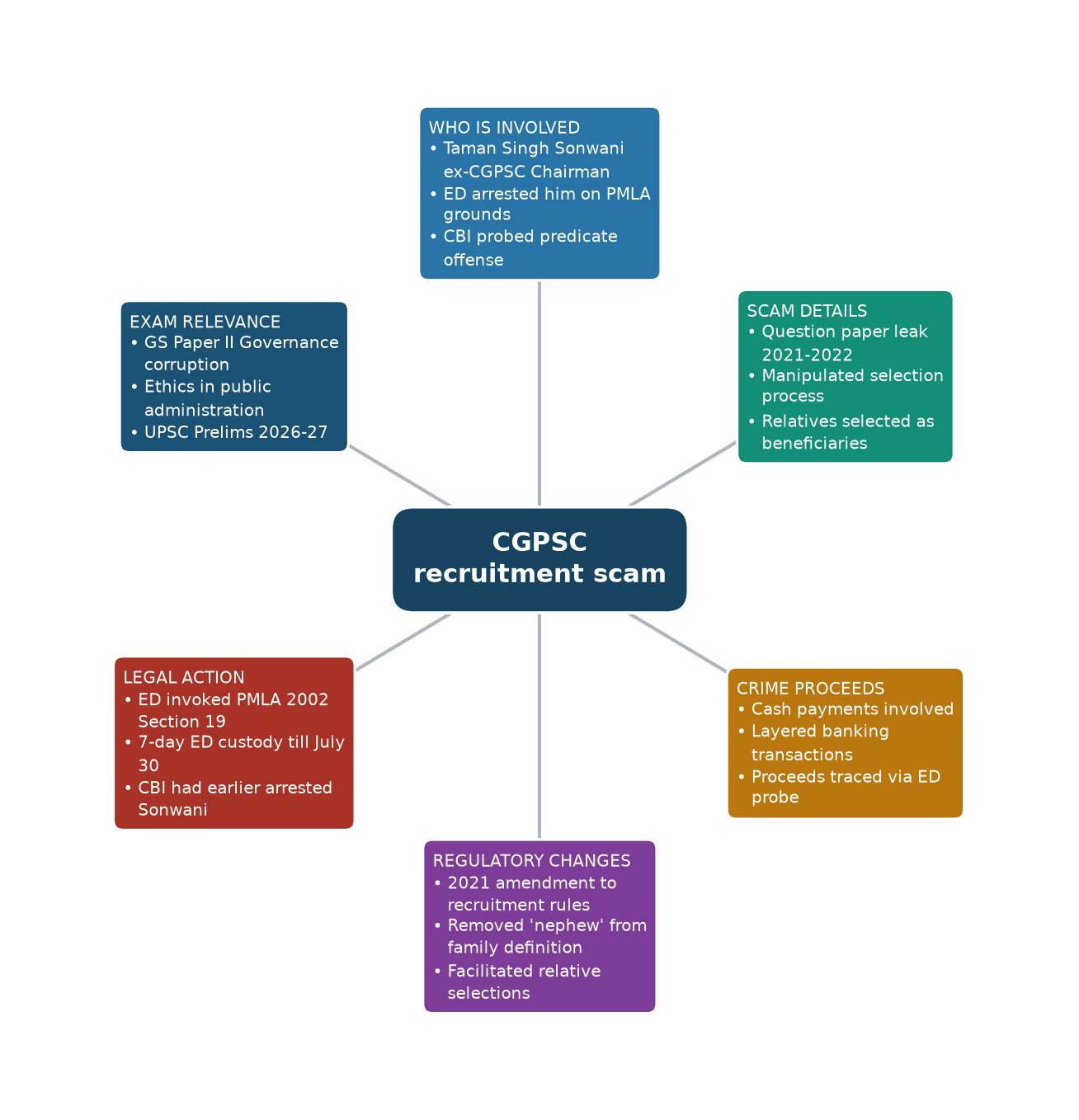
Map & concept mind-map: Chhattisgarh PSC scam arrest
Subject Relevance — Where This Topic Fits
- GS Paper II — Role of Civil Services in a Democracy | GS Paper IV — Ethics and Integrity in Governance
- Prelims: Chhattisgarh Public Service Commission (CGPSC), Prevention of Money Laundering Act (PMLA), 2002, Section 19 of PMLA, Section 50 of PMLA, Central Bureau of Investigation (CBI), Directorate of Enforcement (ED), State Service Examinations, Predicate offence, Layered banking transactions, Judicial custody vs ED custody, Recruitment rules amendment, Family definition in recruitment norms
- Essay: The erosion of institutional trust in public examinations: A systemic challenge, Ethics in governance: Balancing efficiency and integrity in civil service recruitment
Quick Revision: The Prevention of Money Laundering Act (PMLA), 2002, empowers the Directorate of Enforcement (ED) to investigate and prosecute cases involving the concealment, possession, or use of proceeds of crime, including those arising from corruption and institutional malpractice.
Why is this in the news?
The arrest of Taman Singh Sonwani, former Chairman of the Chhattisgarh Public Service Commission (CGPSC), by the Directorate of Enforcement (ED) under the Prevention of Money Laundering Act (PMLA), 2002, marks a significant development in the investigation of a recruitment scam involving alleged question-paper leaks, manipulation of selection processes, and the fraudulent appointment of relatives and influential individuals to senior civil service posts. The case underscores the vulnerabilities in institutional mechanisms governing public service examinations and raises critical questions about the integrity of civil service recruitment systems in India.
Background
- The Chhattisgarh Public Service Commission (CGPSC) is a constitutional body established under Article 315 of the Constitution of India, responsible for conducting recruitment examinations for state civil services, including the State Service Examinations.
- The alleged scam pertains to irregularities in CGPSC recruitments conducted in 2021 and 2022, when Taman Singh Sonwani served as Chairman of the CGPSC.
- The Central Bureau of Investigation (CBI) initiated the probe into the scam, which later expanded to include money laundering charges under the PMLA, 2002, following the involvement of the Directorate of Enforcement (ED).
- The case gained political salience during the 2023 Chhattisgarh Assembly elections, with the Bharatiya Janata Party (BJP) alleging widespread corruption in the Bhupesh Baghel-led Congress government.
- The ED’s investigation revealed that recruitment norms were amended in 2021 to redefine the term ‘family,’ allegedly to facilitate the selection of Sonwani’s relatives.
- The proceeds of crime were allegedly routed through layered banking transactions and collected in cash, indicating a sophisticated money-laundering operation.
What is the Chhattisgarh PSC Recruitment Scam?
- The scam involves allegations of systemic corruption in the Chhattisgarh Public Service Commission (CGPSC), including question-paper leaks, manipulation of selection processes, and the fraudulent appointment of candidates to senior civil service posts.
- Taman Singh Sonwani, former Chairman of the CGPSC, is accused of conspiring with public servants and private individuals to secure the selection of his relatives and other favoured candidates in exchange for illegal gratification.
- The recruitment rules of the CGPSC were allegedly amended in 2021 to redefine the term ‘family,’ removing the word ‘nephew’ from the definition to facilitate the selection of Sonwani’s relatives.
- The proceeds of crime were allegedly collected in cash and routed through layered banking transactions, indicating a deliberate attempt to conceal the illicit gains.
- The Central Bureau of Investigation (CBI) initiated the probe into the scam, while the Directorate of Enforcement (ED) expanded the investigation to include charges under the Prevention of Money Laundering Act (PMLA), 2002.
- The case highlights the vulnerabilities in institutional mechanisms governing public service examinations, including the lack of robust safeguards against collusion and malpractice.
- The scam raises critical questions about the integrity of civil service recruitment systems in India and the need for systemic reforms to prevent institutional corruption.
- The investigation has revealed the involvement of influential individuals, including relatives of Sonwani, in the alleged scam, further eroding public trust in the recruitment process.
Key Features
| Feature | Significance |
|---|---|
| Arrest under PMLA, 2002 | Demonstrates the application of anti-money laundering provisions to corruption in public service examinations, highlighting the legal framework for tracing illicit financial flows. |
| Recruitment rule amendment (2021) | Exposed the misuse of legislative processes to facilitate nepotism, illustrating how administrative rules can be subverted for corrupt ends. |
| Layered banking transactions | Reveals the sophistication of financial manipulation in concealing proceeds of crime, underscoring the challenges in tracking illicit funds. |
| Question paper leaks and selection manipulation | Highlights systemic vulnerabilities in examination processes, threatening the integrity of public service recruitment systems. |
| Involvement of relatives and influential persons | Emphasizes the nexus between power, privilege, and corruption, eroding public trust in institutional fairness. |
Why it Matters
Institutional Integrity
- The case underscores the critical need for robust mechanisms to safeguard the independence and transparency of public service commissions.
- It exposes the erosion of meritocracy in recruitment, which undermines the efficiency and credibility of the civil services.
- The alleged collusion between public servants and private individuals reveals systemic failures in accountability and oversight.
Legal and Procedural Implications
- The invocation of the Prevention of Money Laundering Act (PMLA) signals the state’s commitment to prosecuting financial crimes linked to corruption.
- The use of layered banking transactions highlights the sophistication of money laundering techniques, necessitating enhanced forensic and investigative capabilities.
- The amendment of recruitment rules to facilitate nepotism exemplifies how administrative processes can be weaponized for corrupt purposes.
Political and Governance Impact
- The timing of the scam allegations, coinciding with the 2023 Assembly elections, reflects the weaponization of corruption narratives in electoral politics.
- The case exemplifies how corruption scandals can become focal points in opposition campaigns, influencing public perception and electoral outcomes.
- It raises questions about the adequacy of safeguards in public institutions to prevent such malpractices, particularly in states with frequent transfers of power.
Challenges
1. Systemic Corruption in Recruitment Processes
- Vulnerability of examination systems to leaks and manipulation, compromising merit-based selection.
- Inadequate safeguards against nepotism and favoritism in public service appointments.
- Lack of real-time monitoring and auditing mechanisms to detect irregularities in recruitment.
UPSC Link: GS2: Role of Civil Services in a Democracy
2. Financial Transparency and Money Laundering
- Sophistication of financial transactions used to conceal illicit proceeds, complicating investigative efforts.
- Inadequate financial intelligence and forensic capabilities to trace layered banking transactions.
- Need for stronger collaboration between enforcement agencies and financial institutions to combat money laundering.
UPSC Link: GS3: Money Laundering and its Prevention
3. Politicization of Corruption Allegations
- Risk of corruption cases being exploited for political gains, distorting public discourse.
- Challenges in ensuring impartial investigations and prosecutions in politically sensitive cases.
- Need for institutional mechanisms to depoliticize corruption probes and maintain public trust.
UPSC Link: GS2: Parliament and State Legislatures
4. Administrative Rule-Making and Accountability
- Risk of administrative rules being amended for corrupt purposes, undermining institutional integrity.
- Lack of robust oversight mechanisms to scrutinize rule changes in public institutions.
- Need for transparency in rule-making processes and public consultation to prevent misuse.
UPSC Link: GS2: Functions and Responsibilities of the Union and the States
Challenges — UPSC Perspective
| Issue | Concern |
|---|---|
| Examination integrity | Systemic vulnerabilities to leaks and manipulation, compromising merit-based selection. |
| Financial transparency | Sophisticated money laundering techniques concealing illicit proceeds. |
| Political interference | Corruption allegations being weaponized in electoral politics. |
| Administrative rule-making | Risk of rules being amended for corrupt purposes. |
| Institutional accountability | Collusion between public servants and private individuals eroding trust. |
Way Forward
- Strengthen real-time monitoring and auditing mechanisms in public service commissions to detect irregularities promptly.
- Enhance forensic and financial intelligence capabilities to trace layered banking transactions and illicit financial flows.
- Implement transparent rule-making processes with public consultation to prevent administrative amendments for corrupt purposes.
- Establish independent oversight bodies to investigate and prosecute corruption in recruitment processes.
- Promote digitalization of examination processes with secure, tamper-proof systems to prevent leaks.
- Conduct periodic reviews of recruitment rules and selection criteria to eliminate loopholes for nepotism.
- Foster a culture of accountability and integrity in civil services through training and awareness programs.
- Ensure non-partisan investigations into corruption allegations to maintain public trust in institutions.
UPSC Value Addition
Keywords for Mains Answer-Writing
Public Service Commission · Money Laundering · Prevention of Money Laundering Act (PMLA) 2002 · recruitment scam · question paper leak · criminal conspiracy · Section 19 PMLA · Section 50 PMLA · Directorate of Enforcement (ED) · Central Bureau of Investigation (CBI) · judicial custody · proceeds of crime · nepotism in civil services · civil service reforms · governance and accountability in public institutions
Concept Flow
Amendment of recruitment rules in 2021 → Facilitated nepotism in selections → Collusion between Chairman and private individuals → Leakage of question papers → Manipulation of selection process → Fraudulent appointments of relatives and favorites → Receipt of illegal gratification → Generation of illicit proceeds → Layered banking transactions → Concealment of financial trails → ED investigation under PMLA → Arrest and remand of accused → Erosion of public trust → Demand for institutional reforms
Prelims Practice Questions
Q1. Which constitutional or statutory body is primarily responsible for the investigation of money laundering cases in India?
- A. Central Bureau of Investigation (CBI)
- B. Enforcement Directorate (ED)
- C. Central Vigilance Commission (CVC)
- D. National Investigation Agency (NIA)
Answer: B. Enforcement Directorate (ED) — The Enforcement Directorate (ED) is the statutory authority under the Prevention of Money Laundering Act (PMLA), 2002, tasked with investigating money laundering cases. While the CBI investigates predicate offences, the ED probes the laundering of proceeds from such offences.
Q2. Under which provision of the Prevention of Money Laundering Act (PMLA), 2002, can an arrest be made by the Directorate of Enforcement?
- A. Section 17
- B. Section 19
- C. Section 21
- D. Section 24
Answer: B. Section 19 — Section 19 of the PMLA, 2002, empowers the Directorate of Enforcement to arrest an accused person involved in money laundering, subject to judicial remand.
Q3. The Prevention of Money Laundering Act (PMLA), 2002, defines ‘proceeds of crime’ as:
- A. Only cash proceeds from illegal activities
- B. All property derived directly or indirectly from criminal activity, including its conversion or concealment
- C. Only proceeds from corruption cases
- D. Only proceeds from tax evasion
Answer: B. All property derived directly or indirectly from criminal activity, including its conversion or concealment — Under Section 2(1)(u) of the PMLA, 2002, ‘proceeds of crime’ include all property derived or obtained directly or indirectly from criminal activity, including its conversion, concealment, or disguise.
Q4. Which of the following is NOT a predicate offence under the Prevention of Money Laundering Act (PMLA), 2002?
- A. Offences under the Indian Penal Code (IPC)
- B. Offences under the Narcotic Drugs and Psychotropic Substances Act (NDPS)
- C. Offences under the Foreign Exchange Management Act (FEMA)
- D. Offences under the Right to Information Act (RTI)
Answer: D. Offences under the Right to Information Act (RTI) — The Right to Information Act (RTI), 2005, does not list any offences that qualify as predicate offences under the PMLA, 2002. Predicate offences are specified under the schedule to the PMLA.
Mains Practice Question
✍ Examine the ethical and institutional dimensions of corruption in public service commissions, with particular reference to the alleged recruitment scam involving the former Chairman of the Chhattisgarh Public Service Commission (CGPSC). How can such malpractices be prevented through systemic reforms in civil service recruitment processes?
Approach: The candidate should analyse the ethical dimensions by discussing the violation of public trust, nepotism, and the erosion of meritocracy in civil service recruitment. Institutionally, the focus should be on the role of oversight bodies like the ED and CBI, the efficacy of the PMLA, 2002, and the need for transparency in recruitment rules. Systemic reforms could include strengthening the independence of public service commissions, implementing digital surveillance of examination processes, and introducing whistle-blower protections. The answer should also reference the constitutional provisions ensuring equality and fairness in public employment (Article 14 and 16) and suggest measures like periodic audits, third-party monitoring, and strict adherence to the UPSC model for state PSC examinations.
Source: The Hindu
Generated by AanyaAi for educational purpose.

- बिहार सरकार का बड़ा कदम: 25 हजार परिवारों को सौर ऊर्जा सहायता, 534 प्रखंडों में सोलर मार्ट खोले जाएंगे - September 23, 2026
- Bihar Launches Mega Solar Scheme: 25,000 Families to Benefit, 534 Solar Marts - September 23, 2026
- सुपर एल नीनो से भारत में 15,800 अतिरिक्त गर्मी से मौतें: जानिए पूरा मामला - September 23, 2026

No Comments