


04 Feb Electronics Components Manufacturing Scheme (ECMS): Strengthening India’s Electronics Value Chain
This article covers “Daily Current Affairs” and From Electronics Components Manufacturing Scheme (ECMS): Strengthening India’s Electronics Value Chain
SYLLABUS MAPPING
GS- 3-Economy & Technology-Electronics Components Manufacturing Scheme (ECMS): Strengthening India’s Electronics Value Chain
FOR PRELIMS
What is the Electronics Components Manufacturing Scheme (ECMS)?
FOR MAINS
Why was the Electronics Components Manufacturing Scheme launched?
Why in the News?
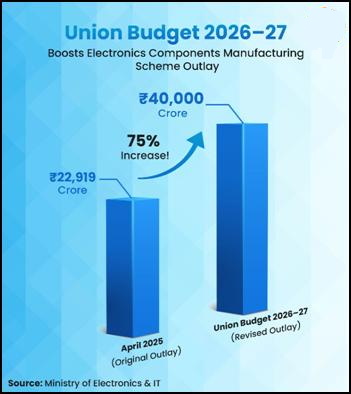
India’s electronics manufacturing sector has entered a decisive phase of structural transformation. The Union Budget 2026–27 has significantly enhanced the outlay of the Electronics Components Manufacturing Scheme (ECMS) to ₹40,000 crore, signalling a strong policy commitment to deepening domestic manufacturing capabilities and reducing import dependence. Over the past decade, India has emerged as a major electronics manufacturing hub, registering nearly a six-fold increase in production, creating around 25 lakh jobs, and strengthening its integration with global value chains.
Electronics: Emerging as India’s Leading Export Sector
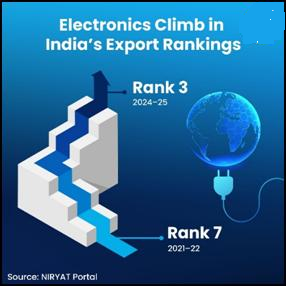
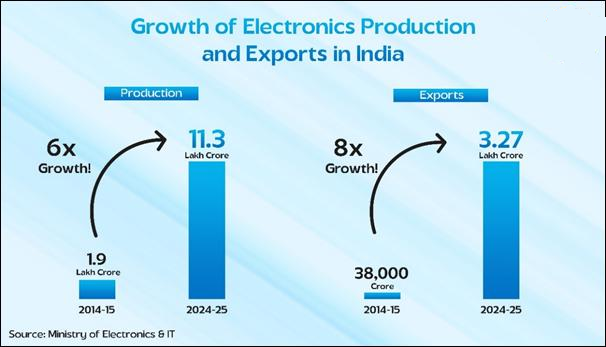
As highlighted in the Economic Survey 2025–26, electronics has emerged as India’s third-largest and fastest-growing export category in 2024–25, rising sharply from the seventh position in 2021–22. During the first half of FY 2025–26, electronics exports stood at USD 22.2 billion, placing the sector on track to become India’s second-largest export item. India’s electronics production expanded from ₹1.9 lakh crore in 2014–15 to ₹11.3 lakh crore in 2024–25, reflecting a six-fold increase. Exports grew even faster, from ₹38,000 crore to ₹3.27 lakh crore, an eight-fold rise over the same period. This growth has been employment-intensive, generating approximately 25 lakh jobs nationwide.
Mobile Manufacturing: The Flagship Success Story
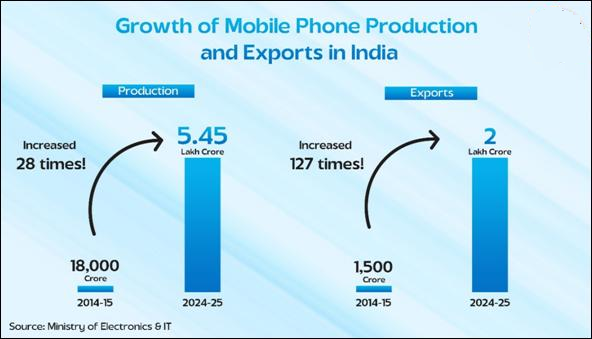
Mobile phone manufacturing has been the primary driver of India’s electronics transformation. Production in this segment surged from ₹18,000 crore in 2014–15 to ₹5.45 lakh crore in 2024–25, marking a 28-fold increase. India is now the world’s second-largest mobile phone manufacturer, with over 300 manufacturing units, compared to just two in 2014. Exports of mobile phones have shown exceptional growth, rising 127 times from ₹1,500 crore in 2014–15 to ₹2 lakh crore in 2024–25. In the first five months of FY 2025–26 alone, smartphone exports reached ₹1 lakh crore, registering a 55 per cent year-on-year growth. This shift from heavy import dependence to near self-reliance underscores the effectiveness of India’s electronics policy ecosystem.
Overview of the Electronics Components Manufacturing Scheme (ECMS)
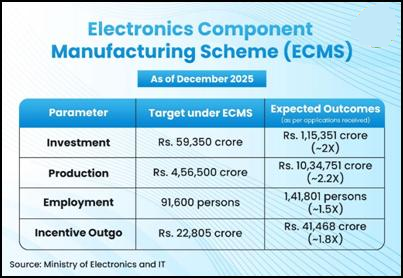
The Electronics Components Manufacturing Scheme was notified on 8 April 2025 with an initial outlay of ₹22,919 crore, a tenure of six years, and an optional one-year gestation period. The scheme aims to create a self-sustaining electronics component manufacturing ecosystem by attracting domestic and global investments, promoting higher domestic value addition, and integrating India into global electronics value chains. ECMS complements the India Semiconductor Mission (ISM) by strengthening upstream and downstream linkages in the electronics ecosystem. Its focus includes the domestic manufacturing of critical components, sub-assemblies, and raw materials. As of December 2025, expected investment commitments under ECMS stand at ₹1,15,351 crore, nearly double the original target. The scheme is projected to generate ₹10.34 lakh crore worth of production over six years, with an estimated incentive outgo of ₹41,468 crore. It is also expected to create 1.41 lakh direct jobs, significantly exceeding initial projections.
Approved Projects and Industrial Spread
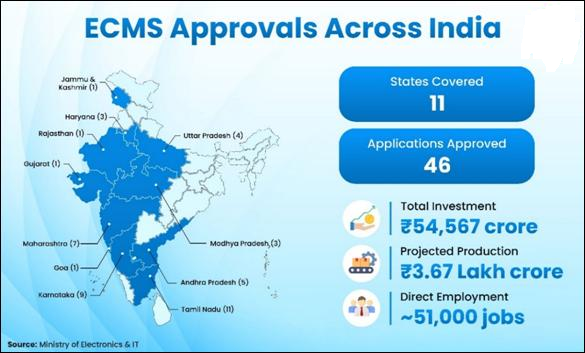
Since its launch, ECMS has received strong industry participation. A total of 46 projects across 11 states have been approved, involving cumulative investments of ₹54,567 crore and a projected production value of ₹3.67 lakh crore. These projects are expected to generate direct employment for around 51,000 workers.
The approved units will manufacture a wide range of components, including multi-layer PCBs, camera modules, connectors, oscillators, optical transceivers, and enclosures for mobile phones and IT hardware. Approvals have been granted in three tranches, with the third tranche alone accounting for the bulk of investments and employment, reflecting growing industry confidence.
Expected Outcomes in FY 2026–27
The scheme is expected to deliver tangible results in FY 2026–27 as approved projects become operational. By the end of the financial year, ECMS is projected to generate:
₹11,156 crore in investments
₹29,024 crore in production
19,240 new jobs
Complementary Government Initiatives
ECMS operates alongside a broader ecosystem of policy support for electronics manufacturing. The Production-Linked Incentive (PLI) Scheme, with an outlay of ₹1.97 lakh crore, has played a key role in attracting investment and boosting exports. Since FY 2020–21, India has received over USD 4 billion in FDI in electronics manufacturing, with nearly 70 per cent contributed by PLI beneficiaries. The Modified Electronics Manufacturing Clusters (EMC 2.0) scheme has strengthened manufacturing infrastructure by approving 11 EMC projects and 2 Common Facility Centres across 10 states, with a projected investment of ₹1.46 lakh crore and employment potential of 1.8 lakh jobs.
Conclusion
The Electronics Components Manufacturing Scheme has emerged as a cornerstone of India’s electronics manufacturing strategy. The enhanced outlay of ₹40,000 crore in Union Budget 2026–27 reflects a clear policy resolve to deepen domestic capabilities, strengthen value chains, and enhance export competitiveness. By mobilising large-scale investment, generating employment, and fostering technological capability, ECMS reinforces India’s emergence as a credible global hub for advanced electronics manufacturing and supports the broader goal of Atmanirbhar Bharat in high-technology sectors.
Best ias coaching in delhi Best ias coaching in chandigar
Prelims question:
Q. With reference to the Electronics Components Manufacturing Scheme (ECMS), consider the following statements:
1. ECMS aims to promote domestic manufacturing of electronic components and sub-assemblies to enhance value addition.
2. The scheme complements the India Semiconductor Mission by strengthening upstream and downstream linkages.
3. ECMS provides incentives only for final assembly of electronic goods.
4. The Union Budget 2026–27 enhanced the outlay of ECMS to ₹40,000 crore.
Which of the statements given above are correct?
A. 1, 2 and 4 only
B. 1 and 3 only
C. 2 and 4 only
D. 1, 2, 3 and 4
Answer:
Q. The Electronics Components Manufacturing Scheme (ECMS) marks a strategic shift in India’s electronics manufacturing policy. Discuss its objectives, expected outcomes, and its significance in strengthening India’s position in global electronics value chains. (250 words)

- RBI’s Shrinking Real-Rate Cushion Amid Rising Inflation and Strong Demand - September 21, 2026
- India’s NGOs at a New Funding Crossroads - September 21, 2026
- Deep-Sea Discovery, Environmental Responsibility - September 19, 2026

No Comments