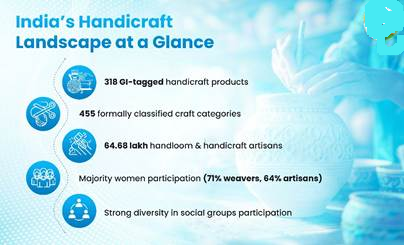
India’s handicraft sector is more than an economic activity; it is a living repository of the nation’s culture, tradition, and creativity. Predominantly located in rural and semi-urban areas, the sector provides livelihoods to millions of artisans, preserves centuries-old craft traditions, and contributes significantly to India’s export earnings. With 318 GI-tagged products and over 455 craft categories, Indian handicrafts showcase the country’s remarkable diversity and rich cultural heritage.
The Art Behind Handicrafts
Handicrafts are primarily handmade products that reflect aesthetic, ethnic, and cultural values. Unlike machine-produced items, each craft item is unique, carrying the skill and vision of its artisan. India’s artisans, even with minimal capital and small setups, add high value, making handicrafts a viable source of income. The sector is labour-intensive and decentralized, providing economic opportunities across the country and ensuring inclusive growth.
Cultural and Societal Significance
Handicrafts are an essential part of India’s cultural identity. Many craft traditions are passed down through generations, preserving historical techniques, motifs, and regional styles. Women, marginalized communities, and rural households form a significant portion of the artisan workforce, highlighting the sector’s role in social empowerment, gender inclusion, and livelihood generation.
National Handicrafts Week
Observed annually from December 8–14, this week celebrates artisans and their craft. Awards like the Shilp Guru Awards and National Handicrafts Awards recognize excellence, skill, and innovation, motivating artisans and promoting cultural pride.
Economic Importance and Livelihoods
India’s handicrafts sector employs an estimated 64.66 lakh artisans, with women constituting 64% of artisans and 71% of handloom weavers. The workforce is diverse, including SCs, STs, and OBCs, making the sector an engine of inclusive economic growth. Handicrafts provide supplemental income for agrarian households, especially during off-seasons, and allow home-based production, minimizing capital requirements.
The Pehchan Artisan Identification Programme has formalized over 32 lakh artisans, integrating nearly 20 lakh women into the economy and granting them access to government benefits, social security, and financial inclusion.
Exports and Global Reach
Handicrafts are a major contributor to India’s export economy. In FY 2024-25, exports (excluding hand-knotted carpets) reached ₹33,122.79 crore, up from ₹20,082.53 crore in 2014-15. Key export items include woodwares, art metal wares, handprinted textiles, embroidered goods, and imitation jewellery. The USA accounts for 37% of exports, with the remaining 61% serving major global markets. Steady growth reflects the global demand for authentic, handmade, and sustainable products.
Government Initiatives for Handicraft Promotion
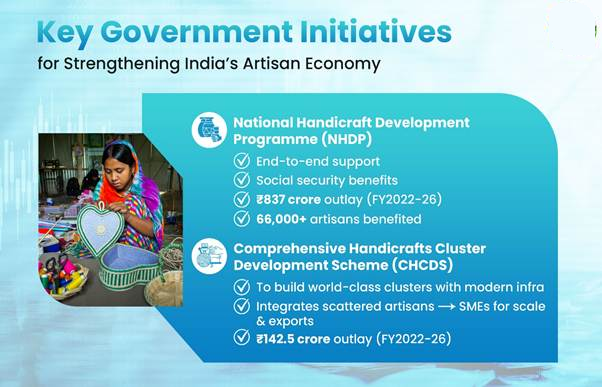
1. National Handicraft Development Programme (NHDP): Provides skill training, marketing support, infrastructure development, and social security for artisans.
2. Skill Development Initiatives: Programs like Guru Shishya Hastshilp Prashikshan transfer traditional knowledge, while comprehensive skill upgradation ensures market-ready artisans.
3. Comprehensive Handicraft Cluster Development Scheme (CHCDS): Creates modern infrastructure, advanced production units, and global market linkages.
4. SFURTI and Ambedkar Hastshilp Vikas Yojana: Empower artisans as entrepreneurs, integrating them into formal markets.
5. Market Access Platforms: Indie Haat, IITF exhibitions, ODOP promote visibility, connect artisans to national and international markets, and enhance trade opportunities.
6. Export Promotion Schemes: RoSCTL, RoDTEP, NiryatProtsahan, Niryat Disha reduce export costs and improve competitiveness.
Empowering Artisans and Inclusive Growth
Government interventions focus on skill enhancement, design innovation, and entrepreneurship, enabling artisans to meet evolving national and global market demands. Women and marginalized groups, forming a substantial part of the workforce, gain economic independence and social empowerment. Integration into formal markets ensures predictable income, better working conditions, and long-term sustainability.
Sustainability and Heritage Preservation
Handicrafts not only provide livelihoods but also preserve India’s intangible cultural heritage. By supporting GI-tagged products, the One District One Product (ODOP) initiative highlights regional crafts, promoting eco-friendly practices and sustainable production. This ensures that traditional knowledge continues to thrive while adapting to modern market needs.
Conclusion
India’s handicraft sector is a vital link between heritage, livelihoods, and economic growth. With a combination of skilled artisans, cultural richness, government support, and global demand, the sector is poised for sustained growth. It empowers women and marginalized communities, strengthens rural livelihoods, and enhances India’s global standing as a hub for authentic handmade products. By promoting inclusive growth, sustainable practices, and cultural preservation, India’s handicraft sector is not only safeguarding its rich heritage but also driving economic progress and social empowerment for generations to come.





No Comments