India’s Current Energy Landscape
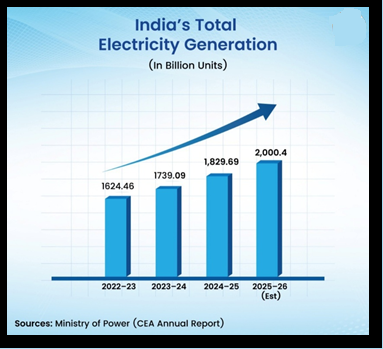
India is among the world’s top three energy consumers, and electricity demand continues to grow every year. The total electricity generation increased from 1,739.09 Billion Units (BU) in 2023–24 to 1,829.69 BU in 2024–25, a growth of 5.21%. For 2025–26, the generation target has been set at 2,000.4 BU.
At the same time, the power system has become more reliable. In June 2025, the energy-shortage levels were reported to be as low as 0.1 %. India’s meta peak demand of 241 GW with zero shortage highlights improved system resilience and better demand-supply management.
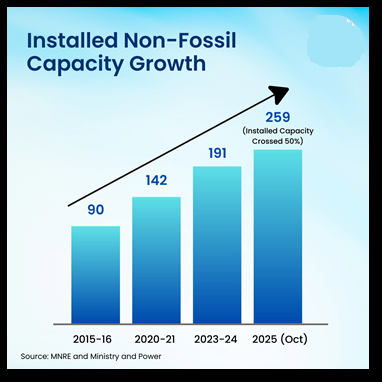
India’s energy mix is rapidly shifting toward cleaner sources. As of 31 October 2025, the country’s total installed generation capacity stands at 505 GW, of which non-fossil sources account for over 259 GW. This means that more than 50% of installed electricity capacity now comes from non-fossil sources such as solar, wind, hydro, and nuclear power. This evolving landscape shows that India is not only expanding access to energy but also moving toward a cleaner and more sustainable energy future.
Major Energy Conservation Initiatives in India
| Sector / Area |
Initiative / Scheme |
Key Features |
Significance / Impact |
| Industrial Energy Efficiency |
Carbon Credit Trading Scheme (CCTS) |
Market-based decarbonisation mechanism; assigns GEI targets to energy-intensive sectors; tradable Carbon Credit Certificates |
Promotes cost-effective emission reduction; links efficiency with climate goals; replaces PAT for major sectors (Dec 2025) |
|
Perform, Achieve and Trade (PAT) |
Mandatory energy-reduction targets for designated consumers; tradable ESCerts for over-achievement |
Laid foundation for industrial energy efficiency; enabled market-linked efficiency improvements |
| Household & MSME Efficiency |
Standards & Labelling (S&L) Programme |
Covers 28 appliances (17 mandatory); star-labelling informs consumers; promotes efficient manufacturing |
Reduces household energy demand; drives market transformation |
|
UJALA LED Programme (2015) |
Affordable LED distribution nationwide |
36.87 crore LEDs; major energy, cost, peak-load and CO₂ savings |
| Renewables & Distribution |
PM Surya Ghar Muft Bijli Yojana (2024) |
Rooftop solar for 1 crore households; up to 300 free units/month; outlay ₹75,021 crore |
Lowers household bills; promotes decentralised clean energy |
|
Revamped Distribution Sector Scheme (RDSS) |
DISCOM reforms; smart metering; loss reduction |
4.76 crore smart meters installed; improves efficiency of power distribution |
| Buildings |
ECBC / ECSBC |
Minimum energy-efficiency standards for commercial buildings; sustainability focus |
Reduces long-term electricity demand; improves building performance |
|
Eco Niwas Samhita (2018) |
Residential building code; efficient design, insulation and ventilation |
Enhances thermal comfort; lowers residential energy use |
| Digital & Institutional Frameworks |
National Mission on Enhanced Energy Efficiency (NMEEE) |
Umbrella mission covering PAT, MTEE, EEFP, FEEED |
Strengthens institutional architecture for energy efficiency |
|
Urja Dakshata Information Tool (UDIT) |
Digital platform for energy-use and savings data |
Enables data-driven policy and monitoring |
|
LiFE (Lifestyle for Environment) |
Behavioural change for responsible consumption |
Complements technological efficiency with public participation |
| Public Participation & Awareness |
National Energy Conservation Awards (NECA) |
Annual awards since 1991 on 14 December |
Incentivises best practices across sectors |
|
National Energy Efficiency Innovation Awards (NEEIA) |
Recognises innovative efficiency solutions (since 2021) |
Encourages R&D and innovation |
|
National Painting Competition on Energy Conservation |
Nationwide student outreach at school, state and national levels |
Builds early awareness and energy-saving culture |
India’s Global Engagement on Energy Efficiency and Climate Action
In 2024, India formally joined the International Energy Efficiency Hub, a global platform that brings together governments, international organisations, and private stakeholders to promote energy-efficient technologies and best practices. This move reflects India’s intent to align its domestic energy-efficiency initiatives with global standards while sharing its own experiences with developing countries.
Under the United Nations Framework Convention on Climate Change (UNFCCC), countries are required to design nationally appropriate energy-transition pathways. India has articulated a balanced approach that reconciles rapid economic growth with long-term climate responsibility. It has committed to achieving net-zero emissions by 2070 and, under its 2030 Nationally Determined Contributions (NDCs), has pledged to reduce the emissions intensity of GDP by 45%, ensure 50% of installed power capacity from non-fossil sources, create an additional carbon sink of 2.5–3 billion tonnes of CO₂ equivalent, promote sustainable lifestyles through the LiFE movement, and strengthen resilience in climate-vulnerable sectors.
Through these commitments, India has emerged as a leading voice of the Global South, consistently advocating affordable clean energy, equitable climate finance, and access to technology in line with the principles of equity and common but differentiated responsibilities. During its G20 Presidency, India advanced global cooperation on clean fuels and energy transitions, including the launch of the Global Biofuels Alliance (GBA). The alliance has since expanded to 25 countries and 12 international organisations, bringing together major producers, consumers, and multilateral institutions to accelerate the adoption of affordable, low-carbon biofuels.
ISA 2025: Expanding Global Solar Leadership
In 2025, India hosted the 8th ISA Assembly in New Delhi, attended by over 125 Member and Signatory countries, 550 delegates, and 30+ ministers, underscoring the alliance’s growing global relevance. Several new initiatives were launched, including SUNRISE for solar recycling and circularity, One Sun One World One Grid (OSOWOG) to promote cross-border solar grid integration, a Solar Procurement Platform for Small Island Developing States (SIDS) developed with the World Bank, and a Global Capability Centre (GCC) to strengthen innovation, training, and capacity-building. ISA also advanced its “Towards 1000” strategy, aiming to mobilise USD 1 trillion in solar investments by 2030 and support the deployment of 1,000 GW of solar capacity across member countries.
Beyond ISA, India actively participates in global platforms such as the Coalition for Disaster Resilient Infrastructure (CDRI), Mission Innovation, and partnerships with the International Renewable Energy Agency (IRENA) to support clean-energy innovation and resilience building. According to the IRENA Renewable Energy Statistics 2025, India ranks third globally in solar energy, fourth in wind energy, and fourth in total installed renewable energy capacity, reflecting its rapid progress in renewable deployment.
The Road Ahead: Energy Conservation, Net Zero and Viksit Bharat
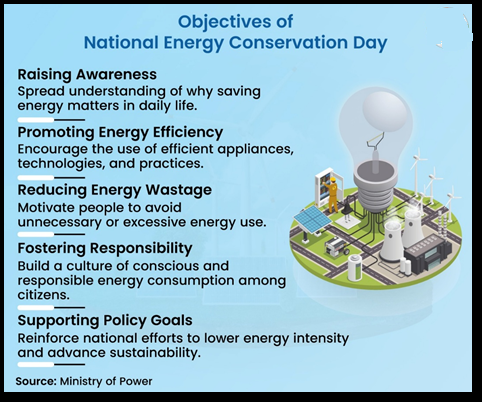
Energy conservation remains a cornerstone of India’s climate and development strategy, with the Bureau of Energy Efficiency (BEE) playing a central role. Through initiatives such as Standards & Labelling, PAT/CCTS, building energy codes, NECA and NEEIA awards, energy audits, state partnerships, and mass public campaigns, BEE is embedding efficiency into everyday decision-making. Its awareness efforts—from school-level painting competitions to national-level recognition programmes—reinforce the message that every unit of energy saved contributes to national progress.
As India observes National Energy Conservation Day, the way forward is clear: energy conservation is not merely a technical requirement but a shared civic responsibility. Coordinated action by the government, industry, institutions, and citizens is essential to build an efficiency-driven culture that supports India’s 2030 climate commitments, its net-zero 2070 goal, and the long-term vision of Viksit Bharat.
Conclusion
India’s observance of National Energy Conservation Day highlights that energy efficiency and conservation are no longer optional policy choices but essential pillars of sustainable development. As electricity demand rises alongside economic growth, conserving energy offers the most cost-effective and environmentally responsible pathway to ensure energy security, reduce emissions, and enhance system resilience. India’s progress—reflected in a cleaner energy mix, declining shortages, and strong institutional mechanisms—demonstrates that efficiency-led growth is both feasible and impactful. Going forward, the combined efforts of the government, BEE, industry, states, and citizens must deepen this efficiency culture through technology adoption, behavioural change, and global cooperation.
Prelims question:
Q. With reference to energy conservation initiatives in India, consider the following statements:
1. National Energy Conservation Day is observed on 14 December to promote awareness about efficient use of energy resources.
2. The Carbon Credit Trading Scheme (CCTS) assigns Greenhouse Gas Emission Intensity (GEI) targets to energy-intensive industries.
3. The UJALA LED programme is implemented by the Ministry of New and Renewable Energy.
4. Eco Niwas Samhita focuses on improving energy efficiency in residential buildings.
Which of the statements given above are correct?
(a) 1, 2 and 4 only
(b) 1, 3 and 4 only
(c) 2 and 3 only
(d) 1, 2, 3 and 4
Answer: A





No Comments