


06 Dec Export Promotion Mission (EPM): A Unified, Technology-Driven Push for India’s Export Competitiveness
This article covers “Daily Current Affairs” and From Export Promotion Mission (EPM): A Unified, Technology-Driven Push for India’s Export Competitiveness
SYLLABUS MAPPING
GS-3 – Indian Economy- Export Promotion Mission (EPM): A Unified, Technology-Driven Push for India’s Export Competitiveness
FOR PRELIMS
What is the Export Promotion Mission (EPM)?
FOR MAINS
Why has the Government of India introduced the Export Promotion Mission (EPM)?
Why in the News?
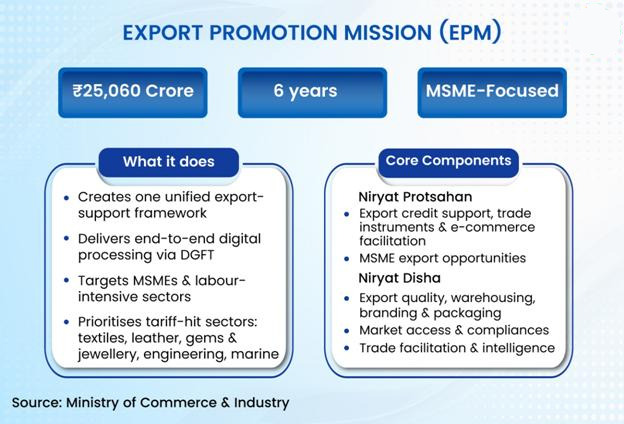
The Export Promotion Mission (EPM) is in the news because the Government of India, through the Union Budget 2025–26, has approved a major structural reform aimed at boosting India’s export competitiveness. With an outlay of ₹25,060 crore for 2025–26 to 2030–31, the Mission consolidates multiple export-support schemes into a single, digitally integrated, outcome-driven framework. It focuses on strengthening MSME participation, improving access to affordable trade finance, expanding India’s presence in global value chains, and enhancing market readiness for exporters across sectors. EPM is expected to play a pivotal role in achieving India’s long-term export targets and generating employment.
Why a Mission?
India’s export ecosystem has historically been supported through a set of targeted interventions such as interest equalisation schemes, market access initiatives, export-linked incentives, and infrastructure development programmes. However, these efforts have often operated in silos. The Export Promotion Mission (EPM) seeks to consolidate and scale these interventions by addressing structural drivers of export competitiveness—affordable trade finance, support for compliance with global quality and sustainability standards, coordinated export branding, market-access facilitation, and reduction of logistics disadvantages, particularly for MSMEs, first-time exporters and firms located in interior regions.
Recent export trends, including sectoral volatility and rising global non-tariff barriers, highlight the need for a digitally enabled, unified, and outcome-driven support system that can respond swiftly to global shifts and strengthen competitiveness across both merchandise and services exports.
By merging multiple schemes into a single digitally managed architecture, the EPM aims to deliver streamlined, transparent and responsive support. The Mission enables better coordination, reduced duplication, greater policy predictability, and real-time monitoring, aligning India’s export promotion strategy with evolving global value chains and international trade conditions.
Structure, Governance and Financing
The Export Promotion Mission will operate for six years (FY 2025–26 to FY 2030–31) with a total financial outlay of ₹25,060 crore. Its institutional design integrates central ministries, state governments and industry bodies to ensure collaborative implementation.
1. Department of Commerce: Nodal Ministry responsible for strategic direction and policy convergence.
2. DGFT: Core implementing agency, managing a dedicated digital platform for end-to-end workflows—application, approval, monitoring and disbursal—seamlessly integrated with customs and trade systems.
3. Ministry of MSME & Ministry of Finance: Support credit access, guarantee mechanisms, and MSME-led export initiatives.
4. Export Promotion Councils, Commodity Boards & Industry Associations: Provide sector insights, market intelligence, and handholding for exporters.
5. State Governments: Key partners for regional export hubs, logistics improvements, and last-mile facilitation.
Two Integrated Sub-Schemes of the Export Promotion Mission (EPM)
| Sub-Scheme | Type of Support | Key Features / Interventions | Purpose / Impact |
|---|---|---|---|
| Niryat Protsahan | Financial Enablers | • Interest subvention on pre- & post-shipment credit • Export factoring & deep-tier financing • Credit cards for e-commerce exporters • Collateral support & credit-enhancement for new/high-risk markets |
• Reduce borrowing costs & liquidity constraints • Facilitate MSMEs & first-time exporters • Expand production & global competitiveness |
| Niryat Disha | Non-Financial Enablers | • Export quality & compliance support (testing, certification, audits) • Branding, packaging & international marketing assistance • Participation in trade fairs, buyer-seller meets, promotional campaigns • Export warehousing, logistics & inland transport reimbursements • Capacity-building at clusters, associations & district facilitation centers |
• Improve market readiness & competitiveness • Strengthen institutional & skill support • Enable efficient scaling and global market integration |
Q. With reference to the Export Promotion Mission (EPM), consider the following statements:
1. The Mission consolidates multiple export-support schemes into a single, digitally integrated architecture managed by DGFT.
2. Niryat Protsahan provides non-financial enablers such as branding and marketing assistance to exporters.
3. The Credit Guarantee Scheme for Exporters (CGSE) under EPM offers 100% guarantee coverage for collateral-free credit to eligible MSME exporters.
4. EPM aims to support both merchandise and services exports with a sectoral–regional focus, particularly benefiting interior districts.
Which of the above statements are correct?
(a) 1 and 3 only
(b) 1, 2 and 3 only
(c) 1, 3 and 4 only
(d) 1, 2, 3 and 4
Answer: C
Mains Question:
Q. The Government of India has launched the Export Promotion Mission (EPM) as a major structural reform to strengthen export competitiveness. Discuss the policy rationale behind the Mission, its core components and governance structure, and evaluate how it is expected to enhance India’s export performance. (250 words)

- RBI’s Shrinking Real-Rate Cushion Amid Rising Inflation and Strong Demand - September 21, 2026
- India’s NGOs at a New Funding Crossroads - September 21, 2026
- Deep-Sea Discovery, Environmental Responsibility - September 19, 2026

No Comments