


28 Jul FAME-II Scheme: ₹912.5 Cr Allocated for EV Charging Stations Nationwide
Subject Relevance — Where This Topic Fits
- GS Paper III — Infrastructure: Energy, Transport
- Prelims: FAME-II Scheme, EV Charging Infrastructure, Oil Marketing Companies (OMCs), PM e-DRIVE Scheme, Electric Mobility Promotion
- Essay: India’s Transition to Electric Mobility: Challenges and Opportunities
Quick Revision: FAME-II, launched under NEMMP 2020, incentivises EV adoption and charging infrastructure deployment with a ₹10,000 crore outlay, extended to 2024, and implemented by the Department of Heavy Industry.
Why is this in the news?
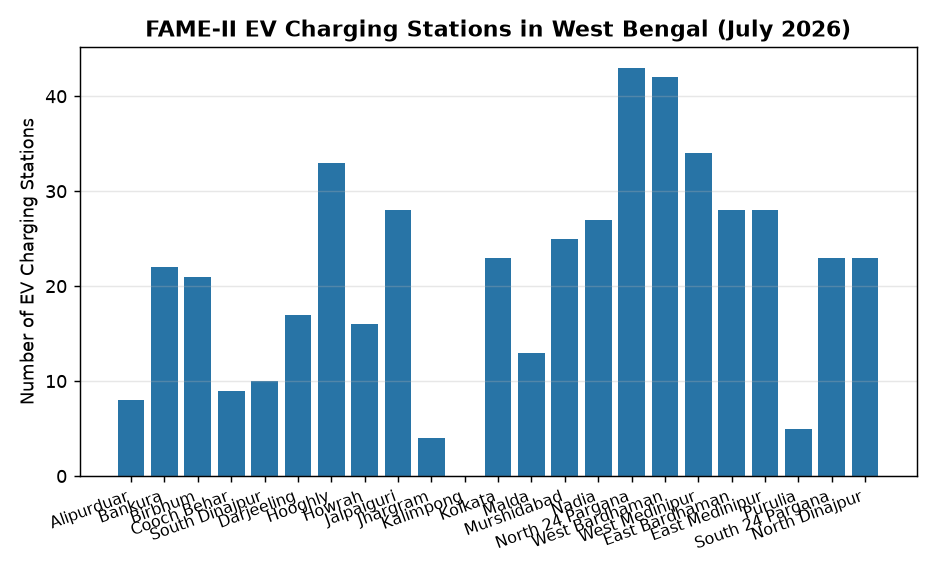
The Press Information Bureau (PIB) released an official statement on 28 July 2026 detailing the allocation of ₹912.50 crore under the FAME-II scheme for the establishment of public electric vehicle (EV) charging stations across India. The release also highlighted the progress of West Bengal, where 482 charging stations have been sanctioned under FAME-II, with 463 operational as of 1 July 2026. Additionally, the PM e-DRIVE scheme’s role in EV infrastructure development was mentioned, including the submission of a proposal for five new charging stations in South 24 Parganas district.
Background
- The Faster Adoption and Manufacturing of Hybrid and Electric Vehicles (FAME-II) scheme, launched in April 2019, is a flagship initiative under the National Electric Mobility Mission Plan (NEMMP) 2020, aimed at promoting the adoption of electric vehicles (EVs) in India.
- FAME-II provides financial incentives for the deployment of EV charging infrastructure, with a total budgetary outlay of ₹10,000 crore over three years (2019–2022), later extended to 2024.
- The scheme is implemented by the Department of Heavy Industry (DHI), Ministry of Heavy Industries and Public Enterprises, and focuses on incentivising the purchase of EVs and setting up charging stations.
- Public charging infrastructure is critical for addressing range anxiety among EV users and accelerating the transition to electric mobility in India.
- Oil Marketing Companies (OMCs) such as Indian Oil Corporation Limited (IOCL), Bharat Petroleum Corporation Limited (BPCL), and Hindustan Petroleum Corporation Limited (HPCL) play a key role in deploying EV charging stations across the country.
What is the FAME-II Scheme?
- FAME-II is a demand-side incentive scheme under the National Electric Mobility Mission Plan (NEMMP) 2020, launched by the Government of India to promote the adoption of electric and hybrid vehicles in the country.
- The scheme provides financial incentives for the purchase of electric vehicles, including two-wheelers, three-wheelers, electric and hybrid cars, and buses, with higher incentives for vehicles equipped with advanced batteries.
- FAME-II also supports the deployment of public charging infrastructure, with a focus on creating a robust network of charging stations across urban, semi-urban, and rural areas to facilitate the widespread adoption of EVs.
- The scheme operates on a credit-based mechanism, where manufacturers or buyers of EVs receive incentives based on the number of EVs sold and the type of technology used.
- FAME-II has been extended beyond its original timeline (2019–2022) to 2024, with a total budgetary allocation of ₹10,000 crore to ensure sustained growth in the EV ecosystem.
- The scheme is implemented by the Department of Heavy Industry (DHI), Ministry of Heavy Industries and Public Enterprises, in collaboration with state governments, OMCs, and private sector stakeholders.
- FAME-II aims to reduce vehicular emissions, improve energy security, and position India as a global leader in electric mobility by fostering indigenous manufacturing and innovation in the EV sector.
- The scheme also includes provisions for pilot projects, awareness campaigns, and skill development initiatives to support the transition to electric mobility.
Key Features
| Feature | Significance |
|---|---|
| Allocation under FAME-II | A centralised corpus of ₹912.50 crore for public EV charging infrastructure, demonstrating Union Government’s commitment to accelerate EV adoption under the broader National Electric Mobility Mission Plan (NEMMP) 2020. |
| State-agnostic allocation | Funds are not earmarked for individual states; instead, they are deployed through centrally-sponsored schemes, ensuring uniformity in implementation while allowing flexibility in deployment based on demand and feasibility. |
| Role of Oil Marketing Companies (OMCs) | BPCL, IOCL, and HPCL are designated nodal agencies for FAME-II, leveraging their existing retail infrastructure to establish and operate public EV charging stations, thereby reducing logistical overheads. |
| PM-eDrive Scheme complementarity | The ₹2,000 crore allocation under PM-eDrive provides additional impetus, targeting high-impact zones such as West Bengal, where specific districts like South 24 Parganas are prioritised for EV charging infrastructure. |
| Licence-free EVCS establishment | The regulatory framework permits private entities and individuals to install, operate, and maintain EV charging stations without requiring a licence, fostering market-driven expansion of charging networks. |
Why it Matters
Economic and Industrial
- Stimulates demand for electric vehicles by reducing range anxiety, thereby supporting the automotive sector’s transition to cleaner technologies and aligning with India’s commitment to reduce vehicular emissions under COP26.
Environmental
- Reduces carbon footprint of the transport sector by promoting the use of electricity over fossil fuels, contributing to India’s Nationally Determined Contributions (NDCs) under the Paris Agreement.
Energy Security
- Diversifies energy sources for mobility, reducing dependence on imported petroleum products and enhancing energy resilience.
Urban Mobility
- Supports the development of smart cities by integrating EV charging infrastructure into urban planning, thereby improving air quality and reducing congestion.
Employment Generation
- Creates jobs in manufacturing, installation, maintenance, and operation of EV charging stations, as well as in ancillary sectors such as battery recycling and renewable energy integration.
Challenges
1. Grid Integration and Power Demand
- High penetration of EV charging stations may strain local power grids, particularly in regions with limited grid capacity or unreliable power supply.
- Solution: Requires coordinated planning with state electricity boards and adoption of smart grid technologies to manage peak demand.
UPSC Link: GS-III: Energy
2. Interoperability and Standardisation
- Lack of uniform charging standards across manufacturers can lead to compatibility issues, limiting consumer choice and increasing costs.
- Solution: Adherence to Bharat EV Charger Standards (BECS) and AIS-138 to ensure interoperability.
UPSC Link: GS-III: Science & Tech
3. Geographical Disparities
- Uneven distribution of charging infrastructure, particularly in rural and remote areas, exacerbates the urban-rural divide in EV adoption.
- Solution: Targeted deployment in underserved regions through schemes like PM-eDrive and state-level incentives.
UPSC Link: GS-II: Governance
4. Financial Viability
- High capital expenditure for charging infrastructure may deter private investment, particularly in low-traffic areas.
- Solution: Public-private partnerships (PPPs) and viability gap funding to enhance investor confidence.
UPSC Link: GS-III: Economy
5. Land Acquisition and Regulatory Hurdles
- Delays in land acquisition and regulatory clearances for charging stations can slow down project implementation.
- Solution: Streamlined approval processes and single-window clearance mechanisms at state and central levels.
UPSC Link: GS-II: Governance
6. Battery Waste Management
- Increased EV adoption necessitates robust battery recycling and waste management frameworks to prevent environmental hazards.
- Solution: Implementation of Extended Producer Responsibility (EPR) policies and investment in recycling infrastructure.
UPSC Link: GS-III: Environment
Challenges — UPSC Perspective
| Issue | Concern |
|---|---|
| Grid Integration | Potential overloading of local power grids due to high EV charging demand, particularly during peak hours. |
| Standardisation | Lack of uniform charging protocols leading to compatibility issues across EV models and charging stations. |
| Geographical Disparities | Concentration of charging infrastructure in urban areas, leaving rural regions underserved. |
| Financial Viability | High upfront costs for charging infrastructure may deter private sector participation. |
| Regulatory Delays | Lengthy approval processes for land acquisition and installation of charging stations. |
| Battery Waste | Inadequate recycling infrastructure for lithium-ion batteries, posing environmental risks. |
Government Initiatives — Must-Memorise for Prelims
- Faster Adoption and Manufacturing of Hybrid and Electric Vehicles (FAME-II) Scheme
Way Forward
- Strengthen grid infrastructure through smart grid technologies and demand-side management to accommodate increased EV charging load.
- Enforce Bharat EV Charger Standards (BECS) and AIS-138 to ensure interoperability and consumer convenience.
- Adopt a phased deployment strategy, prioritising high-traffic corridors, urban centres, and underserved rural districts.
- Promote public-private partnerships to enhance financial viability and accelerate infrastructure expansion.
- Establish a single-window clearance mechanism for charging station approvals to reduce regulatory delays.
- Develop a national battery recycling policy under Extended Producer Responsibility (EPR) to manage end-of-life EV batteries.
- Integrate EV charging infrastructure planning with renewable energy projects to enhance sustainability.
- Conduct periodic reviews of FAME-II and PM-eDrive to assess impact and reallocate resources based on emerging needs.
UPSC Value Addition
Keywords for Mains Answer-Writing
FAME-II Scheme · Electric Vehicle (EV) Charging Infrastructure · Public Electric Vehicle Charging Stations (EVPCS) · Oil Marketing Companies (OMCs) · Bharat Petroleum Corporation Limited (BPCL) · Indian Oil Corporation Limited (IOCL) · Hindustan Petroleum Corporation Limited (HPCL) · PM e-DRIVE Scheme · Bharat Heavy Electricals Limited (BHEL) · EV Ecosystem Development · Fiscal Allocation for EV Infrastructure · State-wise EV Charging Station Distribution · Licence-free EV Charging Activity · Sustainable Mobility · Decarbonisation of Transport Sector
Concept Flow
India’s commitment to reduce vehicular emissions under COP26 and NDCs → Launch of FAME-II and PM-eDrive schemes → Allocation of ₹912.50 crore and ₹2,000 crore for EV charging infrastructure → Deployment of charging stations by OMCs and private entities → Increased EV adoption → Reduction in fossil fuel dependence → Enhanced energy security and environmental sustainability → Job creation in allied sectors → Contribution to India’s climate goals and sustainable development.
Prelims Practice Questions
Q1. Which of the following is NOT a key objective of the FAME-II Scheme?
- Promotion of electric and hybrid vehicles
- Establishment of public charging infrastructure
- Direct financial allocation to state governments for EV adoption
- Incentivisation of electric buses and three-wheelers
Answer: Direct financial allocation to state governments for EV adoption — The FAME-II Scheme, under the Faster Adoption and Manufacturing of Hybrid and Electric Vehicles (FAME) programme, focuses on demand incentives, charging infrastructure, and support for electric buses and three-wheelers. However, it does not provide direct financial allocations to state governments; funds are allocated centrally for nationwide deployment.
Q2. Under the PM e-DRIVE Scheme, which public sector entity is responsible for implementing EV charging infrastructure projects?
- NITI Aayog
- Bharat Heavy Electricals Limited (BHEL)
- National Thermal Power Corporation (NTPC)
- Energy Efficiency Services Limited (EESL)
Answer: Bharat Heavy Electricals Limited (BHEL) — The PM e-DRIVE Scheme, aimed at accelerating the adoption of electric vehicles, designates Bharat Heavy Electricals Limited (BHEL) as the project implementation agency for EV charging infrastructure development.
Q3. Which of the following statements regarding EV charging stations in India is correct?
- Establishment of EV charging stations requires a mandatory licence from the central government.
- Private entities are prohibited from setting up EV charging stations in India.
- EV charging station installation is a licence-free activity in India.
- Only oil marketing companies can establish EV charging stations.
Answer: EV charging station installation is a licence-free activity in India. — As per the Electric Vehicle Charging Guidelines and Standards issued by the Ministry of Power, the establishment of EV charging stations is a licence-free activity in India. Any entity, including private players, can set up, operate, and maintain EV charging stations without requiring a licence.
Q4. The FAME-II Scheme allocates funds for the establishment of public EV charging stations. What is the total financial outlay for this purpose?
- ₹500 crore
- ₹912.50 crore
- ₹2,000 crore
- ₹10,000 crore
Answer: ₹912.50 crore — The FAME-II Scheme, launched under the Faster Adoption and Manufacturing of Hybrid and Electric Vehicles (FAME) programme, has allocated ₹912.50 crore for the establishment of public EV charging stations across the country.
Mains Practice Question
✍ Critically examine the role of public-private partnerships (PPPs) in accelerating the deployment of electric vehicle (EV) charging infrastructure in India. Analyse the challenges and suggest measures to enhance the effectiveness of such partnerships in achieving the country’s decarbonisation goals in the transport sector.
Approach: Begin by outlining the significance of EV charging infrastructure for India’s decarbonisation and the role of PPPs in bridging the resource and technological gaps. Discuss the current institutional framework, including schemes like FAME-II and PM e-DRIVE, and the involvement of Oil Marketing Companies (OMCs) and entities like BHEL. Highlight challenges such as regulatory ambiguities, financial viability, and uneven state-wise distribution of charging stations (e.g., West Bengal’s district-wise disparities). Suggest measures like streamlining approval processes, incentivising private participation through viability gap funding, leveraging state-level policies, and ensuring grid stability for large-scale EV adoption. Conclude by emphasising the need for a cohesive national strategy to align PPP efforts with India’s net-zero ambitions.
Source: PIB (Press Information Bureau)
Generated by AanyaAi for educational purpose.

- तमिलनाडु के लिए क्या है ‘एल नीनो’ और उत्तर-पूर्वी मानसून का खतरा? - September 23, 2026
- El Nino & Northeast Monsoon: Impact on Tamil Nadu for UPSC 2026 - September 23, 2026
- हिमाचल में डिजिटल भुगतान क्रांति: बिलासपुर अव्वल, महिलाओं की भागीदारी 93% तक पहुंची - September 23, 2026

No Comments