


28 Jul FAME India Phase-II: ₹11,500 Cr Boost for EV Adoption & Manufacturing
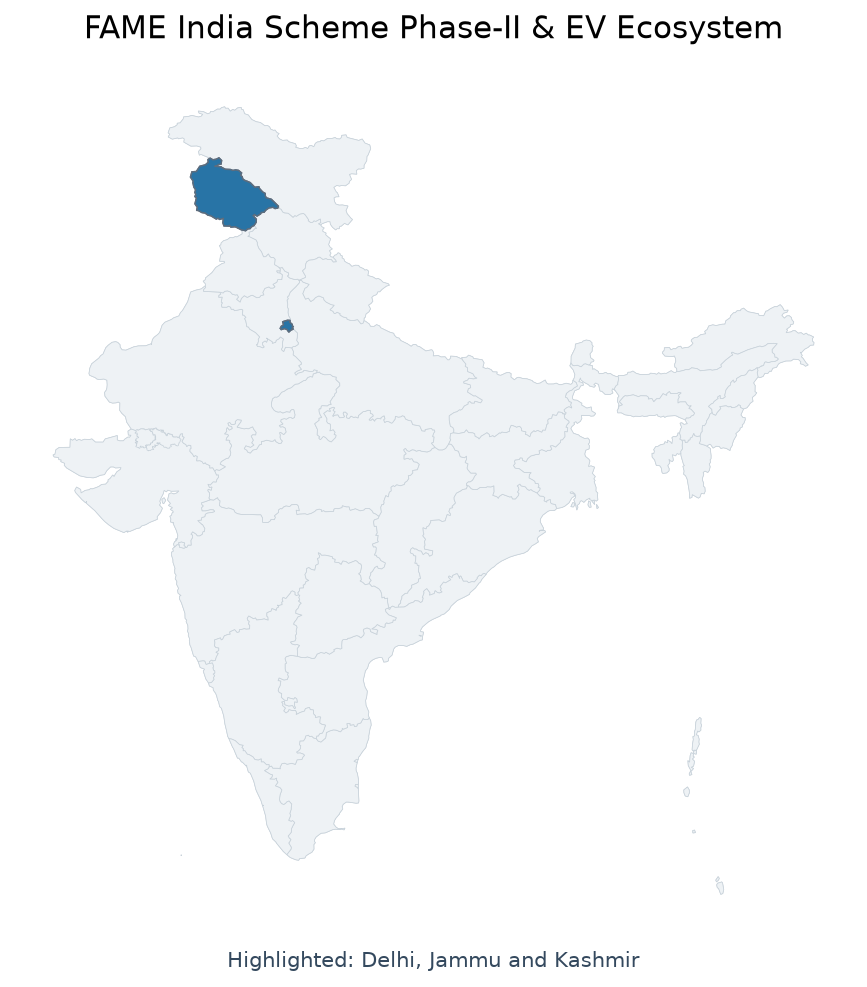
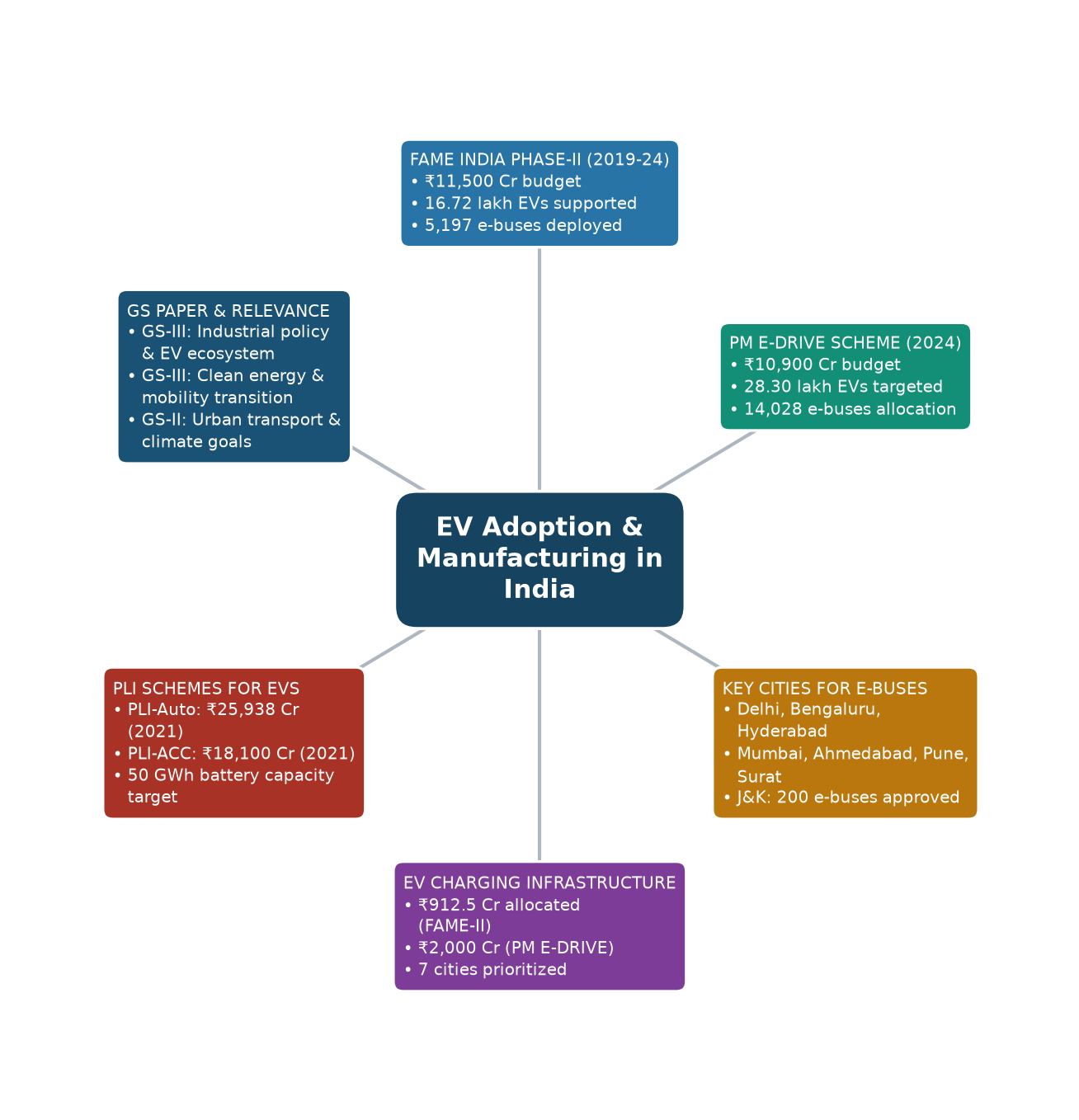
Map & concept mind-map: FAME India Scheme Phase-II & EV Ecosystem
Subject Relevance — Where This Topic Fits
- GS Paper III — Economy: Infrastructure, Investment Models, Government Budgeting and Policies | GS Paper III — Environment: Climate Change and Sustainable Development | GS Paper III — Science and Technology: Indigenous Technology Development and Manufacturing
- Prelims: FAME India Scheme, PLI Scheme for Automobiles and ACC Batteries, PM E-DRIVE Scheme, EV Public Charging Infrastructure, GST on Electric Vehicles, Battery Swapping Policy, National Electric Mobility Mission Plan (NEMMP) 2020, Production Linked Incentive (PLI) Scheme, Domestic Value Addition (DVA), Gigafactories
- Essay: The Role of Government Policies in Accelerating India’s Transition to Electric Mobility: A Case Study of FAME India and PLI Schemes, Balancing Economic Growth and Environmental Sustainability: India’s Approach to Electric Vehicle Adoption
Quick Revision: FAME India Phase-II (2019–2024) is a demand-side incentive scheme with ₹11,500 crore outlay, supporting 16.72 lakh EVs and 5,197 electric buses, while also promoting public charging infrastructure to accelerate India’s transition to electric mobility.
Why is this in the news?
The Government of India’s Ministry of Heavy Industries has reaffirmed the continuation of the Faster Adoption and Manufacturing of Hybrid and Electric Vehicles (FAME) India Scheme Phase-II, with a total budgetary outlay of ₹11,500 crore from 01 April 2019 to 31 March 2024. This scheme, along with complementary initiatives such as the Production Linked Incentive (PLI) Scheme for Automobiles and Advanced Chemistry Cell (ACC) Batteries, the पीएम इलेक्ट्रिक ड्राइव रिवोल्यूशन इन इनोवेटिव व्हीकल एन्हांसमेंट (पीएम ई-ड्राइव) योजना, and the पीएम ई-बस सेवा-भुगतान सुरक्षा तंत्र (पीएसएम) योजना, underscores India’s strategic commitment to reducing vehicular emissions, enhancing energy security, and fostering indigenous manufacturing of electric vehicles (EVs) and their components. The policy framework is particularly significant in the context of India’s climate commitments under the Paris Agreement and the broader global shift towards sustainable transportation.
Background
- India’s transport sector accounts for approximately 18% of the country’s total energy-related CO₂ emissions, with road transport being the dominant contributor, necessitating urgent policy interventions to decarbonise the sector.
- The FAME India Scheme was introduced in 2015 to provide demand-side incentives for the adoption of electric and hybrid vehicles, as well as supply-side support for the development of charging infrastructure.
- The scheme has evolved through two phases: FAME India Phase-I (2015–2019) and FAME India Phase-II (2019–2024), with the latter focusing on scaling up the deployment of electric two-wheelers (E-2W), three-wheelers (E-3W), four-wheelers (E-4W), electric buses, and charging infrastructure.
- Complementary to FAME India, the Production Linked Incentive (PLI) Scheme for Automobiles and Advanced Chemistry Cell (ACC) Batteries, launched in 2021, aims to incentivise domestic manufacturing of advanced automotive technologies and battery storage solutions.
What is the FAME India Scheme Phase-II and how does it integrate with India’s broader electric mobility policy framework?
- The Faster Adoption and Manufacturing of Hybrid and Electric Vehicles (FAME) India Scheme Phase-II is a demand-side incentive scheme launched by the Ministry of Heavy Industries on 01 April 2019 with a total budgetary outlay of ₹11,500 crore, operational until 31 March 2024.
- The scheme provides financial incentives for the purchase of electric two-wheelers (E-2W), three-wheelers (E-3W), four-wheelers (E-4W), and electric buses, as well as for the establishment of public charging infrastructure (EVPCS) across the country.
- Under FAME India Phase-II, approximately 16.72 lakh electric vehicles (EVs) have been supported, including 5,197 electric buses deployed as of 30 June 2026, and ₹912.50 crore allocated for the establishment of public charging stations.
- The scheme categorises incentives based on vehicle type and battery capacity, with higher incentives for vehicles with larger battery packs to encourage the adoption of higher-range electric vehicles.
- FAME India Phase-II is complemented by other government initiatives such as the Production Linked Incentive (PLI) Scheme for Automobiles and Advanced Chemistry Cell (ACC) Batteries, which incentivises domestic manufacturing of electric vehicles and battery storage solutions.
- The scheme is a critical component of India’s strategy to reduce vehicular emissions, enhance energy security, and achieve its climate commitments under the Paris Agreement.
Key Features
| Feature | Significance |
|---|---|
| Demand Incentives for EVs (E-2W, E-3W, E-4W) | Reduces upfront cost for consumers, accelerating EV adoption and market penetration. |
| Subsidy for Public Charging Infrastructure (EVPCS) | Addresses range anxiety by expanding charging network, critical for inter-city and urban mobility. |
| Deployment of 5,197 Electric Buses (as of 30.06.2026) | Supports decarbonisation of public transport and reduces urban air pollution. |
| Budgetary Allocation of ₹11,500 crore (FAME-II) | Ensures sustained financial support for demand-side and supply-side interventions over five years. |
| Integration with PLI Schemes (Auto & ACC Batteries) | Fosters domestic manufacturing ecosystem, reducing import dependence in critical EV components. |
Why it Matters
Economic
- Reduces India’s import bill for crude oil by substituting fossil-fuel-based vehicles with domestically manufactured EVs.
- Creates employment in manufacturing, R&D, and after-sales service sectors, particularly in tier-2/3 cities.
- Stimulates ancillary industries (battery packs, motors, power electronics) and local supply chains.
- Enhances India’s position in global EV supply chains, aligning with ‘Make in India’ and ‘Atmanirbhar Bharat’ objectives.
Environmental
- Contributes to India’s Nationally Determined Contributions (NDCs) under the Paris Agreement by reducing transport-sector emissions.
- Lowers urban particulate matter and NOx emissions, improving public health outcomes.
- Supports India’s goal of achieving 30% EV penetration by 2030 in the road transport sector.
Strategic
- Reduces dependence on imported lithium-ion batteries by incentivizing domestic battery manufacturing (via PLI-ACC scheme).
- Strengthens energy security by diversifying fuel sources and reducing reliance on fossil fuels.
- Positions India as a leader in the Global South for sustainable mobility solutions.
Social
- Improves last-mile connectivity in peri-urban and rural areas through subsidised e-rickshaws and e-buses.
- Promotes inclusive mobility by making public transport more affordable and accessible.
- Encourages skill development in EV technology, charging infrastructure, and maintenance.
Challenges
1. High Upfront Cost of EVs
- Despite subsidies, the initial purchase price of EVs remains higher than ICE vehicles, deterring price-sensitive consumers.
- Limited availability of affordable EV models in the 2W and 3W segments restricts mass adoption.
UPSC Link: GS3: Energy, Environment
2. Charging Infrastructure Gaps
- Uneven distribution of public charging stations, with urban centres overserved and rural areas underserved.
- Slow adoption of fast-charging standards and interoperability issues between charging networks.
- High electricity tariffs in some states discourage private investment in charging infrastructure.
UPSC Link: GS3: Infrastructure
3. Battery Supply Chain Bottlenecks
- Dependence on imported lithium, cobalt, and nickel for battery manufacturing exposes India to geopolitical and price volatility risks.
- Limited domestic recycling infrastructure for end-of-life EV batteries, raising environmental concerns.
- High cost of advanced battery chemistries (e.g., solid-state) limits scalability.
UPSC Link: GS3: Science & Tech
4. Policy Implementation Gaps
- Overlap and fragmentation between FAME-II, PLI schemes, and state-level EV policies create administrative complexities.
- Lack of a unified national EV policy framework leads to inconsistent incentives and regulatory hurdles.
- Slow disbursal of subsidies and delayed approvals for charging infrastructure projects.
UPSC Link: GS2: Governance
5. Consumer Awareness and Behavioural Barriers
- Limited public awareness about EV benefits, charging processes, and total cost of ownership (TCO) advantages.
- Range anxiety persists due to inadequate charging infrastructure in long-distance travel corridors.
- Resistance from traditional automotive stakeholders (dealers, mechanics) to transition to EV ecosystem.
UPSC Link: GS3: Technology
Challenges — UPSC Perspective
| Issue | Concern |
|---|---|
| Battery Recycling | Absence of a formalised EV battery recycling policy increases environmental and health risks. |
| Grid Stability | High EV penetration may strain local power grids during peak demand hours without smart charging solutions. |
| Skill Gap | Shortage of trained EV technicians, engineers, and charging infrastructure installers. |
| Land Acquisition | Delays in acquiring land for charging stations and manufacturing plants due to regulatory hurdles. |
| Financing Challenges | Banks and financial institutions remain hesitant to finance EV projects due to perceived high risk. |
Government Initiatives — Must-Memorise for Prelims
- Faster Adoption and Manufacturing of Hybrid and Electric Vehicles (FAME India) Phase-II
- Production-Linked Incentive (PLI) Scheme for Automobile and Auto Components
- PLI Scheme for Advanced Chemistry Cell (ACC) Battery Storage
- PM e-Bus Sewa – Payment Security Mechanism (PSM)
Way Forward
- Accelerate deployment of fast-charging stations along national highways and in rural clusters to address range anxiety.
- Harmonise EV policies across states to eliminate regulatory fragmentation and ensure seamless incentives.
- Expand domestic lithium-ion battery recycling infrastructure to reduce import dependence and environmental impact.
- Incentivise R&D in alternative battery chemistries (e.g., sodium-ion, zinc-air) to diversify supply chains.
- Launch nationwide awareness campaigns to educate consumers on EV benefits, TCO advantages, and charging protocols.
- Strengthen grid infrastructure with smart charging solutions and renewable energy integration to support EV adoption.
- Establish a unified national EV policy framework to provide clarity and long-term predictability for investors.
- Enhance financing mechanisms for EV startups and MSMEs through credit guarantees and low-interest loans.
UPSC Value Addition
Keywords for Mains Answer-Writing
FAME India Phase-II · Electric Vehicle (EV) adoption · Production-Linked Incentive (PLI) Scheme for Automobiles · National Programme on Advanced Chemistry Cell (ACC) Battery Storage · PM E-DRIVE Scheme · PM e-Bus Sewa Payment Security Mechanism (PSM) · GST reduction on EVs and chargers · EV ecosystem development · Domestic Value Addition (DVA) in EV manufacturing · Public transport electrification
Concept Flow
Rising crude oil imports → Government launches FAME-II (2019) → Subsidies for EVs and charging infrastructure → Subsidies reduce EV prices → Increased consumer demand for E-2W, E-3W, and E-4W → Demand growth incentivises domestic manufacturing → PLI schemes for auto components and ACC batteries → Domestic manufacturing expands → Reduction in import dependence for critical EV components → EV adoption accelerates → Lower urban air pollution and reduced transport-sector emissions → Policy integration (FAME-II + PLI) → Creation of a self-sustaining EV ecosystem → Self-sustaining ecosystem → Alignment with India’s NDCs and energy security goals
Prelims Practice Questions
Q1. Which of the following schemes is NOT directly aimed at promoting electric vehicle (EV) manufacturing or adoption in India?
- FAME India Phase-II
- Production-Linked Incentive (PLI) Scheme for Automobiles
- National Programme on Advanced Chemistry Cell (ACC) Battery Storage
- Pradhan Mantri Kisan Samman Nidhi (PM-KISAN)
Answer: Pradhan Mantri Kisan Samman Nidhi (PM-KISAN) — Pradhan Mantri Kisan Samman Nidhi (PM-KISAN) is a direct income support scheme for farmers and is unrelated to EV promotion, whereas the other three schemes are explicitly designed to incentivise EV manufacturing or adoption.
Q2. Under the FAME India Phase-II scheme, the government provided incentives for the deployment of electric buses. As of 30 June 2026, how many electric buses had been deployed under this scheme?
- 3,197
- 4,197
- 5,197
- 6,197
Answer: 5,197 — According to the PIB press release dated 28 July 2026, 5,197 electric buses were deployed under FAME India Phase-II as of 30 June 2026.
Q3. The GST rate on electric vehicles (EVs) and their chargers/charging stations in India has been reduced to:
- 0%
- 3%
- 5%
- 12%
Answer: 5% — The GST rate on electric vehicles and related charging infrastructure has been reduced to 5% to promote EV adoption and reduce the cost burden on consumers.
Q4. Which of the following is a key objective of the Production-Linked Incentive (PLI) Scheme for Automobiles and Auto Components?
- To promote the export of traditional internal combustion engine (ICE) vehicles
- To enhance India’s manufacturing capabilities for advanced automotive technology (AAT) products including EVs
- To provide subsidies for fossil fuel-based public transport
- To increase the import of electric vehicle components
Answer: To enhance India’s manufacturing capabilities for advanced automotive technology (AAT) products including EVs — The PLI Scheme for Automobiles and Auto Components aims to enhance India’s manufacturing capacity for advanced automotive technology products, including electric vehicles, to make the sector globally competitive.
Mains Practice Question
✍ Critically examine the role of government schemes such as FAME India Phase-II, PLI for Automobiles, and PM E-DRIVE in accelerating the adoption of electric vehicles (EVs) in India. How do these schemes address challenges related to cost, infrastructure, and manufacturing competitiveness? (250 words)
Approach: Begin by outlining the key objectives and components of FAME India Phase-II, PLI for Automobiles, and PM E-DRIVE. Analyse how these schemes address the three critical challenges: (1) Cost competitiveness of EVs through demand incentives and GST reduction, (2) Infrastructure development via subsidies for public charging stations and bus deployments, and (3) Manufacturing competitiveness through PLI incentives and domestic value addition (DVA) requirements. Highlight the synergy between these schemes in creating a holistic EV ecosystem. Conclude by assessing the effectiveness of these measures in achieving India’s EV adoption targets and suggest potential improvements, such as stronger enforcement of DVA norms or expanded charging infrastructure in tier-II cities.
Source: PIB (Press Information Bureau)
Generated by AanyaAi for educational purpose.

- केरल लोक सेवा आयोग ने उच्च न्यायालय में दायर किया मामला, सदस्यों के खिलाफ मामला रद्द करने की मांग - September 23, 2026
- KPSC Challenges Prosecution Sanction in Kerala High Court: Key UPSC Polity Insight - September 23, 2026
- केरल में एंटीमाइक्रोबियल रेजिस्टेंस: सरकारी रिपोर्ट में चौंकाने वाले आँकड़े सामने - September 23, 2026

No Comments